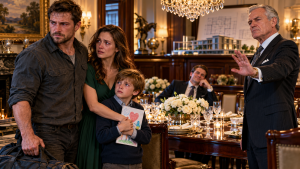
The first time my father told me I wasn’t worth a penny, my nine-year-old son was sitting beside me, holding a handmade anniversary card.
Eight months later, I discovered that my father had helped forge my signature on a $3.8 million real estate agreement.
But the money wasn’t the worst part.
The worst part was what I found buried in my grandfather’s old records—a secret my father had spent forty years hiding, a secret that would turn everything he’d ever said about my wife and son into the cruelest joke imaginable.
And when I finally exposed it, my entire family fell apart.
My name is Danny Hollis.
I’m thirty-three years old, and I work as a diesel truck mechanic in Alpena, Michigan.
I never wanted to be rich.
I wanted a steady paycheck, a warm house, and a family that didn’t make me feel like I had to earn the right to belong.
For most of my life, I believed those were reasonable things to want.
Then came my parents’ fortieth wedding anniversary.
And everything changed.
***
The dining room looked like something from a magazine that evening.
My mother had arranged white roses along the center of the mahogany table.
Crystal glasses sparkled beneath the chandelier, and the smell of roasted beef and rosemary filled the house.
Twenty relatives had gathered to celebrate Frank and Elaine Hollis.
My parents.
Forty years of marriage.
Forty years of family traditions.
Forty years of what everyone insisted was an extraordinary love story.
My wife, Rebecca, sat beside me wearing a dark green dress.
Her brown hair fell loosely over her shoulders, and every few minutes she reached beneath the table to squeeze my hand.
She knew how difficult family gatherings could be.
Across from us, my older brother, Luke, sat beside his wife, Melissa, looking like the heir to an empire.
Technically, that was exactly what he considered himself.
Our father owned Hollis Hardware, a seventy-year-old commercial building housing a hardware business he’d operated since 1983.
With its inventory, trucks, equipment, customer accounts, and reputation, the business had been valued at approximately $1.2 million.
Luke had worked there since high school.
I’d worked there too, until I realized that Dad would never treat us equally.
Luke could make a ten-thousand-dollar mistake and receive a lecture.
I could misplace a fifty-dollar invoice and hear about it for six months.
Eventually, I became a diesel mechanic.
I liked engines.
They made sense.
When something was broken, you found the problem and repaired it.
People were considerably more complicated.
Beside Rebecca sat her son, Toby.
My son, as far as I was concerned.
He was nine years old, with sandy brown hair, curious blue eyes, and an obsession with anything involving gears, tools, or keys.
That evening, he’d brought a handmade card.
“Happy 40th Anniversary, Grandma and Grandpa,” he’d written in green marker.
Underneath, he’d drawn the hardware store with three stick figures standing outside.
Grandpa.
Grandma.
And himself.
All three were wearing bright red aprons.
Toby had even drawn the little key-cutting machine near the front window.
He’d spent almost two hours making it.
“Think Grandpa will like it?” he’d whispered to me before dinner.
“He’s going to love it, buddy.”
I believed that when I said it.
I wish I hadn’t.
Halfway through the meal, Dad stood up.
He tapped his wineglass with a spoon.
“Before we have dessert, there’s something important I’d like to announce.”
The room quieted.
Dad unfolded a piece of paper and adjusted his reading glasses.
“After forty years of marriage, your mother and I have been thinking about the future.
About what we leave behind and who’s going to carry this family’s name forward.”
Luke straightened in his chair.
I noticed it.
Then Dad continued.
“Effective January first, Luke will take over complete ownership of Hollis Hardware.
The business, the inventory, the company vehicles, the customer accounts, everything.”
Luke smiled.
“Eventually, it’ll pass to his boys.”
My nephews exchanged excited looks.
Dad paused.
Then he turned toward me.
“As for Daniel, he will receive nothing.”
I stared at him.
He didn’t look away.
“**That decision became effective the day he married Rebecca.**”
For a moment, I thought I’d misunderstood.
Rebecca went completely still.
Then I looked around the table.
Nobody appeared surprised.
Melissa continued eating.
Luke reached for his wineglass.
My mother stared at the roses.
Even my nephews looked like they already knew.
**They hadn’t invited me to a celebration.
They had invited me to my own public humiliation.**
“Frank,” Rebecca whispered.
Dad raised one hand.
“This isn’t personal.
It’s about preserving what belongs to the family.”
I felt Toby’s small fingers touch my sleeve.
“Danny?”
His voice was barely audible.
I looked down.
His eyes were fixed on the anniversary card.
He wasn’t looking at Grandpa anymore.
He was looking at the three little figures he’d drawn together.
I understood immediately.
To Dad, Rebecca wasn’t family.
And because Toby wasn’t biologically mine, neither was he.
Something inside me went painfully quiet.
I pushed back my chair.
Rebecca stood immediately.
Toby reached for his card, folded it carefully, and held it against his chest.
“Where are you going?”
Dad demanded.
I didn’t answer.
“Daniel, sit down.
You’re embarrassing yourself.”
I took Toby’s hand.
Dad scoffed.
“Don’t be dramatic.
It’s not personal.”
Mom finally looked up.
“We haven’t even had cake.”
I remember that sentence more clearly than almost anything else.
Not the inheritance announcement.
Not Luke’s smile.
Just my mother worrying about dessert while her grandson quietly tried not to cry.
We walked out.
Nobody followed.
***
We drove home without speaking.
The roads were dark, and rain scattered across the windshield.
Rebecca watched the passing headlights.
Toby sat in the back seat with his anniversary card resting on his knees.
About fifteen minutes from home, he finally spoke.
“Danny?”
“Yeah, buddy?”
“Was it because of me?”
The steering wheel felt slippery beneath my hands.
“What?”
“Grandpa said you don’t get the store because you married Mom.”
He hesitated.
“And Mom already had me.”
Rebecca covered her mouth.
I pulled into an empty gas station parking lot.
Then I turned around.
“Toby, listen carefully.
You are not the reason something bad happened to me.”
His eyes filled.
“But Grandpa doesn’t like me.”
I couldn’t lie.
Not completely.
“Grandpa has some things he needs to learn about loving people.”
“Does he think I’m not really yours?”
I felt Rebecca start crying beside me.
I reached into the back seat and took Toby’s hand.
“**You are my son because I choose to be your dad every single day.
Nobody gets to take that away from us.**”
He stared at me.
“Even Grandpa?”
“Especially Grandpa.”
That was the first time I understood how much damage one cruel sentence could do.
And it wasn’t the last.
***
I’d met Rebecca three years earlier at a tire shop.
She’d been standing beside an old Ford Escape with its hood open, trying to understand why the engine kept overheating.
Toby was six.
He stood beside her holding a plastic dinosaur.
I was picking up parts for a customer when I overheard the mechanic quoting her nearly two thousand dollars for repairs.
The problem was a failed thermostat and a damaged coolant hose.
I knew because I’d looked at the vehicle.
The actual parts cost less than a hundred dollars.
I offered to help.
Rebecca initially refused.
She’d learned the hard way not to trust men who appeared out of nowhere promising to rescue her.
But eventually she let me explain what I saw.
I fixed the car that Saturday.
She bought me coffee afterward.
Toby asked whether diesel trucks were stronger than dinosaurs.
I told him it depended on the dinosaur.
That made him laugh so hard he spilled his hot chocolate.
Six months later, Rebecca and I were dating.
A year after that, I proposed.
Her former boyfriend, Corey, was Toby’s biological father.
He was good at making promises and terrible at keeping them.
Birthday cards rarely arrived.
Child support was inconsistent.
Visits were even less reliable.
I didn’t enter Rebecca’s life expecting to become a father.
But Toby made that decision surprisingly easy.
He wanted someone to teach him how to ride a bicycle.
Someone to sit beside him during school concerts.
Someone to help him build model airplanes.
Someone who showed up.
I loved him.
Simple as that.
Dad never understood.
“You’re taking responsibility for another man’s mistakes,” he told me shortly before the wedding.
I answered, “I’m marrying someone I love.”
“And inheriting her baggage.”
I walked out of that conversation.
Looking back, I should have recognized it as a warning.
But I still believed family could change.
Especially because I’d grown up hearing stories about Grandpa Silas.
My father’s father.
Silas Hollis had been the kind of man who carried peppermint candies in his coat pocket and never let someone leave his kitchen hungry.
He’d bought the old commercial property decades earlier.
When Dad opened Hollis Hardware in 1983, Grandpa rented him the building for one dollar a year.
“Make something of it,” Grandpa had supposedly told him.
Dad did.
The store became a fixture in Alpena.
Contractors depended on it.
Farmers bought supplies there.
Teenagers got their first jobs carrying lumber.
And whenever Dad talked about his success, he reminded everyone that he had built the business with his own two hands.
He rarely mentioned the man who’d practically given him the building.
Grandpa died several years before I met Rebecca.
I missed him constantly.
Sometimes I wondered what he’d have thought of Toby.
I never doubted he’d have loved him.
***
Three weeks after the anniversary dinner, someone left a grocery bag on our front porch.
Inside was Toby’s red hardware-store apron.
The one Chuck, the longtime employee who operated the key-cutting counter, had made for him.
“Junior Key Specialist” was embroidered across the chest.
There was no note.
No explanation.
Rebecca found Toby standing in the hallway holding it.
“Sweetheart?”
He looked up.
“Does this mean I can’t help Chuck anymore?”
Rebecca knelt beside him.
“I’m not sure, honey.”
Toby nodded like he understood.
Then he carried the apron upstairs.
That night, I found him asleep wearing it over his pajamas.
I stood in his doorway for a long time.
I’d been angry before.
Now I was something worse.
I was disappointed in people I’d spent my whole life trying to please.
And although I didn’t know it yet, **the apron would eventually become the most important object in our entire family history.**
***
In July, Luke called me.
His tone was unusually friendly.
“Hey, little brother.
You got a minute?”
“Depends.”
He laughed.
“Still upset about Dad’s announcement?”
I said nothing.
“Look, you know how he gets.
He’s old-fashioned.”
“He embarrassed my wife and son.”
“Nobody was talking about the kid.”
“That makes it worse.”
Luke sighed.
Then he changed the subject.
“Listen, I’ve been thinking about Grandpa’s building.”
I looked up from the truck engine I was repairing.
“What about it?”
“I could buy out your half.”
The property had belonged to Grandpa Silas.
Years before his death, he’d deeded it equally to Luke and me.
Not the hardware business.
The building and land underneath it.
We each owned fifty percent.
Luke had always considered the arrangement inconvenient.
The business occupied the property, and our father had paid almost nothing for using it.
Luke and I paid the property taxes.
Now my brother wanted me gone.
“How much?”
I asked.
“Forty thousand dollars.”
I nearly laughed.
“Forty thousand?”
“Come on, Danny.
The roof’s failing.
The boiler’s ancient.
Half the place needs rewiring.
It’s basically a liability.”
“Then why do you want it?”
Silence.
Then he said, “Because I care about keeping it in the family.”
I looked toward a photograph on my toolbox.
Rebecca, Toby, and me at a county fair.
“Apparently, I’m not family.”
Luke’s voice hardened.
“Don’t make this emotional.
Forty grand is good money.
You could get Rebecca a bigger house.”
“Not interested.”
I hung up.
He called again in August.
Then September.
By October, his friendly offers had become thinly disguised demands.
Dad joined in.
“You owe your brother the chance to make something of the place.”
I said, “I already own half.”
“You didn’t earn that property.”
“Grandpa gave it to me.”
“Exactly.
You didn’t earn it.”
I wanted to ask whether Dad had earned the building he’d rented for one dollar a year.
But I didn’t.
Instead, I contacted an attorney.
Her name was Meredith Shaw.
She was in her early forties, with sharp gray eyes and the kind of calm voice that made arguments feel unnecessary.
She studied Grandpa’s deed.
Then she looked up.
“Your father can give Luke his business.
That’s his decision.”
“I understand.”
“But he cannot give Luke your half of the property.”
She tapped the document.
“**This belongs to you.
Your father’s disapproval doesn’t change the deed.**”
It was the first reassuring thing anyone had said about the situation in months.
I left her office thinking the worst was over.
I couldn’t have been more wrong.
***
In November, Chuck called.
He’d worked at Hollis Hardware for thirty-four years.
He was sixty-seven, with thick gray eyebrows, permanently stained fingertips, and a voice that sounded like gravel rolling down a driveway.
He’d taught me to cut keys when I was eleven.
He’d taught Toby the same thing.
“Danny, you been around the rear lot lately?”
“No.
Why?”
“Some fellows came through measuring everything.
Said they were surveying for a redevelopment project.”
I frowned.
“What redevelopment project?”
“That’s what I asked.”
“What did they say?”
“Told me it was above my pay grade.”
The next morning, I drove past the store.
Pink survey flags dotted the gravel behind the lumberyard.
A man in a reflective vest was photographing the loading dock.
I took pictures from the public road.
When I called Luke, he brushed it off.
“Routine insurance stuff.”
“Insurance companies survey the rear lot?”
“Sometimes.”
“Since when?”
“Danny, I’m busy.”
He hung up.
Two weeks later, Dad called about bank documents.
“Luke needs your signature for collateral.”
“What loan?”
“A business loan.”
“How much?”
“Don’t interrogate me.”
“Have the bank contact my attorney.”
Dad exploded.
“You always make everything difficult!”
I answered, “Then stop asking me to sign things nobody will explain.”
He hung up.
No bank ever contacted me.
Then came January.
The morning snow was falling so heavily that our driveway had disappeared beneath a blanket of white.
Rebecca was at work.
Toby was at school.
Someone knocked on the front door.
It was Mom.
She stood on the porch wearing a wool coat, holding a manila folder.
Her eyes were red.
“Danny, please.
We need to talk.”
I let her inside.
She didn’t remove her coat.
“Luke says the store might go under.”
I waited.
“He says you need to sign these papers.
They’re just for the bank.”
She handed me the folder.
I opened it.
And my stomach dropped.
**The documents included a quitclaim deed transferring my entire half of Grandpa’s property to Luke for zero dollars.**
No purchase price.
No protection.
No explanation.
Just my ownership disappearing.
“Mom, do you understand what this is?”
She looked confused.
“Luke said the bank requires it.”
“He’s asking me to give him my property.”
“For the loan.”
“There is no loan described here.”
I turned the page so she could see.
“Mom, this gives Luke everything.”
Her face went pale.
“He told me you were helping save the store.”
I looked at her for a long moment.
Then I closed the folder.
“I’m not signing.”
She started crying.
“Your father says you’re trying to punish us.”
“Is that what you believe?”
She didn’t answer.
And somehow, her silence hurt more than the accusation.
Before leaving, she looked toward the family photographs hanging beside our staircase.
One showed Toby and me fishing.
Another showed Rebecca laughing while Toby decorated our Christmas tree.
Mom stared at them.
“He’s a sweet boy,” she whispered.
I said, “I know.”
She looked down.
“Frank doesn’t make things easy.”
“No, Mom.
He doesn’t.”
I opened the door.
“But you’ve spent forty years letting him decide who gets hurt.”
She left without responding.
***
Three days later, Chuck called again.
This time, he sounded frightened.
“Can you come by the store?”
“What’s wrong?”
“I found something.”
Twenty minutes later, I entered through the service door.
Chuck led me into the office behind the key counter.
He locked the door.
Then he reached into his desk drawer and removed a large folded sheet.
“Found this stuck in the copier.”
I unfolded it.
At first, I saw what looked like an ordinary architectural drawing.
Then I recognized the building.
Hollis Hardware.
The loading dock.
The rear lot.
The small parking area beside the lumberyard.
Except someone had drawn a huge dotted rectangle across the property.
I leaned closer.
Inside the rectangle were five words.
**EXISTING BUILDING SCHEDULED FOR DEMOLITION.**
My throat tightened.
“Chuck, where did this come from?”
“Luke’s office.”
I examined the title block.
Northlake Development.
Preliminary redevelopment site plan.
Then I saw the date.
April.
One month before Dad had announced my disinheritance.
My heart began pounding.
All the strange pieces suddenly connected.
The anniversary speech.
Luke’s desperate offers.
The surveyors.
The bank paperwork.
The quitclaim deed.
They didn’t merely want me out of the family.
**They needed me off the property records.**
I folded the plan.
“Has anyone else seen you with this?”
Chuck shook his head.
“Please be careful, Danny.”
I nodded.
Then I texted Luke.
“Bring your papers to the store Saturday morning.
I want Mom and Dad there.”
He replied within seconds.
“Glad you’ve finally come around.”
I stared at the message.
Then I called Meredith.
“I think we found out what they’re doing.”
She listened without interrupting.
When I finished, she said, “Don’t sign anything.
And don’t confront them alone.”
“Why?”
“Because if that plan is genuine, there’s probably a contract somewhere.”
“A contract?”
“Yes.
And I want to know exactly whose signatures are on it.”
***
Saturday morning arrived gray and cold.
I parked outside Hollis Hardware at eight forty-five.
Rebecca wanted to come.
I told her I’d rather she stay home with Toby.
She didn’t argue.
Instead, she kissed me and slipped a folded note into my jacket pocket.
I opened it before getting out.
Three words.
**Come home proud.**
Inside the store, everything looked familiar.
The smell of sawdust.
The squeak of old floorboards.
The faded advertisements above the paint aisle.
For a moment, I was twelve again, following Grandpa through the building while he explained why every tool had a purpose.
Then I heard Dad’s voice.
“He’s here.”
The office door stood open.
Luke sat behind the desk.
Mom occupied a chair by the window.
Dad stood beside a filing cabinet, arms crossed.
“Well,” Luke said, smiling.
“You finally ready to be reasonable?”
I didn’t answer.
I placed Grandpa’s deed on the desk.
Then the demolition plan.
Dad’s expression changed immediately.
“Where did you get that?”
Luke stood up.
“That’s confidential.”
“Interesting,” I said.
“Because my name is on the deed to this property, and nobody bothered telling me you planned to demolish it.”
Mom stared at the blueprint.
“Demolish?”
Luke turned toward her.
“Mom, don’t start.”
She looked at Dad.
“Frank, you told me we were refinancing.”
Dad ignored her.
“Danny, you’re overreacting.”
“Then explain the demolition plan.”
Luke slammed his palm against the desk.
“Fine!
There’s a developer interested in the property.”
“How interested?”
He hesitated.
I watched him carefully.
“How much, Luke?”
“That’s none of your business.”
I smiled without humor.
“Half the property is mine.
Seems pretty relevant.”
The office door opened.
Meredith stepped inside.
Beside her stood a sharply dressed man carrying a leather briefcase.
Luke froze.
Meredith introduced him.
“This is Evan Pierce, attorney for Northlake Development.”
Dad took one step backward.
Evan placed a document on the desk.
“We’re here because my client received notice that one of the purported property owners disputes the transaction.”
Luke’s face turned white.
Meredith opened the agreement.
“The developer has offered three million eight hundred thousand dollars.”
Mom gasped.
I looked at Luke.
“Forty thousand,” I whispered.
He wouldn’t meet my eyes.
Meredith continued.
“According to this document, both owners consented to the sale.”
She turned the final page toward me.
There were two signatures.
Luke Hollis.
And Danny Hollis.
My name.
Written in handwriting that looked almost like mine.
Almost.
**But I had never signed that agreement.**
“That’s not my signature.”
Nobody spoke.
Evan opened his briefcase.
“The agreement also contains payment instructions.
Mr.
Daniel Hollis was supposedly to receive forty thousand dollars for his interest, with the balance going to the other seller and designated parties.”
I looked at Luke.
“Three million eight hundred thousand dollars, and you offered me forty grand?”
He swallowed.
Dad stepped forward.
“Now, everybody calm down.”
Meredith looked at him.
“Mr.
Hollis, a forged signature on a commercial real estate agreement is not a family disagreement.”
Then she turned another page.
“And we haven’t discussed the most interesting part.”
Luke sat down heavily.
“What part?”
Mom whispered.
Meredith pointed to an attachment.
“A consulting agreement authorizing a payment of **$1.1 million to Blue Heron Advisory Services** upon closing.”
I frowned.
“Who’s Blue Heron?”
Evan looked toward my father.
“According to the corporate records we obtained, it’s a company controlled by Frank Hollis.”
My father didn’t move.
Neither did I.
Then Mom spoke.
Her voice was almost inaudible.
“Frank?”
He stared at the window.
“You said you were giving the business to Luke,” she whispered.
Dad’s jaw tightened.
“I was.”
She looked at the agreement.
“Then why were you secretly taking more than a million dollars from the sale?”
Silence.
Luke suddenly looked up.
“What?”
For the first time that morning, he seemed genuinely surprised.
“Dad, you said the consulting company was just for taxes.”
Dad snapped, “Shut your mouth.”
Meredith closed the folder.
“Nobody is signing anything today.”
I stared at the man who had raised me.
The man who’d accused me of marrying for the wrong reasons.
The man who’d publicly stripped me of an inheritance because my wife had a child.
**He had been willing to steal my property to make himself a millionaire.**
But the look on his face told me something else.
He was still hiding something.
***
The meeting ended badly.
Luke accused me of destroying the family.
Dad accused Meredith of threatening him.
Mom left the office in tears.
Evan explained that Northlake would suspend the transaction until the ownership dispute was resolved.
No demolition.
No closing.
No payment.
At least not yet.
Outside, snow drifted across the parking lot.
I stood beside my truck while Meredith reviewed her notes.
“You okay?” she asked.
“Not really.”
“Understandable.”
I looked toward the store.
“I thought Luke was the one behind everything.”
She slipped the paperwork into her briefcase.
“He may be.
But your father seems to have had a much larger role than anyone admitted.”
“What happens now?”
“We preserve the evidence.
We notify the title company formally.
And we determine whether anyone tried to use that false agreement to obtain money.”
“Can they still sell without me?”
“Not the whole property voluntarily.
Both owners have rights.
Luke might eventually ask a court to partition the property, but he cannot simply pretend you don’t exist.”
I nodded.
She studied me.
“Danny, there’s something I need you to understand.”
“What?”
“**The person who forged your signature probably believed you would never challenge your father publicly.**”
I thought about every Thanksgiving dinner.
Every apology I’d made when I wasn’t wrong.
Every time Dad told me to stop being difficult.
She was right.
They hadn’t only counted on my silence.
They’d spent decades training me to be silent.
***
By Monday morning, the entire family knew.
Not because I told anyone.
Because Luke did.
He posted a long message in our family group chat.
“Danny is trying to destroy Dad’s retirement and put thirty people out of work because he’s bitter about the inheritance.”
My aunt Carol immediately replied.
“Family should come before money.”
My cousin Brandon wrote, “Can’t believe you’d do this to your own father.”
Melissa sent a message saying the store might close because of my selfishness.
I stared at the screen.
Then I wrote one sentence.
“Someone forged my signature on a $3.8 million contract.”
I attached a photograph of the signature page.
The chat went quiet.
For eleven minutes.
Then Dad sent:
“Private family documents do not belong in public discussions.”
I almost laughed.
Apparently, humiliating me in front of twenty relatives was acceptable.
Showing them evidence of fraud was not.
By that evening, Dad had called three times.
I didn’t answer.
Rebecca finally took my phone.
“Enough,” she said.
I was sitting at the kitchen table, staring at the screen.
“They’re telling everyone I’m trying to ruin the store.”
“Then let them talk.”
“They’re making me sound like a monster.”
She pulled out the chair beside me.
“Danny, look at me.”
I did.
“You have spent your whole life trying to earn your father’s approval.”
I swallowed.
“He always made it sound like I was one good decision away from getting it.”
Rebecca touched my cheek.
“And every time you got close, he moved the finish line.”
I looked away.
She continued.
“You didn’t steal anything.
You didn’t lie.
You didn’t embarrass a child at dinner.”
A tear slipped down my face before I could stop it.
She wrapped her arms around me.
“**Protecting yourself isn’t destroying your family.
It’s refusing to let them keep destroying you.**”
That night, I slept for almost seven hours.
It was the best sleep I’d had since May.
***
The following week, things got uglier.
Luke called my employer.
He told the service manager that I was involved in a serious financial dispute and might be facing legal problems.
Fortunately, my boss, Ray Patterson, had known me for twelve years.
He called me into his office.
“Danny, your brother seems to think I should fire you.”
I stared at him.
Ray leaned back.
“Funny thing is, I remember when that same brother brought his pickup here with a blown transmission and tried to get you to do the labor for free.”
I didn’t know what to say.
Ray pushed a mug of coffee toward me.
“Your job’s safe.
But if he calls again, I’m billing him for my time.”
I actually smiled.
For about thirty seconds, life felt normal.
Then Rebecca called.
Toby had come home from school crying.
One of my nephews had told another boy that Toby was the reason Grandpa hated me.
The rumor spread during recess.
A classmate asked Toby whether he was “a fake grandson.”
I left work early.
When I arrived home, he was sitting on his bedroom floor beside a half-built model truck.
His red apron lay folded on the bed.
“Hey, buddy.”
He didn’t look up.
“Mom said you got in trouble because of Grandpa’s store.”
“No.
I didn’t get in trouble.”
“Then why is everyone mad?”
I sat beside him.
“Sometimes people get angry when somebody tells the truth about something they did wrong.”
He considered that.
“Even grown-ups?”
“Especially grown-ups.”
He pushed a plastic wheel across the carpet.
“Would things be easier if I wasn’t here?”
My chest tightened.
I moved closer.
“Toby, look at me.”
He did.
“**There is nothing in that store, nothing in Grandpa’s bank account, and nothing in the entire world that I would trade for being your dad.**”
His lower lip trembled.
“Promise?”
“Promise.”
He climbed into my lap.
He was getting too big for it.
I held him anyway.
And I made myself another promise.
Whatever happened with the property, the money, or my father, Toby would never again have to wonder whether he was worth choosing.
***
Two weeks later, Meredith received a response from Northlake.
The company had conducted its own internal review.
The forged signature wasn’t merely attached to a purchase agreement.
It appeared on a letter authorizing the release of preliminary due-diligence funds.
Luke had already received money through a business account.
Not millions.
But enough to raise questions.
There were also emails suggesting Dad had personally reassured the developer that I was willing to sell.
One message included the sentence:
“Daniel is emotional but compliant.
I’ll handle him.”
Meredith read it aloud in her office.
I sat motionless.
“Compliant,” I repeated.
She nodded.
“He also wrote that your marriage had created some family complications.”
I closed my eyes.
“Of course he did.”
She slid another page toward me.
“This is more concerning.”
It was an email sent from Luke’s address.
Attached was a scanned signature sample from an old contractor release I’d signed years earlier while working at the hardware store.
Somebody had used it as a model.
My signature wasn’t exactly copied.
But the resemblance was unmistakable.
The signature on the purchase agreement had been constructed to look authentic.
A handwriting expert later confirmed substantial differences.
Meredith also identified a problem with the notarization attached to one of the supporting documents.
The notary claimed I’d appeared in person on a Tuesday afternoon.
I hadn’t.
I was at work.
Ray had payroll records, a security-camera recording, and a signed service ticket showing me underneath a semi-truck forty miles away.
Meredith smiled faintly when I told her.
“That’s excellent.”
I frowned.
“Excellent?”
“For your case.”
I stared at the documents.
For months, my father and brother had told everyone I was selfish.
Meanwhile, somebody had been manufacturing evidence that I agreed to give away my property.
“Can they go to prison?”
I asked.
She chose her words carefully.
“Potentially.
But that’s for investigators and prosecutors to determine.
Our immediate job is protecting your ownership and stopping anyone from relying on false documents.”
I looked out the window.
Snow was falling again.
Part of me wanted to feel victorious.
Instead, I felt sick.
Because the deeper we looked, the more it seemed my father had been planning this long before that anniversary dinner.
And I still didn’t understand why.
***
The answer began arriving in pieces.
The first came from Melissa.
She called Rebecca on a Thursday afternoon.
Rebecca put her on speaker.
“Danny?”
Melissa asked.
“I’m here.”
She sounded exhausted.
“I need to tell you something about Luke.”
I looked at Rebecca.
“Go ahead.”
“He’s been borrowing money.”
“From whom?”
“Everyone.”
She took a breath.
“Credit cards.
Private lenders.
Dad.
He took money from our home equity line without telling me.”
“How much?”
“I don’t know anymore.”
Her voice broke.
“He told me the redevelopment deal would solve everything.”
I sat forward.
“What redevelopment deal?”
“The buyer wanted to build a medical office complex and apartments.
Luke said the hardware business could move somewhere else.”
“Then why didn’t he tell me?”
She gave a bitter laugh.
“Because he said you’d never agree.”
I thought about the store.
The old key counter.
The lumber racks.
The loading dock where Grandpa used to sit drinking coffee.
“Did Luke know about my signature?”
Silence.
“Melissa?”
“I found a folder in his desk.”
My pulse quickened.
“What’s in it?”
“A printed copy of your old signature.
And emails from Frank.”
She started crying.
“Luke keeps telling me it’s legal.
He says your father promised he’d take responsibility if anything went wrong.”
I didn’t speak.
Then she whispered something that changed the way I saw the entire situation.
“**Danny, I don’t think Luke was supposed to keep the store.
I think your father was using him to sell it.**”
I looked at Rebecca.
Neither of us spoke.
Melissa continued.
“Luke thought he’d get rich.
But Frank had already negotiated payments to himself through another company.”
“Blue Heron.”
“Yes.”
She sounded surprised.
“You know?”
“I do.”
There was another pause.
Then she said, “Luke found out last week that the money Dad promised him wasn’t what he thought.”
“What happened?”
“They had a screaming match.”
“About what?”
Melissa lowered her voice.
“Your dad told him that without his name and reputation, Luke would never have gotten the deal.”
I stared at the table.
“That sounds like Dad.”
Then she said something even worse.
“He told Luke that if anything went wrong, he could blame everything on you.”
***
The next day, Mom appeared at my workplace.
Ray led her into the waiting room.
When I walked in, she looked ten years older than she had at Christmas.
“Can we talk?”
I wiped my hands on a rag.
“I’m working.”
“Please, Daniel.”
I sat across from her.
For several minutes, she couldn’t find the words.
Then she said, “I didn’t know.”
I waited.
“About the money.
The consulting company.
The demolition.
I didn’t know.”
“Why should I believe that?”
She flinched.
“Because I’m your mother.”
I almost stood up.
But she grabbed my hand.
“Please.”
Her fingers were cold.
“I know that isn’t enough anymore.”
I sat back down.
She opened her purse and removed a small envelope.
Inside were photocopies of bank statements.
I recognized Dad’s handwriting on a deposit slip.
Then I noticed repeated transfers to Blue Heron Advisory Services.
“Where did you get these?”
“Your father left them in the study.”
I looked through the pages.
The consulting company had existed for more than a year.
Long before Dad’s inheritance announcement.
There were also transfers from the hardware business to the company.
Some labeled management fees.
Others had no clear explanation.
“Mom, you need your own attorney.”
She nodded.
“I already called one.”
That surprised me.
Then she started crying.
“I kept telling myself Frank was doing what was best for the family.”
“Even when he hurt Toby?”
Her expression crumpled.
“I was wrong.”
“Mom, Toby thinks he’s the reason Grandpa hates him.”
She covered her face.
“I’m sorry.”
I waited until she looked at me.
“Have you ever actually asked Dad why he hates that little boy?”
She shook her head.
“Because I was afraid of the answer.”
I leaned forward.
“What answer?”
She looked toward the office door.
Then she whispered, “There’s something about your grandfather you don’t know.”
My stomach tightened.
“What about Grandpa?”
Her lips trembled.
But before she could speak, her phone rang.
Frank.
She looked at the screen and went pale.
“I have to go.”
“Mom.”
She stood.
“Not here, Danny.”
Then she walked out.
And for the first time, I realized the secrets in our family went far beyond a real estate contract.
***
That Sunday, I drove to the cemetery.
Grandpa Silas was buried beneath a simple gray headstone overlooking a row of old pine trees.
SILAS HOLLIS
1931–2014
BELOVED HUSBAND, FATHER, AND GRANDFATHER.
I stood in the cold wind with my hands in my coat pockets.
“I don’t know what I’m doing, Grandpa,” I said quietly.
It felt ridiculous talking to a grave.
But I kept going.
“Dad’s trying to steal the property.
Luke’s lying.
Mom’s scared.
And Toby thinks he doesn’t belong.”
The wind moved through the trees.
I remembered Grandpa teaching me to sharpen tools when I was twelve.
He’d always said, “A tool doesn’t care who holds it, Danny.
It only cares whether the work gets done right.”
Another memory surfaced.
I was eight, crying because Dad had told me I wasn’t tough enough to work in the store.
Grandpa found me behind the loading dock.
He handed me a peppermint.
“Your father sometimes mistakes hardness for strength,” he’d said.
“What’s the difference?”
Grandpa smiled.
“**Hard things break.
Strong things hold.**”
I hadn’t thought about that conversation in years.
Standing beside his grave, I understood it differently.
My father had spent his life trying to look strong.
But the moment something threatened his control, he became cruel.
Grandpa hadn’t been like that.
And suddenly, I wanted to know why.
***
Chuck invited me to his house the following Wednesday.
His wife had made coffee.
A fire crackled in the living room.
On the dining table sat an old metal document box.
“I’ve had this since Silas died,” Chuck said.
I frowned.
“Why?”
“He asked me to keep some things.”
“What things?”
Chuck opened the box.
Inside were photographs, letters, old receipts, and several yellowed notebooks.
I picked up a photograph of Grandpa standing outside the hardware store in the early eighties.
Beside him stood a young Frank.
Dad couldn’t have been older than twenty.
His hair was longer.
He looked nervous.
Grandpa had one arm around his shoulders.
Chuck watched me.
“Your grandfather wasn’t a perfect man.
But he tried hard to be a good one.”
“I know.”
Chuck looked down.
“There’s something your dad doesn’t like people discussing.”
My heart began to pound.
“What?”
Chuck hesitated.
“Not my story to tell.”
I almost laughed.
“Everybody keeps saying that.”
He sighed.
“Your grandfather took your father in when Frank was nine years old.”
I stared at him.
“What do you mean, took him in?”
Chuck opened one of the notebooks.
“Silas married a woman named Margaret.
She had a son from an earlier relationship.”
I blinked.
“My grandmother Margaret?”
He nodded.
“Frank was her boy.”
I looked down at the photograph.
“Grandpa wasn’t Dad’s biological father?”
Chuck shook his head.
“No.”
My mouth went dry.
“Did he adopt him?”
“Legally, yes.
A few years after the marriage.”
I stared at Chuck.
I suddenly remembered every hateful comment Dad had made about Toby.
Another man’s kid.
Not our blood.
Not a real grandson.
I could barely breathe.
“You’re telling me Dad was raised by a stepfather?”
Chuck nodded.
“Silas loved him more than anything.”
I sat down slowly.
“Why didn’t anyone tell me?”
Chuck looked genuinely sad.
“Frank never wanted it discussed.
Silas respected his privacy.”
I stared at the photograph again.
My father was standing beside the man who had raised him.
The man who’d given him a name.
A home.
A business opportunity.
An entire future.
**My father had spent years insulting me for raising another man’s child, while his own life had been built by a man who did exactly the same thing.**
I couldn’t speak.
Chuck opened another notebook.
“There’s more.”
My head snapped up.
“What?”
He slid a faded envelope toward me.
On the front, in Grandpa’s handwriting, were two words.
FOR FRANK.
The envelope had already been opened.
Inside was a handwritten letter.
Chuck watched me carefully.
“Your grandfather gave him that years ago.
Your dad left it behind at the store after an argument.
Silas asked me to keep the original when Frank refused to take it back.”
I unfolded the letter.
The paper trembled in my hands.
“Frank,” it began.
“I know there are times you’ve wondered whether you truly belong in this family.
You came into my life when you were nine years old, frightened and angry and convinced that everyone you loved would eventually leave.”
I swallowed.
“I didn’t give you my name because I felt sorry for you.
I gave it because you were my son.”
Tears blurred the words.
“You never had to become someone else to earn that place.
You were enough the day I met you.”
I stopped reading.
Chuck quietly moved toward the kitchen.
He gave me privacy.
I forced myself to continue.
“One day, if you become a father, I hope you remember that love isn’t something a child must prove he deserves.”
Then came the final line.
“**The family we choose is no less real than the family we inherit.
Sometimes it is the family that saves us.**”
I pressed the letter against the table.
My father had read those words.
And somehow, he’d become the very person Grandpa had warned him not to be.
***
I drove home carrying copies of the letter and photographs.
Rebecca was making dinner when I walked into the kitchen.
She turned.
“What’s wrong?”
I handed her the letter.
She read it.
Then she looked at me.
“Oh, Danny.”
I sat down.
“I don’t understand.”
She pulled up a chair.
“Maybe he hated being reminded of his own childhood.”
“Then why take it out on Toby?”
“I don’t know.”
I rubbed my face.
“Grandpa gave him everything.”
Rebecca reached across the table.
“That doesn’t mean he learned what Grandpa was trying to teach him.”
I nodded slowly.
Then I told her about the adoption.
She stared at me.
“Your father?”
“Yeah.”
“The man who keeps calling Toby another man’s child?”
I nodded.
For a moment, Rebecca didn’t speak.
Then her eyes filled.
“That poor little boy.”
I knew she meant Frank at nine years old.
But I also knew she meant Toby.
And that was what made everything so unbearable.
Two frightened boys.
Separated by decades.
One had been welcomed into a family by a man who chose to love him.
The other had been rejected by that man’s adopted son.
I suddenly knew something.
Whatever happened next, I wasn’t going to expose Grandpa’s private family history simply to humiliate my father.
The truth mattered.
But I wanted to use it for something better than revenge.
I wanted Toby to understand that belonging had never been about blood.
And I wanted Dad to face the consequences of the choices he’d made.
Not the circumstances of his birth.
***
The investigation continued.
Meredith arranged for a forensic document examiner to review the signatures.
Northlake turned over additional emails.
The title insurer confirmed it would not proceed while the ownership dispute remained unresolved.
Most importantly, investigators began examining the questionable transaction.
Nobody was arrested immediately.
Real cases didn’t move like television dramas.
There were interviews.
Subpoenas.
Bank records.
More waiting than I could stand.
Luke continued insisting that he’d believed everything was legal.
Dad stopped taking my calls.
Mom moved into a small apartment near the lake.
She told me she needed time away from Frank.
I’d never known my parents to spend more than a night apart.
Their marriage had seemed immovable.
Now it looked like an old building with rot hidden behind fresh paint.
One evening, Luke came to my house.
I nearly shut the door.
But he looked different.
His hair was uncombed.
His face was hollow.
“Can we talk?”
I stepped outside.
He stood on the porch, staring at the snow-covered driveway.
“Melissa’s staying with her sister.”
I said nothing.
“She took the boys.”
“Why?”
He gave a bitter laugh.
“Because apparently she doesn’t enjoy discovering her husband signed away the family house as collateral.”
I looked at him.
“Luke.”
He raised his hand.
“I know.”
We stood silently.
Then he said, “Dad told me you’d never help.”
I frowned.
“Help with what?”
“The business.”
“Did you ever ask me?”
He didn’t answer.
“Luke, you offered me forty thousand dollars for property worth millions.”
“That’s what Dad said your share was worth.”
I stared at him.
“You knew the sale price.”
“Not at first.”
He rubbed his face.
“When the deal started, Dad told me the property wouldn’t sell unless you got out of the way.”
“Why?”
“Because you were sentimental.
Because you’d insist on keeping the store.
Because Rebecca would talk you into demanding more money.”
I felt my jaw tighten.
Luke continued.
“Then he said if we gave you forty grand, you’d probably take it.”
“Because I needed the money?”
“Because he said you’d never risk fighting him.”
The words hurt more than they should have.
Luke looked down.
“I believed him.”
“Then you helped forge my signature.”
He closed his eyes.
“I signed documents I shouldn’t have signed.”
“That’s not an answer.”
He looked at me.
“I knew someone was using your signature without permission.”
For a moment, the world seemed absolutely still.
Then he whispered, “I’m sorry.”
I stared at my brother.
I’d waited my entire life to hear those words from him.
Now they sounded impossibly small.
“Did Dad tell you to do it?”
Luke swallowed.
“He said he’d handle everything.”
“Luke, did you know it was fraud?”
Tears filled his eyes.
“I knew it was wrong.”
There it was.
No excuses.
No misunderstanding.
Just the truth.
I stepped back.
“Then you need to tell Meredith.”
He nodded.
“And the investigators.”
His face crumpled.
“Danny, I could lose everything.”
I looked through the window.
Toby was inside helping Rebecca set the table.
He was laughing at something she’d said.
Then I looked back at Luke.
“You were willing to let me lose everything.”
Luke stared at the ground.
“**And you were willing to let my son believe he was the reason.**”
He had no answer.
***
A month later, Mom asked me to meet her at a small café overlooking Lake Huron.
The lake was gray beneath the winter sky.
She sat near the window with two untouched cups of coffee.
When I arrived, she handed me a folder.
“I found more of Frank’s documents.”
I opened it.
Inside were emails and financial statements.
I recognized the Blue Heron company.
But there was another name.
Dana Whitcomb.
I’d heard it before.
She was a real estate consultant who’d occasionally attended charity dinners with Dad.
Her name appeared on several transfers.
“Who’s Dana?”
I asked.
Mom stared out the window.
“Apparently, someone your father has been seeing.”
I slowly looked up.
“What?”
She nodded.
“For almost three years.”
I felt sick.
“Mom.”
“He told her he’d be financially independent once the redevelopment deal closed.”
I looked at the papers.
One email referred to a condominium in Traverse City.
Another discussed transferring funds after closing.
Dad had planned to take his consulting payout, leave the marriage, and start a new life.
The fortieth anniversary dinner suddenly looked different.
The flowers.
The speeches.
The congratulations.
The public declaration about protecting the family legacy.
All of it.
Dad had stood before twenty relatives pretending to celebrate forty years of marriage while secretly arranging to leave my mother.
I couldn’t speak.
Mom watched me.
“There’s something else.”
I almost laughed.
“How much more can there be?”
She reached into her purse.
Then she placed a small document on the table.
An old adoption certificate.
Frank Hollis.
Born Frank Mercer.
Legally adopted by Silas Hollis.
I looked at her.
“You knew?”
“Of course.”
“Then why did you let him talk about Toby like that?”
Her eyes filled.
“Because every time I tried to remind him where he came from, he became furious.”
I stared at the certificate.
Mom continued.
“Your father spent his childhood being called somebody else’s boy.
His biological father abandoned him.
He carried that shame for years.”
I looked up.
“That explains why it hurt him.
It doesn’t excuse what he did.”
She nodded.
“I know.”
Then her voice changed.
“Frank once told me that when he had children of his own, nobody would ever question whether they belonged to him.”
I sat back.
And suddenly, I understood.
Dad didn’t simply dislike Toby.
**He hated seeing me embrace the very thing he’d spent his whole life trying to erase from his own story.**
I took a slow breath.
“Mom, why are you giving me this?”
“Because I’m tired of hiding the truth.”
She reached across the table.
“And because your grandfather would be ashamed of what we’ve become.”
***
Spring arrived slowly.
The snow melted.
The lake thawed.
And the legal dispute continued gathering momentum.
Northlake withdrew from the existing purchase agreement and reserved its right to pursue damages relating to the false representations.
The developer’s lawyer confirmed that nobody at the company had authorized forgery.
The company had believed it was negotiating with legitimate representatives of both property owners.
Luke had received preliminary funds based on documents that appeared valid.
Dad had made promises he couldn’t legally fulfill.
The title company had concerns about the notary.
And the $1.1 million consulting arrangement raised questions nobody could explain convincingly.
Meanwhile, Hollis Hardware was collapsing.
Contractors began transferring accounts.
Suppliers tightened credit terms.
Employees whispered about whether their paychecks would clear.
Chuck called me one evening.
“Three people quit today.”
I closed my eyes.
“Who?”
“Donnie from lumber.
Sarah from receiving.
And Pete from deliveries.”
“How bad is it?”
Chuck hesitated.
“Bad.”
I sat at our kitchen table looking at Grandpa’s photograph.
The store had survived recessions.
Snowstorms.
Big-box competition.
Decades of changing customers.
And now it might die because two men were desperate to get rich.
I called Meredith.
“Is there anything we can do to save the business?”
She was quiet.
“Do you mean the company or the store?”
I frowned.
“What’s the difference?”
“The company belongs to your father and, since January, your brother.
The property belongs to you and Luke.”
I waited.
“If the company fails, the assets could eventually be sold through a lawful process.
Inventory, equipment, customer lists, the name, depending on what’s available.”
I stared at the notebook in front of me.
“So somebody could buy it.”
“Potentially.”
“Even me?”
She paused.
“Are you considering that?”
I thought about Toby’s apron.
About Chuck.
About the employees.
About Grandpa’s one-dollar lease.
“I don’t know.”
Meredith’s voice softened.
“Then figure out what you want before you decide how to fight.”
That night, I spoke with Rebecca.
I expected her to tell me I was crazy.
Instead, she asked, “Do you want the store?”
I hesitated.
“I want what the store used to mean.”
“That’s different.”
I nodded.
“I don’t want to spend my life trying to prove Dad wrong.”
She smiled sadly.
“Then don’t.”
I looked at her.
“Build something because it’s right for us.”
For the first time, I allowed myself to imagine a future beyond revenge.
And the possibility terrified me.
***
A few weeks later, Luke requested a private meeting with Meredith and me.
He arrived looking exhausted.
His attorney accompanied him.
Luke sat across from me and placed a folder on the table.
“I’ve been cooperating with the investigators,” he said.
I nodded.
He pushed the folder toward Meredith.
“These are the emails Dad told me to delete.”
She looked up sharply.
Luke swallowed.
“I kept copies.”
Inside were communications about the redevelopment deal.
But one email immediately caught my attention.
It was dated the day before my parents’ anniversary dinner.
Dad had written:
“Once Daniel understands he’s out of the inheritance, he’ll be more willing to take the forty thousand and move on.
Embarrassment is sometimes the only language he understands.”
I read it twice.
Then a third time.
My father had planned the dinner announcement as pressure.
He hadn’t disinherited me simply because he hated my marriage.
He’d deliberately humiliated me to make me feel worthless.
To make forty thousand dollars seem like a gift I should be grateful to receive.
I stared at Luke.
“You knew?”
He shook his head.
“Not about that email until later.”
“But you knew Dad wanted me gone.”
“Yes.”
“Did you know he was using Toby?”
Luke’s eyes filled.
“I knew Dad thought you cared more about Rebecca and Toby than the property.”
I leaned forward.
“Of course I do.”
Luke looked down.
“I know that now.”
Meredith turned another page.
There were instructions concerning the forged documents.
Dad’s initials appeared on a note identifying the old contractor release as the source for a signature sample.
I felt my stomach twist.
“That’s his handwriting.”
Luke nodded.
“Dad told me he could make the paperwork look right.”
I looked at my brother.
“And you let him?”
He didn’t answer.
His attorney eventually spoke.
“My client understands the seriousness of what occurred.”
I laughed once.
Not because anything was funny.
Because the words sounded so small compared with what they’d done.
Luke rubbed his forehead.
“There’s something else.”
I looked up.
“Dad told me he’d arrange for the developer to pay me enough to clear the business debts.”
“And?”
“He didn’t.”
“What happened?”
Luke swallowed.
“Once I reviewed the full agreement, I realized the consulting payment and several other obligations would leave me with far less than he promised.”
I stared at him.
“And you kept going?”
He nodded.
“Because I’d already borrowed against the expected proceeds.”
I sat back.
There it was.
The trap.
Dad had promised Luke everything.
Then used Luke’s desperation to control him.
Exactly the way he’d controlled me with the promise of approval.
My brother wasn’t innocent.
But he wasn’t the mastermind he’d imagined himself to be.
He was another son Dad had taught to mistake obedience for love.
***
The settlement negotiations began in early summer.
Dad refused to attend the first session.
His attorney arrived alone.
He offered a proposal.
Luke would retain the business.
I would receive one hundred thousand dollars for my property interest.
In exchange, I would release all civil claims relating to the documents and stop publicly discussing the dispute.
Meredith read the offer.
Then pushed it back across the table.
“No.”
Dad’s attorney frowned.
“Mr.
Hollis should consider the uncertainty of litigation.”
I looked at him.
“Your client offered me forty thousand dollars for half a property under contract for nearly four million.”
“That contract is no longer in effect.”
“Because somebody forged my signature.”
He adjusted his glasses.
“Allegations are not findings.”
Meredith opened her folder.
“Then let’s discuss the forensic report, the workplace footage contradicting the notarization, the payment records, and your client’s emails.”
The attorney stopped talking.
I looked at him.
“Tell my father something.”
He waited.
“I’m not asking him to love me anymore.”
My throat tightened.
“**I’m asking him to stop stealing from me.**”
The meeting ended.
Two days later, Dad finally called.
I answered.
For a moment, neither of us spoke.
Then he said, “You think you’ve won.”
I stared at the wall.
“No, Dad.”
“You’ve turned your brother against me.
Your mother’s left.
The business is dying.
Are you happy?”
I closed my eyes.
“You did those things.”
He laughed bitterly.
“Everything I built, Daniel.
Everything.
And you’re tearing it apart.”
I thought about Grandpa.
“No.
Grandpa gave you a chance to build something.
You chose what to do with it.”
Silence.
Then Dad said, “You have no idea what I sacrificed for that store.”
I took a breath.
“I know Grandpa rented you the building for a dollar a year.”
His breathing changed.
“Don’t you dare.”
“And I know why he did it.”
Another silence.
“What are you talking about?”
I looked at the framed copy of Grandpa’s letter on my desk.
“I know about Silas.”
Dad went completely quiet.
Then he whispered, “Who told you?”
I didn’t answer.
“Daniel.”
I closed my eyes.
“I know he adopted you.”
The silence stretched so long that I thought the call had disconnected.
Then my father spoke.
His voice sounded unlike anything I’d ever heard.
“**That is none of your business.**”
And he hung up.
***
Three nights later, Dad appeared at our house.
It was almost ten.
Rebecca had gone upstairs to read with Toby.
I opened the door.
Dad stood beneath the porch light wearing the same dark coat he’d worn at the anniversary dinner.
For the first time in my life, he looked old.
“Can I come in?”
I stepped outside instead.
“What do you want?”
His face tightened.
“You’ve been digging through family history.”
I said nothing.
“Silas wasn’t my biological father.
Congratulations.
You’ve found something to humiliate me with.”
I stared at him.
“Is that what you think?”
He looked away.
“Everyone knows how families talk.”
“No, Dad.
Everyone knows how you talk.”
He flinched.
I continued.
“You think I went looking for something to embarrass you?”
“What else would you do with it?”
I felt a painful heaviness settle over me.
“Nothing.”
He looked confused.
“I’m not going to tell people about your adoption to shame you.”
He blinked.
“Why not?”
“Because there’s nothing shameful about it.”
Dad stared at me.
I took a breath.
“Grandpa loved you.”
His face changed.
“Don’t.”
“He chose you.”
“Stop.”
“He gave you his name.
He gave you a home.
He gave you the opportunity to build that store.”
Dad’s hands curled into fists.
“**I said stop.**”
I waited.
For a moment, we stood facing each other beneath the porch light.
Then I said quietly, “Why was it beautiful when Silas loved you, but shameful when I loved Toby?”
Dad looked as though I’d struck him.
His mouth opened.
Nothing came out.
I continued.
“Toby is nine years old.
The same age you were when Grandpa took you in.”
Dad stared toward the dark street.
“He isn’t your blood,” he whispered.
I shook my head.
“Neither were you to Silas.”
His eyes filled.
“I was his son.”
The words came out fiercely.
Like a frightened boy defending the only home he’d ever known.
I nodded.
“Exactly.”
For one second, I thought something had reached him.
Then his expression hardened.
“You think that gives you the right to judge me?”
“No.”
I stepped closer.
“Your fraud gives me that right.”
He recoiled.
“You betrayed me.”
“No, Dad.”
I looked him straight in the eyes.
“**You betrayed the man who taught you what a father was supposed to be.**”
Dad turned and walked away.
I watched his car disappear down the street.
I wanted to feel satisfied.
Instead, I felt like I’d just watched someone close a door from the inside.
***
The months that followed were difficult.
The legal process moved forward.
Luke entered negotiations concerning his cooperation.
The company struggled under debts and declining revenue.
The building itself remained standing, protected from demolition while the ownership dispute and related claims were addressed.
I kept working at the repair shop.
Rebecca kept showing up for her shifts at the medical clinic.
Toby kept going to school.
Life continued in ordinary ways even when everything extraordinary seemed to be falling apart.
One morning, Chuck called.
“Danny, the business is shutting down.”
I stopped tightening a bolt.
“What?”
“Luke told us today.”
I closed my eyes.
“When?”
“End of the month.”
“How many employees?”
“Eleven left.”
I leaned against the workbench.
Eleven families.
Eleven paychecks.
Eleven people who had done nothing wrong.
Chuck cleared his throat.
“I know this isn’t your responsibility.”
I didn’t answer.
“But I thought you should know.”
That evening, I drove to Hollis Hardware.
The parking lot was nearly empty.
The red and white sign hung above the entrance.
I stood outside remembering every Saturday of my childhood.
The smell of lumber.
The clatter of keys.
The sound of Grandpa laughing behind the counter.
Then I noticed something in the window.
A piece of paper taped beside the door.
BUSINESS CLOSING.
The words struck harder than I expected.
This was the place where Grandpa had taught me that work could be honorable.
Where Chuck had taught Toby how to make a duplicate key.
Where families had bought paint, tools, and supplies for generations.
And now it was closing because greed had consumed the men entrusted with it.
I went home.
I sat beside Rebecca.
And I said something I hadn’t expected to say.
“I want to buy the business.”
She looked at me.
“Are you serious?”
“I think so.”
“Not to save your father’s reputation?”
“No.”
“Not to prove something to Luke?”
“No.”
“Then why?”
I thought about Toby.
About Chuck.
About all those employees.
“Because I don’t want the story of that place to end this way.”
Rebecca reached for my hand.
“Then let’s see if there’s a way.”
***
We spent the next six weeks learning more about business than I had ever wanted to know.
Meredith introduced us to an accountant.
A small-business lender reviewed our finances.
Chuck helped estimate what equipment and inventory might be worth.
The company’s creditors, owners, and attorneys had to sort through the outstanding obligations.
Nothing was simple.
I couldn’t just walk into the building and declare myself the new owner.
The land was still jointly owned.
The old business had debts.
The employees needed certainty.
And my brother’s decisions had made everything more expensive.
But gradually, a possible path emerged.
A lawful purchase of the business assets at an independently reviewed price.
A negotiated resolution of the property ownership dispute.
A new company with clean books.
A smaller operation.
A strong service department.
A focus on contractors and local customers.
No grand plans.
No million-dollar redevelopment scheme.
Just an honest business.
The biggest obstacle was Luke’s half of the property.
He eventually agreed to sell his interest as part of a broader settlement, with the proceeds handled under the terms negotiated with his creditors and legal counsel.
It wasn’t a gift.
It wasn’t revenge.
It was an expensive, complicated transaction that took months to finish.
But when the paperwork was complete, **I owned the building Grandpa had once rented to my father for one dollar a year.**
And the new operating company was mine and Rebecca’s.
I stood in Meredith’s office holding the recorded deed.
My hands were shaking.
She smiled.
“Congratulations, Danny.”
I looked at the paper.
“I never thought I’d own this place.”
“Then what are you going to do with it?”
I smiled.
“First?”
She raised an eyebrow.
“Fix the roof.”
She laughed.
For the first time in almost a year, I laughed too.
***
We reopened in September.
Not as the old Hollis Hardware.
Not exactly.
The new sign read:
HOLLIS & SON SUPPLY.
We kept the familiar red lettering.
We kept the key counter.
We kept the lumberyard.
Chuck became our store manager.
We rehired eight former employees immediately, with plans to bring back more as business allowed.
Ray helped us set up a small commercial repair service in the rear building.
Rebecca handled the administrative side until we could afford additional help.
I continued working part-time at the truck shop while learning to run the company.
We struggled.
There were days when nothing went according to plan.
Suppliers demanded deposits.
Equipment broke.
The new accounting software seemed determined to ruin my life.
But people came.
Contractors.
Farmers.
Retired electricians.
Families who remembered buying their first paintbrush from Grandpa.
And one little boy who insisted on working Saturdays.
Toby.
He wore his red apron proudly.
Chuck gave him the important job of organizing the display of key blanks.
We paid him a small allowance for age-appropriate tasks and made sure he still had plenty of time to be a kid.
On opening day, he stood beside me beneath the new sign.
“Does this mean Grandpa’s store is ours now?” he asked.
I looked down at him.
“It means we’re taking care of something important.”
He considered that.
“Will I get it when I’m big?”
I smiled.
“If you want it.
And if you learn how to run it properly.”
He grinned.
“What if I want to be a dinosaur scientist?”
“Then I’ll be very disappointed in your lack of loyalty.”
He burst out laughing.
I lifted him onto my shoulders.
And for a moment, the past felt very far away.
***
Dad never came to the reopening.
Mom did.
She arrived carrying a bouquet of sunflowers.
She hugged Rebecca first.
Then she knelt in front of Toby.
“Would you mind showing me your key machine?”
Toby hesitated.
He looked at me.
I nodded.
“Only if you want to, buddy.”
He considered her request.
Then he took her hand.
“Chuck says I can show people, but I’m not allowed to run it by myself yet.”
Mom laughed through tears.
“That sounds very sensible.”
They walked toward the counter.
I watched them.
Rebecca slipped her arm around my waist.
“How do you feel?”
I thought about it.
“Like something finally belongs to us.”
She kissed my cheek.
“It always did.”
I shook my head.
“Not like this.”
Across the store, Toby was proudly showing Mom a display of brass keys.
For the first time, I noticed she wasn’t looking at the machines.
She was looking at him.
Really looking.
Like she’d finally understood what she’d nearly lost.
***
The criminal investigation did not disappear simply because the property dispute was resolved.
Luke continued cooperating.
Dad’s attorney argued that his client had believed the transaction could be finalized once I signed a proper release.
Investigators had other questions.
Especially about the forged signature.
And the false notarization.
And the representations made to Northlake.
The matter eventually resulted in criminal charges concerning the fraudulent documents and related financial conduct.
Luke accepted a negotiated resolution that included restitution obligations, restrictions, and a period of supervised probation.
Dad fought longer.
He had always believed that if he argued forcefully enough, people would eventually back down.
But bank records didn’t care about his reputation.
Emails didn’t care about his anger.
And surveillance footage didn’t care that he had been the respected owner of Hollis Hardware for decades.
When Dad finally appeared in court for a plea hearing, I attended with Meredith.
I didn’t sit beside him.
Mom wasn’t there.
Neither was Luke.
The courtroom was quiet.
Dad looked smaller than I remembered.
His shoulders were rounded.
His hair had gone almost completely white.
When the judge asked whether he understood the agreement, he answered yes.
His voice barely carried across the room.
I watched him accept responsibility for his role in the fraudulent transaction.
The final sentence included restitution and a term of incarceration, followed by supervision.
It was not a triumphant moment.
I didn’t smile.
I didn’t feel the satisfaction I’d imagined.
I only felt sad.
Because the man standing before the judge could have chosen differently at almost every point.
He could have sold the store honestly.
He could have asked me to negotiate.
He could have told the truth.
He could have apologized.
Instead, he’d decided that his sons were tools to be used.
And that love was something people had to earn from him.
Outside the courthouse, a reporter approached.
“Mr.
Hollis, do you feel vindicated?”
I looked at the courthouse doors.
Then I thought about Grandpa.
About Luke.
About Mom.
About Toby.
“No,” I said.
“Then how do you feel?”
I took a breath.
“Relieved that the truth matters.”
She asked whether I had anything to say to my father.
I thought for a moment.
Then answered, “I hope someday he understands the difference between owning a business and building a family.”
I walked away.
***
By Thanksgiving, the new store was doing better than we’d expected.
Not perfectly.
But better.
Chuck had hired two apprentices.
We’d restored the key counter.
The roof no longer leaked.
The service department was booked three weeks ahead.
Rebecca had designed a little community board where customers could post requests for help.
Someone needed a porch repaired.
Someone else needed a wheelchair ramp.
One local farmer offered free firewood to families struggling with heating bills.
The store had become something different.
Something warmer.
One afternoon, Toby asked whether we could create a program teaching children simple repairs.
“Like Grandpa used to teach you?” he asked.
I smiled.
“Which Grandpa?”
He thought about it.
“Your Grandpa Silas.”
My chest tightened.
I’d told Toby stories about Silas.
How he’d carried peppermints.
How he’d sharpened tools.
How he’d made every customer feel welcome.
Toby loved those stories.
“That’s a pretty good idea,” I said.
We started a monthly Saturday workshop.
The first lesson was how to assemble a wooden toolbox.
Four children attended.
The next month, twelve came.
By Christmas, we had a waiting list.
Chuck called it the Silas Hollis Workshop.
I told him Grandpa would have loved it.
Chuck smiled.
“I know.”
***
Then something happened that I never expected.
On a cold December afternoon, a package arrived at the store.
No return address.
Inside was a small wooden box.
And a letter.
The handwriting was unmistakable.
Dad.
I stared at it for several minutes.
Then I opened it.
“Daniel,
I heard about the store.
Chuck sent me a photograph of the sign.
I never thought you would actually manage to keep the place open.
Your grandfather would have been proud.
I don’t know how to say much more than that.
I’m sorry about the paperwork.
I’m sorry about the dinner.
I know those words don’t fix anything.
There are things about my childhood I never learned how to discuss.
I spent my life terrified that people would discover I wasn’t Silas’s real son.
He kept telling me I was.
I never believed him completely.
When I saw you with Toby, I hated how easily you seemed to accept something I had spent my whole life being ashamed of.
I know that was wrong.
I made you suffer for something that had nothing to do with you.
I made that little boy suffer too.
You don’t owe me forgiveness.
But I wanted you to know I finally understand why Silas loved you so much.
You became the kind of father he tried to teach me to be.
Frank.”
I read it twice.
Then I opened the wooden box.
Inside was an old brass key.
Attached to it was a faded red ribbon.
I recognized the key.
It had belonged to Grandpa’s original storefront.
The little building he’d operated before moving to the larger property.
I’d believed it had been lost decades earlier.
There was a second note beneath it.
“Silas gave me this when he trusted me with the business.
I think it belongs with you now.”
I sat behind the desk for a long time.
I didn’t know whether Dad had truly changed.
A letter couldn’t undo years of cruelty.
It couldn’t erase a forged signature.
It couldn’t give Toby back the innocent trust he’d lost.
But I believed Dad had written it himself.
And I believed the remorse was real.
That mattered.
Just not as much as the choices he would make afterward.
I placed the key in my desk drawer.
I didn’t write back immediately.
Some things needed time.
***
Christmas Eve arrived with heavy snow.
We closed the store early.
Rebecca baked cinnamon rolls.
Toby helped decorate the tree.
Mom came over for dinner.
Luke didn’t.
He was rebuilding his relationship with Melissa and their sons, and those relationships were still fragile.
But he’d started making genuine efforts.
He attended counseling.
He worked a regular job.
He repaid what he could.
He’d even sent Toby a birthday card without asking for anything in return.
It wasn’t forgiveness.
Not yet.
But it was a beginning.
After dinner, Toby brought me a small wrapped present.
“For you,” he said.
I smiled.
“What’s this?”
“Open it.”
Inside was a wooden plaque he’d made during one of our workshops.
Three figures were carved into the surface.
A man.
A woman.
A little boy.
Underneath, he’d carefully burned five words into the wood.
OUR FAMILY.
OUR HOME.
ALWAYS.
I swallowed hard.
“Toby.”
He looked nervous.
“Do you like it?”
I pulled him into my arms.
“I love it.”
He hugged me tightly.
Then he whispered something that made me close my eyes.
“I’m glad you picked us.”
I held him closer.
“No, buddy.”
He pulled back.
“What?”
I brushed his hair away from his forehead.
“**I’m glad we found each other.**”
He smiled.
And for a moment, I thought that was the ending.
The business had survived.
The fraud had been exposed.
My father had finally admitted what he’d done.
My son knew he belonged.
What more could I possibly want?
But the biggest surprise was still waiting.
And it came from a place none of us expected.
***
Three days after Christmas, Chuck called.
“Danny, there’s something you need to come see.”
I laughed.
“Please tell me it’s not another demolition plan.”
“No.”
His voice sounded strange.
“Bring Toby.”
I frowned.
“Why?”
“Because I think Silas left something for him.”
My heart skipped.
“Grandpa died years before Toby came into our lives.”
“I know.”
“Then how could he leave Toby anything?”
Chuck was quiet.
“Just come over.”
An hour later, Rebecca, Toby, and I arrived at Chuck’s house.
He’d cleared the dining table.
On it sat Grandpa’s old metal document box.
The same one he’d shown me months earlier.
But this time, there was something else.
A faded red apron.
A small sewing kit.
And a sealed envelope.
Toby stared at the apron.
“That looks like mine.”
Chuck smiled.
“It should.”
I looked closer.
The fabric was worn and carefully repaired.
The apron had once belonged to Grandpa Silas.
Chuck explained that when he’d made Toby’s Junior Key Specialist apron, he’d used part of an old roll of matching red fabric stored with Grandpa’s things.
He’d also copied the design from Silas’s original apron.
Recently, while repairing a torn seam in the old garment, he’d discovered a hidden pocket beneath the lining.
Inside was a letter.
Chuck handed it to me.
The envelope was yellowed.
Across the front, Grandpa had written:
“FOR THE NEXT CHILD WHO NEEDS TO KNOW HE BELONGS.”
My throat tightened.
I looked at Chuck.
“When did he write this?”
“Near the end of his life.”
“How did you know it was for Toby?”
Chuck shook his head.
“I didn’t.
Not until I read it.”
I carefully opened the envelope.
Inside were three pages.
Grandpa’s handwriting filled every one.
I began reading aloud.
“To whoever finds this,
I’ve spent most of my life learning that the world can be very cruel to children who arrive in a family by a different road.
Some are born into loving homes.
Some are adopted.
Some come through marriage.
Some are raised by grandparents, neighbors, or people who simply decide that a child should never have to face the world alone.”
My voice shook.
I continued.
“When Margaret married me, she brought a frightened little boy named Frank.
He believed every adult would eventually leave.
For years, he asked whether I would still love him if he made mistakes.
I told him yes.
I thought, with enough time, he would believe me.”
I stopped.
Rebecca touched my shoulder.
I continued.
“But there is one thing I regret.
I worked so hard to give Frank a respectable name and a successful business that I sometimes forgot to teach him what those things were actually for.
A family name isn’t something we protect by shutting people out.
It’s something we honor by making room.”
Toby was listening carefully.
He didn’t fully understand every word.
But he understood enough.
I turned the page.
“If there is a child standing in this store someday who believes he isn’t real family because of where he came from, please tell him this:
I was never Frank’s father because we shared blood.
I was his father because I stayed.
And if he has children who make the same choice for someone else, then my family has grown, not diminished.”
Tears blurred my vision.
Then I reached the last paragraph.
And stopped breathing.
“One more thing.
I have kept a record of something Frank does not know.
Years ago, after I adopted him, I placed a small amount of money into a separate investment account.
Not for Frank.
Not for the hardware store.
But for children in our family who might someday need a second chance.
The account is held by a charitable trust I established with my attorney.
It is to be used to help children who need a stable home, education, or the chance to learn a trade.
Chuck knows where the original trust papers are kept.
If you’ve found this letter because a child has been made to feel unwanted, I hope you’ll remember what the money is truly for.
Nobody should ever have to purchase the right to belong.”
I lowered the letter.
Nobody spoke.
Finally, I looked at Chuck.
“Grandpa created a trust?”
He nodded.
“Years ago.”
“Why didn’t you tell me?”
“Because I wasn’t the trustee.
I only knew Silas had left instructions.
After we found this letter, I contacted the attorney’s successor to ask whether the trust still existed.”
My pulse raced.
“And?”
Chuck smiled.
“It does.”
Rebecca stared at him.
“How much is in it?”
Chuck handed me another envelope.
Inside was a letter from a law office.
It confirmed the existence of the Silas Hollis Family Opportunity Trust.
Grandpa had funded it decades earlier.
The assets had been professionally managed.
The trust supported educational and vocational opportunities for children and young adults facing family instability or financial barriers.
And it had grown considerably over the years.
I stared at the statement.
Then I counted the digits.
Once.
Twice.
**The trust held more than $6.4 million.**
Rebecca gasped.
I sat down.
Toby looked between us.
“Is that a lot?”
Chuck laughed softly.
“Quite a bit, buddy.”
I stared at the pages.
But the amount wasn’t what shocked me most.
It was the final section of the letter.
The trust wasn’t ordinary family inheritance.
Nobody could simply withdraw the money.
It was governed by independent trustees and a charitable mission.
Frank had no control over it.
Luke had no control over it.
Neither did I.
And there was a reason.
Grandpa had deliberately made sure that future family members couldn’t use the money to control one another.
The trust was designed to help people, not reward obedience.
There was also a recommendation in Grandpa’s original instructions.
He wanted the trust to support hands-on training programs for children who needed encouragement, stability, and practical skills.
I looked up slowly.
“The workshops.”
Chuck nodded.
“Exactly.”
Then he smiled.
“Your grandfather wanted this place to teach kids how to build things long before Toby ever thought of the idea.”
I looked at my son.
He was standing beside the table, studying Grandpa’s old apron.
“Can I ask something?”
Toby said.
“Of course,” I answered.
He pointed to the photograph of Silas.
“Was he your grandpa?”
“Yes.”
“And he wasn’t Grandpa Frank’s real dad?”
I took a breath.
“He was Frank’s real dad, buddy.
He adopted him.”
Toby considered that.
“Like how you’re my real dad?”
I looked at Rebecca.
She was crying.
I knelt in front of him.
“Exactly like that.”
He smiled.
Then he looked toward Grandpa’s photograph.
“So he would’ve liked me?”
I couldn’t speak.
Chuck knelt beside us.
“Toby, that man would’ve absolutely adored you.”
Toby looked relieved.
Then he reached into his pocket and pulled out a peppermint candy.
He placed it beside Grandpa’s photograph.
“For him,” he whispered.
I covered my face.
And I cried.
***
The trust did not suddenly make us personally wealthy.
That wasn’t its purpose.
After reviewing its terms, the independent trustees agreed to consider supporting our educational workshops through a formal application process.
We submitted a proposal.
The program already existed.
Children were attending.
Volunteers were helping.
We had measurable costs, instructors, and safety procedures.
Several months later, the trust approved a multi-year grant to expand the Silas Hollis Workshop.
We renovated an unused room.
Bought proper equipment.
Established scholarships for older teenagers interested in skilled trades.
And partnered with local educators to reach children who might otherwise never have those opportunities.
Toby helped design the first toolbox kits.
He insisted each one include a small red apron.
“Everybody should get one,” he explained.
“Why?”
I asked.
He shrugged.
“So nobody feels left out.”
I stared at him.
Nine years old when this began.
Ten now.
And somehow, he understood something my father had spent an entire lifetime refusing to learn.
***
Almost a year after the anniversary dinner, I visited Dad.
He was serving his sentence at a correctional facility several hours away.
The visiting room was plain.
Plastic chairs.
Bright lights.
A clock that seemed louder than it should have been.
When Dad walked in, he stopped.
He looked surprised.
“You came.”
I nodded.
We sat across from each other.
For a while, neither of us spoke.
Then he asked, “How’s the store?”
“Good.”
“Chuck still there?”
“Every day.”
Dad smiled faintly.
“That man’s impossible to retire.”
I almost smiled.
Then I placed a photograph on the table.
It showed Toby standing beneath the new workshop sign.
Around him were twelve children holding wooden toolboxes.
Dad studied it.
“What’s this?”
“The Silas Hollis Workshop.”
His eyes narrowed.
“Your grandfather?”
I nodded.
“We teach kids basic repairs and woodworking.”
He looked at the photograph again.
“That’s nice.”
I took a breath.
“Grandpa left a letter.”
Dad went still.
I explained the trust.
The hidden note.
The educational program.
I didn’t reveal confidential details beyond what the trustees had authorized us to share.
But I told him what mattered.
That Grandpa had made arrangements to help children who needed stability.
That the program would continue.
That Toby had inspired us to find the old letter.
Dad stared at the photograph.
Then he began crying.
I’d never seen my father cry like that.
Not when Grandpa died.
Not when Mom left.
Not even in court.
He covered his face.
“All those years,” he whispered.
I waited.
“All those years, I thought he felt sorry for me.”
I shook my head.
“He loved you.”
Dad wiped his eyes.
“I know.”
Then he looked at the photograph again.
“Does Toby know about me?”
“He knows you made some serious mistakes.”
Dad nodded slowly.
“Does he hate me?”
I thought about my son.
About his questions.
About the afternoon he’d made a peppermint offering to a grandfather he’d never met.
“No,” I said.
Dad looked up.
“But he doesn’t trust you.”
He closed his eyes.
“I understand.”
I leaned forward.
“Trust isn’t something you inherit, Dad.”
He stared at me.
“**It’s something you build.
One choice at a time.**”
His eyes filled again.
We talked for another twenty minutes.
It wasn’t a reconciliation.
There were no magical apologies.
No promise that everything would return to normal.
But for the first time in my life, my father listened without interrupting.
And when I left, I realized I no longer needed him to tell me he was proud.
I already knew who I was.
***
A few months later, something happened that completed the story in a way I never could have planned.
It was Saturday morning.
The store was busy.
Chuck was teaching a teenager how to repair a damaged cabinet hinge.
Rebecca was helping a customer at the front counter.
I was showing Toby how to inventory a shipment of drill bits when he stopped.
“Danny?”
“Yeah?”
“Can I ask you something?”
“Always.”
He glanced toward the workshop.
“Do you think Grandpa Silas knew I was coming?”
I smiled.
“He died before we met you, buddy.”
“I know.”
He looked down at his apron.
“But he left that letter.”
I thought about it.
“I don’t think he knew your name.”
Toby nodded.
“Okay.”
Then he looked up.
“But he knew there might be a kid like me?”
My throat tightened.
“Yeah.”
He smiled.
“That’s pretty cool.”
I laughed softly.
“Yeah, buddy.
It really is.”
He returned to sorting the drill bits.
Then he stopped again.
“One more question.”
I grinned.
“Go ahead.”
“When I’m grown up, and if I have a kid who doesn’t have a dad, can I choose him too?”
I set down the clipboard.
I looked at this boy who had once believed he was the reason his grandfather didn’t love him.
This boy who’d carried a handmade anniversary card out of a dining room while grown adults pretended nothing terrible had happened.
This boy who’d cried himself to sleep wearing an apron someone had returned in a grocery bag.
And now he was standing in the very store he’d once been made to feel unwelcome in, asking whether he could someday love another child the way he’d been loved.
I knelt in front of him.
“Toby, you can build whatever kind of family your heart has room for.”
He thought about that.
Then he smiled.
“Good.”
“Why?”
“Because I think Grandpa Silas would’ve liked that.”
I pulled him into a hug.
“He would’ve loved it.”
***
That afternoon, after the customers had gone and the employees were finishing their shifts, I stood outside the store.
The evening sun painted the windows gold.
Through the glass, I could see Rebecca laughing with Chuck.
Toby was sweeping the floor.
He wore his red apron.
The one that had once been sent back to him as though he didn’t belong.
Now it was faded from washing and stained with sawdust.
He wore it proudly.
Above the door hung our new sign.
HOLLIS & SON SUPPLY.
For years, I’d thought the word “son” referred to me.
A son trying to prove he deserved his father’s respect.
A son desperate to earn an inheritance.
A son who kept returning to the same people, hoping this time they’d finally choose him.
But standing there, I understood something.
The sign didn’t have to mean that anymore.
It could mean Grandpa Silas, who’d chosen to raise a frightened boy.
It could mean me, who’d chosen to raise Toby.
And someday, if Toby wanted, it could mean him too.
Not because of blood.
Not because of a last name.
But because of love.
I pulled Grandpa’s old brass key from my pocket.
I’d started carrying it with me.
The metal was worn smooth from decades of use.
One day, I planned to mount it beside the workshop entrance.
Underneath it, I wanted to place the words from Grandpa’s letter.
The ones that had survived everything.
**THE FAMILY WE CHOOSE IS NO LESS REAL THAN THE FAMILY WE INHERIT.**
Then I heard the door open.
Toby stepped outside.
“Dad?”
I turned.
He was smiling.
“Mom says dinner’s ready.”
For a second, I couldn’t move.
It wasn’t the first time he’d called me Dad.
But somehow, standing beneath that sign, holding Grandpa’s key, it felt different.
Like every painful thing that had happened had finally led us somewhere peaceful.
I slipped the key into my pocket.
“Coming, buddy.”
He reached for my hand.
I took it.
And together, we walked inside.
***
I used to think my father disinherited me because I’d married a woman with a child.
Then I thought he’d done it because he wanted my share of a valuable property.
Both things were true.
But the deeper truth was harder.
My father had spent his life believing love was something people could lose if they weren’t good enough.
His own father had spent years trying to teach him otherwise.
And when Frank finally had the chance to pass that lesson down, he chose fear instead.
I couldn’t change what he’d done.
I couldn’t give Toby back the trust he’d lost.
I couldn’t erase my mother’s years of silence or my brother’s betrayal.
But I could decide what happened next.
We kept the store.
We protected our home.
We built something that helped other families.
And the boy my father refused to call his grandson became the reason our family finally understood its greatest inheritance.
It wasn’t the $1.2 million business.
It wasn’t the $3.8 million redevelopment offer.
It wasn’t even Grandpa’s $6.4 million charitable trust.
**It was the belief that a child should never have to prove he deserves a place at the table.**
My father tried to take my inheritance because I chose to love someone who wasn’t my blood.
But Grandpa had already left us something far more valuable.
A lesson my father had forgotten.
A lesson my son understood without anyone having to explain it twice.
And one I intend to spend the rest of my life honoring.
**Family isn’t defined by who shares your blood.**
**It’s defined by who stays when leaving would be easier.**
**And sometimes, the child everyone calls an outsider is the one who finally teaches the whole family what belonging really means.**
THE END.