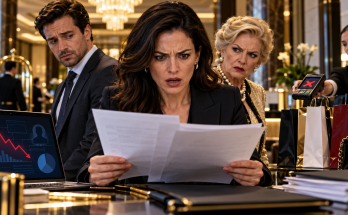
Mom arrived at Daniel's office carrying a narrow black folder. She had chosen a gray dress I recognized from church gatherings and wore her pearl necklace beneath the collar. Her appearance was carefully composed, but the skin around her eyes looked swollen. She stopped in the doorway when she saw me seated beside Daniel and Caroline Mercer.
"I thought this would be a conversation between you and me," she said.
"I told you I wouldn't meet privately."
Mom glanced toward the attorneys. "You really don't trust me anymore."
I looked at the folder she was holding. "I trust you to tell me what happened if you're willing to answer questions and support your answers with records."
She sat down without replying. For several seconds, she arranged the folder squarely in front of her, aligning its edges with the table. I recognized the gesture from family dinners. When Mom felt circumstances slipping beyond her control, she concentrated on small things she could arrange precisely.
Daniel explained that the meeting was voluntary and that Mom was free to consult her attorney before discussing potentially serious financial matters. She said she understood. Her attorney, a woman named Judith Allen, joined us shortly afterward and asked that we distinguish any settlement discussions from the ongoing record-preservation process.
I listened while the attorneys clarified those boundaries. There would be no informal promise to conceal documents, no assurance that investigators would overlook suspected misconduct, and no agreement that I would become personally responsible for Caldwell Audiovisual Solutions. Mom's expression hardened as each condition was stated.
Finally, she opened the folder.
Inside was a copy of an agreement relating to Westbridge Procurement Services. The document described a private financial arrangement involving Blake and Mom. It purported to authorize Westbridge to receive funds for purchasing equipment and managing investment opportunities connected to the family business.
The language was broad, but the signatures were what caught my attention. Blake had signed as an authorized representative of Caldwell Audiovisual Solutions. Mom had signed for Westbridge. A third signature was attributed to Dad.
I looked at the date.
It was several months after Grandpa's death and years before the suspicious transfers currently under investigation. The original arrangement seemed to have been designed as a possible procurement mechanism, although the records did not establish whether it had ever operated legitimately at that time.
"What is this supposed to prove?" I asked.
Mom folded her hands. "That Westbridge wasn't something Blake invented in secret. Richard knew there were plans to use an outside company for purchasing."
Daniel examined the document. "We'll need to verify its authenticity, its legal effect, and whether it authorized the specific transactions under investigation."
"It shows I wasn't hiding everything," Mom insisted.
I looked at her. "It doesn't explain why customer deposits were transferred without matching equipment deliveries."
She drew a breath. "Because Blake believed he could earn better returns before the invoices came due."
The room became still.
Caroline stopped turning pages. Daniel looked directly at Mom.
"What do you mean by better returns?" he asked.
Mom glanced toward Judith, who quietly reminded her that she could choose whether to continue. Mom hesitated, then nodded.
"Blake said the company had money sitting in accounts while equipment orders were being scheduled. He told me that some of it could be invested temporarily. He said the profits would cover expenses and give the company room to grow."
I felt a wave of disbelief. "Those weren't spare funds. They were customer deposits."
"He said the equipment could still be purchased before installation."
"That doesn't make the money his to gamble with."
Mom's expression tightened. "He didn't describe it as gambling."
"What did he call it?"
"Cash management."
I looked down at the agreement. It used polished financial language, but the explanation was simple. Blake had taken money associated with obligations to customers and moved it into investments he hoped would generate quick returns.
Mom continued, speaking slowly. She said that the arrangement initially appeared successful because account statements showed gains. Blake began transferring larger amounts. When the investments declined, he believed the losses were temporary and that waiting would allow the money to recover.
"Did you know the company was using customer deposits?" Daniel asked.
Mom hesitated.
"I knew some of the funds came from customer payments."
"Did you know those payments were connected to projects the company had not completed?"
She looked at her attorney.
"I knew there were outstanding contracts."
The admission was narrow, but it mattered. She had not simply signed paperwork without understanding that the money carried obligations. She knew at least some funds came from customers awaiting services.
I thought of Paula worrying about payroll and the school district still waiting for equipment. "Why didn't you stop him?"
Mom's eyes filled. "Because every time we discussed selling the investments, Blake said we'd lose everything. He promised the market would recover."
"And you believed him?"
"At first."
"Then what?"
She looked away. "Then I was afraid of what would happen if Richard found out."
For years, Mom had treated Dad's pride as something the entire family was required to protect. She had concealed difficulties rather than allow him to experience embarrassment. Now those habits had contributed to a crisis affecting employees, customers, and the family business.
Daniel asked when Mom first realized that the losses could not be covered through ordinary operations. She estimated that it was several months before the dinner confrontation. Blake had told her a large withdrawal would resolve the problem. When the investment manager declined the request, he began exploring outside financing.
"That's when the six-hundred-and-fifty-thousand-dollar loan entered the picture?" I asked.
Mom nodded.
"Whose idea was it to use the house as collateral?"
She looked at me.
"Blake said the lender wanted additional security. Richard thought there might be equity in the property."
"He signed an agreement acknowledging that he didn't own it."
"Your father never accepted that it wasn't still his home."
"Living there and owning it are different things."
Mom lowered her eyes.
I leaned forward. "Did you tell Blake that Caldwell Property Holdings belonged to me?"
"No. I didn't know for certain until Richard received the disclosure."
The answer was plausible. I had taken care to keep my control of the company separate from household discussions. But Mom had possessed Grandpa's records, had helped arrange family financial documents, and had participated in conversations about the property. I could not simply assume her ignorance.
Daniel asked whether she had ever attempted to identify the company's controlling owner before using the address in financing discussions. She said Blake had contacted people who claimed they could help establish what authority was necessary. She did not provide names.
"Did you understand that a person who doesn't own property cannot pledge it merely by living there?" Daniel asked.
Mom's expression became defensive. "I understood that documents would be needed."
"What documents?"
She looked down at the folder.
"The lender asked for confirmations."
I felt my chest tighten. "And that's why you gave Blake copies of my identification?"
Mom's silence lasted long enough to answer before she spoke.
"He said he needed information about everyone associated with the household."
"Did he say he intended to list me as a guarantor?"
"He said it might be necessary if you agreed."
"But nobody asked me."
"I thought he would."
I stared at her. "You knew he had my identification. You knew the lender was discussing guarantees. You knew I hadn't agreed to anything. Then you helped prepare a thirty-thousand-dollar invoice that required my signature."
Mom pressed her lips together.
"Tell me what you expected to happen when I signed it."
She looked at Judith, who quietly advised her to consider the question carefully.
Mom eventually answered. "I thought that if you signed an acknowledgment showing you owed money to the household, Blake could persuade you to help with the larger financing."
"How?"
"He said it would show you understood the family's financial responsibilities."
I felt an unpleasant mixture of anger and sadness. The rent invoice had not been a direct authorization to pledge my assets. It had been a pressure tactic designed to make me accept a false debt and become more vulnerable to further demands.
"Did you know there was already a guarantee bearing my signature?" I asked.
Mom's eyes moved toward the folder.
"Blake showed me a draft."
"When?"
"A few days before the dinner."
"Was my signature on it?"
She hesitated.
"Yes."
I sat perfectly still.
"You saw a document with my signature, even though you knew I hadn't agreed?"
"He said it was a sample."
"Did it look like a sample?"
Mom began crying. She reached for a tissue, then stopped when nobody moved to comfort her.
"I wanted to believe he wouldn't actually use it," she whispered.
Her words did not establish who had written the disputed signature, but they placed her knowledge of the document earlier than she had previously admitted. She had seen a version bearing my name before presenting the invoice and demanding that I sign an acknowledgment of another nonexistent obligation.
Daniel asked whether she had witnessed anyone reproduce my handwriting. Mom shook her head. She said Blake handled the lender documents, and she did not know how the signature had been added.
"Did you question him?" I asked.
"Yes."
"What did he say?"
"That everything would be corrected before the loan closed."
I looked at her across the table. She had accepted the same assurance repeatedly: the investments would recover, the company would be protected, the signatures would be corrected, and nobody would suffer. Every promise had allowed the misconduct to continue another little while.
Caroline then asked about Grandpa's ledger and the altered authority resolution. Mom looked exhausted, but she answered. She admitted that she had retained the records because Grandpa's instructions complicated the leadership arrangement she and Dad wanted for Blake.
"Richard believed Blake should eventually run the company," she said. "George kept insisting on restrictions and reviews. I thought those conditions would discourage Blake and make Richard feel that his father never trusted him."
"Did you alter the records?" Caroline asked.
Mom shook her head. "I didn't write the later resolution."
"Who did?"
"I don't know. Blake worked with people who prepared company documents."
"Did you know the approval reference did not match the trust records?"
"No."
"Why did you write that Richard shouldn't see that version until everything was settled?"
Mom looked toward me.
"Because it gave Blake more authority than Richard had agreed to at the time."
My stomach tightened.
"You knew the documents were different."
"I knew they weren't the same."
"Then why did you keep them hidden?"
She covered her face briefly. "Because I thought Richard would eventually approve the changes. I wanted Blake to have a chance to prove himself before anyone stopped him."
The explanation revealed a familiar pattern. Mom had repeatedly created circumstances she believed would produce the future she wanted, then treated anyone who questioned those circumstances as an obstacle. She had not merely defended Blake's ambition. She had helped remove safeguards intended to protect the company from exactly the kind of decisions he later made.
Daniel asked whether she had received personal payments from Westbridge. She acknowledged receiving money but insisted that some amounts were repayments of funds she had invested or expenses she had covered. Elaine would need to examine those claims against bank records. Mom could not produce complete supporting documentation during the meeting.
"What happened to the money?" I asked.
"Some went into the investments. Some paid household expenses."
"How much remains?"
She looked at Judith.
"I don't know the exact amount."
I thought about the grocery complaints, the supposed financial sacrifices, and the years she had portrayed my career as unstable. Throughout that period, money originating from the family business had moved through an entity she controlled, while she demanded six hundred dollars from me every month.
I had to look away.
After a short break, Daniel asked whether Mom would cooperate in producing the remaining bank records and correspondence. Judith said they would consider the requests through appropriate channels. Mom offered to provide additional information if the investigation could remain private.
Daniel explained that he could not promise confidentiality that would obstruct legitimate claims by the company, its customers, or relevant authorities. Mom's face tightened again, but she did not withdraw the documents she had brought.
The meeting ended without the bargain she wanted.
As she prepared to leave, Mom turned toward me. Her eyes were red, and her voice had lost its carefully controlled warmth.
"I did all of this because I wanted your brother to succeed."
I looked at her.
"And what did you want for me?"
She opened her mouth, then stopped.
I waited.
For the first time in my life, she seemed unable to produce an answer that would make her choices sound generous.
"You were always capable of taking care of yourself," she said finally.
The sentence hurt more than I expected.
It was the explanation beneath years of unequal treatment. Blake needed encouragement, money, protection, and opportunities because he might fail without them. I needed nothing because I had learned to survive disappointment quietly. My competence had become a reason to deny me support.
"I could take care of myself," I said. "That didn't mean I didn't need parents."
Mom looked at me for a long moment. Then she lowered her eyes and left with Judith.
I remained seated until Daniel returned from seeing them out. He asked whether I wanted to continue discussing the records or finish for the day.
"One more question," I said.
He sat opposite me.
"Does what she told us establish that Blake forged my signature?"
"No," Daniel answered. "It strengthens the evidence that the disputed guarantee was prepared and circulated without your authorization. But identifying who made the signature requires additional evidence and appropriate examination."
I nodded. I had expected that answer.
"And the trust documents?"
"Her admissions support concerns about concealment and possible irregularities in the authority arrangements. We still need the complete corporate records before determining the legal consequences."
I stood and gathered my notes.
I felt exhausted, but something had changed. For the first time, Mom had explained her actions without relying entirely on the claim that she was misunderstood. She had admitted knowing about the investment scheme, seeing the unauthorized signature, and hiding records because they interfered with Blake's future.
Those admissions did not resolve everything. They made the next steps clearer.
That evening, Dad called after learning that Mom had met with Daniel. He asked whether I could tell him what had happened. I said the relevant information would be shared through the proper process, but I would not become a messenger between them.
He was quiet for a moment.
"Are you going to take the house away from us?" he asked.
I looked around Maya's dining room, where my files were arranged beside her work papers.
"No," I said. "I'm not making decisions about the house to punish you. But I also won't allow it to be used to cover the company's losses."
"I understand."
"Do you?"
He sighed.
"I'm trying to."
After the call, I opened the company cash-flow forecast Elaine had prepared. The business still needed money to complete contracts and pay employees. The investment losses remained unresolved. Blake had not returned the missing files, and his attempted financing arrangement had been challenged.
I could not repair those problems by exposing Mom's lies alone.
Then an email arrived from Daniel with a new development. The lender had provided additional correspondence relating to the disputed guarantee. One message, sent from an account associated with Blake, referred to the attached signature page as completed and ready for processing.
The message had been sent after Mom claimed Blake showed her a sample.
A later reply from the lender requested confirmation of the guarantor's authority and independent verification of the collateral. That request appeared to have halted the transaction before funds were released.
I read the email carefully.
The evidence now showed that a document bearing my unauthorized signature had not merely remained an unfinished draft in Blake's possession. It had been represented to the lender as completed.
I forwarded the correspondence to my secure records folder and called Daniel.
"Whatever Blake told Mom," I said, "he submitted the guarantee as though I had signed it."
"That's what the correspondence indicates," Daniel answered. "And we're taking the necessary steps to preserve and address that evidence."
I looked at the photograph of Grandpa George beside my laptop.
For years, my family had expected me to surrender my judgment whenever someone accused me of being disloyal. Now I understood how dangerous that expectation had become.
I would not withdraw my challenge to the forged guarantee. I would not conceal the financial records to protect Blake or Mom. And I would not rescue the company by pretending that the missing money had never existed.
The next morning, I signed the documents authorizing Daniel to pursue the available protections and remedies concerning my identity and property. Separately, I approved the limited independent restructuring assessment for Caldwell Audiovisual Solutions.
The two decisions mattered because they were not the same. One protected me from obligations I had never accepted. The other allowed an honest examination of whether the company and its employees could be helped without concealing wrongdoing.
By noon, Elaine called with an update. The investment manager had provided a preliminary verified statement showing that the account's recoverable value was substantially below the amounts Blake and Mom had expected. Some funds remained, but recovering them would not fully restore the missing customer deposits.
"Does that mean the business is finished?" I asked.
"Not necessarily," Elaine replied. "But any realistic recovery plan must acknowledge the losses instead of pretending the original money is still available."
I looked at the figures on my screen.
The full cost of Blake's decisions was finally beginning to emerge, and there would be no easy way to make everyone whole.
Yet for the first time since the dinner confrontation, I felt that the investigation had reached solid ground. There were verified records, documented admissions, and people willing to cooperate. The family's carefully maintained appearance of success was collapsing, but beneath it there might still be something worth preserving.
I closed the report and prepared for another meeting with Daniel, Dad, and the restructuring team.
Whatever happened next, it would have to begin with the truth.