My son laughed while I rented
a one-bedroom apartment behind a laundromat.
Eight months later, he walked into
my beautiful new villa, looked at his wife,
and announced, “It’s perfect.
Kendra will love living here.”
Then he pointed toward my guesthouse
and told me I could move in there
while his family took the main house.
I smiled, but not because I agreed.
I was sixty-one years old, newly divorced,
and finally living in a home
I had purchased with my own money.
My son had no idea
how much I had sacrificed to get there,
and he certainly didn’t know
what I was prepared to do
to keep it.
A few hours later, he would call
the police on his own mother.
My name is Evelyn Hale,
and I live in Sarasota, Florida.
For thirty-four years, I was married
to Richard Hale, a man everyone believed
was a brilliant businessman and generous provider.
When our marriage ended,
he kept the lake house, the boat,
the expensive lifestyle, and most of our friends.
I walked away with my sewing machine,
my grandmother’s china, and the determination
to build a peaceful life.
The first place I found
was a small apartment behind a laundromat.
The kitchen cabinets were peeling,
the bathroom fan rattled, and my bedroom window
faced a brick wall.
But the rent was manageable,
the neighborhood was quiet, and nobody
could tell me what to do
inside those walls.
For the first time in decades,
I could make decisions without hearing Richard
criticize them.
My only son, Preston,
didn’t see it that way.
He visited twice during those eight months,
and both visits left me feeling
smaller than the apartment itself.
The first time, he brought his wife,
Kendra, and stood in my kitchen
looking around with an expression of disgust.
Then he laughed as though
my new living situation proved something
he had always suspected about me.
“Mom, you’re sixty-one,” he said.
“You should be thinking practically,
not pretending you’re going to start over.”
Kendra smiled into her coffee and added,
“Renting is fine for some people.”
I looked at the two of them
and wondered when my own family
had started speaking to me
like I was a disappointing stranger.
Preston was thirty-five, married,
and the father of a beautiful baby girl
named Lila.
I adored my granddaughter,
and I would have done almost anything
to make her happy.
But Preston had inherited his father’s habit
of confusing confidence with wisdom.
Like Richard, he believed
that a woman who didn’t advertise
her accomplishments probably didn’t have any.
During his second visit,
Preston inspected my apartment like he was touring
a warning about bad decisions.
“You should have let Dad
handle the divorce finances,” he said.
I folded a towel and tried
not to react, although his words
hurt more than I wanted to admit.
My son had no idea
that I had been handling
the complicated financial details of our household
for decades.
While Richard entertained clients and accepted compliments,
I maintained the books, watched our investments,
and managed financial paperwork.
My grandmother had also left me
two small commercial properties,
which I had carefully maintained
throughout my marriage.
After the divorce, I sold those properties
and reviewed my finances with professionals
I trusted.
The money gave me an opportunity
nobody in my family expected.
I found a white Mediterranean villa
near Sarasota Bay, surrounded by palm trees
and lemon trees.
It had arched windows, beautiful stone floors,
a marble fireplace, and a courtyard
filled with sunlight.
Behind the main house stood
a separate guesthouse with tall windows,
perfect for my sewing machine
and painting supplies.
I walked through the property once
and knew I had found the place
where I wanted to spend
the next chapter of my life.
I purchased it without a mortgage,
and every important document carried my name.
The deed was mine, the accounts were mine,
and the decision had been mine
from the beginning.
I didn’t tell Preston
because I wanted to enjoy something beautiful
before anyone had the chance
to criticize it.
For three wonderful weeks,
I lived quietly among my books, flowers,
and grandmother’s china.
Then a neighbor posted photographs
from my housewarming dinner.
By Saturday morning, Preston’s black SUV
was rolling through my gate without an invitation.
Kendra climbed out carrying Lila,
and both adults stared at the villa
as if they had discovered
an unexpected prize.
Preston walked through my front door
before I could even welcome him.
“Mom, how did you afford this?”
he demanded, looking up
at the vaulted ceiling.
I told him I had purchased the home
with money I had managed
over the years.
He laughed and suggested his father
must have been more generous
during the divorce than anyone realized.
I didn’t correct him
because I was beginning to recognize
that he preferred his own explanations
to the truth.
Kendra wandered toward the French doors,
admiring the courtyard and the pool.
She mentioned how wonderful the property
would be for Lila,
and Preston immediately agreed.
Then he looked around my living room,
grinned at his wife, and said,
“My wife will love living here.”
I thought I had misunderstood him
until he casually explained his plan.
“We’ll move into the main house,” he said.
“You can take the guesthouse.
This place is too big for you anyway.”
Kendra nodded and added
that the smaller building would be easier
for someone my age to maintain.
Neither of them asked
whether I wanted this arrangement.
I looked at the son
who had laughed when I rented
a tiny apartment.
Now that I owned something beautiful,
he had decided it should belong
to his family instead.
I folded my hands
and asked one simple question:
“Preston, when exactly did I invite you
to move into my house?”
His smile disappeared,
and the answer he gave me
revealed just how far he intended to push.
“You don’t have to invite us, Mom.”
For a moment,
I thought I had misheard him.
He continued speaking
with the same casual confidence
Richard once used when announcing decisions
that affected my entire life.
“We’re family. That’s how this works.”
Kendra shifted Lila against her shoulder.
My granddaughter was sleeping,
one tiny hand resting
against the collar of her mother’s blouse.
I looked at that little hand.
Then I looked at my son.
“That’s not how ownership works, Preston.”
He gave an irritated sigh.
“Don’t make this difficult.”
“I’m asking you to respect my home.”
“Your home?”
He laughed again.
“Come on, Mom. Seriously?”
Something inside me became very still.
“Yes,” I said.
“My home.”
Preston gestured toward the marble fireplace.
“You couldn’t afford this without Dad.”
“I already told you how I purchased it.”
“Dad says you were always terrible
with money.”
Those words should have surprised me.
They didn’t.
For thirty-four years,
Richard had told the world
that I was fortunate to have him.
Whenever a financial decision succeeded,
he accepted the praise.
Whenever something went wrong,
he found a way
to make it my responsibility.
Apparently, our son had believed every word.
“Your father doesn’t know my finances anymore.”
Preston crossed his arms.
“Then show me.”
“Show you what?”
“Your bank statements. The purchase documents.
Whatever inheritance you supposedly received.”
I stared at him.
He was standing in my living room,
demanding proof that I deserved
the house I had purchased.
Not because he worried about fraud.
Not because he feared I was vulnerable.
He wanted to decide
whether my success was legitimate enough
for him to respect.
“No,” I said.
He blinked.
“What?”
“I won’t show you my private finances.”
His expression hardened.
“That’s suspicious.”
“No, Preston. That’s privacy.”
Kendra finally spoke.
“Evelyn, I think everybody’s getting emotional.”
I turned toward her.
“Then perhaps we should end this visit.”
Her mouth tightened.
“We’re only trying to help.”
“Help whom?”
She looked briefly at Preston.
Then she adjusted Lila’s blanket.
“This place would be wonderful for children.”
“I’m sure it would.”
“You don’t even use half these rooms.”
“I’ve lived here three weeks.”
She frowned.
“Well, we’re thinking about the future.”
“So am I.”
That silenced her.
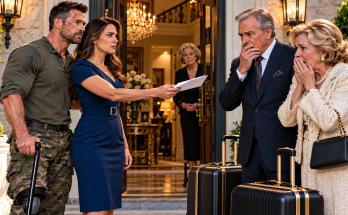
Preston reached into his jacket.
He removed a folded sheet of paper.
Then he placed it
on my grandmother’s mahogany coffee table.
“We’ve already worked everything out.”
I didn’t touch it.
“What is that?”
“A family living arrangement.”
I looked down.
The heading read:
Family Occupancy Agreement.
Underneath were paragraphs describing
how Preston, Kendra, and Lila
would occupy the main residence.
I would retain permission
to use the detached guesthouse.
Permission.
In my own property.
At the bottom was a line
waiting for my signature.
I felt the room tilt slightly.
Not from fear.
From recognition.
Richard used to prepare documents like this.
He would make decisions without consulting me.
Then he would put papers
in front of my dinner plate.
He called it being organized.
I had called it marriage.
Now I knew better.
“Who prepared this?”
Preston shrugged.
“Dad helped.”
Of course he had.
I picked up the paper.
One paragraph caught my attention.
The proposed arrangement would continue
for an indefinite period.
Another authorized Preston
to manage household expenditures.
A third allowed him
to approve structural changes.
I read that sentence twice.
“You intend to renovate my house?”
“Kendra wants a bigger nursery.”
Kendra looked toward the courtyard.
“And the guesthouse could use some updating.”
I folded the paper.
Carefully.
Then I handed it back.
“I won’t sign this.”
Preston didn’t move.
“Mom, we’ve already made arrangements.”
“What arrangements?”
“Our furniture is going into storage.”
“Why?”
“Because we’re moving.”
I studied his face.
“Moving from where?”
He hesitated.
“Our house.”
“What happened to your house?”
“That’s not relevant.”
“It certainly seems relevant.”
He glanced at Kendra.
She looked suddenly uncomfortable.
“Preston,” she said quietly.
“Tell her.”
He ignored her.
“We’ve got a moving company booked.”
“For when?”
“Monday morning.”
It was Saturday.
My son had arranged
to move his family into my house
without asking my permission.
And he had done it
before I even knew he needed somewhere
to live.
I felt an old familiar instinct.
The instinct to fix everything.
To make calls.
To open my checkbook.
To rearrange my life
until everyone else felt comfortable again.
That instinct had once kept my marriage alive.
It had also nearly destroyed me.
I looked at Lila.
Then at Preston.
“Whatever is happening with your home,
we can discuss it honestly.”
His expression relaxed slightly.
“But you are not moving into mine.”
The relief vanished.
“Unbelievable.”
“I’m sorry you’re disappointed.”
“Disappointed?”
His voice rose.
“I’m your only son!”
“And I am your mother.”
“Exactly!”
He pointed toward the guesthouse.
“You should want to help your family.”
“I do.”
“Then what’s the problem?”
“The problem is that you decided
my home belonged to you.”
Kendra stepped closer.
“Evelyn, think about Lila.”
I felt that sentence
more deeply than anything else.
Because Lila was innocent.
Because she deserved safety.
Because loving her
was the easiest thing in my world.
But I understood something important.
If I surrendered my home today,
I would teach Preston
that he could use his daughter
to take anything he wanted.
I would also teach Lila
that older women were expected
to disappear when younger families needed space.
I wasn’t going to teach her that.
“I am thinking about Lila.”
“Then let us live here.”
“No.”
The word landed between us.
Plain.
Uncomplicated.
Final.
Preston stared.
“You’re really doing this?”
“Yes.”
He shook his head.
“Dad was right about you.”
That hurt.
Even after everything,
it hurt.
I remembered him at six years old.
Barefoot in our old kitchen.
Asking me to make pancakes
shaped like dinosaurs.
I remembered sitting beside his hospital bed
during a terrible childhood fever.
I remembered teaching him to ride
his first bicycle.
And here he stood,
a grown man treating my home
like a prize he had won.
“What did your father say?”
Preston gave me a cold smile.
“That you’ve become selfish.”
I took a breath.
“And what do you think?”
“I think you’re embarrassing yourself.”
There it was.
The same accusation Richard used
whenever I refused to obey.
I looked toward the front door.
“I think this visit is over.”
Preston laughed sharply.
“You can’t throw us out.”
“You are guests.”
“I’m your son.”
“Being my son doesn’t make you the owner.”
He stepped toward me.
Not close enough to touch.
But close enough
to remind me how much taller
he had become.
“You’re not thinking clearly, Mom.”
My stomach tightened.
“Be careful what you say next.”
He lowered his voice.
“People your age make strange decisions.”
“I’m sixty-one, Preston.”
“Exactly.”
I almost laughed.
At sixty-one,
I had survived a difficult divorce.
Managed investments.
Purchased a beautiful house.
Moved an entire lifetime of possessions
without asking anyone’s permission.
And my son thought
sixty-one meant I couldn’t make decisions.
“I am thinking perfectly clearly.”
He stared at me.
Then he reached for his phone.
“Fine.”
“What are you doing?”
“Getting someone involved
who can straighten this out.”
I watched him dial.
His thumb moved rapidly.
He turned away.
Then I heard him say,
“I need officers sent to this address.”
Kendra’s eyes widened.
“Preston!”
He raised one hand.
“My mother’s behaving irrationally.
I’m concerned she’s not mentally well.”
For several seconds,
I couldn’t understand
what I was hearing.
He gave the dispatcher my address.
Then he said something worse.
“She’s refusing access to family members
who have a right to be here.”
Kendra whispered his name again.
He ignored her.
I stood in my own living room
while my son called the police
because I wouldn’t give him my house.
And strangely,
the feeling that came over me
wasn’t panic.
It was clarity.
I walked to the kitchen counter.
Picked up my phone.
And called my attorney.
Her name was Sabrina Ortiz.
She had represented me during the divorce.
More importantly,
she knew exactly how much
I had endured before leaving Richard.
She answered on the fourth ring.
“Evelyn? Is everything all right?”
“My son is in my house.”
“Okay.”
“He says he’s moving in.”
A pause.
“Did you invite him?”
“No.”
“Did you sign anything?”
“Absolutely not.”
“Whose name is on the deed?”
“Mine. Only mine.”
Another pause.
Then Sabrina said,
“Good. Tell me what’s happening.”
I explained everything.
The proposed agreement.
Richard’s involvement.
The moving truck.
The call to police.
She listened without interrupting.
When I finished,
her voice became very calm.
“Don’t argue about family history.”
“I’m trying not to.”
“Show the officers your ownership documents.
Explain that no permission was granted.”
“I have everything in my office.”
“And Evelyn?”
“Yes?”
“Do not sign anything today.”
“I won’t.”
“I’m serious.”
“So am I.”
There was a brief silence.
Then she said,
“I’m proud of you.”
I nearly cried.
Not because I needed praise.
But because someone finally understood
what standing my ground was costing me.
When I returned,
Preston was pacing near the fireplace.
Kendra sat on the sofa.
Lila had awakened
and was playing with her mother’s necklace.
Nobody spoke.
We waited nearly twenty minutes.
I used that time
to retrieve my deed,
closing statement, and identification.
I placed everything
in a neat blue folder.
Preston watched me.
“Making yourself look organized
doesn’t prove you’re competent.”
I looked at him.
“No,” I said.
“But it does prove I’m prepared.”
His jaw tightened.
Then the doorbell rang.
Two officers stood outside.
One was a middle-aged woman
with a steady expression.
The other was younger,
carrying a small notebook.
I invited them inside.
“I’m Officer Ramirez,” the woman said.
“We received a call about a family dispute.”
Preston stepped forward immediately.
“Thank God you’re here.”
Ramirez glanced at him.
“Are you the caller?”
“Yes. My mother’s acting irrationally.”
She looked toward me.
“Ma’am, can you tell me what’s happening?”
I nodded.
“This is my home.
My son wants to move in.
I have refused permission.”
Preston interrupted.
“She’s leaving out important details.”
Ramirez raised her hand.
“I’ll speak with everyone.”
I handed her the folder.
“These are my ownership documents.”
She examined them.
The younger officer took notes.
Then Ramirez asked,
“Mr. Hale, do you own this property?”
Preston hesitated.
“Not technically.”
“Are you on the deed?”
“No, but—”
“Do you have a lease?”
“It’s a family arrangement.”
“Has your mother agreed to it?”
He looked at me.
I answered clearly.
“No.”
He threw up his hands.
“She’s being unreasonable!”
Ramirez remained calm.
“Being unreasonable and being legally entitled
to exclude someone are different matters.”
Preston’s face reddened.
“Dad helped pay for this house.”
I spoke before Ramirez could respond.
“That is not true.”
He turned toward me.
“You don’t know that!”
I almost smiled.
“I attended my own closing, Preston.”
Kendra lowered her eyes.
Ramirez examined the documents again.
“Mr. Hale, you haven’t shown us
any basis for a right to occupy.”
He stared at her.
Then he tried another approach.
“I’m worried about my mother’s judgment.”
“Has she threatened anyone?”
“No.”
“Has she harmed herself?”
“No.”
“Is there an immediate medical emergency?”
“That’s not the point.”
Ramirez folded her notebook.
“Then that concern doesn’t give you possession
of her residence.”
Preston looked astonished.
As though nobody had ever explained
that his wishes were not laws.
Kendra stood.
“Preston, let’s just go.”
He ignored her.
“I’m not leaving my mother
in this huge house alone.”
I looked straight at Ramirez.
“I would like my visitors to leave.”
The officer nodded.
Then she faced Preston.
“Your mother has withdrawn her invitation.
You need to leave the property.”
Silence.
Preston looked at the second officer.
Then back at Ramirez.
“You’re taking her side?”
“We’re explaining the situation.”
He gave a harsh laugh.
“This is unbelievable.”
Ramirez’s expression didn’t change.
“Sir, collect your belongings.”
For the first time
since entering my house,
my son had nothing to say.
He grabbed his jacket.
Kendra picked up Lila’s diaper bag.
I walked them to the front entrance.
The afternoon sunlight
had turned the courtyard walls golden.
Lemon blossoms moved in the breeze.
It should have been peaceful.
Instead, I heard Preston whisper,
“You’ll regret humiliating me.”
I met his eyes.
“I didn’t humiliate you.”
He waited.
“You humiliated yourself.”
Kendra gasped softly.
Preston opened his mouth.
But Officer Ramirez was standing behind us.
So he said nothing.
He walked to his SUV.
Kendra followed.
Just before she climbed inside,
she turned toward me.
For an instant,
I thought she might apologize.
Instead, she said,
“I hope you’re happy.”
I looked at my granddaughter.
Lila smiled when she saw me.
That innocent little smile
nearly broke my heart.
“I hope one day
all of us can be.”
Kendra looked away.
The SUV rolled down the driveway.
The gate closed.
And suddenly,
my beautiful house was silent again.
I stood beneath the archway.
My hands began trembling.
Only then.
After everything was over.
I walked inside,
sat on the bottom stair,
and cried.
Not because I regretted my decision.
I didn’t.
I cried because I had spent
thirty-five years raising a son
who believed love meant surrender.
I cried for the little boy
who once brought me wildflowers
from the yard.
I cried for the man
who had replaced those flowers
with a document demanding my signature.
And I cried
because I finally understood
that protecting myself
might mean disappointing him.
For a very long time.
A soft knock interrupted me.
It came from the front door.
I wiped my cheeks.
When I opened it,
my neighbor Celia stood outside.
She was seventy,
with warm brown eyes
and an enormous plate of lemon cookies.
Celia had taken the photographs
that revealed my new home.
She looked past me.
Then at my face.
“Oh, sweetheart.”
I tried to smile.
“Apparently you’ve missed quite a show.”
Her expression tightened.
“I saw the police cars.”
“Family disagreement.”
She glanced toward the driveway.
“Was that your son?”
I nodded.
She looked deeply troubled.
“Evelyn, I’m so sorry.”
“For what?”
“The photographs.”
I blinked.
“I never imagined
they’d cause something like this.”
I reached for her hand.
“Celia, you didn’t cause anything.”
“But if I hadn’t posted them—”
“He would have found out eventually.”
She studied me.
“Would you like some company?”
I thought about saying no.
The old Evelyn
would have pretended everything was fine.
She would have smiled,
accepted the cookies,
and cried alone afterward.
But I was learning.
“Yes,” I said.
“I would.”
Celia came inside.
We sat at the kitchen island.
She poured tea
while I told her everything.
When I finished,
she was silent for several seconds.
Then she said,
“My daughter tried something similar.”
I looked up.
“Really?”
She nodded.
“After my husband died,
she decided I shouldn’t drive anymore.”
“Were you having difficulty driving?”
“Not at all.”
Celia smiled sadly.
“She wanted my car.”
I stared at her.
“She said it would be safer
for me to give it to her.”
“What happened?”
“I told her no.”
“And?”
“She didn’t speak to me for months.”
“That must have been painful.”
“It was.”
She reached across the table.
“But then something interesting happened.”
“What?”
“She eventually needed me
for something money couldn’t purchase.”
I waited.
“She needed a mother
who could tell her the truth.”
Celia squeezed my hand.
“So don’t confuse silence with failure.”
Those words stayed with me
long after she went home.
That evening,
I walked through every room.
Not because I was checking for damage.
I needed to remember
why I had chosen the house.
The kitchen with its wide windows.
The library overlooking the courtyard.
The upstairs bedroom
where moonlight crossed the pale stone floor.
The little balcony facing the bay.
And finally,
the guesthouse.
I opened its blue wooden door.
Inside stood my grandmother’s sewing machine,
a wooden easel,
and shelves filled with fabric.
My unfinished paintings leaned against the wall.
A half-completed quilt rested on the table.
It was for Lila.
Soft pink squares.
Tiny embroidered stars.
And one corner
where I had stitched her name.
I sat beside the quilt.
Then I remembered something
my grandmother used to say.
“Never make your life smaller
to accommodate somebody else’s greed.”
I had been seventeen
when she first told me that.
At the time,
I thought she was talking about business.
Now I understood.
She had been talking about freedom.
The next morning,
my phone showed thirty-one missed calls.
Seventeen from Preston.
Nine from Richard.
Five from Kendra.
There were also eleven messages.
I read the first three.
Preston’s began with anger.
Then came accusations.
Then a demand.
“You need to apologize to Kendra.”
The second message was longer.
“You embarrassed us in front of police.
Dad says this is completely unacceptable.”
The third made me pause.
“We have nowhere to go Monday.
Are you seriously doing this to Lila?”
I stared at that last sentence.
Then I opened Richard’s messages.
The first said,
“Evelyn, stop being dramatic.”
The second said,
“You owe your son some stability.”
And the third said,
“Call me before this becomes expensive.”
I read those words twice.
Expensive.
That was Richard’s favorite kind of threat.
He believed every disagreement
could be settled through financial pressure.
I set down my phone.
Then I made breakfast.
Eggs.
Toast.
Coffee with cinnamon.
I sat outside,
watching sunlight move through the lemon trees.
For years,
Richard had dictated our mornings.
The temperature of the coffee.
The placement of the newspaper.
Whether I could discuss anything important
before his second cup.
Now I ate slowly.
And nobody complained.
At nine,
I called Sabrina.
She had already reviewed
the documents I sent her.
“The deed is clear,” she said.
“The title is yours alone.”
“I know.”
“But we need to address something else.”
“What?”
“Your son’s proposed agreement.”
I straightened.
“What about it?”
“Did you read the management provisions?”
“Some of them.”
“They’re unusually broad.”
I remembered the paragraph
allowing Preston to approve structural changes.
Sabrina continued.
“If you signed this,
you could surrender significant control
over your own property.”
I felt cold.
“Richard helped him prepare it.”
“That doesn’t surprise me.”
There was a pause.
Then Sabrina asked,
“Have you changed your estate documents
since the divorce?”
“Not yet.”
“We should.”
I looked toward the guesthouse.
“Why?”
“Because your former husband
is still named in several older documents.”
My stomach tightened.
“Which documents?”
She explained.
An outdated medical directive.
An old financial power of attorney.
A beneficiary designation
that required immediate review.
Nothing gave Richard present ownership
of my new home.
And Sabrina assured me
that the divorce had changed
the effect of certain provisions.
But outdated paperwork
could still create unnecessary problems.
Especially with someone like Richard.
“We’ll review everything,” I said.
“Good.”
She hesitated.
“And Evelyn?”
“Yes?”
“Your son may be under financial pressure.”
“I suspected that.”
“Pressure doesn’t excuse coercion.”
“I know.”
“I’m saying it
because you might need reminding.”
I smiled sadly.
“I probably will.”
We arranged an appointment for Tuesday.
She also recommended practical precautions.
Change the gate access code.
Review who possessed spare keys.
Enable property-record alerts.
Document the police visit.
Keep copies of threatening messages.
None of it felt pleasant.
But it felt necessary.
That afternoon,
I received a call
from a number I didn’t recognize.
“Mrs. Hale?”
“Yes?”
“This is Martin
with Gulf Coast Moving Services.”
I closed my eyes.
“Hello, Martin.”
“We’re confirming your delivery
for Monday morning.”
“I haven’t scheduled a delivery.”
A pause.
“Is this the Mediterranean residence
near Sarasota Bay?”
“Yes.”
“We have a full household shipment
scheduled for that address.”
“Who booked it?”
“Preston Hale.”
“That’s my son.”
“Wonderful. Then everything’s correct?”
“No, Martin.”
Another silence.
“The delivery is not authorized.”
He sounded confused.
“But Mr. Hale said—”
“My son doesn’t live here.”
I spoke gently.
“And he doesn’t have permission
to move anything onto my property.”
Martin apologized immediately.
He asked whether I wanted
the delivery canceled.
I explained that Preston
would need to provide another address.
Then I requested written confirmation
that my property wouldn’t be used
without my authorization.
Before hanging up,
Martin said something unexpected.
“Mrs. Hale, may I ask a question?”
“Of course.”
“Did your son tell you
about the additional storage charge?”
“No.”
“He told our office
you’d be responsible for everything.”
I looked at the ceiling.
Of course he had.
“I’m sorry,” I said.
“But I haven’t agreed to pay anything.”
Martin sighed.
“I understand.”
After that call,
I opened my grandmother’s old ledger.
Not because I needed to calculate expenses.
I needed to remember
how I had learned to protect myself.
My grandmother, Margaret,
had owned a small fabric shop.
Later, she purchased the building.
Then another storefront.
When she died,
she left those properties to me.
Richard had dismissed them
as sentimental investments.
He called them
“your little buildings.”
Yet those little buildings
had quietly appreciated over decades.
I had maintained them carefully.
Negotiated leases.
Paid taxes.
Funded repairs.
Saved rental income.
And when the right opportunity appeared,
I made a decision
based on years of patient work.
Richard had never understood
the strength of quiet persistence.
He understood grand announcements.
Impressive dinners.
Photographs beside expensive cars.
I understood spreadsheets.
Receipts.
And the importance of keeping promises
made to yourself.
I closed the ledger.
Then my phone rang again.
Richard.
This time,
I answered.
“Hello, Richard.”
“Finally.”
His voice carried that familiar irritation.
“Are you finished with this nonsense?”
“What nonsense?”
“Calling the police on your own son.”
I almost laughed.
“Preston called the police on me.”
“Don’t split hairs.”
“Those are rather important hairs.”
He exhaled sharply.
“Evelyn, I’m trying to help.”
“Then tell Preston
he cannot move into my house.”
A long silence.
Then Richard said,
“You’re being selfish.”
“I’ve heard.”
“It’s an enormous house.”
“Yes.”
“You don’t need that much space.”
“I wanted it.”
“That’s not a reason.”
“It was enough for the seller.”
He made an impatient sound.
“Preston has a family.”
“So do I.”
“You know what I mean.”
“I know exactly what you mean.”
His voice lowered.
“Look, their situation is complicated.”
“Then explain it.”
“That’s not my place.”
“You helped draft an occupancy agreement.”
Another silence.
This one lasted longer.
“Preston showed you that?”
“He tried to make me sign it.”
“Well, it’s perfectly reasonable.”
“Then why didn’t you ask me first?”
Richard didn’t answer.
I waited.
Finally, he said,
“He needs a place to land.”
“Why?”
“Business complications.”
“What business complications?”
He sighed.
“Preston invested in a development project.”
I felt something shift.
“Your development project?”
Silence.
I looked out toward the bay.
“Richard?”
“Yes.”
The answer came reluctantly.
“What happened?”
“We encountered unexpected costs.”
“How unexpected?”
“That’s confidential.”
“Then my house is also confidential.”
“Evelyn—”
“No.”
He stopped.
“You don’t get to demand my property
while refusing to explain why.”
His tone sharpened.
“Everything you have came from our marriage.”
I looked at the grandmother’s ledger.
At the neat handwriting
stretching across forty years.
At the photographs
of a woman who worked tirelessly
long before Richard entered my life.
“No,” I said.
“Everything I have came from work.”
“You were my wife!”
“And now I’m not.”
For a moment,
neither of us spoke.
Then he delivered his final threat.
“Preston will remember this.”
I looked across the courtyard.
At the pool.
At the flowers.
At the small blue guesthouse.
“So will I.”
I ended the call.
Then I blocked his number.
My hands were steady.
That surprised me most.
Monday morning arrived with rain.
Not a storm.
Just a soft Gulf Coast shower
that darkened the courtyard stones.
I had already changed
the gate access code.
The security company had reviewed
every authorized user.
The delivery company had confirmed
that no truck would enter.
And yet,
at eight seventeen,
someone rang the front gate.
I checked the camera.
Preston’s SUV stood outside.
Behind it was a rented van.
Kendra sat in the passenger seat.
Lila’s car seat was visible
through the rear window.
I pressed the intercom.
“Good morning, Preston.”
His face appeared on the screen.
“Open the gate.”
“No.”
“Mom, it’s raining.”
“I can see that.”
“We need to talk.”
“Then speak.”
He stared directly into the camera.
“You canceled our movers?”
“I prevented an unauthorized delivery.”
“Same difference.”
“No. It isn’t.”
Kendra leaned toward the window.
“Evelyn, please.”
Her voice sounded different.
Less confident.
Almost frightened.
I looked at Lila’s car seat.
Then I made a decision.
“I’ll meet you outside the gate.”
Preston frowned.
“Just open it.”
“I’ll meet you outside.”
I took an umbrella.
Then I walked down the driveway.
The rain smelled of wet leaves
and warm pavement.
When I reached the gate,
Preston climbed out.
His shirt was wrinkled.
His eyes looked tired.
Kendra remained inside.
He approached the bars.
“Mom, we’re desperate.”
That was the first honest sentence
I’d heard from him all weekend.
“Then tell me why.”
He looked toward the van.
“We sold the house.”
My breath caught.
“You sold your house?”
“Yes.”
“When?”
“Last month.”
“Why didn’t you tell me?”
“Because you’d judge us.”
I almost reminded him
of every judgment he’d made about me.
Instead, I asked,
“Where is the money?”
He looked away.
“Gone.”
The word hung between us.
I waited.
Preston rubbed his forehead.
“Dad had this coastal development deal.”
“I know.”
“He said the return was guaranteed.”
My stomach sank.
“He used that word?”
Preston nodded.
“Guaranteed.”
I knew Richard.
He never guaranteed anything
unless he wanted someone
to stop asking questions.
“How much did you invest?”
Preston swallowed.
“Most of our equity.”
I stared at him.
“Preston.”
“It was supposed to double.”
“And?”
“The project stalled.”
“What about your mortgage?”
“We sold before things got worse.”
“Where are you living now?”
His jaw tightened.
“We were staying at a hotel.”
“Were?”
“We checked out.”
I glanced at the van.
It contained suitcases.
Boxes.
A folded stroller.
And a child’s portable crib.
I looked back at him.
“Where did you think you’d go?”
He stared at me.
Then he said,
“Here.”
It was such a simple answer.
And such a terrible one.
Not because he was desperate.
I understood desperation.
I had felt it
when my marriage ended.
I had felt it
standing inside that tiny apartment,
wondering whether I had made
the greatest mistake of my life.
But desperation doesn’t give someone ownership
of another person’s future.
“Preston, you should have told me.”
“Would it have changed anything?”
“Yes.”
His face brightened.
“You’d let us move in?”
“No.”
The brightness vanished.
“But I could have helped you plan.”
He shook his head.
“That’s not help.”
“It is if you need a plan.”
“We need a house.”
“You need stable housing
that you can afford.”
He stepped closer.
“And you’ve got plenty of room!”
I felt the old pressure returning.
The guilt.
The expectation.
The unspoken demand
that I sacrifice first.
I held my ground.
“You may not live here.”
He looked at me
as though I had struck him.
Then Kendra opened the passenger door.
She stepped into the rain.
Without an umbrella.
Her face was pale.
“Evelyn, there’s something
I need to ask you.”
I turned toward her.
“What is it?”
“Did you really never agree
to let us live here?”
Preston went still.
I looked between them.
“No, Kendra.”
Her eyes filled.
“Preston said you’d offered.”
He turned sharply.
“Kendra!”
She ignored him.
“He said you’d asked us
to move closer.”
I felt my heartbeat quicken.
“He said the guesthouse
was already being prepared for you.”
I looked at Preston.
He stared at the wet driveway.
Kendra continued.
“He told me you were excited
about having Lila around every day.”
My throat tightened.
Because that part was true.
I would have loved seeing Lila.
Just not at the price
of losing my independence.
“Kendra, I never made that offer.”
She covered her mouth.
For several seconds,
only the rain spoke.
Then she whispered,
“You lied to me.”
Preston looked furious.
“I was trying to solve a problem!”
“By lying?”
“I knew Mom would come around!”
Kendra shook her head.
“We sold our house.”
“That was already happening!”
“You told me we had somewhere permanent!”
He raised his voice.
“We do!”
Then he pointed at me.
“She just refuses to cooperate!”
Something inside me hardened.
Not toward Kendra.
Toward the lie.
The enormous, ugly lie
my son had built
around his wife’s trust.
I opened the pedestrian gate.
Just enough to step closer.
“Preston, listen carefully.”
He turned.
“This isn’t my responsibility to repair.”
His expression darkened.
“But your daughter and granddaughter
deserve immediate safety.”
Kendra began crying.
Quietly.
Almost angrily.
I looked at her.
“Do you have family nearby?”
“My sister’s in Bradenton.”
“Can she take you in?”
Kendra nodded.
“For a few days.”
“Then call her.”
Preston scoffed.
“You’re sending us to her sister?”
I ignored him.
“Kendra, I’ll pay directly
for a hotel tonight if necessary.”
She looked at me.
“Really?”
“For you and Lila.
Not as permission to move here.”
She nodded quickly.
“Thank you.”
Preston crossed his arms.
“So you’ll spend money on a hotel
but not let us use the guesthouse?”
I looked toward that little blue building.
The one holding my grandmother’s sewing machine.
My books.
My canvases.
My plans.
“Yes,” I said.
“That’s exactly what I’m saying.”
He shook his head in disgust.
“Unbelievable.”
I lowered my voice.
“Preston, if you want my help,
it begins with telling the truth.”
He opened his mouth.
Then closed it.
I looked at Kendra.
“Take care of Lila.”
She wiped her face.
“I will.”
Then she whispered,
“I’m sorry about Saturday.”
I studied her.
She seemed sincere.
But sincerity wasn’t the same
as repairing harm.
“We can discuss that another day.”
She nodded.
Preston climbed back into the SUV.
He slammed the door.
Kendra stood beside the vehicle,
staring at the rain.
Then she looked at me.
“I thought we were moving into paradise.”
I glanced behind me.
At my beautiful white villa.
“So did I.”
She looked confused.
I continued softly.
“Until someone tried to take it.”
Kendra closed her eyes.
Then she returned to the car.
I stepped back behind the gate.
The vehicles drove away.
And for the second time,
I watched my son leave
because I refused to surrender my home.
Only this time,
I didn’t cry.
I went inside.
Made coffee.
And called Sabrina.
There were things we needed to discuss.
The first surprise came Tuesday afternoon.
I was sitting across from Sabrina
in her downtown office.
Sunlight fell across the conference table.
A stack of documents lay between us.
We had reviewed my updated estate plan.
My medical directives.
Financial authorizations.
Property-record alerts.
And beneficiary designations.
Then Sabrina opened another folder.
“I’ve been looking into the proposed agreement.”
I straightened.
“Did you find something?”
“Yes.”
She slid a copy toward me.
The first page looked familiar.
But the final page was different.
A signature appeared near the bottom.
My signature.
Or something resembling it.
For several seconds,
I couldn’t speak.
“Where did that come from?”
“Your son’s moving company
forwarded its authorization paperwork.”
I stared at the page.
A letter claimed
I had approved the move
and agreed to provide access.
Below the typed statement
was a badly copied signature.
Mine.
Except I had never signed it.
My mouth went dry.
“That’s not my signature.”
“I know.”
Sabrina’s voice remained gentle.
“Did you authorize anyone
to sign on your behalf?”
“No.”
“Have you ever approved
that property arrangement verbally?”
“Never.”
She nodded.
“Then we need to document this formally.”
I looked closer.
The signature was familiar.
Not because I had written it recently.
But because I recognized
the particular way my name appeared.
The long loop in Evelyn.
The narrow ending of Hale.
I had signed that way
on our old joint tax documents.
Years ago.
Before the divorce.
Richard kept copies of everything.
I looked up.
“Richard had access
to signatures that look exactly like this.”
Sabrina studied me.
“That’s important information.”
I felt sick.
“Do you think he did it?”
“I don’t know yet.”
She tapped the paper.
“We shouldn’t assume who created it.
But someone submitted an authorization
that you say is false.”
I leaned back.
My hands were cold.
This was no longer simply
an entitled son making demands.
Someone had used my name
to authorize something against my wishes.
I thought about Richard’s words.
Call me before this becomes expensive.
Now I understood
why he sounded so confident.
He hadn’t merely encouraged Preston.
He had helped create the illusion
that my permission was a formality.
Or worse.
That it wasn’t necessary.
“What happens next?” I asked.
“We preserve the documents.
We report the suspected forgery.
And we notify relevant parties
that the authorization is disputed.”
I nodded slowly.
Sabrina watched my face.
“Evelyn, are you all right?”
I thought about the question.
For thirty-four years,
I had worked carefully
to protect our family’s finances.
And now someone in that family
had placed my name
on a document I never signed.
“No,” I said.
“Not entirely.”
She waited.
“But I’m not changing my mind.”
A small smile appeared.
“Good.”
We spent another hour
reviewing the safest way forward.
Sabrina didn’t promise arrests.
She didn’t promise dramatic courtroom victories.
She explained that investigators
would need to establish
who prepared and submitted the document.
She also explained
that the false authorization
didn’t transfer ownership of my house.
That mattered.
More than I could express.
When I left her office,
I sat in my car
for almost fifteen minutes.
Then I called Kendra.
She answered cautiously.
“Evelyn?”
“Hello, Kendra.”
“Is everything okay?”
“I need to ask you something.”
“All right.”
“Did Preston show you
a letter giving permission to move?”
A pause.
“Yes.”
My chest tightened.
“What did it look like?”
“It had your name.
And your signature.”
I closed my eyes.
“Did you see me sign it?”
“No.”
“Did you speak with me about it?”
“No.”
She began breathing faster.
“Evelyn, what’s happening?”
“That letter wasn’t signed by me.”
A long silence followed.
Then Kendra whispered,
“Oh, my God.”
I gave her a moment.
“Do you still have a copy?”
“I think Preston emailed it to me.”
“Please preserve the email.”
She sounded frightened.
“Are you going to call the police again?”
“I’ve already spoken with my attorney.”
Another silence.
Then she said,
“I didn’t know.”
“I believe you didn’t know
about the false signature.”
Her breath caught.
“But Kendra,
you did know I hadn’t invited you.”
She didn’t answer.
I continued gently.
“You heard me refuse on Saturday.
And you still expected me to leave.”
Her voice trembled.
“I know.”
“That hurt me.”
“I know.”
I waited.
Then she said something
I hadn’t expected.
“I was awful to you.”
I looked through my windshield.
A woman crossed the parking lot,
holding her little boy’s hand.
He was skipping beside her.
For a moment,
I remembered Preston at that age.
Then Kendra said,
“I thought you looked down on us.”
I frowned.
“Why?”
“Preston said you were trying
to prove you were better than Richard.”
I closed my eyes.
“Is that what he told you?”
“Yes.”
I took a slow breath.
“Kendra, I bought my house
because I wanted somewhere peaceful.”
She began crying.
Quietly.
I let her.
Then she asked,
“Do you hate me?”
The question surprised me.
“No.”
“Even after what I said?”
“I don’t hate you.”
She exhaled shakily.
“But I won’t pretend
nothing happened.”
“I understand.”
“Where are you staying?”
“With my sister.”
“Is Lila all right?”
“Yes.”
Her voice softened.
“She keeps reaching for your photograph.”
That nearly undid me.
I pressed my fingers against my eyes.
“Give her a kiss for me.”
“I will.”
We said goodbye.
And for the first time,
I wondered whether Kendra
might be capable of changing.
Not because she was frightened.
But because she had finally begun
to tell the truth.
That evening,
I received an email from Preston.
The subject line read:
What You’ve Done.
I almost deleted it.
Instead, I opened it.
He accused me
of destroying his family’s future.
He called my decisions cruel.
He said Kendra had stopped trusting him.
He said Richard was furious.
And he said
I had turned a temporary misunderstanding
into a family catastrophe.
Then came the final sentence.
If you really loved me,
you’d make this go away.
I read that sentence three times.
Then I closed the laptop.
There was a time
when I would have obeyed.
I would have called.
Apologized.
Offered money.
Signed whatever paper restored peace.
But I had learned something
during eight months
in a tiny apartment behind a laundromat.
Peace purchased with self-betrayal
isn’t peace.
It’s a payment.
And the price always increases.
I didn’t answer that night.
Instead, I went into the guesthouse.
I finished stitching Lila’s quilt.
One tiny star after another.
The needle moved steadily.
The fabric gathered beneath my fingers.
And by midnight,
her name was surrounded
by a complete circle of stars.
I held the quilt up.
It was beautiful.
Not perfect.
Some stitches were slightly uneven.
But it was made with love.
Real love.
The kind that didn’t require
anyone else to become smaller.
Three weeks passed.
Preston didn’t call.
Kendra sent photographs of Lila.
In one,
she was eating mashed strawberries.
In another,
she was asleep beside a stuffed elephant.
I answered politely.
I didn’t ask Kendra
to carry messages between us.
And I didn’t let Preston
use her to pressure me.
Meanwhile,
Sabrina helped me put protections in place.
My updated documents
named independent professionals where appropriate.
My healthcare wishes were clear.
My home was protected
by ordinary legal safeguards
that should have been completed years earlier.
I also made one decision
that took me several sleepless nights.
I created a separate trust
for Lila’s future.
It would be administered independently.
No parent could borrow against it.
No relative could use it
to guarantee a business investment.
And the money would remain protected
until she reached the ages
specified in the trust.
I didn’t tell Preston.
Not then.
I wanted my granddaughter protected
without turning her inheritance
into another family argument.
The investigation into the false authorization
continued quietly.
An officer took my statement.
The moving company provided records.
Sabrina preserved the email correspondence.
And Richard,
who had always seemed eager to talk,
suddenly became very difficult to reach.
I wasn’t surprised.
Then, one Thursday morning,
Kendra called.
“Evelyn, can we meet?”
“Is something wrong with Lila?”
“No. She’s fine.”
I relaxed.
“Then what is it?”
“I have something to show you.”
We met at a quiet café
near the waterfront.
Kendra arrived alone.
She looked different.
Her hair was pulled into a loose bun.
There was no expensive handbag.
No carefully coordinated jewelry.
She wore jeans
and a simple blue blouse.
Her eyes were tired.
I stood when she approached.
“Hello, Kendra.”
“Hi.”
She sat across from me.
For a while,
we talked about Lila.
Her first teeth.
Her favorite toys.
The way she laughed
whenever someone sneezed.
Then Kendra became quiet.
She placed her phone on the table.
“I found something.”
I looked at her.
“What?”
“Preston left his email open
on our old tablet.”
I remained silent.
“I wasn’t trying to spy.”
She swallowed.
“But I saw your name.”
Then she turned the screen toward me.
It showed an email exchange.
Preston had written to Richard
three days before visiting my villa.
His message was short.
Mom has more money than we thought.
We need to get her to cooperate.
Richard’s response appeared beneath it.
Use the family argument.
She always gives in eventually.
I felt my stomach turn.
Kendra watched me carefully.
“There’s more.”
She scrolled.
Another message.
This one from Preston.
I don’t think she’ll sign.
Richard replied:
Then make it seem already settled.
I stared at the screen.
For a long moment,
I forgot the café around us.
The soft music.
The clinking cups.
The couple laughing by the window.
All I could see
were those words.
Make it seem already settled.
I had lived that sentence
for thirty-four years.
Every holiday plan.
Every financial decision.
Every compromise that benefited Richard.
He would announce something publicly.
Then act wounded
when I objected privately.
Now he had taught our son
the same ugly method.
Kendra continued scrolling.
A later email contained
the false authorization letter.
Preston had sent it to Richard
asking whether it looked acceptable.
Richard had answered,
The signature should be enough.
My chest tightened.
There it was.
Not every answer.
But enough to understand
that the deception wasn’t accidental.
I looked at Kendra.
“Does Preston know you’ve seen this?”
She shook her head.
“No.”
“Why are you showing me?”
Tears gathered in her eyes.
“Because I helped him hurt you.”
I didn’t move.
She took a trembling breath.
“I didn’t know about everything.”
“I understand.”
“But I knew we were pushing you.”
She looked down.
“And I liked the idea
of living in your house.”
Her honesty surprised me.
She continued.
“I wanted that kitchen.
That pool.
That beautiful nursery.”
A tear fell.
“I convinced myself
you didn’t need those things.”
I listened.
“I thought because you were older,
your dreams mattered less than ours.”
Her voice broke.
“And I was wrong.”
I looked at the young woman
sitting across from me.
For the first time,
she wasn’t hiding behind Preston.
She wasn’t using Lila.
She wasn’t performing politeness
while expecting something in return.
She was admitting
what she’d actually done.
“That was very painful, Kendra.”
“I know.”
“It wasn’t just the house.”
She nodded.
“It was the way you spoke to me.”
“I know.”
“And the way you laughed
when Preston made fun of my apartment.”
Kendra covered her face.
“I remember.”
I waited.
Then she whispered,
“I’m so ashamed.”
I reached for my coffee.
The cup had gone cold.
“When I lived in that apartment,
I was rebuilding my life.”
She looked up.
“I wasn’t failing.
I was starting over.”
Kendra wiped her cheeks.
“I understand that now.”
I studied her.
“Do you?”
She nodded.
“My sister’s letting us stay
until I save enough.”
“Save enough for what?”
“My own apartment.”
I blinked.
“Your own?”
She took a breath.
“Preston and I are separated.”
For several seconds,
I couldn’t speak.
Then I asked,
“Are you safe?”
“Yes.”
“And Lila?”
“She stays with me.”
I nodded.
“Does Preston see her?”
“Yes. We have a schedule.”
Kendra looked toward the window.
“He’s staying with Richard.”
I almost laughed.
The irony was painful.
The two men
who believed they understood everything
were now living under one roof.
And I suspected
neither appreciated receiving instructions
from the other.
Kendra looked back at me.
“I’ve started working again.”
“Where?”
“A medical office.”
She gave a small smile.
“I used to handle scheduling
before Lila was born.”
“Do you like it?”
“I do.”
“That’s wonderful.”
Her eyes filled again.
“Preston told me working wasn’t necessary.”
I looked at her quietly.
“And now?”
“Now it feels necessary
for reasons beyond money.”
I smiled.
“I understand that feeling.”
She slid the phone closer.
“I want your attorney
to have copies of these emails.”
I nodded.
“Thank you.”
Then I asked,
“Are you sure?”
She looked at me.
“Yes.”
“Even if it causes problems for Preston?”
Kendra took a long breath.
“He caused those problems.”
There it was.
The beginning of responsibility.
Not revenge.
Not bitterness.
Just truth.
I reached across the table.
She took my hand.
And for a moment,
two women who had once competed
for space inside the same family
sat together
without asking the other to disappear.
I didn’t forgive everything that day.
But something changed.
Something important.
I began to believe
that the next generation
might learn a different way to live.
The emails changed the investigation.
They were provided through proper channels.
Sabrina coordinated with the authorities.
An investigator interviewed Kendra.
Then Preston.
Then Richard.
I wasn’t present
for any of those conversations.
And I was grateful.
I had spent too many years
trying to manage Richard’s behavior.
I wasn’t going to spend
the rest of my life
managing the consequences of it.
Still,
the process hurt.
More than I expected.
One afternoon,
Preston left a voicemail.
His voice sounded unfamiliar.
Not angry.
Not commanding.
Frightened.
“Mom, please call me.
They’re asking questions about the letter.
Dad says I shouldn’t say anything.
I don’t know what to do.”
I listened once.
Then twice.
The mother in me
wanted to call immediately.
I wanted to tell him
that everything would be fine.
That I would fix it.
That he wouldn’t have to worry.
But I couldn’t honestly promise that.
And for the first time,
I realized that my old habit
of rescuing him
had never taught him
how to rescue himself.
I forwarded the voicemail to Sabrina.
Then I sent Preston
a short message.
Preston, you need independent legal advice.
Tell the truth.
I love you.
But I cannot fix this for you.
He didn’t answer.
Two days later,
he appeared outside my gate.
Alone.
No SUV.
He drove an older sedan
I didn’t recognize.
The gate camera showed him
standing beneath the afternoon sun.
His shoulders were slumped.
His shirt was untucked.
He looked exhausted.
I considered ignoring him.
Then I pressed the intercom.
“Hello, Preston.”
He looked toward the camera.
“Mom.”
“What do you need?”
He swallowed.
“Can we talk?”
I watched his face.
“Through the gate.”
He closed his eyes.
“Seriously?”
“Yes.”
He rubbed his forehead.
“Okay.”
I walked down the driveway.
This time,
I didn’t open the gate.
We stood on opposite sides.
The iron bars cast shadows
across the pale stone.
For a long moment,
neither spoke.
Then Preston said,
“I messed up.”
I looked at him.
“Yes.”
He flinched.
He had probably expected
some comforting contradiction.
But none came.
He stared at the ground.
“Dad said you would never report anything.”
I waited.
“He said it was just paperwork.”
My chest tightened.
“Did you believe him?”
Preston hesitated.
“At first.”
“And afterward?”
He looked away.
“I knew you hadn’t signed.”
There it was.
The truth.
Plain and terrible.
He had known.
He hadn’t merely been manipulated.
He had participated.
I gripped the gate.
“Preston.”
His eyes filled.
“I thought you’d give in.”
The words landed heavily.
“Why?”
“Because you always did.”
I felt them
all the way down to my bones.
Not because they were surprising.
Because they were accurate.
I remembered the birthdays
when Richard changed our plans.
The vacations I canceled.
The purchases I postponed.
The evenings spent calming Preston
after Richard disappointed him.
I had stepped aside so often
that my son mistook sacrifice
for my natural place in the world.
“I did,” I whispered.
Preston looked up.
“But I shouldn’t have had to.”
He began crying.
I hadn’t seen him cry
in many years.
His face twisted.
He wiped his cheeks angrily.
“I thought you had everything.”
I waited.
“And we were losing everything.”
“You should have come to me honestly.”
“I was ashamed.”
“So you decided to shame me instead?”
He closed his eyes.
I wasn’t trying to wound him.
I needed him to understand.
He nodded slowly.
“Yes.”
The admission was barely audible.
But I heard it.
For a moment,
I saw my little boy again.
The child who hid broken toys
because he feared disappointing his father.
The teenager who pretended
he understood every problem
because Richard mocked uncertainty.
And I finally recognized
how much damage
my former husband had done.
Not just to me.
To Preston.
But that recognition
didn’t erase my son’s choices.
“You could have told me the truth.”
“I know.”
“You could have asked for advice.”
“I know.”
“You could have apologized
when I said no.”
He nodded.
“I know.”
I watched him struggle.
Then I asked,
“What are you doing now?”
He sniffed.
“Looking for work.”
“What happened to your business?”
“It’s over.”
“And your father?”
His expression changed.
Something bitter crossed his face.
“Dad says none of this was his idea.”
I said nothing.
“He told the investigator
I misunderstood his advice.”
I wasn’t surprised.
Richard had spent decades
escaping responsibility
through carefully chosen words.
Preston stared at the pavement.
“He said I should take the blame.”
I looked at him.
“Did you participate?”
“Yes.”
“Then you must accept your part.”
He nodded.
“But you don’t have to accept his.”
Preston looked up sharply.
I continued.
“Tell the truth about both.”
A long silence followed.
Then he whispered,
“Do you hate me?”
I looked at the man
I had once held
against my chest
when he couldn’t sleep.
How easy it would have been
to tell him everything was forgiven.
How dangerous.
“No,” I said.
“I love you.”
His face crumpled.
“But I don’t trust you.”
He nodded.
Tears slid down his cheeks.
“I understand.”
“Trust will take time.”
“I know.”
“And apologies alone won’t rebuild it.”
He looked at me.
“What will?”
I thought carefully.
“Consistent honesty.”
He nodded.
“Respect for boundaries.”
Another nod.
“Accepting consequences
without blaming someone else.”
He wiped his face.
“And no more lies.”
I held his gaze.
“No more lies.”
For several seconds,
the only sound was wind
moving through the palm trees.
Then Preston asked,
“Can I come inside?”
My heart tightened.
I wanted to say yes.
I wanted to make coffee.
To sit beside him.
To pretend we had returned
to a simpler time.
But wanting wasn’t enough.
“Not today.”
His face fell.
I continued softly.
“You’re still welcome to speak with me.
But we’ll arrange meetings elsewhere
while things are being resolved.”
He looked toward the villa.
Then back at me.
“Okay.”
One word.
No argument.
No threat.
No reference to Lila.
Just acceptance.
It was a small beginning.
But it was real.
Before leaving,
he reached into his pocket.
He removed a folded sheet of paper.
I stiffened.
He noticed.
And his face filled with shame.
“It’s not another agreement.”
I waited.
He held it against the bars.
“A list.”
“Of what?”
“Everything I owe people.”
I took the paper carefully.
It contained names.
Amounts.
Dates.
Debts to lenders.
Money borrowed from friends.
Unpaid business expenses.
And one final line.
Mom — apology and accountability.
I looked up.
He was crying again.
“I don’t know how to fix everything.”
“Neither do I.”
He nodded.
“But you can start honestly.”
He took a breath.
“I will.”
I folded the paper.
Then I handed it back.
“Keep this.”
He looked confused.
“Why?”
“Because it’s your responsibility now.”
He accepted it.
For the first time,
he didn’t argue.
Then he turned and walked away.
I watched until his car disappeared.
And only then
did I let myself cry.
Not because I had lost my son.
But because there was finally
a possibility
that he might become
someone I could know again.
The next several months
were not easy.
There was no magical reconciliation.
No sudden transformation.
No dramatic apology
that erased years of entitlement.
There were meetings.
Interviews.
Legal expenses.
Difficult conversations.
And consequences.
The authorities reviewed
the false authorization and related correspondence.
Eventually,
Preston admitted his role
in submitting the document.
Richard’s involvement was also examined.
Their accounts didn’t match.
That didn’t surprise anyone
who understood Richard.
The matter moved through
a process neither man could control
with charm or intimidation.
Preston retained his own attorney.
Richard retained another.
I followed Sabrina’s advice
and refused to negotiate privately
over what had happened.
A prosecutor later approved
a resolution requiring Preston
to accept formal responsibility,
complete supervised obligations,
and comply with strict conditions.
The exact outcome
wasn’t the theatrical punishment
some people might have expected.
But it was real.
He couldn’t simply call everything
a misunderstanding.
He couldn’t blame me
for refusing to sign.
And he couldn’t pretend
that using someone else’s signature
was a harmless family shortcut.
Richard faced separate scrutiny
over his role
and the business transactions connected to it.
His development project collapsed.
Creditors pursued outstanding obligations.
Several people who once praised
his brilliant financial instincts
began asking difficult questions.
I didn’t celebrate.
I knew too much
about what financial ruin could do
to innocent people.
But I also didn’t intervene.
When Richard’s attorney contacted Sabrina
about whether I might consider
a private family settlement,
my answer was straightforward.
I would not provide money.
I would not pledge my house.
I would not retract truthful statements.
And I would not sign documents
designed to make misconduct disappear.
For thirty-four years,
Richard had depended on my willingness
to preserve his reputation.
That arrangement had ended.
A few weeks later,
I received a letter from him.
Not an email.
Not a text.
A handwritten letter.
I recognized the heavy stationery.
The same expensive paper
he used for clients
and important business contacts.
It began with familiar words.
We’ve both made mistakes.
I almost stopped reading.
He wrote about our marriage.
About Preston.
About family loyalty.
About how unfortunate it was
that private disagreements
had become public matters.
Then came the request.
He wanted me
to speak on his behalf.
To explain that he was
a good father
who had merely tried
to help his son.
I sat quietly
with the letter in my hands.
Then I remembered another letter.
The one he had given me
twenty years earlier,
after canceling our anniversary trip
without discussing it.
He had written
that I needed to be understanding.
That marriage required flexibility.
That my disappointment
was an unfortunate overreaction.
I had saved that letter.
Not because it was loving.
But because I believed
it proved he still cared enough
to explain himself.
Now, reading this new one,
I finally saw the pattern.
He wasn’t apologizing.
He was asking me
to help protect him
from the consequences of his choices.
I placed the letter
inside a plain envelope.
Then I wrote one sentence
on a separate sheet.
I will not make false statements
to protect anyone.
I sent it through Sabrina.
And that was the last personal message
I ever sent Richard.
The silence afterward
felt strange at first.
Then peaceful.
One morning,
I realized I hadn’t thought about him
for an entire day.
Then two.
Then a week.
Healing didn’t arrive
as a grand revelation.
It came quietly.
In ordinary mornings.
In conversations with friends.
In the realization
that my happiness no longer depended
on somebody else’s approval.
Meanwhile,
Kendra was building her own life.
She found a small rental apartment
not far from her sister.
It wasn’t luxurious.
The kitchen was narrow.
The living room overlooked a parking lot.
The bedrooms were small.
But she sent me photographs
of the first evening there.
Lila sat on a blanket
surrounded by stuffed animals.
A secondhand lamp glowed
beside a blue sofa.
And on the coffee table
stood a little vase
filled with grocery-store daisies.
Underneath the photograph,
Kendra had written,
It’s ours.
I stared at those words.
Then I smiled.
I knew exactly
how powerful they could feel.
I called her that evening.
She answered while cooking dinner.
“Evelyn!”
“Congratulations on your new apartment.”
“Thank you.”
“It looks lovely.”
She laughed.
“It’s nothing like your house.”
I looked around my kitchen.
“No,” I said.
“It’s something even more important.”
She sounded curious.
“What?”
“It’s the home you chose
and can manage yourself.”
A silence followed.
Then she said,
“I hadn’t thought about it that way.”
I smiled.
“Enjoy it.”
She hesitated.
“Can I tell you something?”
“Of course.”
“I’m happier than I expected.”
I felt my throat tighten.
“I’m glad.”
“And I’m scared.”
“That’s normal.”
“I keep wondering
whether I’ll make mistakes.”
“You will.”
She laughed softly.
“That’s reassuring.”
I laughed too.
“Then you’ll learn from them.”
She grew quiet.
“Preston and I are in counseling.”
I listened.
“We’re not getting back together
just because he says he’s sorry.”
“Good.”
“But I want Lila
to have a healthy relationship
with her father.”
“So do I.”
Kendra sighed.
“I think he wants to change.”
“I hope he does.”
She paused.
“Do you think people really can?”
I looked toward the guesthouse.
At the little blue door
standing open in the sunlight.
“Yes,” I said.
“But wanting to change
and actually changing
are different things.”
Kendra was silent.
Then she said,
“I’m learning that.”
We talked a little longer.
Before hanging up,
she surprised me.
“Evelyn, would you like to see Lila
this weekend?”
My heart leaped.
“Of course.”
“She’s getting so big.”
“I’d love that.”
Kendra hesitated.
“Could we come to your house?”
I looked around.
At the living room.
The courtyard.
The sunlight.
The rooms I had fought
so hard to keep.
Then I smiled.
“Yes.”
That Saturday,
Kendra arrived with Lila.
Not a moving truck.
Not an agreement.
Not a demand.
Just a diaper bag,
a small box of pastries,
and a baby girl
who squealed when she saw me.
I opened the gate myself.
Lila reached out both arms.
“Nana!”
It was the first time
I’d heard her say it clearly.
My heart nearly burst.
I lifted her into my arms.
“Oh, sweetheart.”
She pressed her warm cheek
against mine.
I closed my eyes.
For a moment,
nothing else mattered.
Not Richard.
Not Preston.
Not the papers.
Not the police.
Only the weight
of my granddaughter against my chest.
Kendra stood nearby.
Her eyes were shining.
“She practiced that all morning.”
I laughed through tears.
“Did she?”
Kendra nodded.
“She kept pointing at your picture.”
I kissed Lila’s forehead.
“Well, Nana’s right here.”
We spent the afternoon outside.
Lila crawled across a blanket
beneath the shade of a lemon tree.
Kendra and I drank iced tea.
We talked about ordinary things.
Children’s shoes.
Work schedules.
Recipes.
The best way
to remove strawberry stains.
It was wonderfully ordinary.
Then Kendra noticed the guesthouse.
“Is that where you sew?”
“Yes.”
“Could I see it?”
I hesitated.
Only briefly.
Then I nodded.
“Of course.”
We carried Lila inside.
Kendra stopped in the doorway.
Sunlight poured through the tall windows.
Fabric covered one table.
Paintbrushes stood in glass jars.
Finished watercolor paintings
lined the pale walls.
My grandmother’s machine
sat beside a modern sewing table.
Kendra looked around slowly.
“Oh, Evelyn.”
I smiled.
“It’s my favorite room.”
She approached a painting.
It showed the little apartment
behind the laundromat.
The brick wall.
The narrow window.
A single potted plant.
And a woman sitting beside it
with a sewing machine.
Kendra stared.
“Is that where you lived?”
“Yes.”
She looked closer.
“Why would you paint that place?”
I considered the question.
Then I answered honestly.
“Because that’s where I found myself again.”
She looked at me.
I continued.
“The apartment wasn’t beautiful.”
I smiled.
“But I was free there.”
Kendra turned back to the painting.
For a while,
she said nothing.
Then she whispered,
“I wish I’d understood that sooner.”
I stepped beside her.
“So do I.”
Lila began babbling.
She reached toward a folded quilt
on the sewing table.
I laughed.
“Well, someone’s found her present.”
Kendra looked surprised.
“Present?”
I picked up the quilt.
The pink fabric was soft.
Tiny stars formed a circle
around Lila’s embroidered name.
Kendra covered her mouth.
“Evelyn.”
“I started it before everything happened.”
She reached out carefully.
“It’s beautiful.”
I looked at Lila.
“I made it for her.”
Kendra’s eyes filled.
“Even after what we did?”
I nodded.
“Lila never did anything wrong.”
She began crying.
I placed the quilt
in her hands.
“And I want her to know
that love can be steady
even when life becomes complicated.”
Kendra held it against her chest.
Then she whispered,
“I don’t deserve this.”
I shook my head.
“It’s not for you to deserve.”
I looked at Lila.
“It’s for her to keep.”
That afternoon,
we took photographs in the courtyard.
Not staged ones.
Not photographs meant
to impress neighbors or relatives.
Just ordinary pictures.
Lila laughing.
Kendra holding the quilt.
Me sitting beside my granddaughter
with sunlight in my hair.
When they left,
Kendra hugged me.
Genuinely.
Without asking for anything.
“Thank you for today.”
I hugged her back.
“Thank you for coming.”
She hesitated.
“Evelyn?”
“Yes?”
“I’m glad you didn’t give up your house.”
I studied her.
She smiled through tears.
“I think I understand why now.”
I watched them drive away.
And this time,
the gate closing didn’t feel
like another rejection.
It felt like a boundary
that allowed love to return safely.
Autumn approached.
The Sarasota heat softened slightly.
The courtyard filled
with late-season flowers.
And my life began expanding
in ways I hadn’t imagined.
It started with Celia.
She came over one morning
carrying a torn canvas tote.
“Can you repair this?”
I laughed.
“Of course.”
She watched me work
on my grandmother’s machine.
Then she said,
“You should teach people.”
I looked up.
“Teach what?”
“Sewing. Painting. Whatever you’re doing here.”
I shook my head.
“I’m hardly an expert painter.”
“Neither are most people
when they begin.”
She smiled.
“And you’re very good
at helping people begin again.”
Her words stayed with me.
A week later,
I mentioned the idea
to a woman named Marisol.
She owned the laundromat
behind my old apartment.
During those eight months,
Marisol had become an unexpected friend.
She often brought me coffee
when I carried laundry downstairs.
Sometimes we talked for hours.
She had listened
when I struggled with divorce paperwork.
And she had once told me,
“A small room can hold
a very big beginning.”
I hadn’t forgotten.
When I called,
she laughed warmly.
“Evelyn! How’s the palace?”
I smiled.
“Peaceful.”
“Good.”
“I have an idea.”
“Those are dangerous words.”
I laughed.
“I want to start
a small creative workshop.”
“For whom?”
“Women rebuilding their lives.”
She became quiet.
I continued.
“Divorced women.
Widows.
Anyone beginning again
who needs community and useful skills.”
Marisol was silent.
Then she asked,
“Do you remember Rosa?”
I thought for a moment.
“The woman who worked evenings?”
“Yes.”
“She had two children.”
“Three now.”
I smiled.
“How is she?”
“Looking for work.”
I looked toward the sewing machines.
“Does she know how to sew?”
Marisol laughed.
“Better than I do.”
And just like that,
an idea became something real.
Not a business empire.
Not a grand charitable foundation.
Just a small beginning.
I worked with Sabrina
to establish an appropriate structure.
I checked local requirements.
Reviewed insurance.
Made sure the guesthouse
could be used lawfully
for the activities I envisioned.
Then I invited a few women
to an introductory afternoon.
Celia came first.
Marisol arrived carrying pastries.
Rosa brought a box
filled with beautiful fabric remnants.
Three other women joined us.
One had recently retired.
Another was rebuilding
after the death of her husband.
The third was a young mother
who wanted to learn alterations
to earn extra income.
We sat around the big table.
I made coffee.
Marisol passed around pastries.
Celia told outrageous stories.
And for the first time,
my guesthouse filled with laughter
that had nothing to do
with humiliating someone.
We named the project
The Second Stitch.
I loved the name immediately.
Because sometimes
the first version of a life
doesn’t hold together.
Sometimes it tears.
Sometimes the seams give way.
And sometimes,
with patience and care,
you can make something beautiful
from what remains.
The workshops grew gradually.
We repaired clothes.
Made quilts.
Learned basic bookkeeping.
Shared information
about starting small service businesses.
Sometimes I taught sewing.
Sometimes I talked about budgeting.
And sometimes
we simply listened to one another.
One afternoon,
Rosa stayed after everyone left.
She looked around the room.
Then she asked,
“Can I tell you something?”
“Of course.”
“When I first came here,
I thought rich women
must have easy lives.”
I laughed softly.
“So did my son.”
She smiled.
“But then you told us
about your apartment.”
I nodded.
“And I realized
we were all starting from somewhere.”
Her eyes filled.
“This place makes me feel capable.”
I reached for her hand.
“You are capable.”
She shook her head.
“I didn’t believe it before.”
I looked around the room.
At the fabric.
The paintings.
The sunlight.
The sewing machine
my grandmother had left me.
And suddenly,
I understood why the villa mattered
even more than I had realized.
It wasn’t simply proof
that I could succeed without Richard.
It wasn’t merely a beautiful retirement home.
It was a place
where I could become someone new.
Someone I had been postponing
for most of my adult life.
That evening,
I sat on the terrace
and watched the sun lower
over Sarasota Bay.
I thought about my grandmother.
How she had worked
in that little fabric shop.
How she had counted every dollar.
How she had protected her properties
when people told her
women shouldn’t worry about investments.
And how her quiet determination
had given me the freedom
to begin again.
I whispered into the evening air,
“Thank you, Grandma.”
The palm leaves rustled softly.
For a moment,
I could almost imagine
her sitting beside me.
Telling me
not to waste perfectly good fabric.
And not to waste
a perfectly good life.
Then my phone rang.
Preston.
I stared at his name.
We had exchanged a few messages
since our conversation at the gate.
He had begun working
for a building-supply company.
An ordinary job.
Long hours.
No impressive title.
No expensive company car.
He had also begun counseling.
And he was complying
with the conditions of his legal resolution.
I answered.
“Hello, Preston.”
“Hi, Mom.”
He sounded nervous.
“Is this a bad time?”
“No.”
“I just got off work.”
“How was your day?”
He gave a tired laugh.
“Long.”
I smiled.
“That’s familiar.”
A small silence followed.
Then he said,
“I got paid today.”
“Congratulations.”
“It’s not much.”
“It doesn’t have to be.”
He breathed out.
“I paid one of my debts.”
I straightened.
“That’s good.”
“I’ve still got a long way to go.”
“I know.”
He paused.
“But it felt good.”
I smiled.
“I understand.”
He was quiet for a moment.
Then he said,
“Mom?”
“Yes?”
“I owe you an apology
for something else.”
I waited.
“Not just the house.”
“All right.”
He took a breath.
“The apartment.”
My throat tightened.
He continued.
“When I visited you there,
I laughed.”
“I remember.”
He swallowed.
“I thought you were failing.”
I stared toward the bay.
“I know.”
“But you weren’t.”
His voice trembled.
“You were doing something
I was too afraid to do.”
“What was that?”
“Starting over.”
I closed my eyes.
He continued.
“I stayed in Dad’s business
because I wanted to look successful.”
I listened.
“I borrowed money
because I wanted to seem wealthy.”
His voice broke.
“And I treated you badly
because you weren’t pretending anymore.”
I couldn’t speak.
Preston sniffed.
“I’m sorry, Mom.”
This apology felt different.
It didn’t contain excuses.
It didn’t end with a request.
He didn’t say
that I owed him forgiveness.
He simply told the truth.
I wiped a tear from my cheek.
“Thank you for saying that.”
He exhaled shakily.
“Do you believe me?”
I considered my answer carefully.
“I believe you understand more now.”
He was silent.
“And I hope your actions
continue to show it.”
“They will.”
I smiled sadly.
“We’ll see.”
Then he said something
I never expected to hear.
“I’m proud of you, Mom.”
The words struck deep.
Not because I needed them.
But because they came
from the son
who had once laughed
at my small apartment.
I stared at the sunset.
“Thank you, Preston.”
Another silence.
Then he asked,
“Could I see you sometime?”
I thought carefully.
“Yes.”
He sounded surprised.
“Really?”
“We can have lunch next week.”
“Where?”
I smiled.
“Somewhere with good sandwiches.”
He laughed softly.
“Okay.”
“And Preston?”
“Yes?”
“You’re paying for your own lunch.”
For a moment,
he was silent.
Then he laughed.
A real laugh.
Not cruel.
Not mocking.
Just warm.
“Fair enough, Mom.”
After we hung up,
I sat beneath the changing sky
and cried quietly.
The tears were different now.
They carried grief.
But also possibility.
A few days later,
we met at a small café.
Preston arrived early.
He stood when I entered.
I noticed immediately
that he wasn’t wearing
one of his expensive watches.
His shirt was clean.
His hair neatly combed.
His hands looked rougher
than they used to.
He hugged me.
Carefully.
As though he wasn’t sure
whether he still had permission.
I hugged him back.
Then we sat down.
He ordered a sandwich.
I ordered soup.
And for almost two hours,
we talked.
Not about money.
Not about the villa.
Not about Richard.
We talked about work.
About books.
About Lila.
About the strange things
people did in grocery stores.
At one point,
Preston told a ridiculous story
about a customer
who tried to return a ladder
after cutting it in half.
I laughed so hard
that tears came to my eyes.
He stopped talking.
Then he smiled.
“What?”
I wiped my cheeks.
“Nothing.”
He studied me.
“You just look happy.”
I looked at him.
“I am.”
He nodded slowly.
Then he said,
“Good.”
It was such a small word.
But it held something new.
Acceptance.
He wasn’t asking
whether my happiness benefited him.
He wasn’t trying
to make it smaller.
He was simply glad
that I had found it.
When lunch ended,
he paid his own bill.
Then he walked me to my car.
Before I got in,
he asked,
“Will I ever be allowed
back at the house?”
I looked at him.
He seemed frightened of the answer.
“I don’t know when.”
He nodded.
“But not now.”
“I understand.”
I touched his arm.
“Preston, I’m not shutting you out.”
“I know.”
“I’m asking you
to rebuild what you damaged.”
He looked down.
“I will.”
Then he met my eyes.
“And if it takes years,
I’ll keep trying.”
I nodded.
“That’s all I can ask.”
He stepped back.
And for once,
he didn’t look disappointed
that I hadn’t given him more.
He looked determined
to earn what mattered.
The following spring,
The Second Stitch held
its first small community exhibition.
Nothing extravagant.
Just handmade quilts,
paintings,
and clothing created by the women
who had spent months
learning and working together.
We rented a modest local space.
Marisol organized refreshments.
Celia greeted visitors.
Rosa displayed the alterations
she had completed for paying customers.
Several women sold their work.
Others simply enjoyed
seeing something they created
hanging proudly on a wall.
I brought the painting
of my old apartment.
I wasn’t sure
whether anyone would notice it.
But people stopped.
They studied the brick wall.
The narrow window.
The small sewing machine.
And the woman sitting beside it.
One visitor asked,
“Why did you paint such a lonely room?”
I looked at the picture.
Then I smiled.
“Because it wasn’t lonely to me.”
She seemed surprised.
I continued.
“It was where I discovered
that being alone
and being powerless
are not the same thing.”
She looked at the painting again.
Then she said,
“That’s beautiful.”
I nodded.
“It became beautiful.”
Near the end of the exhibition,
I saw Kendra enter.
She was carrying Lila.
Preston walked beside them.
They weren’t holding hands.
But they were speaking kindly.
That alone felt significant.
Kendra smiled when she saw me.
“Evelyn!”
I hurried over.
Lila reached toward me.
“Nana!”
I laughed.
“My beautiful girl!”
She was walking now.
Unsteady little steps.
Determined.
Fearless.
Always reaching
for the next interesting thing.
Kendra explained
that she and Preston
were continuing counseling.
They remained separated.
They weren’t rushing reconciliation.
But they were learning
how to parent together.
I was glad.
Not because I needed them married.
But because Lila deserved
adults who treated one another
with honesty and respect.
Preston looked around the exhibition.
“Mom, this is incredible.”
I smiled.
“Thank you.”
He pointed toward Rosa’s display.
“Did she make all those?”
“She did.”
He shook his head.
“That’s impressive.”
Then he saw my painting.
The little apartment.
He stopped.
For a long moment,
he said nothing.
I walked beside him.
“Do you recognize it?”
He nodded.
“Of course.”
He studied the painted window.
The brick wall.
The narrow kitchen.
Then he whispered,
“I remember making fun of this place.”
I remained silent.
He looked at me.
“I’m sorry.”
I nodded.
“I know.”
He stared at the painting again.
Then he asked,
“Would you ever sell it?”
I smiled.
“No.”
“Why not?”
“Because I need the reminder.”
“Of what?”
I looked at the painted woman.
“Of how little I actually needed
to become myself again.”
He swallowed.
Then he nodded.
We stood together
for another quiet moment.
Afterward,
Preston offered to carry boxes
as the exhibition closed.
I accepted.
Not because I needed rescuing.
But because he was offering help
without expecting anything in return.
He carried supplies to the car.
Helped Rosa fold tables.
And stayed until everyone finished.
At the end,
Marisol handed him a broom.
“Here, young man.”
He looked surprised.
She pointed toward the floor.
“Make yourself useful.”
I watched his expression.
A year earlier,
he would have been offended.
Now he grinned.
“Yes, ma’am.”
And he swept the floor.
Something about that moment
filled me with unexpected tenderness.
My son had spent years
believing dignity came from status.
Now he was discovering
that dignity could also come
from doing a simple job well.
One evening in early summer,
Sabrina invited me to her office
for a final estate-planning review.
We had completed
the remaining beneficiary changes
and updated the trust documents.
Everything was organized.
Clear.
Protected.
She handed me a folder.
“Your plans are in place.”
I smiled.
“Thank you.”
She looked at me carefully.
“There’s one decision
I’d like you to reconsider periodically.”
“Which one?”
“The successor arrangements
for your property and trust.”
I nodded.
“I know.”
She continued.
“You’ve chosen independent administration.
That’s sensible given recent events.”
“I agree.”
“But relationships can change.”
I looked toward the window.
“Yes,” I said.
“They can.”
Sabrina smiled.
“You don’t have to decide
the rest of your life today.”
I laughed softly.
“That’s a lesson
I’ve been learning all year.”
Before leaving,
I asked her a question.
“Do you think I was too harsh?”
She looked surprised.
“With Preston?”
“Yes.”
She considered her answer.
Then she said,
“Evelyn, you refused an unauthorized takeover
of your own home.”
I nodded.
“You protected yourself
without denying anyone food or shelter.”
Another nod.
“You offered practical help
without giving up your independence.”
She folded her hands.
“And now you’re rebuilding relationships
at a pace you can accept.”
I looked down.
“Then why do I still feel guilty?”
Sabrina’s expression softened.
“Because guilt can outlast
the circumstances that taught it to you.”
Those words stayed with me.
As I drove home,
I thought about everything
that had happened since the divorce.
The apartment.
The house.
The police.
The gate.
The false document.
The painful truth about Richard.
The slow changes in Preston.
Kendra’s new independence.
Lila’s laughter.
The women in my guesthouse.
And the strange, wonderful fact
that my life had become larger
after I finally learned to say no.
I pulled into my driveway.
The gate opened.
The villa appeared ahead.
White walls glowing in evening light.
Palm trees moving gently.
The blue guesthouse visible
beyond the courtyard.
I parked.
Then I sat quietly
for a few minutes.
I wasn’t waiting for anyone.
I wasn’t worried
about whether dinner would be ready
to Richard’s satisfaction.
I wasn’t expecting
another lecture about money.
I was simply home.
And that was enough.
But life had one more surprise.
It arrived on a Sunday afternoon
almost a year
after Preston first tried
to claim my villa.
I was arranging fresh flowers
when the gate intercom sounded.
I checked the screen.
Preston stood outside.
Beside him was Kendra.
Lila held his hand.
I hadn’t expected them.
For a moment,
my stomach tightened.
Then I noticed something unusual.
Preston wasn’t carrying luggage.
There were no boxes.
No documents.
No moving truck.
Just a small wooden planter
filled with young lemon seedlings.
I pressed the intercom.
“Hello?”
Preston smiled nervously.
“Hi, Mom.”
“What’s going on?”
He looked at Kendra.
She nodded encouragingly.
Then he faced the camera.
“We wanted to ask you something.”
I felt my old caution return.
“What?”
He swallowed.
“Would you like us to visit?”
I stared at him.
Not because the question was difficult.
Because it was new.
He had finally asked.
Not assumed.
Not demanded.
Not announced.
He had asked.
I looked toward the living room.
At the little photograph
of Lila in my courtyard.
At the sewing basket
beside the fireplace.
At the home
that had taught me
the meaning of boundaries.
Then I smiled.
“Yes, Preston.”
His face brightened.
“You can come in.”
I pressed the button.
The gate opened.
And for the first time,
my son entered my property
because I had invited him.
We sat outside
beneath the shade of the lemon trees.
Lila chased soap bubbles
that Kendra blew across the courtyard.
Preston placed the planter
on the table.
“I brought you something.”
I examined the seedlings.
“They’re beautiful.”
He smiled.
“I remembered you like lemon trees.”
“I do.”
He took a breath.
“And I wanted to give you something
that would grow.”
I looked at him.
His eyes were bright.
He continued.
“Instead of taking something
you worked hard to build.”
My throat tightened.
Kendra reached for his hand.
They exchanged a small smile.
Not a perfect marriage.
Not a guaranteed reconciliation.
But a moment of kindness.
Preston looked at me.
“Mom, I need to say something.”
I nodded.
He sat straighter.
“I was wrong about this house.”
I waited.
“I was wrong about your money.”
Another breath.
“And I was wrong about you.”
I felt tears gathering.
He continued.
“You raised me.
You helped build our family’s life.
And I treated you
like you hadn’t accomplished anything.”
His voice shook.
“I thought I deserved your sacrifices
more than you deserved the results.”
I looked down.
He wasn’t finished.
“I don’t anymore.”
The courtyard was quiet
except for Lila’s laughter.
Preston wiped his eyes.
“I know I can’t undo
what I did.”
I nodded.
“But I can spend my life
making different choices.”
He looked at me.
“I’m sorry, Mom.”
I reached across the table.
Took his hand.
And for a moment,
I couldn’t speak.
Finally, I whispered,
“Thank you, sweetheart.”
He began crying.
So did I.
Kendra quietly turned away.
Giving us the space
we should have had long ago.
Then Preston asked,
“Can you forgive me?”
I looked into his eyes.
The same brown eyes
that had stared up at me
when he was a child.
The same eyes
that once held arrogance.
And now held something else.
Humility.
I thought about forgiveness.
How people sometimes confused it
with forgetting.
How they expected forgiveness
to erase boundaries.
To restore trust instantly.
To make everything return
to the way it had been.
But I didn’t want
the way things had been.
I wanted something better.
“I can forgive you,” I said.
His breath caught.
“But trust is something
we’ll keep rebuilding.”
He nodded.
“I know.”
“And this will always be my home.”
He smiled through tears.
“I know that too.”
I squeezed his hand.
“Then we can begin again.”
He nodded.
“Yes.”
We sat quietly.
Then Lila came running toward us.
Her little sandals tapped
against the stone courtyard.
“Nana!”
I opened my arms.
She ran straight into them.
I lifted her carefully.
She pointed toward the house.
“Pretty!”
I laughed.
“Yes, sweetheart.”
She pointed toward the guesthouse.
“Pretty!”
Kendra smiled.
“She thinks everything is pretty.”
I kissed Lila’s cheek.
“Then she’s absolutely right.”
Preston laughed.
And for the first time
in a very long time,
our laughter felt uncomplicated.
Later that afternoon,
we planted the lemon seedlings.
Preston dug the holes.
Kendra carried water.
Lila supervised with a plastic shovel.
I watched them work,
feeling sunlight warm my shoulders.
When we finished,
Preston stood beside me.
He wiped dirt from his hands.
“Mom?”
“Yes?”
“I have some news.”
I raised an eyebrow.
“Good news, I hope.”
He smiled.
“I got promoted.”
My face brightened.
“Preston! Congratulations!”
“Thanks.”
“What will you be doing?”
“Managing inventory and purchasing.”
I laughed.
“Well, that’s right up your alley.”
He nodded.
“Lots of spreadsheets.”
I smiled.
“Then you might finally understand
what I did all those years.”
He looked at me.
Then laughed softly.
“Actually, Mom,
I think I’m beginning to.”
He hesitated.
“And there’s something else.”
I waited.
“I’ve been taking evening classes.”
“In what?”
“Accounting.”
For a moment,
I simply stared.
Then I burst out laughing.
Preston laughed too.
“I know.”
I wiped my eyes.
“Your father would be shocked.”
He shook his head.
“It’s not about Dad anymore.”
The laughter faded.
He looked toward the house.
“I want to understand money properly.
Not just how to make it look impressive.”
I felt something warm
move through my chest.
“That’s a very good reason.”
He nodded.
“And I want Lila
to learn something different.”
I looked toward my granddaughter.
She was helping Kendra
water the new seedlings.
“What do you want her to learn?”
Preston considered the question.
Then he said,
“That nobody gets to take
what belongs to her.”
I looked at him.
He swallowed.
“Not even family.”
My eyes filled.
For a long moment,
I couldn’t speak.
Then I reached for his hand.
“That’s exactly right.”
That evening,
after they had gone home,
I walked into the guesthouse.
The Second Stitch had grown
into a steady little community.
We now held weekly workshops.
Several women had started
small income-producing businesses.
Rosa had become our lead sewing instructor.
Marisol handled scheduling and outreach.
Celia remained our enthusiastic organizer.
And I had discovered
that teaching financial confidence
was as satisfying
as managing investments had ever been.
On the wall
hung the painting of my old apartment.
Beneath it,
I had placed a photograph
of the first workshop.
Six women.
A table covered in fabric.
Coffee cups.
Scissors.
And smiles that looked
both nervous and hopeful.
I stood before the two pictures.
One showed a small room
where I had been alone.
The other showed a beautiful room
where nobody had to be.
And then I noticed something
I hadn’t seen before.
The little potted plant
in my old apartment painting
was a lemon seedling.
I had forgotten.
During those difficult eight months,
Marisol had given me
a tiny lemon plant.
She said it needed sunlight
and a little patience.
I had kept it
on my narrow windowsill.
Watered it carefully.
Turned it toward the light.
And when I moved,
I had brought it with me.
I walked outside.
Across the courtyard.
Toward the largest lemon tree
near the guesthouse.
There it stood.
The same little plant.
Now tall enough
to cast its own shadow.
I touched its leaves gently.
Then I laughed.
Because all this time,
I had thought the villa
was proof that I had succeeded.
But the real proof
was standing right in front of me.
A little tree
that had survived
a dark, cramped apartment.
And grown beautifully
once it had enough room.
I looked toward the house.
My house.
Not Richard’s.
Not Preston’s.
Not Kendra’s.
Mine.
And for the first time,
I didn’t feel the need
to justify that word.
Summer slowly became autumn again.
The house settled into familiar rhythms.
Morning coffee.
Afternoon workshops.
Quiet evenings with books.
Visits from Lila.
Occasional lunches with Preston.
Conversations with Kendra
that had become surprisingly comfortable.
Preston and Kendra eventually decided
to rebuild their marriage.
Slowly.
They continued counseling.
Maintained separate financial safeguards.
And agreed that their next home
would be chosen within their means.
They rented a modest townhouse.
No marble fireplaces.
No swimming pool.
No grand entrance.
But it had a sunny backyard.
A little room for Lila.
And a kitchen
where they could sit together
without pretending
their lives were something they weren’t.
One afternoon,
Preston sent me a photograph.
Lila stood beside a small table.
Her father was assembling
a secondhand bookshelf.
Kendra was laughing
at the complicated instructions.
The caption read:
Our first home built on honesty.
I looked at it for a long time.
Then I saved it.
Not because everything was fixed.
But because
something was finally changing.
I learned to appreciate progress
without demanding perfection.
To love Preston
without excusing his mistakes.
To welcome Kendra
without surrendering my boundaries.
To enjoy Lila
without letting anyone use her
as a bargaining chip.
And to forgive myself
for the years
when I had confused silence
with keeping the peace.
Eventually,
I invited Preston and Kendra
to Christmas dinner.
Not because anyone demanded it.
Not because I felt obligated.
Because I wanted them there.
Celia joined us.
So did Marisol and Rosa.
The dining room filled
with laughter and warm conversation.
Lila sat in a high chair
wearing a little red sweater.
Preston helped carry dishes.
Kendra arranged flowers.
And I brought out
my grandmother’s china.
The same china
I had carried away
when my marriage ended.
The same plates
Richard once called outdated.
Now they gleamed beneath candlelight.
Beautiful.
Familiar.
Entirely at home.
When everyone sat down,
Preston raised his glass.
“Before we eat,
I’d like to say something.”
I looked at him.
He smiled nervously.
“A year ago,
I thought this house
was the most important thing
my mother owned.”
I felt my heart tighten.
He continued.
“I was wrong.”
The room grew quiet.
“The most important thing
she had was the courage
to build a life
that belonged to her.”
My eyes filled.
“And I nearly destroyed
our relationship
because I couldn’t respect that.”
Kendra reached for his hand.
Preston looked at me.
“Mom, thank you
for teaching me
that love isn’t ownership.”
A tear slipped down my cheek.
He raised his glass higher.
“And thank you
for giving us a chance
to become a better family.”
Everyone lifted their glasses.
I looked around the table.
At my son.
My daughter-in-law.
My granddaughter.
My friends.
At the candles.
The flowers.
The beautiful old china.
And I understood
that I hadn’t lost my family
when I refused to surrender my home.
I had finally given us
a chance to become one
without anyone being sacrificed.
After dinner,
Preston helped wash dishes.
Kendra wrapped leftovers.
Celia told another outrageous story.
Marisol laughed so loudly
that Lila started laughing too.
I stood in the doorway
and watched them.
For years,
I had dreamed of moments like this.
A happy table.
A peaceful home.
People who enjoyed one another
without humiliation or control.
I had once believed
I needed Richard
to make that dream possible.
Then I believed
I needed Preston’s approval.
Now I knew.
The dream had always been mine.
And I had finally built it.
Late that night,
after the last guest left,
I carried a cup of tea
onto the terrace.
The air was cool.
Stars shimmered above the palm trees.
The courtyard lights glowed softly.
And beyond the lemon trees,
the blue guesthouse stood quiet.
I thought about the first morning
in my little apartment.
How frightened I had been.
How uncertain.
How embarrassed I felt
when Preston laughed at my circumstances.
I wished I could go back
and sit beside that younger version
of myself.
I would take her hand.
Tell her she wasn’t failing.
Tell her the brick wall
outside her bedroom window
wasn’t the end of her world.
Tell her she would laugh again.
That she would paint.
Teach.
Grow lemon trees.
Hold her granddaughter
in a courtyard filled with sunlight.
And one day,
she would hear her son apologize
without asking for anything afterward.
Most of all,
I would tell her
that she didn’t need permission
to begin again.
A soft breeze moved through the trees.
I closed my eyes.
And for a moment,
I imagined my grandmother’s voice.
Quiet.
Certain.
Proud.
“See, Evelyn?
You didn’t need anyone
to give you a beautiful life.
You only needed
to stop giving yours away.”
I smiled.
Then I looked through the windows
of my peaceful villa.
The marble fireplace glowed.
My books waited beside the sofa.
The dining table still held
a few forgotten Christmas ribbons.
And upstairs,
my bedroom overlooked the water.
Every room told a story.
Not of wealth.
Not of revenge.
Not even of victory.
But of a woman
who had finally remembered
that her life belonged to her.
My son once laughed
because I lived behind a laundromat.
He thought that apartment proved
I had nothing.
Then he walked into my villa
and assumed everything I had built
should belong to him.
He was wrong both times.
Because the most valuable thing
I had gained
wasn’t the apartment.
Wasn’t the villa.
Wasn’t the money.
It was the freedom
to make my own decisions.
And the strength
to keep making them
even when the people I loved
didn’t understand.
I finished my tea.
Turned off the terrace light.
And walked back inside.
Before closing the French doors,
I looked once more
at the little lemon tree
that had traveled with me
from my old apartment.
Its branches were heavy
with bright yellow fruit.
I smiled.
Then I whispered,
“We made it.”
And for the first time
in a very long time,
there was nothing left
I needed to prove.
No argument left
I needed to win.
No one waiting
to take away my peace.
I closed the doors.
The house settled around me.
Warm.
Quiet.
Safe.
And entirely mine.
I went upstairs,
opened my bedroom window,
and listened to the distant water.
Tomorrow,
Lila would come over
to help me pick lemons.
Preston had promised
to bring a basket.
Kendra was baking a cake.
And I had planned
to teach my granddaughter
how to plant a seed.
Not because I expected
her to understand everything yet.
But because one day,
when she was older,
I wanted her to remember
her grandmother’s garden.
And the lesson
I had learned too late
but could finally give her early.
Beautiful things take time.
Strong roots matter.
And nobody should ever
have to surrender their place
in the sunlight
just because somebody else
wants to stand there.
I turned out the light.
And slept peacefully.
In the home I had chosen.
In the life I had rebuilt.
With a heart
that was finally,
completely,
free.