Part 1 — The Christmas Morning Surprise
Daniel Mercer was a forty-three-year-old widower living on forty-seven acres in western North Carolina. His family had owned the property for generations. His grandfather purchased the land in 1961, and in 1973, he built a reinforced concrete dam across Miller Creek, creating Mercer Lake.
Decades later, Cedar Ridge Estates was constructed nearby. The development grew into an expensive neighborhood of 212 homes, complete with a clubhouse, swimming pool, fountains, and beautifully landscaped lawns.
But the homeowners’ association, or HOA, had a problem: its president, Cynthia Vance, believed she could control everything around the community.
For two years, Cynthia had sent Daniel letters demanding that he pay association dues, change his fence, and comply with neighborhood regulations. She eventually claimed he owed $18,640 in unpaid assessments, penalties, and administrative fees.
Daniel had never joined the HOA. His attorney repeatedly explained that his property was outside the association’s jurisdiction.
Cynthia refused to accept that answer.
Then, on Christmas morning, Daniel heard the roar of diesel engines outside his house.
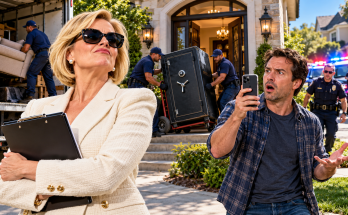
When he stepped onto his porch, he saw two excavators, a dump truck, and several workers standing beside his grandfather’s dam. Cynthia was there too, dressed in a bright red coat and smiling as if she were about to win a long-running battle.
“Merry Christmas, Daniel,” she greeted him.
Daniel stared at the machinery.
“What are you doing?”
Cynthia opened her folder and announced that the HOA had voted to remove his unauthorized dam because he had ignored notices and refused to pay his dues.
Daniel reminded her that the dam was privately owned, legally permitted, and located on his land.
Cynthia dismissed his objections.
She insisted that the neighborhood had enjoyed the lake for decades and that the association had authority over the shoreline.
Daniel knew she was wrong.
He could have argued, shouted, or physically tried to stop the workers. Instead, he took out his phone and began recording.
He asked Cynthia to state clearly what she was authorizing.
She proudly declared that the HOA was ordering the demolition and would assume responsibility.
Daniel looked at the excavator operator and warned him that the structure was private property.
Cynthia repeated that the association would take responsibility.
Daniel simply stepped aside.
“Okay. Go ahead.”
Cynthia appeared confused. She had expected a confrontation, not cooperation.
Ten minutes later, the excavator struck the concrete.
The dam began to break.
What Cynthia didn’t realize was that she had just made a decision that could cost her far more than the money she claimed Daniel owed.
Part 2 — The Secret Behind Mercer Lake
Daniel immediately called his attorney, Mark Holloway.
When Mark learned that the demolition had begun, he told Daniel to keep recording everything. He also contacted the sheriff and county environmental officials.
Then Mark asked a surprising question.
“Has she figured out the water agreement?”
Daniel said no.
“Then don’t explain it to her.”
To understand why that mattered, Daniel had to look back at the development’s history.
When Cedar Ridge was being planned in 1997, the municipal water main was almost three miles away. Connecting the neighborhood to the public system would have been extremely expensive.
The developer found a cheaper solution by negotiating an agreement with Daniel’s father.
The Mercer family owned two high-volume groundwater wells. They agreed to supply water to Cedar Ridge through a treatment facility and transfer system.
The arrangement was supposed to last five years.
Instead, it continued for twenty-seven years.
The neighborhood expanded, property values increased, and residents enjoyed reliable water for their homes, swimming pool, decorative fountains, and irrigation systems.
Most residents had no idea how dependent their community had become on the Mercer property.
The water agreement contained a crucial protection. Cedar Ridge’s access rights depended on respecting the Mercer family’s property and infrastructure. Unauthorized interference with the protected watershed could suspend those rights while the dispute was investigated.
Daniel’s father had insisted on that clause when the original agreement was signed.
It was intended to prevent the developer from abusing the arrangement.
Now Cynthia’s decision to destroy the dam had activated the very protection she had ignored.
At 9:06 a.m., the sheriff arrived. Deputy Ryan Cole examined the situation and reviewed Daniel’s deed, property survey, water agreement, and engineering permits.
He ordered the demolition stopped.
But by then, approximately forty percent of the spillway had already been destroyed. Water was rushing through the damaged section, and the lake level was dropping.
Daniel’s attorney arrived shortly afterward.
After examining the damage and checking the system’s emergency readings, Mark advised Daniel to follow the agreement’s safety requirements.
Daniel opened the control application for the water-transfer system.
He selected the Cedar Ridge connection.
A warning appeared on the screen asking whether he wanted to suspend external water transfer.
He confirmed.
At 10:16 a.m. on Christmas morning, the pumps stopped supplying the neighborhood.
Daniel did not describe the decision as revenge. The damaged structure created potential safety and contamination concerns, and the system required an engineering assessment before normal transfers could resume.
At first, Cedar Ridge residents barely noticed.
Their storage tanks still contained water.
But those reserves would not last forever.
Part 3 — The Neighborhood Begins to Run Dry
The first call came from Daniel’s neighbor, Tom Bradley, shortly before noon.
Tom explained that his water pressure had suddenly dropped.
Daniel knew exactly why.
Within an hour, neighbors began gathering at his house. Some were confused, while others were furious with Cynthia.
She had apparently told residents that Daniel was stealing water from the community and that demolishing his dam was necessary to protect their interests.
Daniel brought out the original water agreement.
As the residents read it, Cynthia’s version of events began to collapse.
Cedar Ridge had contractual access to water from the Mercer property. It did not own the lake, the dam, the wells, or the treatment infrastructure.
An elderly resident named Walter Harris looked through the documents and asked Daniel what the association actually owned.
Daniel replied that it owned some pipes.
Nobody laughed.
Then Cynthia arrived at Daniel’s front door with board members and angry residents behind her.
She accused him of cutting off their water and demanded that he restore it immediately.
Daniel’s attorney calmly explained that the transfer had been suspended under the water agreement because the association had interfered with protected infrastructure.
Cynthia protested that families and children lived in the neighborhood and that it was Christmas.
Daniel reminded her that she had chosen Christmas morning to send excavators onto his property.
He also explained that the county had been contacted and emergency arrangements were being made to supply drinking water. The goal was not to leave innocent residents without essential water, but to prevent unsafe operation of a damaged system.
Cynthia insisted that the dam had nothing to do with drinking water.
Daniel asked her whether she was certain.
She had no answer.
One of the board members, Robert Wells, began reading the agreement more carefully. He discovered the clause suspending Cedar Ridge’s access rights following unauthorized interference with the Mercer watershed.
Robert confronted Cynthia.
Had she known about the clause?
She avoided answering.
Then Robert revealed that the HOA’s lawyer had sent the board a warning the previous week. The lawyer had specifically advised them not to enter Daniel’s property before confirming ownership.
Cynthia had told the board that its legal counsel approved the action.
The residents were furious.
They had been told that Daniel owed thousands of dollars and that the HOA owned the lake. Now they were discovering that both claims were questionable and that their president had misrepresented the situation.
As the neighborhood’s reserve water supply dropped, its decorative fountains began shutting down one after another.
For years, those fountains had symbolized Cedar Ridge’s wealth and comfort.
Now their silence became a reminder of how fragile the community’s arrangements really were.
Part 4 — The Email That Destroyed Cynthia’s Defense
By sunset, emergency water tanks had been delivered to Cedar Ridge.
Residents had access to drinking water and basic sanitation, but the community had to shut down its pool, fountains, irrigation systems, and outdoor taps.
Two days later, the HOA held an emergency meeting at the clubhouse.
Nearly two hundred residents attended.
Cynthia attempted to blame Daniel, accusing him of withholding a vital resource to pressure the neighborhood.
Daniel stood and explained the facts. The association had a water-access agreement, not ownership of his property. The damaged infrastructure needed to be inspected and stabilized before transfers could safely resume.
Engineers estimated that repairs and regulatory approval could take four to six weeks.
There was another option: connect Cedar Ridge permanently to the municipal water system.
But that project would cost approximately $2.8 million and take eight to twelve weeks.
The room erupted in protest.
Residents began realizing that one person’s decision had placed their entire community in a costly emergency.
Then a younger board member named Allison Reed stood up with printed emails.
She had searched the board’s records and found the HOA attorney’s original warning.
The lawyer had reviewed Daniel’s property documents and advised the board that the dam appeared to be entirely on private Mercer land. He had also warned that the water agreement contained a clause that could suspend access rights.
He had recommended obtaining a title review before taking action.
Cynthia had ignored that advice.
Allison then displayed Cynthia’s own response.
Cynthia had dismissed the warning as overly cautious and argued that delaying enforcement would make the board appear weak.
Most damaging of all, she had written that once the dam was destroyed, Daniel would have no leverage.
The room fell silent.
Cynthia tried to claim that her words had been taken out of context.
Robert challenged her, asking what context could possibly justify ignoring the attorney’s warning and destroying someone else’s property.
Cynthia claimed she had been protecting property values.
Daniel finally stepped forward and addressed the residents directly.
His family had helped the developer when Cedar Ridge could not afford a municipal water connection. For twenty-seven years, the Mercers had maintained the wells, spillway, and watershed while providing reliable water under the agreement.
They had paid the costs of maintaining the infrastructure.
They had not demanded control over the neighborhood.
Daniel made one thing clear: he did not want families to suffer, and he had never intended to leave the community without water.
But he would not accept a system in which the HOA could trespass on his property, destroy his grandfather’s work, and then demand that he continue supplying water as though nothing had happened.
His words changed the mood of the room.
Walter stood and proposed removing Cynthia as HOA president.
The motion was seconded.
The vote was overwhelming: 168 residents supported her removal, while only eleven opposed it.
At 8:42 p.m., Cynthia Vance was no longer president of Cedar Ridge Estates.
However, removing her from office would not repair the dam or resolve the financial crisis she had created.
Part 5 — The Real Cost of Cynthia’s Decision
Three weeks later, the engineering report arrived.
The dam could be repaired, but the cost was substantial.
The report estimated:
-
Dam repairs: $486,000.
-
Shoreline restoration: $92,000.
-
Environmental remediation: $61,000.
-
Temporary water supplies for Cedar Ridge: nearly $140,000.
Legal expenses were also increasing.
The HOA’s insurance company initially refused coverage because Cynthia had authorized the demolition despite receiving written legal advice against it.
The association faced the possibility of a massive special assessment that would force hundreds of homeowners to pay additional money.
Daniel’s attorney believed they had a strong case for damages.
Daniel could have sued the association aggressively and demanded substantial compensation. Instead, he considered the residents who had tried to stop Cynthia and the families who had done nothing wrong.
He proposed a settlement.
The HOA would contribute to repairing the dam, formally acknowledge that Daniel’s property was outside its authority, and renegotiate the walking-trail easement so that ownership boundaries were clear.
The neighborhood would also begin transitioning to municipal water, ensuring that it would no longer depend indefinitely on the Mercer family’s wells.
In exchange, Daniel would restore temporary water access once engineers confirmed that the system was safe.
Robert Wells was surprised by the offer.
Daniel could have demanded far more, but he did not want innocent homeowners to suffer financially because one person had abused her position.
Robert agreed to the terms.
Cynthia, however, refused to accept responsibility immediately. She hired her own attorney and attempted to argue that the HOA had authorized her actions.
But the evidence was overwhelming.
There were the emails, the video Daniel had recorded on Christmas morning, and the excavation company’s signed authorization bearing Cynthia’s signature.
Eventually, Cynthia settled the dispute. She paid a substantial amount toward the repairs, permanently resigned from the board, and sold her house six months later.
Her attempt to prove that she controlled Daniel had cost her position, her reputation, and eventually her home.
Part 6 — The Dam Rises Again
By February, the repaired dam was curing.
By March, Mercer Lake was beginning to fill again.
By April, the walking trail had reopened under a revised agreement that clearly defined the boundaries between Daniel’s land and the neighboring development.
The residents also approved the expensive municipal-water project.
For the first time, they understood exactly what they were paying for: independence from a private water supply they had taken for granted.
Daniel did not celebrate the financial losses the community had endured. He was relieved that the dam could be repaired and that the water system could eventually operate safely again.
The following Christmas, his sister returned with her family.
Her children ran across the backyard toward the lake while Daniel prepared for the holiday.
The dam stood where his grandfather had built the original structure decades earlier. Its new spillway was wider and stronger, and the lake reflected the Christmas lights from Cedar Ridge across the water.
Then someone knocked on Daniel’s door.
Walter, Robert, Tom, and several other neighbors stood outside carrying a wooden box.
Inside was a small brass plaque they had made to commemorate what had happened.
Daniel laughed when he saw it.
The neighbors suggested putting the plaque beside the dam.
He immediately refused.
After everything that had happened, he was not about to let the HOA install something on his property again.
Everyone laughed, including Daniel.
The plaque stayed in his kitchen.
By the following spring, Cedar Ridge had completed its connection to municipal water. Daniel’s wells returned to agricultural use, Mercer Lake remained private, and the dam stayed under his ownership.
Most importantly, the HOA never sent him another invoice for dues.
Final Part — The Lesson Cynthia Learned Too Late
People sometimes asked Daniel whether he regretted suspending Cedar Ridge’s water access on Christmas morning.
His answer never changed.
He had not acted to punish the neighborhood. He had acted because Cynthia had damaged a water-control system without understanding the consequences, and the system needed to be secured and inspected.
Cynthia had believed that becoming HOA president gave her authority over other people’s property.
She believed a board vote could turn private land into community property.
She believed repeated warning letters could transform a debt that Daniel never owed into a legitimate obligation.
And she believed that destroying the dam would eliminate the one thing that prevented her from controlling him.
She had been wrong about everything.
Daniel’s family had helped the neighborhood for decades. Their water agreement had enabled Cedar Ridge to grow into the wealthy development it had become.
But generosity did not mean surrendering ownership, and a position of authority did not grant someone unlimited power.
If Cynthia had respected the property boundaries and followed her own attorney’s advice, the dam would have remained intact, the water would have kept flowing, and the neighborhood would have celebrated Christmas as usual.
Instead, she sent excavators onto private land to collect dues that Daniel did not owe.
She destroyed a structure she did not own, ignored warnings she did not like, and endangered the very water system her community depended upon.
In the end, Daniel repaired what his family had built, the neighborhood gained an independent water supply, and the residents learned to respect the boundaries Cynthia had tried to erase.
The final irony was simple: Cynthia had ordered the dam destroyed because she believed it gave Daniel too much power.
But she had never bothered to ask the one question that mattered most.
Where did Cedar Ridge’s water actually come from?