Then I called my attorney, Rebecca Shaw.
Rebecca had been my friend since high school.
She practiced real estate litigation and had exactly the kind of personality you wanted when someone was trying to steal your land.
After examining the documents, she looked up from her desk.
“Daniel, this isn’t just an HOA dispute.”
“I figured.”
“Someone may have committed real estate fraud.”
“Can we get the filing removed?”
“We can challenge it, seek an injunction, and demand the supporting records. But first, we need to determine who prepared this.”
She tapped the forged signature.
“Whatever you do, don’t confront Vivian alone.”
I promised I’d be careful.
Unfortunately, Vivian had already decided to escalate.
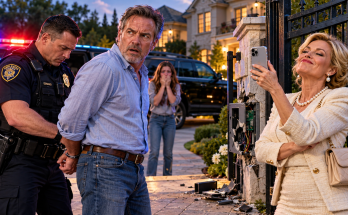
Three days later, I returned home from grocery shopping to find a construction crew installing metal fence posts along my driveway.
A yellow excavator sat near the oak trees.
And Vivian Caldwell stood beside it, directing workers like a general commanding an army.
I parked.
“Stop working,” I told the crew.
The foreman turned off the excavator.
Vivian spun around.
“Oh, wonderful. He’s finally here.”
“What are you doing on my property?”
She adjusted her sunglasses.
“Preparing the approved community access route.”
“This is private land.”
“Not according to the updated records.”
“Those records are being challenged because they’re fraudulent.”
Her expression flickered.
Only for a second.
But I noticed.
“That’s a serious accusation, Mr. Reed.”
“It’s supported by evidence.”
She stepped closer.
“Do you have any idea how much money is involved in this development?”
“No. But I’m beginning to think that’s the problem.”
Her jaw tightened.
“You’re standing in the way of progress.”
“I’m standing on my driveway.”
She pulled out her phone.
“Then perhaps the sheriff can explain things more clearly.”
I didn’t stop her.
That was my first mistake.
Twenty minutes later, a patrol SUV arrived.
Deputy Ryan Miller stepped out.
He was young, maybe twenty-seven, with a serious expression and a hand resting near his duty belt.
Vivian hurried toward him.
“Officer, thank goodness. This man has been trespassing on HOA-controlled property and threatening our contractors.”
I remained beside my truck.
“Deputy, I’m the property owner. I can show you my deed.”
Vivian immediately produced a folder.
Inside were copies of the disputed annexation document and several HOA notices.
She spoke rapidly, describing me as aggressive, uncooperative, and dangerous.
I waited until she finished.
Then I handed Deputy Miller my driver’s license and a copy of the original recorded deed.
“There’s an ongoing title dispute,” I explained. “My attorney has challenged the newer filing.”
He glanced at the documents.
Vivian interrupted.
“The association has already established possession. We’ve repeatedly instructed him not to interfere.”
“Ma’am,” I said, “you can’t establish possession by putting fence posts in somebody else’s yard.”
She pointed toward the road.
“Deputy, he was told to leave this morning.”
Miller looked at me.
“Sir, I’m going to need you to step off the disputed section until we sort this out.”
I glanced around.
“My truck is parked ten feet away from my front porch.”
“Just cooperate.”
“Deputy, this is my residence. There is no court order removing me from it.”
Vivian was recording everything on her phone now.
“See?” she shouted. “He’s refusing a lawful instruction!”
I could see Miller becoming frustrated.
He radioed dispatch, spoke briefly, and turned back toward me.
“Last warning. Leave the property.”
“No,” I answered, keeping my voice steady. “I’m not going to abandon my home based on an HOA president’s disputed paperwork.”
That was when he pulled out the handcuffs.
I didn’t resist.
I knew precisely how quickly a bad arrest could become a dangerous encounter.
As he secured my wrists, Vivian walked closer.
“I told you, Daniel. People like you always think the rules don’t apply.”
I looked over my shoulder.
“Actually, Vivian, I spend my life enforcing rules.”
She smirked.
“Then perhaps you’ll appreciate this educational experience.”
The neighbors watched as Miller placed me in the back of his patrol SUV.
Vivian waved.
Actually waved.
And that was the moment she made the biggest mistake of her life.
Because she believed the handcuffs meant she’d won.
In reality, they’d just brought official attention to her carefully hidden scheme.
At the county detention center, Deputy Miller began processing me.
I had already informed him that I was carrying law enforcement credentials and a secured firearm that needed to be handled according to department procedures.
During the property inventory, the booking sergeant examined my identification.
Then he looked at me.
Then back at the credentials.
“Deputy United States Marshal?”
“Yes, Sergeant.”
He studied the photograph.
“Daniel Reed?”
“That’s me.”
His expression changed.
“Why are you being booked for trespassing?”
“An HOA president claims she owns the property where I live.”
He stared at me for several seconds.
“You’re serious?”
“Completely.”
He picked up the telephone.
“I need to speak with the sheriff.”
Within fifteen minutes, Sheriff Thomas Brennan entered the booking area.
He was fifty-eight, broad-shouldered, and had served in county law enforcement for more than three decades.
He read the arrest report.
Then he looked at me.
“Marshal Reed, I understand there’s been some confusion.”
“There’s a forged property filing and a woman who convinced your deputy to arrest the legal owner.”
Brennan exhaled slowly.
“Your federal position doesn’t exempt you from state law.”
“I know that, Sheriff. I’m not asking for special treatment.”
“Good.”
“I’m asking you to examine the evidence before deciding a crime occurred.”
That answer seemed to surprise him.
I explained everything.
The original deed.
The disputed annexation.
The development plans.
The forged signature.
Then I gave him Rebecca’s phone number.
Within an hour, the sheriff’s office had obtained the relevant records and contacted the county prosecutor.
No one could identify a valid court order granting the HOA possession of my land.
The prosecutor declined to proceed with the trespassing charge on the evidence presented.
I was released that afternoon.
The sheriff met me outside the processing area.
“I’m sorry this happened, Mr. Reed,” he said.
“I appreciate that.”
“Deputy Miller should have investigated the conflicting property records more carefully.”
I nodded.
“Then make sure the next homeowner gets a better investigation, whether he’s wearing a badge or not.”
Brennan extended his hand.
“I intend to.”
But the forged document was a separate matter.
Before I left, he asked one more question.
“Do you believe Mrs. Caldwell knowingly submitted false information?”
“I believe there’s enough evidence for your investigators to find out.”
The sheriff’s expression darkened.
“So do I.”
By the following morning, Cedar Hollow was in chaos.
Vivian had posted a photograph of me in handcuffs on the neighborhood’s private Facebook group.
Underneath, she’d written:
Another victory for community standards.
The comments had started out congratulatory.
Then someone revealed I was a U.S. Marshal.
The mood changed.
Neighbors began questioning why the HOA president had needed police assistance to take control of a homeowner’s driveway.
Vivian deleted the post.
But Eleanor had already saved screenshots.
And Eleanor had something else.
At 7:30 that evening, she knocked on my door carrying a small black memory card.
“Daniel, I think you need to see this.”
“What is it?”
“Security footage from my garage camera.”
We plugged it into my laptop.
The recording showed the eastern edge of my driveway two nights before my arrest.
At 11:46 p.m., a dark SUV pulled up.
Two people climbed out.
One was a man wearing a baseball cap.
The other wore a bright pink jacket.
Even in grainy nighttime footage, I recognized the jacket.
Vivian had worn it at the HOA’s Fourth of July barbecue.
The two figures walked toward the survey markers identifying the property boundary.
The man used a shovel to loosen one marker.
Vivian pointed toward the oak trees.
They moved the marker several feet.
Then they left.
I watched the recording twice.
Eleanor folded her arms.
“Your father paid good money to have those boundaries surveyed. I knew something wasn’t right.”
I called Rebecca.
She instructed me to preserve the original recording and provide a copy to the sheriff’s investigators.
By noon, the county detective assigned to the case had requested the video.
But the most important discovery came forty-eight hours later.
Rebecca called me from her office.
“Daniel, sit down.”
“That bad?”
“Worse.”
She had obtained documentation connected to the Westbridge development.
The developers were advertising a new section called Cedar Hollow Reserve.
Seventy-six luxury townhomes.
Prices starting at $640,000.
Every promotional map showed a private access road crossing my property.
And according to preliminary financial records, the HOA had collected hundreds of thousands of dollars in special assessments and reservation payments connected to the promised access.
I felt my stomach drop.
“Vivian sold access she didn’t own?”
“That’s what the documents suggest.”
“How much money?”
“We’re still checking. But it could be over a million dollars.”
I leaned back in my chair.
Suddenly, the fake violations made sense.
The forged filing made sense.
The construction crew made sense.
And my arrest made sense.
Vivian needed me out of the way long enough to establish the appearance of a functioning access route.
If buyers, lenders, and developers discovered the road didn’t legally exist, the entire project could collapse.
And Vivian had apparently assured everybody the land was already controlled by the HOA.
One week later, Sheriff Brennan called.
“Mr. Reed, we’ve uncovered something you should know.”
“What happened?”
“The notary listed on the annexation document says she never witnessed your signature.”
“That doesn’t surprise me.”
“There’s more. The notary commission number was copied from an unrelated transaction.”
I remained silent.
“We also found evidence that the document was prepared using a computer at the HOA management office.”
“And Vivian?”
“She’s retained an attorney.”
That afternoon, Cedar Hollow’s board held an emergency meeting.
For the first time in years, Vivian didn’t control the room.
More than sixty residents crowded into the clubhouse.
I attended with Rebecca.
Vivian sat at the head table wearing an emerald-green blazer, diamond earrings, and an expression of practiced confidence.
“These accusations are nothing more than harassment,” she announced.
A homeowner in the front row stood up.
“Did you promise Westbridge access through Daniel Reed’s property?”
Vivian adjusted her microphone.
“All arrangements were made through appropriate legal channels.”
Another resident rose.
“Then why did my mortgage lender say the road isn’t legally secured?”
Murmurs spread through the crowd.
Vivian’s smile vanished.
“That is a confidential business matter.”
A man near the back shouted, “I paid eighteen thousand dollars toward that access project!”
Another voice called, “I paid twenty-two thousand!”
Rebecca leaned toward me.
“Don’t say anything yet.”
Then the treasurer stood.
His name was Martin Bell.
He was a quiet accountant who rarely spoke during board meetings.
His hands trembled as he unfolded a piece of paper.
“Vivian,” he said, “I’ve asked you four times for documentation explaining the transfers from our reserve account.”
The room went silent.
Vivian stared at him.
“Martin, this isn’t the appropriate venue.”
“I think it is.”
He swallowed.
“Over the past six months, $412,000 was transferred to an outside consulting company.”
Vivian’s face turned pale.
Martin continued.
“I couldn’t find any board authorization. And when I reviewed the vendor information, the company’s registered manager was your husband.”
Someone gasped.
Vivian slammed her hand onto the table.
“That is a disgusting accusation!”
Martin raised his voice.
“I have the bank statements!”
The clubhouse erupted.
Residents began shouting.
Vivian tried to call the meeting to order, but nobody listened.
Finally, she grabbed her purse and stormed toward the exit.
As she passed my chair, she stopped.
Her voice dropped to a furious whisper.
“You think you’ve won?”
I looked up.
“I think you’ve been lying to a lot of people.”
She leaned closer.
“You have no idea what happens when this development fails.”
“Then maybe you should have considered that before trying to steal my land.”
She marched outside.
It was the last time I saw Vivian Caldwell presiding over Cedar Hollow Estates.
Two days later, the remaining board members voted to suspend her authority pending a formal removal process.
They placed the HOA’s development-related financial activity under independent review.
And investigators obtained records that changed everything.
Vivian hadn’t merely been trying to gain unauthorized access through my property.
She and her husband had established a consulting business that received payments connected to the development.
Investigators alleged they’d used misleading property documents to secure money from buyers and the association.
Because some transactions crossed state lines and involved electronic financial communications, federal investigators began examining potential wire fraud.
I wasn’t assigned to that investigation.
In fact, I deliberately stayed away from it professionally.
I was a complainant and a potential witness, not the investigator handling my own case.
That distinction mattered.
My badge wasn’t a weapon to use against someone who annoyed me.
The evidence needed to stand on its own.
And it did.
Three weeks after my arrest, investigators executed court-authorized search warrants at the HOA management office and Vivian’s residence.
They seized computers, financial records, contracts, and communications.
One recovered email became particularly important.
It was from Vivian to her husband, sent four days before my arrest.
The message discussed using the county trespassing complaint to keep me away from the proposed road while contractors started work.
Another communication showed she had been informed by an attorney that the HOA’s claim to my property was legally defective.
She had continued anyway.
When Rebecca read those records, she shook her head.
“She knew.”
“Yes,” I said.
“She knew your land wasn’t hers.”
I looked through my kitchen window toward the old oak trees.
“And she was willing to have me arrested to pretend otherwise.”
The following Monday, Vivian was arrested.
Not by me.
Not by the U.S. Marshals Service.
County investigators took her into custody on state charges connected to the allegedly forged records and fraudulent representations.
Her husband was arrested separately as investigators pursued the financial evidence.
The federal investigation continued.
Vivian’s booking photograph circulated through Cedar Hollow faster than her photograph of me in handcuffs ever had.
But I didn’t celebrate.
I remembered standing beside my truck while a deputy secured my wrists.
I remembered neighbors watching.
I remembered Vivian smiling.
Most of all, I remembered how easily a person with the right title, a confident voice, and a folder of official-looking papers had persuaded someone to stop listening to the actual homeowner.
A badge hadn’t prevented my arrest.
My career hadn’t prevented the humiliation.
The truth had emerged because people examined the documents, preserved evidence, and refused to accept Vivian’s story without proof.
The legal proceedings took more than a year.
During that time, a court determined that the disputed annexation instrument did not convey any ownership interest in my property.
The county records were corrected through the appropriate legal process.
My attorney also pursued a civil claim arising from the attempted interference with my land.
The developer was forced to redesign its project around property it actually controlled.
Several proposed townhomes were eliminated.
Buyers who had paid money based on the promised access sought refunds and restitution.
The HOA elected an entirely new board.
Martin Bell became the interim president.
His first official action was to send me a letter.
Not a violation notice.
An apology.
He acknowledged the association’s misconduct and confirmed that Cedar Hollow would make no further claims against my property.
For the first time in months, I felt I could breathe.
Eventually, Vivian pleaded guilty in a negotiated resolution involving the fraudulent property documentation and financial transactions.
Her husband also entered a guilty plea relating to his role in the scheme.
Vivian received a prison sentence and was ordered to pay restitution, subject to the court’s findings and recovery process.
The court didn’t treat her wealth, her HOA title, or her influence as an excuse.
At sentencing, the judge made one observation I never forgot.
“This case demonstrates what happens when private authority is mistaken for ownership of the law itself.”
Vivian sat silently.
No designer sunglasses.
No audience to impress.
No microphone she could seize to silence questions.
Just a defendant facing the consequences of her decisions.
Months later, I was sitting on my porch when a familiar patrol SUV pulled into the driveway.
Deputy Ryan Miller stepped out.
He wasn’t wearing his duty belt.
He carried a small paper bag.
“Mr. Reed?”
“Deputy.”
He looked nervous.
“I wanted to apologize in person.”
I said nothing.
He continued.
“I reviewed everything that happened that day. I should’ve taken more time with the documents. I shouldn’t have treated the loudest person at the scene as the most credible.”
I studied him.
“You’re right.”
He nodded.
“I know.”
After a moment, he held up the bag.
“My wife made banana bread. She said I shouldn’t show up empty-handed.”
I laughed despite myself.
“That’s probably the smartest advice you’ve gotten all year.”
He smiled weakly.
I invited him onto the porch.
We talked for nearly an hour.
He explained that he’d completed additional training and had become much more careful when dealing with disputed property claims.
Before leaving, he asked me a question.
“Why didn’t you tell me you were a U.S. Marshal right away?”
“I told you I was a law enforcement officer. But my employment wasn’t what established my right to be there.”
He considered that.
“The deed did.”
“Exactly.”
I pointed toward the oak trees.
“A retired schoolteacher, a mechanic, or a grocery clerk standing on that same driveway deserved the same careful investigation I did.”
Miller nodded.
“I understand.”
“I hope so.”
He shook my hand and left.
And strangely enough, that conversation gave me more satisfaction than watching Vivian receive her sentence.
Because there was a chance something good might come out of what happened.
A chance that the next homeowner wouldn’t have to experience the same thing.
The following spring, I hired a local contractor to repair the damage near the oak trees.
We removed the unauthorized fence posts.
Restored the disturbed ground.
And placed new survey markers along the original boundary.
I also installed two sturdy wooden signs.
One identified the property as privately owned.
The other was simpler.
It displayed the Reed family name.
Nothing more.
One Saturday afternoon, Eleanor came over with another apple pie.
She stood beside me near the driveway, admiring the repaired landscape.
“Your father would have loved this,” she said.
I smiled.
“He probably would have charged Vivian rent for every minute she stood on his land.”
Eleanor burst out laughing.
Then she grew quiet.
“You know, Daniel, everybody thought that woman was untouchable.”
“Nobody’s untouchable.”
“She had money. Connections. Half the neighborhood was afraid of her.”
I looked across the street.
Children were riding bicycles past the clubhouse.
A couple walked their dog along the sidewalk.
The subdivision looked peaceful again.
“She made one mistake,” I said.
Eleanor raised an eyebrow.
“Only one?”
“The one that brought everything else into the open.”
“What was that?”
I thought about the morning of my arrest.
Vivian standing beside her Mercedes.
The deputy approaching with handcuffs.
The neighbors watching from their porches.
Her triumphant smile.
“She thought getting me arrested meant the law was on her side.”
Eleanor nodded slowly.
“And she didn’t know you were a U.S. Marshal.”
“No,” I said. “But that’s not why she lost.”
“Then why?”
I looked at the old farmhouse behind us.
At the porch my father built.
At the oak trees he’d planted when I was a child.
At the land he’d worked his entire life to own.
“Because she confused having power with having the right.”
Eleanor smiled.
“Your father would’ve liked that answer.”
That evening, I sat on the porch as the sun settled behind the trees.
My phone buzzed with a message from Rebecca.
The final portion of my civil settlement had been approved.
The dispute was over.
My property was legally secure.
The unauthorized construction had been removed.
The fraudulent records had been addressed.
And the woman who’d tried to steal my land was no longer in a position to threaten my neighbors.
I placed the phone on the table.
For the first time in a long time, I listened to nothing but the wind moving through the oaks.
Vivian Caldwell had wanted to teach me a lesson about authority.
She’d called the police, watched me get handcuffed, and smiled while I was driven away from my own home.
She thought I was just another homeowner she could intimidate.
She had no idea I was a U.S. Marshal.
But in the end, my title wasn’t what saved my property.
The truth did.
And the most satisfying part wasn’t seeing Vivian arrested.
It was watching the neighborhood finally understand something my father had taught me decades earlier:
A person can have a title, money, influence, and an entire board behind them—but none of those things gives them the right to take what belongs to someone else.