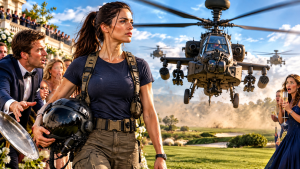
PART 1 — THEY HANDED ME A SERVING TRAY AND TOLD ME I DIDN’T BELONG
The silver banquet tray hit my ribs when Chase Bennett shoved it into my hands.
“If you can’t afford the reunion ticket,” he said with a grin, “you can earn your dinner clearing plates.”
For a moment, I simply stared at him.
Around us, laughter erupted beneath the elegant stone archway of the country club. Champagne glasses glittered beneath the outdoor lights. Women in expensive dresses raised their phones, eager to capture what they believed would become the funniest moment of the evening.
Ten years after graduation, my former classmates had apparently decided that humiliating me was the perfect entertainment.
I looked down at the tray.
Then I looked back at Chase.
He had been the most popular boy in our graduating class, the captain of the football team, and the person who had once told me that girls like me belonged behind a desk, not in a cockpit.
Apparently, he hadn’t changed.
Madison Cole, our reunion committee chair, stood behind the registration table, pretending to search for my name on her tablet.
“That’s strange,” she announced loudly. “I don’t see Riley Mercer anywhere.”
“My invitation was confirmed three weeks ago.”
Madison tilted her head and examined my clothes.
I was wearing a fitted navy T-shirt, olive cargo pants, and leather boots. My outfit wasn’t glamorous, but it was practical. I’d received instructions to remain available for an operational briefing that evening, and I had planned to attend the reunion briefly before returning to my duties.
“There’s a dress code,” Madison said. “Cocktail attire.”
“I was told the invitation included appropriate accommodations for guests on standby.”
She examined the printed confirmation I offered her.
Then she let it fall onto the pavement.
“Oh, dear. You must have misunderstood.”
The laughter grew louder.
I bent to retrieve the paper.
Madison leaned toward Chase and whispered something I couldn’t hear. He immediately burst into laughter.
“Come on, Riley,” he said. “We all remember you. You were the scholarship girl who disappeared after graduation. Nobody expects you to become somebody important.”
I placed the invitation in my pocket.
“You’d be surprised what can happen in ten years.”
His expression hardened.
Before he could respond, Jessica Price approached with a champagne glass in her hand.
Jessica had once been the girl who organized every school dance, controlled every social circle, and made sure everyone knew who was invited and who wasn’t.
She looked me up and down.
“Honestly, Riley, I thought you might have at least tried to look successful tonight.”
Then she tipped her champagne.
The liquid splashed across my boot. The glass struck the pavement and shattered, leaving a shallow cut above my ankle.
“Oops,” she said. “Maybe the staff can bring a mop.”
Someone laughed so hard that they nearly dropped their phone.
I pressed a napkin against my ankle.
I could have told them who I was.
I could have explained that I was Chief Warrant Officer Three Riley Mercer of the United States Army, an AH-64E Apache instructor pilot stationed at Fort Campbell.
I could have told them about the more than two thousand flight hours, the tactical training missions, and the nights I’d spent preparing young pilots for situations that left no room for mistakes.
But I didn’t.
Not because I was ashamed.
Because I had learned something important during my years in the military.
You don’t need to announce your strength to people who have already decided to underestimate you.
I turned away from the entrance.
I had come for one person that evening: Mrs. Elena Alvarez, my former guidance counselor, who had encouraged me to apply for an aviation scholarship when everyone else thought my ambitions were ridiculous.
Years ago, when my family couldn’t afford the application fee, she had quietly paid it herself.
She never asked for recognition.
She only told me, “One day, Riley, you’ll fly farther than anyone who ever tried to hold you down.”
I had promised myself that if I ever saw her again, I would thank her properly.
I was determined to keep that promise.
Even if I had to leave without seeing her.
My encrypted phone vibrated.
I answered immediately.
“Mercer.”
Major Daniel Cross, from battalion operations, spoke in a clipped, urgent voice.
“Riley, we’ve got an emergency. A civilian rescue helicopter supporting an approved search mission has made a forced landing near Land Between the Lakes. Two paramedics, a pilot, and an injured twelve-year-old are aboard. Weather is deteriorating.”
I straightened.
“What’s the status of the crew?”
“Alive, but the child needs medical evacuation. Our training pair has suitable sensor equipment already airborne nearby. We need you recalled as flight lead.”
I glanced toward the darkening horizon.
“Understood.”
“County emergency management has identified the country-club fairway as a contingency landing zone. The club manager is being notified. We need the area secured immediately.”
“Copy. I’ll coordinate with the manager and clear the landing zone.”
I ended the call and started walking toward the golf course.
Madison hurried after me.
“Excuse me! Where do you think you’re going?”
“To clear the fairway.”
She laughed.
“Are you seriously trying to create another attention stunt?”
I ignored her and approached the club manager, who was already receiving an emergency call.
He listened for several seconds, then his face changed.
“Yes, sir. Understood. We’ll clear the area immediately.”
He turned toward his staff.
“Everyone off the fairway! Move the guests behind the stone terrace! This is an emergency landing zone!”
The laughter faded.
Madison stared at him.
“What are you doing? The reunion program is about to begin!”
The manager didn’t answer her.
I checked my phone again.
The rescue team needed every available minute.
I started toward the open grass.
Madison grabbed my arm and tried to pull me back.
“You are not hijacking my reunion with another one of your fantasies.”
I removed her hand.
“Move everyone behind the terrace. Now.”
Chase stepped in front of me.
“What are you going to do? Call an Uber with missiles?”
I looked at him.
“Move.”
He smiled and spread his arms.
“Make me.”
Then we heard it.
At first, it was a distant rhythmic thumping.
Then the sound rolled over the trees, growing louder until the windows of the clubhouse began to tremble.
Wine rippled inside glasses.
Balloons jerked against their strings.
Every conversation stopped.
The outdoor speakers crackled.
“All personnel clear the designated landing zone. Priority Army aviation recovery in progress.”
Two dark shapes rose above the tree line.
The lead aircraft was an AH-64E Apache.
Its rotor blades churned through the evening air as it approached the golf course.
I folded the bloodstained napkin over my ankle and stepped onto the fairway.
The aircraft descended toward the designated landing area.
Its sensor turret moved beneath the nose. The cockpit canopy reflected the last orange light of the setting sun.
Hundreds of people stood behind the stone terrace, watching.
Chase’s smile disappeared.
Madison lowered her phone.
The Apache adjusted its approach.
And then, as the entire reunion watched, the aircraft turned directly toward me.
For the first time that evening, nobody laughed.
I raised my hand to acknowledge the crew.
The aircraft settled into a controlled hover before touching down in the cleared area.
I walked toward the designated approach point, following the emergency coordination procedures.
The side of the cockpit caught the light.
The crew chief climbed down after the aircraft was secure and looked straight at me.
“Chief Mercer! Major Cross wants you on the radio immediately.”
Behind me, I heard someone whisper, “Chief Mercer?”
I turned toward the terrace.
Chase Bennett stood frozen, his face pale.
He had spent the evening trying to convince everyone that I was a failure.
Now, for the first time in ten years, he was beginning to realize he had never known me at all.
But the greatest shock of the night hadn’t happened yet.
Because as I reached the aircraft, a familiar voice called my name from behind the crowd.
“Riley?”
I turned.
Mrs. Alvarez stood near the terrace, one hand covering her mouth.
She was staring at me with tears in her eyes.
And beside her stood a man in an Army uniform who had just arrived from the parking lot.
He looked at the Apache.
Then at me.
“Chief Warrant Officer Three Mercer,” he said formally. “We need you. The child is running out of time.”
I nodded.
“I’m ready.”
As I turned back toward the aircraft, Mrs. Alvarez whispered something I barely heard.
“I always knew you’d make it.”
I climbed aboard, unaware that the most difficult part of the evening was still waiting for me.
And that, before the night ended, the people who had humiliated me would discover that the girl they remembered had become the woman they never imagined.
PART 2 — THE MOMENT THE APACHE LANDED, EVERYTHING CHANGED
The aircraft’s arrival transformed the country club in less than a minute.
The same people who had laughed at me were now standing silently behind the stone terrace.
Some had lowered their phones.
Others continued recording, but their expressions had changed from amusement to confusion.
I heard Chase mutter, “That can’t be right.”
Madison turned toward him.
“What did you say?”
“She’s not a pilot.”
He sounded as though he were trying to convince himself.
“She was nobody in high school.”
Jessica folded her arms.
“Maybe she’s just pretending. People do strange things for attention.”
The club manager overheard them.
“Ma’am,” he said to Jessica, “the aircraft and its crew were dispatched through official military channels. This is not a performance.”
He pointed toward the emergency personnel moving across the fairway.
“Now, please step behind the barrier.”
Jessica’s mouth fell open.
Meanwhile, I was inside the aircraft’s operational area, receiving the latest information.
The civilian helicopter had suffered a serious mechanical failure while assisting with a search for a missing hiker. The pilot had managed to bring it down in a wooded clearing, but the impact had injured one of the paramedics and trapped the young patient.
The child, twelve-year-old Ethan Brooks, had been traveling with his mother when she was injured in an accident earlier that afternoon. He had sustained injuries himself and was experiencing complications that required urgent medical attention.
The rescue team had reached them, but worsening weather was closing the window for a safe evacuation.
Our task was to support the coordinated response, relay updated observations, and help emergency personnel determine the safest way to reach the stranded crew.
The mission wasn’t a spectacle.
It was a race against time.
“Mercer,” Major Cross said over the radio, “we’ve got deteriorating visibility. County responders are establishing a ground route. Coordinate with the other aircraft and follow the approved mission plan.”
“Copy.”
I glanced toward the distant clouds.
The sky had turned an ominous shade of purple.
Every second mattered.
As we prepared to depart, I thought about the people behind the terrace.
I didn’t hate them.
That surprised me.
Ten years earlier, their laughter would have followed me into my dreams. I would have replayed every insult, every cruel joke, every reminder that I was poor and different.
I had once believed that if I worked hard enough, I could become so successful that nobody would ever be able to hurt me again.
The Army had taught me otherwise.
You could earn qualifications, medals, respect, and responsibilities. You could become excellent at your job.
But you couldn’t build a life around proving something to people who had never bothered to understand you.
The radio crackled.
“Chief Mercer, status?”
“Ready to proceed.”
The mission continued.
The aircraft departed the country-club area as the emergency coordination team managed the response.
From the air, the golf course became a small patch of green surrounded by trees, roads, and distant lights.
The reunion guests disappeared into the landscape.
But I knew they would still be talking about what had happened.
I also knew that I had more important things to do.
When we reached the designated operating area, the weather had deteriorated further. Ground responders were working to establish safe access to the downed helicopter, and the rescue coordinator needed accurate information about the terrain and the condition of the surrounding area.
We assisted within the approved mission plan.
The stranded crew was alive.
The injured paramedic was conscious.
Ethan was frightened, exhausted, and asking for his mother.
The words reached me over the radio.
“Please tell my mom I’m trying to be brave.”
For a moment, I closed my eyes.
I remembered being seventeen, sitting alone in the school library after another day of being mocked for my worn-out shoes and secondhand clothes.
I remembered Mrs. Alvarez placing a cup of hot chocolate on the table beside me.
“You don’t have to be fearless, Riley,” she had said. “You just have to keep moving when you’re afraid.”
I opened my eyes.
“Tell Ethan that being brave doesn’t mean he isn’t scared,” I said. “It means he keeps going anyway.”
The rescue operation continued through the evening.
Emergency responders eventually reached the stranded crew, and the injured passengers were transferred to medical personnel. The operation required careful coordination, but the immediate crisis was brought under control.
When Major Cross finally confirmed that the rescue team had completed its urgent work, I felt the tension leave my shoulders.
The child was receiving medical care.
The paramedics were safe.
The pilot was alive.
That was what mattered.
Hours later, I returned to the country club to complete the required coordination and documentation.
The reunion had moved indoors.
The ballroom was quiet when I entered.
People turned in their chairs.
Nobody laughed.
Chase was standing beside the bar, holding a glass he had barely touched.
Madison sat at the head table, staring at her phone.
Jessica looked down at her champagne.
I walked toward Mrs. Alvarez.
She rose from her chair and embraced me.
“Oh, sweetheart,” she whispered. “Look at you.”
I smiled.
“I’m still the same person.”
“No,” she said gently. “You’re the same person who always wanted to fly. But now you know what you can do.”
She stepped back and examined my face.
“Are you hurt?”
“Just a small cut.”
Her expression tightened.
“Who did that?”
I glanced toward Jessica.
Mrs. Alvarez followed my gaze.
For several seconds, she said nothing.
Then she took my hand.
“I wish I had known they were treating you this way.”
“You couldn’t have known.”
“I should have noticed sooner.”
I shook my head.
“You gave me something more important than protection. You gave me a chance.”
Her eyes filled with tears.
Before either of us could say more, a microphone squealed from the stage.
Madison had stood up.
“Everyone,” she announced, “we need to address something that happened tonight.”
The room went silent.
I watched her carefully.
She was smiling, but it was the strained smile of someone trying to regain control of a situation that had already slipped away.
“Apparently, Riley has been involved in an Army aviation operation. We congratulate her on her service.”
A few people applauded.
Madison continued.
“But I think we should all remember that tonight was supposed to be about reconnecting, not creating drama.”
She looked directly at me.
I understood the implication.
She wanted to turn my presence into the problem.
I could have challenged her in front of everyone.
Instead, I remained silent.
Then Mrs. Alvarez stood.
“Madison, may I ask you a question?”
Madison blinked.
“Of course.”
“Why was Riley given a serving tray at the entrance?”
The room froze.
Madison’s smile vanished.
“I think there was a misunderstanding.”
“Was there?”
Mrs. Alvarez turned toward Chase.
“And why was her invitation thrown onto the ground?”
Chase looked at his shoes.
Jessica shifted in her chair.
Mrs. Alvarez’s voice remained calm.
“Riley came here tonight because she wanted to honor someone who believed in her when she was young. She came despite knowing that many of you had never treated her kindly.”
She looked around the room.
“She did not come to prove that she was better than you. She came because she remembered the people who helped her.”
Nobody moved.
“And while some of you were laughing at her clothes, she was being called to help people whose lives were in danger.”
Madison reached for the microphone.
“Mrs. Alvarez, this isn’t the appropriate time—”
“It became the appropriate time when you decided that humiliation was entertainment.”
The words landed harder than any shout.
For the first time that evening, Madison had no answer.
But Chase wasn’t finished.
He stepped forward, his face flushed.
“Fine. She flies a helicopter. Congratulations. That doesn’t make her better than everyone else.”
I looked at him.
“You’re right.”
He seemed surprised.
I continued.
“Flying an Apache doesn’t make me better than you. Being poor doesn’t make someone worse than you. Wearing expensive clothes doesn’t make someone important.”
I paused.
“What you do when you think someone has nothing to offer you—that’s what reveals who you are.”
Nobody spoke.
Then I turned away from the stage.
I had no desire to humiliate anyone in return.
But as I walked toward the exit, a voice stopped me.
“Riley, wait.”
It was Chase.
And for the first time in ten years, he wasn’t smiling.
PART 3 — THE BOY WHO THOUGHT I WOULD NEVER BECOME ANYTHING
Chase followed me into the hallway.
The music from the ballroom became muffled behind the heavy doors.
For a moment, neither of us spoke.
He looked older than I remembered. His expensive suit was slightly wrinkled, and the confidence that had once seemed permanent was beginning to crack.
“I didn’t know,” he said finally.
I leaned against the wall.
“Didn’t know what?”
“That you were in the Army. That you flew those aircraft. That you were some kind of officer.”
“Would it have mattered if I weren’t?”
He opened his mouth, then closed it.
I waited.
He looked toward the ballroom.
“I thought you were coming back because you wanted everyone to see you.”
“I came back because Mrs. Alvarez was being honored.”
“I didn’t know that.”
“You didn’t ask.”
He rubbed his forehead.
“I guess I owe you an apology.”
“You do.”
He stared at me, apparently surprised that I hadn’t made the answer easier for him.
“I was trying to be funny,” he said.
“You handed me a tray and told me to earn my dinner.”
“I didn’t mean it like that.”
“Then how did you mean it?”
He had no answer.
I remembered the last day of high school, when Chase had stood in the corridor while several classmates laughed at my scholarship acceptance letter.
I had been carrying a folder filled with aviation applications.
He had taken one look at it and said, “You? A pilot? Be serious, Riley.”
Everyone had laughed.
I had pretended it didn’t hurt.
That afternoon, I had gone to the library and cried in a locked bathroom stall.
Not because Chase was right.
Because I was afraid that one day I might discover he was.
Now, ten years later, he stood before me, waiting for me to absolve him.
“I spent years believing I had to become successful before I could stop being ashamed of who I was,” I said.
He lowered his eyes.
“I worked hard because I wanted to fly. I studied because I wanted to learn. I joined the Army because it gave me a way to serve and a chance to earn my place through effort.”
I took a breath.
“But I also spent too much time imagining the faces of people who had laughed at me. I wanted them to see me succeed.”
“Is that so wrong?”
“No. But it can become a trap.”
I looked at him.
“If the only reason you succeed is to make someone regret underestimating you, then they still control part of your life.”
He looked genuinely uncomfortable.
I continued.
“I don’t need you to think I’m impressive, Chase. I needed you to treat me like a human being.”
He swallowed.
“I’m sorry.”
This time, his voice was quieter.
I believed that he regretted what had happened.
I didn’t know whether he understood it.
Those were different things.
“I accept your apology,” I said. “But that doesn’t mean what you did was harmless.”
He nodded.
“I understand.”
I wasn’t sure he did.
But I left him in the hallway and returned to the ballroom.
Mrs. Alvarez was waiting beside the stage.
“Are you ready to leave?” she asked.
“Almost.”
I glanced at the tables.
Some of my former classmates were watching me. A few looked embarrassed. One young woman, whom I remembered from chemistry class, approached hesitantly.
“Riley?”
I turned.
“Hi, Amanda.”
She looked as though she had rehearsed what she wanted to say.
“I owe you an apology, too.”
I said nothing.
“In high school, I laughed at things Chase said because I wanted to be accepted. I knew some of it was cruel, but I didn’t want to become the next target.”
She looked down.
“Tonight, when they gave you that tray, I laughed again. I don’t have an excuse.”
For the first time that evening, I felt something loosen inside me.
Not forgiveness exactly.
Recognition.
She had finally admitted what had happened without trying to make it sound harmless.
“Thank you for saying that,” I replied.
She nodded, her eyes shining.
“I hope the child you helped tonight will be okay.”
“So do I.”
When Amanda walked away, Mrs. Alvarez touched my arm.
“Not everyone will understand what they did,” she said. “Some people will apologize because they’re ashamed. Some will apologize because they fear being judged.”
“And some won’t apologize at all.”
“Exactly.”
I smiled faintly.
“Then I suppose I don’t need to wait for every apology.”
Mrs. Alvarez squeezed my hand.
“No, sweetheart. You don’t.”
We left the ballroom together.
Outside, the air had cooled, and the first stars were appearing above the parking lot.
For a few minutes, we stood beside her car and talked about the years that had passed.
She asked about my work, my training, and the places I had visited.
I told her about the long hours, the demanding instructors, and the pilots I had helped train.
I didn’t tell her every difficult thing.
Some memories were still too heavy to carry into an ordinary conversation.
But I told her one thing I had never said aloud.
“There were times when I wanted to quit.”
She looked at me.
“Why didn’t you?”
I thought about the answer.
“Because every time I imagined giving up, I remembered that girl in the library who had no idea whether she could make it. I couldn’t abandon her.”
Mrs. Alvarez began to cry.
“Oh, Riley.”
I laughed softly.
“I’m sorry.”
“Don’t you dare apologize for making me proud.”
She pulled me into another embrace.
Then she stepped back and opened her purse.
“I brought something for you.”
She handed me a small envelope.
Inside was a faded copy of the scholarship application she had helped me submit ten years earlier.
My handwriting covered the first page.
At the bottom, beneath the question about future ambitions, I had written:
I want to become a pilot because I want to prove that where I come from does not determine how far I can go.
I stared at the sentence.
It looked so young.
So hopeful.
So certain that success would answer every question.
Mrs. Alvarez pointed to the words.
“You were always capable of flying,” she said. “Even before the Army gave you the opportunity.”
I folded the paper carefully.
“Thank you.”
She smiled.
“Now go do what you do best.”
I returned to Fort Campbell the following morning.
The reunion videos had already begun circulating online.
One showed Chase handing me the serving tray.
Another captured Jessica breaking her glass.
The third showed the Apache approaching the fairway.
The clips spread quickly, accompanied by dramatic captions and thousands of comments.
Some people praised me.
Others criticized my former classmates.
A few accused me of staging the incident, despite the emergency response and the official explanation that followed.
I didn’t respond to any of it.
I had work to do.
Two days later, Major Cross called me into his office.
“Mercer, sit down.”
I took the chair opposite his desk.
He slid a folder toward me.
“The rescue operation was reviewed this morning. The response team has submitted its report. Your coordination and judgment were noted.”
“Thank you, sir.”
He studied me for a moment.
“I also received a call from someone asking about you.”
My shoulders tightened.
“Who?”
“Your former guidance counselor. Elena Alvarez.”
I blinked.
“Mrs. Alvarez called you?”
“She wanted to thank the unit for helping the rescue team.”
He smiled.
“She also told me that you once promised her you’d become a pilot.”
I looked away, embarrassed.
“That’s true, sir.”
“Good. Keep your promises.”
He closed the folder.
Then his expression became more serious.
“The rescue operation was successful, but we need to talk about the future.”
I straightened in my chair.
“What about it?”
He reached for another document.
“There’s an instructor development opportunity opening up. It’s competitive, and it comes with greater responsibility. Your experience makes you a strong candidate.”
I looked at the paperwork.
For a moment, I couldn’t speak.
I had spent years proving to myself that I belonged in aviation.
Now I was being asked to take the next step.
“Do you want it?” he asked.
I thought about the girl I had been at eighteen.
The girl who had written that sentence on a scholarship application.
The girl who had believed that one day she would fly farther than anyone expected.
“Yes, sir,” I said. “I do.”
He nodded.
“Then prepare yourself.”
I left his office carrying the application folder.
For the first time since the reunion, I smiled without thinking about Chase, Madison, or Jessica.
My future had nothing to do with them.
And that was the most liberating realization of all.
PART 4 — THE VIDEO THAT CHANGED MY OLD SCHOOL FOREVER
Three weeks after the reunion, I received a message from an unfamiliar number.
It was from Madison.
Riley, I know you probably don’t want to hear from me. I owe you an apology. Could we talk?
I stared at the screen for a long time.
Then I put my phone down.
I wasn’t ready to have that conversation.
A few days later, I received another message.
This time, it was from the principal of my former high school.
He explained that the reunion video had reached several former teachers and students. Some had contacted the school to discuss the way scholarship students had been treated during our years there.
The school was planning an alumni event to raise money for a scholarship fund.
They wanted me to attend as a guest speaker.
I nearly declined.
I had no desire to become the face of a viral story.
But then I learned that Mrs. Alvarez had been asked to help organize the event.
She called me that evening.
“I know what you’re thinking,” she said.
“Then you know I don’t want to give a speech about being humiliated.”
“Good. Don’t.”
I laughed.
“What should I talk about?”
“Talk about the truth.”
“What truth?”
“That success doesn’t make cruelty acceptable. And that a child should never have to become extraordinary before people treat her with dignity.”
I sat quietly.
She continued.
“You can tell them about flying if you want. But tell them about the girl who was afraid, too. There are children sitting in classrooms right now who believe the cruelest thing anyone has said about them.”
I thought about my younger self.
The scholarship applications.
The secondhand clothes.
The long hours in the library.
The fear of being discovered as someone who didn’t belong.
“I’ll do it,” I said.
The event was held in the high-school auditorium.
The same stage where I had once watched other students receive awards while pretending not to care.
The same room where Chase had delivered a speech about his football scholarship.
The same rows of seats where people had laughed when I announced that I wanted to become a pilot.
When I entered, the principal greeted me warmly.
Mrs. Alvarez was standing beside the podium.
She wore a blue dress and a silver necklace I remembered from my childhood.
“You came,” she said.
“I promised.”
She smiled.
“Then let’s make it count.”
The auditorium filled slowly.
Students sat beside teachers. Parents occupied the back rows. Alumni gathered in small groups, whispering about the reunion and the viral video.
I noticed Chase near the rear entrance.
He had come alone.
He looked uncomfortable, but he stayed.
Madison sat several rows away from him.
Jessica wasn’t there.
When the principal introduced me, the applause was polite and brief.
I walked to the podium.
For a moment, the auditorium seemed enormous.
I could almost see my younger self sitting near the back, wearing a faded sweater and holding a notebook against her chest.
I took a breath.
“When I was a student here, I wanted to become a pilot,” I began.
A few people smiled.
“Some people thought that was unrealistic. I came from a family that couldn’t afford many of the things other students took for granted. I didn’t have the right clothes, the right connections, or the confidence to walk into a room and assume I belonged.”
I paused.
“I learned to work hard. I learned to study. I learned to keep going when I was afraid.”
I looked across the room.
“But I also learned something that took me much longer to understand. Being underestimated can hurt you. Yet sometimes, the worst damage comes when you begin to believe the people who underestimate you.”
The auditorium grew quiet.
“For years, I carried other people’s opinions like a weight. I wanted to prove that I was capable, intelligent, and worthy of respect. I believed that if I achieved enough, the people who had laughed at me would finally see my value.”
I glanced at Mrs. Alvarez.
“She helped me understand that my value wasn’t something I had to earn.”
Mrs. Alvarez wiped her eyes.
I continued.
“Ten years later, I returned to this community for a reunion. Some people treated me as though I had no right to be there. They judged my clothes, assumed I couldn’t afford a ticket, and tried to turn me into a joke.”
Nobody moved.
“I won’t pretend it didn’t hurt. It did.”
I let the silence settle.
“But I want you to understand something. My work in the Army didn’t make me worthy of respect. The aircraft didn’t make me worthy. The uniform didn’t make me worthy.”
I placed both hands on the podium.
“I was worthy of basic respect before any of those things happened.”
A student in the front row raised her head.
I looked directly at her.
“So are you.”
The words seemed to echo through the auditorium.
“You don’t need to become a doctor, a pilot, a lawyer, a soldier, or a millionaire before people should treat you with dignity. You don’t have to become famous. You don’t have to prove that you’re exceptional.”
I paused.
“You are allowed to be a work in progress and still deserve kindness.”
For several seconds, nobody applauded.
Then Mrs. Alvarez stood.
She clapped slowly.
A teacher beside her joined in.
Then another.
Within moments, the entire auditorium was standing.
I looked toward the back.
Chase was applauding, his face pale and his eyes lowered.
When the applause finally faded, the principal returned to the podium and announced the launch of a new scholarship program for students interested in aviation, engineering, and technical careers.
The fund would help cover application fees, training materials, and other expenses that often prevented talented students from pursuing their ambitions.
Mrs. Alvarez had insisted that the scholarship be open to students regardless of family income, grades alone, or social connections.
The selection committee would look for determination, curiosity, and a willingness to learn.
As I left the stage, a girl with a short ponytail hurried toward me.
She looked about sixteen.
“Excuse me,” she said. “Could I ask you something?”
“Of course.”
She glanced at the floor.
“Everyone says I should choose something easier. My parents think aviation is too expensive. My friends say I’ll never make it.”
I recognized the fear in her voice immediately.
“What do you want to do?” I asked.
“Fly.”
“Then start learning everything you can about it.”
“But what if I fail?”
I smiled.
“You might. Everyone fails at something. The question isn’t whether you’ll make mistakes. It’s whether you’ll let fear make every decision for you.”
She thought about that.
Then she asked, “Were you ever afraid?”
“Every day.”
Her eyes widened.
“Really?”
“Of course. Courage isn’t the absence of fear. It’s deciding that something matters enough to try.”
She smiled for the first time.
“Thank you.”
I watched her return to her friends.
For a moment, I imagined what my own life might have looked like if someone had said those words to me when I was sixteen.
Then I realized that I had been given the chance to become that person for someone else.
And perhaps that was a greater achievement than anything I could put on a résumé.
But outside the auditorium, Chase Bennett was waiting.
He had something to tell me.
Something that would finally explain why he had seemed so determined to humiliate me at the reunion.
PART 5 — THE SECRET BEHIND CHASE BENNETT’S CRUELTY
Chase stood near the school entrance, holding a folded piece of paper.
“Riley,” he said, “could we talk?”
I considered walking away.
Then I remembered the conversation we’d had in the country-club hallway.
He had apologized, but there had been something unfinished in his expression.
“What’s going on?” I asked.
He looked toward the auditorium.
“I watched your speech.”
“Thank you for coming.”
“I almost didn’t.”
He gave a humorless laugh.
“I thought everyone would look at me.”
“Some people probably did.”
He nodded.
“I deserved that.”
For several seconds, he stared at the paper in his hands.
Then he told me the truth.
After graduation, Chase had followed the path everyone expected him to follow. He attended college on an athletic scholarship, but an injury ended his football career before he could pursue professional opportunities.
He struggled to decide what came next.
Eventually, he entered the family business and became successful by the standards he had once used to judge everyone else.
He bought a house, acquired an expensive car, and developed a reputation for confidence.
But he had spent years terrified of being seen as ordinary.
“I knew how people looked at you in high school,” he said. “I thought if I kept making sure you stayed at the bottom, I wouldn’t have to worry about where I stood.”
I watched him carefully.
“That sounds exhausting.”
“It was.”
He looked at the ground.
“When I saw your name on the reunion list, I remembered everything. I remembered the scholarship, the aviation applications, the way you kept saying you’d become a pilot.”
He swallowed.
“I wanted to see if you had actually done it.”
“Why?”
“Because I didn’t believe you could.”
His honesty was ugly, but at least it was honest.
“And when you arrived wearing those clothes,” he continued, “I assumed you hadn’t made it. I thought I could get a few laughs and feel like the person I used to be.”
“You wanted to feel superior.”
“Yes.”
He looked directly at me.
“And when that aircraft landed, I realized how little I knew about you.”
I folded my arms.
“Would you have treated me differently if I’d arrived in a designer dress?”
He hesitated.
“Probably.”
I nodded.
“Then you still have work to do.”
He accepted that without arguing.
“I know.”
For a moment, I felt sorry for him.
Not because he had been unsuccessful. He had achieved plenty by conventional measures.
I felt sorry for the person he had become while trying to avoid feeling insignificant.
He held out the folded paper.
“What’s that?” I asked.
“My apology.”
I didn’t take it.
“You can say what you need to say.”
He unfolded it himself.
“I wrote it because I wanted to make sure I didn’t hide behind excuses.”
He began reading.
“Riley, I treated you cruelly because I wanted to feel powerful. I judged you by your clothes and your past because I was too insecure to see you as a person. I humiliated you in front of people who should have known better. I cannot undo what I did, and I don’t expect you to make me feel better about it.”
He stopped.
His voice had become unsteady.
“I am sorry.”
The words hung between us.
I believed him more than I had at the reunion.
But forgiveness wasn’t a performance, and I didn’t owe him an immediate answer.
“Chase,” I said, “I don’t want you to spend the rest of your life hating yourself for what happened.”
He looked up.
“But I also don’t want you to use your guilt as a way to avoid changing.”
He nodded slowly.
“If you mean what you said, then start treating people differently when nobody is watching. Not because you want people to admire you. Not because you want me to forgive you. Because it’s the right thing to do.”
“I can do that.”
“Then do it.”
He folded the paper.
“Thank you for hearing me.”
I turned toward the parking lot.
Before I reached my car, he called after me.
“Riley?”
I looked back.
“I hope you get that instructor position.”
I smiled.
“So do I.”
It was the first thing he had said to me in ten years that didn’t carry a hidden insult.
I left him standing by the entrance.
For the first time, I didn’t feel the need to win.
There was nothing left to prove.
Over the following months, the scholarship fund grew beyond the school’s expectations. Former students donated money, local businesses contributed supplies, and several aviation professionals volunteered to mentor young people.
Mrs. Alvarez called me whenever a new student applied.
She sent me photographs of essays, acceptance letters, and nervous teenagers who had finally begun to believe their ambitions might be possible.
One afternoon, she called with especially good news.
“The first scholarship has been awarded,” she announced.
“That’s wonderful. Who is it?”
“Her name is Hannah Brooks.”
I froze.
“Brooks?”
“Yes. She’s Ethan’s older cousin. The boy from the rescue operation.”
I leaned back in my chair.
“Does she want to become a pilot?”
“An aerospace engineer. She wrote about the importance of emergency aviation after what happened to Ethan.”
I smiled.
“That’s amazing.”
“She said she wants to help design aircraft that can operate safely in difficult conditions.”
“Then I hope she succeeds.”
“So do I.”
Mrs. Alvarez paused.
“Riley, there’s something else.”
“What is it?”
“Hannah asked whether you’d be willing to speak with her.”
I looked toward the window.
Beyond the buildings, the sky was clear and bright.
“Of course,” I said.
And that was how I came to meet the next young person who would remind me why the journey had mattered.
Not because I had finally earned the respect of people who once mocked me.
But because I could help someone else discover what she was capable of becoming.
PART 6 — THE CHILD WHO REMEMBERED THE APACHE
I met Hannah Brooks at the school library on a Saturday morning.
She was seventeen, tall, and so nervous that she nearly dropped the folder she was carrying.
“Chief Mercer?”
“Riley is fine.”
She smiled uncertainly.
“Thank you for meeting me.”
“Mrs. Alvarez told me about your scholarship.”
Hannah sat across from me and opened her folder.
Inside were sketches of aircraft, pages of calculations, and a carefully organized list of questions.
I was impressed before she had even said a word.
“I want to study aerospace engineering,” she explained. “I know it’s difficult, and I know the program is expensive. But after what happened to Ethan, I started researching rescue aircraft.”
She showed me a drawing.
“I want to work on designs that make emergency operations safer. Better visibility, improved navigation, more reliable systems.”
I examined the sketch.
“You’ve done a lot of research.”
“I spend hours on it.”
“Good.”
She looked surprised.
“Good?”
“Curiosity is a powerful starting point. Now you need to build the skills to turn your ideas into something useful.”
She nodded eagerly.
Then her expression changed.
“Can I ask you something personal?”
“Go ahead.”
“When you were my age, did you ever think people were right about you?”
The question took me back to the school corridors, the whispered jokes, and the scholarship application that had once seemed impossibly far away.
“Yes,” I answered.
Hannah looked down.
“What did you do?”
“I kept collecting evidence that their opinions weren’t facts.”
She looked up again.
“I don’t understand.”
“People told me I wasn’t the kind of person who became a pilot. I didn’t know whether I could succeed, but I knew they couldn’t predict my future just by looking at me.”
I tapped her folder.
“You’ve got drawings, calculations, and questions. Those are things you can build on. Someone else’s opinion isn’t a substitute for your own effort.”
She thought about that for a moment.
Then she smiled.
“I think I understand.”
We spent the next hour discussing education, technical training, and the importance of finding mentors who would challenge her without humiliating her.
Before she left, she asked one final question.
“Do you ever think about the reunion?”
I considered the answer.
“Sometimes.”
“Do you regret going?”
“No.”
“Even after what happened?”
I smiled.
“Because of what happened, I had a chance to understand something about myself. I realized I no longer needed those people to approve of me.”
Hannah nodded.
Then she gathered her folder.
“I’m going to remember that.”
I watched her walk out of the library.
For the first time in a long time, I thought about my future without imagining the faces of my old classmates.
My career continued to grow.
I completed additional instructor training and accepted greater responsibilities within my unit. The work remained demanding, and there were still days when I doubted myself.
Success didn’t make life easy.
It simply gave me more opportunities to learn.
I also stayed in touch with Mrs. Alvarez.
She sent me updates about the scholarship fund, and I helped connect students with appropriate aviation education resources whenever my duties allowed.
Chase eventually wrote to me again.
This time, he didn’t ask for forgiveness.
He told me that he had begun volunteering with a local youth organization that helped students explore career paths they might otherwise consider out of reach.
He had also apologized publicly to the people he had bullied in school.
I read his message twice.
Then I replied.
I’m glad you’re trying to make things better. Keep going.
That was all.
I didn’t need to become his friend.
I didn’t need to monitor his progress.
His choices belonged to him.
Mine belonged to me.
Months later, Ethan’s family invited me to a small gathering to celebrate his recovery.
When I arrived, he was standing in the garden, playing with a model helicopter.
His mother introduced us.
“Ethan, this is Chief Mercer. She’s one of the people who helped coordinate your rescue.”
He stared at me.
“You’re the Apache lady?”
I laughed.
“I suppose I am.”
He held up his toy.
“Is this what you fly?”
“Something a little bigger.”
He grinned.
Then he became serious.
“My mom said you helped make sure everyone knew where we were.”
“Our team worked with the rescue personnel to help coordinate the response.”
“Thank you.”
His voice was so quiet that I almost missed it.
I knelt beside him.
“You’re welcome. I’m glad you’re doing better.”
He looked down at his helicopter.
“When I was scared, I thought nobody would find us.”
I felt my throat tighten.
“But they did,” I said.
“Yeah.”
He looked at me.
“I want to do something like that when I grow up. I don’t know if I’ll be a pilot or a doctor or an engineer.”
“You don’t have to decide today.”
He smiled.
“Good.”
His mother laughed.
As I stood, Ethan handed me the model helicopter.
“Can you sign it?”
I took a marker and wrote my name on the underside.
He examined it carefully.
Then he ran back into the garden.
I watched him go.
I thought about the evening at the country club, when a group of adults had decided that my clothes made me unworthy of respect.
And I thought about this child, who had no idea what I wore, how much money I earned, or how impressive my résumé might appear.
He was simply grateful that people had worked to help him survive.
His gratitude reminded me of something I had nearly forgotten.
The point of becoming good at something was not to make other people feel small.
It was to become capable of doing something that mattered.
PART 7 — TEN YEARS LATER, I RETURNED TO THE FAIRWAY
Ten years after the reunion, I returned to the same country club.
This time, I wasn’t attending a high-school event.
I was there to speak at a community aviation fundraiser organized by the scholarship program Mrs. Alvarez had helped establish.
The event had grown considerably.
Students from several schools attended. Local businesses supported the program, and aviation professionals volunteered to discuss engineering, flight safety, maintenance, and emergency services.
The club manager greeted me at the entrance.
“Chief Mercer, it’s an honor to have you back.”
“Thank you.”
He glanced toward the fairway.
“It’s hard to believe what happened here all those years ago.”
I followed his gaze.
The grass was bright beneath the afternoon sun. The stone terrace had been repaired, and the entrance looked almost exactly as I remembered it.
For a moment, I could see Chase standing there with the silver tray.
I remembered the laughter.
The champagne.
The cut above my ankle.
Then I remembered the Apache descending toward the fairway and the urgent voice over the radio.
I remembered the frightened child who needed help.
The rescue mattered more than the humiliation.
And the years that followed had taught me why.
Inside the ballroom, Mrs. Alvarez waited beside the stage.
She had grown older, and her hair was now almost entirely silver. But her smile was unchanged.
“There she is,” she said, embracing me.
“You look wonderful.”
“So do you.”
She held my hands.
“Are you nervous?”
“Always.”
“Good. It means you care.”
I laughed.
“Some things never change.”
The event began with a short introduction from the principal, followed by a presentation about the scholarship program.
Then Hannah Brooks stepped onto the stage.
She was now a young aerospace engineer, and she had returned to share her experience with the students who were beginning their own journeys.
She spoke about the accident that had changed her family’s life, the questions it had inspired, and the mentors who had helped her turn curiosity into a career.
When she finished, the audience applauded.
She found me near the side of the stage.
“I wanted you to be here,” she said.
“I’m glad I could make it.”
She smiled.
“You remember what you told me in the library?”
“About collecting evidence that other people’s opinions aren’t facts?”
“Exactly.”
She looked toward the students.
“I think about that whenever a project gets difficult.”
I felt a quiet pride.
“Then keep going.”
She nodded.
After her presentation, the principal announced that the scholarship program had helped dozens of students pursue aviation and engineering education.
Mrs. Alvarez was invited to speak.
She walked to the podium slowly, carrying a small folder.
“I’ve spent much of my life working with students,” she began. “Some were confident. Some were frightened. Some believed the world had already decided what they could become.”
She looked toward me.
“Years ago, I met a girl who wanted to fly. She didn’t have much money, and she didn’t have many people encouraging her. But she had determination.”
I smiled.
“She taught me something, too. Sometimes, the students we help become the people who help others.”
Mrs. Alvarez opened the folder.
Inside was a photograph of my old scholarship application.
The same one she had given me after the reunion.
The audience watched as she held it up.
“This young woman once wrote that she wanted to prove her background did not determine how far she could go.”
She paused.
“Today, I think she has learned something even more important. Her background never determined her worth in the first place.”
The room fell silent.
Then the applause began.
I stood beside the stage, fighting tears.
After the event, people gathered in the garden to talk.
Several students asked questions about aviation. One wanted to know what it was like to fly in difficult weather. Another asked whether I had ever considered leaving the Army.
I answered honestly.
My career had included extraordinary moments, but it had also involved fatigue, frustration, difficult decisions, and sacrifices that were not visible in photographs.
I told them that no career was worth pursuing simply because it impressed other people.
“You have to understand why you want it,” I said. “The work will be difficult. There will be days when nobody applauds. You need a reason that belongs to you.”
As the afternoon drew to a close, I noticed a familiar figure standing near the terrace.
Chase Bennett.
He was older now, with gray beginning to appear at his temples.
He approached slowly.
“Riley.”
“Chase.”
He glanced toward the students.
“This is a good thing you’ve built.”
“Mrs. Alvarez built the foundation. A lot of people helped.”
He nodded.
“I know.”
For a moment, we stood in silence.
Then he said, “I still think about that night sometimes.”
“So do I.”
“I used to remember the aircraft. The way everyone looked at you. I thought that was the moment I lost.”
I studied him.
“And now?”
He smiled faintly.
“Now I think the moment I lost was much earlier. It was when I decided that making someone else feel small was the only way to feel important.”
I said nothing.
He continued.
“I can’t change what I did. But I can make different choices now.”
“That’s all any of us can do.”
He looked toward the clubhouse.
“I hope you know I’m proud of what you’ve accomplished.”
I smiled.
“Thank you.”
Then I added, “But you don’t have to be proud of me to treat people well.”
He laughed softly.
“I know.”
We shook hands.
It wasn’t a dramatic reconciliation.
There were no tears, no grand declarations, and no promise that we would suddenly become close friends.
There was simply a moment of mutual understanding.
Then Chase walked away.
I watched him disappear into the crowd.
I didn’t feel triumphant.
I felt free.
As the sun lowered toward the horizon, I walked out onto the fairway.
The grass moved gently in the breeze.
For a moment, I imagined the distant sound of rotor blades.
I could almost hear the laughter from that first reunion, followed by the silence that had fallen when the Apache approached.
But the memory no longer hurt.
It had become one chapter in a much larger story.
A story about a girl who had been underestimated.
A woman who had learned to trust herself.
A child who had survived.
A teacher who had believed in her.
And a community that had discovered how much could change when people chose to do better.
I looked up at the sky.
Then I smiled.
Because I had finally understood the truth I had been searching for since high school.
The greatest victory was never making the people who doubted me regret their words.
It was building a life so meaningful that their opinions no longer determined how I saw myself.
I had wanted to fly farther than anyone expected.
And I had.
But the most important distance I had traveled was the distance between the frightened girl I once was and the woman who could finally stand in front of the world without asking permission to belong.
THE END