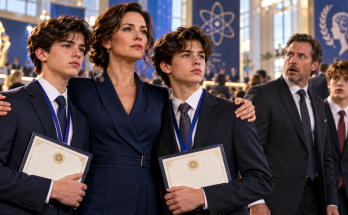
On the morning my father was sentenced, I stood outside the courthouse for nearly ten minutes before going inside. The sky was clear, and the city was beginning its ordinary weekday routine. A delivery truck stopped near the corner. Two pedestrians argued about a parking space. Someone hurried past carrying coffee in a paper cup. I watched the movement around me, struck again by how little the world paused for events that could permanently alter one family's life.
The criminal proceedings had taken months to resolve. Several individuals connected to Holloway Development had reached agreements with prosecutors, while others had contested portions of the allegations before eventually resolving their cases. My father had ultimately pleaded guilty to charges involving fraudulent financial transactions associated with public contracts. Vanessa had also entered a guilty plea to offenses connected to financial misrepresentations and the improper use of funds from the memorial campaign. Their admissions and the corroborating evidence established facts that my family had spent a long time refusing to acknowledge.
Margaret met me beside the courthouse entrance. She wore a dark coat and carried a small folder containing the statement I had prepared. I had spent days deciding what to say. My father's attorney had requested a character letter describing his positive contributions to my life and the community. I could have refused without explanation. Instead, I chose to provide a truthful statement that included both the father I remembered from childhood and the father who had abandoned me during the most devastating moment of my life.
The document did not ask the court to overlook his conduct. It acknowledged that he had built a business, employed people, and sometimes shown generosity. It also described the pressure he placed on me to transfer my home, his attempts to discourage scrutiny of financial records, and the way he had treated my grief as evidence that I could not manage my affairs. I included those facts because I would no longer participate in protecting a false version of our family.
Inside the courtroom, Dad sat beside his attorney. His hair had become noticeably grayer, and the confidence that once seemed to fill every room had diminished. He looked at me briefly when I entered, then lowered his eyes. Mother sat several rows behind him, her hands folded tightly in her lap. She gave me a small nod but did not approach. We had maintained limited correspondence since her visit to the lake house, and she had respected my request not to pressure me about the case.
The judge reviewed the offenses, the evidence, and the parties' arguments. The public-contract scheme had caused substantial financial harm, affecting organizations that depended on money intended for legitimate construction and community improvements. Some funds had been directed through companies whose stated services did not match the underlying records. The court also considered my father's role in approving arrangements and benefiting from transactions that concealed how money was being used.
The sentence included a term of imprisonment, financial penalties, and obligations connected to restitution. The court's determination was less severe than the maximum punishment prosecutors had initially described as possible, but it was far from the outcome Dad had insisted would follow once everyone understood his explanation. Holloway Development would also face civil and administrative consequences separate from his criminal sentence, with its remaining legitimate operations subject to decisions by creditors, regulators, and other responsible parties.
When the judge finished speaking, my father remained seated for a moment. He looked older than I had ever seen him. I remembered him standing beside my childhood bicycle, promising he would catch me if I lost my balance. I remembered being proud when he attended my law school graduation and introduced me to everyone as his daughter. I also remembered the cemetery, his voice telling me that Vanessa's birthday celebration could not be interrupted, and the signed documents he had expected me to accept without independent advice.
All of those memories belonged to the same man. I no longer needed to erase the good ones to recognize the harm he had caused.
Afterward, Dad's attorney approached Margaret and asked whether I wished to speak with him before he left. I considered the request, then agreed to a brief conversation with counsel nearby. My father stood beside a window in a quiet corridor, looking out at the street. When he turned, I saw that his eyes were red.
“Claire,” he said. “I read your statement.”
“I meant what I wrote.”
He nodded slowly. “I suppose you did.”
For a moment, I expected another explanation about complicated contracts or unfair investigators. Instead, he said that he had convinced himself he was protecting the family by keeping the company functioning, even when the arrangements became dishonest. He admitted that he had used the language of responsibility to justify decisions that benefited him. He did not ask me to agree.
Then he mentioned the funeral. “I should have been there. Your mother and I should both have been there. There was no excuse.”
I looked at him for a long time. I had waited months to hear those words. When they finally arrived, they sounded smaller than I had imagined. The absence they described had become part of my life, something no apology could reverse.
“No,” I said. “There wasn't.”
He wiped his face with one hand. “I don't expect you to forgive me.”
“That's good, because I don't know whether I ever will.”
He nodded. I told him I hoped he would accept responsibility for what he had done and make whatever restitution he could. Then I said goodbye. It was not a dramatic ending. There was no embrace, no promise to visit, and no declaration that everything was repaired. I walked away because the conversation had reached its natural limit.
Vanessa's sentencing took place separately several weeks later. Her plea acknowledged that she had knowingly made misleading representations about the memorial campaign and allowed money raised for charitable purposes to be used improperly. The court imposed a custodial sentence along with restitution obligations and restrictions related to handling charitable funds. Her role in the broader financial arrangements was considered in light of the evidence and her cooperation.
I attended because the proceeding involved money donated in Eli and Rose's names. I did not want their memory represented solely through statements prepared by attorneys. With Margaret's assistance, I submitted a victim-impact statement explaining that the campaign had been created without my authorization and that my children had been presented to strangers as instruments of a fundraising operation I neither controlled nor supported.
I did not describe every painful detail of their deaths. The court already understood that three people had died in the accident. I wrote instead about the responsibility attached to their names. Eli had been curious, patient, and proud of the bridges he built from cardboard. Rose had loved insects, yellow sweaters, and the old swing behind our house. They deserved to be remembered as children who had lived, not as photographs used to persuade people to give money under false pretenses.
When Vanessa addressed the court, she acknowledged that her decisions had harmed donors and compounded my grief. She said she had allowed ambition, debt, and fear of failure to override responsibilities she understood. Her attorney emphasized the assistance that had genuinely reached some families and her eventual cooperation with the investigation. The judge considered those facts without treating them as an excuse for the diversion of other contributions.
Vanessa looked toward me when the proceeding ended. I met her eyes briefly. There was nothing left to argue about in that room. The legal consequences had been determined through evidence and procedure, not through my willingness to forgive her. I left without approaching.
The restitution process continued after sentencing. Financial authorities and the organizations administering recoveries worked to identify eligible victims, including donors and entities affected by the contract scheme. Some money was recovered through available assets and negotiated payments. Other losses could not be made whole immediately, and the final recovery depended on what could lawfully be collected. I learned that justice rarely arrived as a single complete correction. It often consisted of imperfect, carefully administered steps that could never undo the original harm.
For the memorial campaign, Margaret helped me communicate with the proper parties to ensure that donors received accurate information about the fund's status and the available claims process. I refused to take control of the tainted organization or present it as a project I had supported all along. Instead, I worked with a reputable, independent charitable organization to explore a separate initiative that could help families facing sudden bereavement without placing financial authority in the hands of my relatives.
I approached that decision slowly. For months, I had resisted every attempt to turn Daniel, Eli, and Rose into a public cause. Their lives were private and precious, and I did not owe strangers access to my grief. But I had also met people whose compassion was genuine. Laura Mitchell and other donors had wanted to help. Some of the families who had received limited assistance from Vanessa's campaign had written messages expressing gratitude without knowing about its financial problems.
I realized that refusing to let my sister exploit the children's names did not mean I had to reject every opportunity to honor them through kindness. The difference would be honesty, consent, independent oversight, and a purpose that did not require their photographs to be displayed for attention.
With Margaret's guidance, I established a modest memorial giving arrangement through an existing charitable organization rather than creating a new business or fundraising platform. Its purpose was straightforward: provide practical support to families experiencing sudden loss, with clear eligibility rules and independent accounting. I contributed money from my own resources and directed that any future donations be handled transparently by the organization. I did not invite public campaigns centered on my personal story.
The first family assisted through the arrangement was referred by a local hospital social worker. I never met them, and I did not request identifying details beyond what was necessary to verify that the assistance was properly administered. The money helped cover immediate expenses while the family arranged a funeral. When the organization confirmed that the payment had been completed, I sat quietly at my desk, thinking about how different the process felt from Vanessa's elaborate publicity.
There had been no photographs, no emotional video, and no claims that generosity made anyone extraordinary. A family needed help, and the help reached them. Daniel would have appreciated the simplicity.
My mother learned about the arrangement through a relative and wrote to ask whether she could contribute. I considered the request for several days before answering. She had continued attending counseling and had stopped defending Dad's decisions whenever we spoke. She had also begun acknowledging how her constant efforts to protect Vanessa had come at my expense. I was not certain how much of that change would endure, but she had respected the boundaries I set.
I told her she could donate through the same independent process available to anyone else. She would not receive special recognition or a role in managing the funds. She accepted the condition without complaint and sent a contribution. I did not interpret it as repayment for missing the funeral. It was simply one constructive action in a relationship that remained deeply damaged.
The lake house stayed in my name. No trust controlled by my father was created, no loan was secured against the property for Holloway Development, and Vanessa never moved into the guest suite. I reviewed the title and estate arrangements with Margaret and made sensible updates to protect my independence. The home remained what Daniel and I had intended it to be: a place where our family had lived, not an asset available to satisfy someone else's obligations.
As the seasons changed, I began making small alterations. I repaired the swing and replaced the faded blue ribbon with another of the same color, keeping Rose's original ribbon in a memory box. I finished Eli's bridge model only after spending an afternoon studying his sketches. The completed structure stood on a shelf in his bedroom, slightly crooked in the way he would have found amusing. I moved Daniel's reading glasses from the kitchen counter into a wooden box beside his favorite books.
Some days, those changes felt manageable. Other days, moving a single object could leave me crying on the floor. I learned not to measure healing by how often I cried or how long I could speak about them without losing my voice. Grief did not move steadily in one direction. It returned through ordinary details: the smell of hot chocolate, the sight of a school bus, a father lifting a child onto his shoulders at the grocery store.
I resumed more legal work, though I chose assignments carefully. My experience reviewing financial records had become newly meaningful. I began advising small nonprofit organizations on recordkeeping, financial controls, and responsible management of charitable contributions. The work suited me because it was practical and because mistakes in those systems could affect people who depended on the organizations' promises.
Michael remained a regular visitor. He helped repair things around the house and sometimes joined me for dinner. We spoke about Daniel often, not only about his integrity or the investigation but about the ridiculous things he had done. Michael remembered a camping trip when Daniel insisted he knew how to assemble a tent without instructions and ended up with a structure that collapsed every time the wind changed direction. I laughed so hard that I cried, and afterward the tears changed for reasons neither of us needed to explain.
Mrs. Bennett continued bringing food occasionally, although I had begun returning the favor. We planted herbs in the garden and argued cheerfully about whether my tomatoes received enough sunlight. She never asked me to move on, find a new purpose, or transform tragedy into a lesson. She treated me as a neighbor whose life had been altered but not ended. That steady companionship helped more than she probably knew.
Nearly a year after the funeral, I received a final letter from my father before he began serving his sentence. He wrote without asking for money or intervention. He acknowledged that he had repeatedly placed Vanessa's needs and his business interests ahead of mine. He said he had confused providing material comfort with being a good father, and that when I suffered a loss he could not fix, he had avoided it rather than standing beside me.
I read the letter on the porch. The lake was bright beneath the afternoon sun, and the repaired swing moved gently in the breeze. Dad wrote that he hoped I would someday remember the better parts of our relationship. He also said he understood that remembering them did not require me to overlook the harm he had done.
I placed the letter in a folder with Mother's correspondence. I did not write back immediately. I might answer one day. I might choose only limited contact. I had stopped treating forgiveness as a duty that had to be completed before I could live peacefully. My father was responsible for his actions, and I was responsible for deciding what place, if any, he would have in my future.
Vanessa sent a letter as well. She described the work she was doing to understand her financial decisions and wrote that she regretted using my children's names. She asked for no favor. I could not determine how much of her remorse came from personal reflection and how much came from the consequences she now faced. I decided I did not need to know. Her future conduct would speak more clearly than another apology.
On the anniversary of the funeral, I woke before sunrise. For several minutes, I lay listening to the wind move across the roof. The date had lived in my mind for weeks, approaching with the same slow inevitability as the original ceremony. I had considered inviting friends to the cemetery, but in the end I wanted to spend the morning alone.
I prepared three small bouquets at the kitchen counter. Daniel's contained white lilies and greenery. Eli's included blue flowers, the color he had chosen for his bedroom walls. Rose's held soft yellow blossoms and a few white roses. I wrapped the stems carefully, then placed them on the passenger seat of the car.
The cemetery was quiet when I arrived. A maintenance worker was trimming grass near the far entrance, and several birds moved between the trees. The three markers stood together beneath a pale morning sky. I knelt first beside Rose's grave, brushing away a leaf that had settled against her name.
“Your swing is fixed,” I whispered. “And Mrs. Bennett says the garden looks better than ever.”
I placed her flowers carefully, then turned to Eli. I told him that I had finished his bridge, although he would probably have found a mistake in the measurements. I smiled as I imagined his serious expression and the way he would explain why the supports needed adjusting.
At Daniel's grave, I stayed longer. I told him about the legal proceedings, the work I had resumed, and the memorial arrangement established through the independent organization. I told him that the house was safe and that nobody had taken control of it. I told him how often Michael still made me laugh with stories of their friendship.
Then I sat on the grass and allowed myself to say what I had been holding back.
“I wish you were here,” I whispered. “I wish none of this had happened. I wish I could go home and find the three of you waiting for me.”
There was no answer. The morning continued around me, indifferent but peaceful. The trees moved gently, and somewhere beyond the cemetery walls, children were calling to one another on their way to school.
I remained there for a long time. I did not ask for a sign or try to imagine what Daniel would tell me to do. I had spent months learning to make decisions without him while keeping faith with the life we had shared. I could never know exactly what he would have chosen in every circumstance. But I knew the values by which he had lived: care for people, respect for evidence, loyalty expressed through actions, and the belief that promises mattered.
The investigation had exposed financial wrongdoing and led to serious consequences. The memorial donations had been examined, restitution processes were underway, and my family could no longer use my silence to protect false accounts of what had happened. My house remained mine. The threats to my independence had failed. The truth about Daniel's unfinished work had been preserved and tested.
The separate investigation into the fatal collision had not established a connection between the accident and the financial scheme. I had accepted that conclusion because I would not invent a more elaborate explanation merely to make the loss feel purposeful. The truck collision had taken Daniel, Eli, and Rose from me. The choices my parents and sister made afterward had inflicted another kind of harm. Both truths could exist without being forced into a single story.
I had also come to understand that the people who attended the funeral mattered more than those who later claimed special rights because of blood. Michael had stood beside me when I could barely remain upright. Mrs. Bennett had fed me when eating seemed impossible. Daniel's colleagues and the children's teachers had honored lives they genuinely remembered. Their presence had shown me that family was not merely a relationship recorded on paper.
When I finally stood, my knees were stiff from sitting on the grass. I brushed the dirt from my coat and looked at the three graves. The flowers moved slightly in the breeze.
“I love you,” I said.
Those words were not a farewell. They were simply true, as they had been every morning when I woke beside Daniel and every evening when I tucked the children into bed.
I drove home slowly. Sunlight spilled across the lake as I turned into the driveway, and the repaired swing was visible through the trees. Inside, the house was quiet, but it no longer felt like a place I had been sentenced to occupy alone. It held grief, certainly, and memories that would always hurt. It also held the books Daniel loved, the drawings the children made, the friends who still came through the front door, and the work I had chosen to continue.
I put the kettle on and opened the study windows. A cool breeze moved across Daniel's desk, stirring the corner of Eli's bridge drawing. I placed the paper beneath a book and smiled.
My parents had once believed I would always sacrifice my own needs to preserve their approval. They had mistaken patience for weakness and loyalty for obedience. When I lost my husband and children, they assumed I would be too devastated to resist their demands.
They were wrong about what grief had taken from me. It had shattered the life I expected to live, but it had not erased my judgment, my dignity, or my right to decide what happened next.
I could not recover the years Daniel, Eli, and Rose should have had. I could not make my parents attend a funeral that had already passed. I could not force Vanessa to become the sister I once wished she would be.
But I could protect the truth, honor the people I loved, and build a life that did not depend on the approval of those who had abandoned me.
That afternoon, I sat on the porch with a cup of tea and watched the sunlight move over the water. The house behind me was filled with memories. The future ahead of me remained uncertain.
For the first time, that uncertainty did not frighten me.
I had survived the day I thought would end everything, and I was still here.
The End
Read more original stories on Feel Every Story.