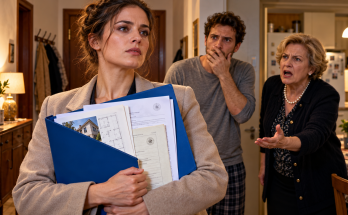
By nine the next morning, I was sitting in my car outside Dana Caldwell's office with my father's documents arranged on the passenger seat. I had arrived fifteen minutes early, though I had barely slept. Rain had collected in shallow puddles along the pavement, and people hurried past my windshield carrying coffee cups and folded umbrellas. I watched them enter offices and shops with the ordinary purposefulness of a weekday morning. My own life seemed to have stopped three weeks earlier, yet everything around me continued without interruption.
Dana had represented me in routine matters before, though I had never needed her for a conflict involving Logan. She was a precise woman in her early fifties who preferred questions to assumptions. When I called, I told her that my husband was leaving me and insisting I vacate our home. She asked whether I had copies of the ownership records. I said I believed I did. She arranged an appointment immediately and told me not to sign anything until we had reviewed the documents together.
Her office smelled faintly of paper and lemon furniture polish. A framed landscape hung behind her desk, and a small plant occupied the windowsill. Dana greeted me without the excessive sympathy I had begun to dread from acquaintances who knew about Logan's new marriage. She offered coffee, waited until I had settled into the chair, and asked me to explain the situation from the beginning. I told her about the separation, the wedding in Italy, the children's trip, and the message instructing me to leave. She listened without interrupting, occasionally noting dates on a yellow legal pad.
When I showed her Logan's messages, her expression changed slightly. She read each one twice, then asked whether he had presented any court order granting him exclusive possession of the property. I said he hadn't. She wanted to know whether the divorce was finalized. It was not. Logan had announced that everything was being handled, but I had received no final decree and had signed no settlement. Dana drew a line beneath one of her notes. She explained that Logan's claims about the house should not be treated as legal facts merely because he delivered them forcefully.
I placed my father's folder on the desk. Dana put on her reading glasses and began examining the records. For several minutes, only the turning of pages disturbed the silence. She checked the dates, compared signatures, and opened a digital copy of the recorded deed. Then she looked at me over the top of her glasses. She said the property history required careful attention, but the essential point was clear. Logan's repeated description of the house as his personal asset was not supported by the documents before her.
The news should have relieved me immediately. Instead, I felt an unfamiliar combination of gratitude and embarrassment. I had lived on that land for almost twenty years and had somehow allowed my husband to speak about it as though my father's contribution had disappeared upon our wedding day. Dana noticed my expression and asked what was troubling me. I admitted that Logan had always taken charge of financial matters and that I had grown accustomed to accepting his explanations. She suggested we begin replacing explanations with records.
My father had purchased the property years before Logan entered my life. The original house had needed repairs, and Dad had spent several summers clearing overgrown sections of land and restoring the long gravel driveway. I remembered helping him carry tools from his truck while he explained how to recognize trees by their bark. He used to say that land outlived arguments about who deserved it. At the time, I thought he was simply being philosophical. Sitting in Dana's office, I began to suspect he had been trying to teach me something more practical.
Six years before Dad died, he had arranged a transfer of the property into my name. Dana explained that we would need to examine the complete history of ownership and any trust provisions before making decisions, but the recorded documents gave Logan no basis for treating the property as his alone. She also found references to a separate trust that my father had established seventeen years earlier. Its name was familiar, yet I had never fully understood the relationship between the trust, the land, and the accounts associated with it.
I asked whether my father had expected my marriage to fail. Dana set down her pen and considered the question before answering. She said careful estate planning did not require predicting a specific betrayal. Parents sometimes established protections because circumstances changed, marriages ended, businesses failed, and people made decisions that endangered those depending on them. My father had evidently wanted his daughter and grandchildren to retain certain protections regardless of what happened elsewhere in their lives.
Her answer brought back a conversation I had nearly forgotten. Dad and I had been standing beside the kitchen window on a rainy afternoon. Logan was away at a business meeting, and Marcus had been playing outside with a toy truck. Dad asked whether I knew where our important documents were kept. I laughed and told him Logan handled most of that. My father did not laugh. He said there was a difference between trusting a husband and surrendering responsibility for one's own affairs. I had been offended by the implication. Now I wished I had asked him to explain more.
Dana began making calls. She contacted the office responsible for the trust administration and requested the most recent available records. While she worked, I examined the documents spread across her desk. Each date represented an action Dad had taken without demanding gratitude or drawing attention to himself. He had never used his generosity to control me. He had simply made arrangements and encouraged me to understand them. I thought about the way Logan announced every expensive purchase, expecting admiration for decisions that often affected the entire family.
Before leaving, I asked Dana a question that had been troubling me since the previous night. If the house was protected, could Logan still force me to leave through some other arrangement? She explained that possession, ownership, marital claims, and divorce proceedings could involve different questions. We needed a complete legal review before taking action. But she assured me that I should not pack my belongings merely because Logan had sent threatening messages from an airplane. His demand was not a substitute for legal authority.
I drove home more slowly than usual. The rain had stopped, leaving the road dark beneath the trees. At the entrance to our property, I pulled over and looked through the windshield at the familiar stone posts my father had helped repair. For years, Logan had spoken about replacing them with something grander. He wanted gates operated by a remote control and pillars that would impress business associates arriving for dinner. I had always preferred the stone posts. They belonged to the character of the place, and Dad's hands had touched nearly every one.
Inside, I made tea and stood beside the kitchen island. The yellow-flowered mug remained where I had left it. I picked it up and remembered Logan's face during the conversation that ended our marriage. He had seemed impatient whenever I referred to our history, as though nineteen years were an inconvenience preventing him from describing his plans. I realized that his instructions to leave the house were another version of the same attitude. He had decided our shared past was finished and assumed he could determine what happened to everything associated with it.
An email arrived from Lily that afternoon, although it contained only photographs and a short message about the weather. She said the sea was beautiful and that they had visited a village with tiny streets and shops selling lemon candy. I wrote back asking whether she was enjoying herself and reminding her to wear sunscreen. I did not mention Dana or the property. I wanted my daughter to have a few uncomplicated days, even if the occasion surrounding them was painful for me.
Marcus called later from the terrace of their hotel. Behind him, I could hear conversation and the clatter of dishes. He looked tired, and I asked whether the trip was overwhelming. He shrugged. Then he wanted to know whether I was doing all right alone. I told him I was managing. His gaze shifted toward someone outside the camera's view. When he spoke again, he asked whether his father had contacted me. I said yes. Marcus pressed his lips together and nodded, but he offered no explanation.
I considered asking what Logan had been saying. Instead, I told Marcus that he could call whenever he needed to talk, whether he wanted to discuss the wedding or something entirely different. He smiled briefly. Before ending the conversation, he asked if the house was still the same. I looked around the kitchen at the grocery list attached to the refrigerator and the sunlight crossing the floorboards. I told him it was. He seemed satisfied, though his question lingered in my mind long after the screen went dark.
The following morning, Dana called with news from the trust administrator. She had obtained preliminary records confirming that my father had established protections extending beyond the five-acre property. There were investments associated with the trust, along with arrangements intended to benefit Marcus and Lily. The records would take time to examine properly, but Dana believed my father had been more deliberate than either Logan or I understood. She asked me to return to her office that afternoon.
I spent the hours before the appointment searching through additional papers in the study. Logan had maintained a filing system based on categories he understood but rarely explained. Business correspondence sat beside household invoices, and account statements were mixed with documents concerning the children's education. I did not remove anything that belonged solely to his company. I simply gathered records involving my name, the property, and accounts associated with our family. Several envelopes carried the logo of a bank I recognized from statements Logan occasionally left on the kitchen counter.
One envelope contained a notice about account activity I could not identify. Another referred to a business expense that appeared to have some connection with family travel. I set them aside, unsure whether they mattered. Logan had always traveled extensively for work, and I did not want to transform every unfamiliar transaction into an accusation. But I also remembered my father's insistence that understanding financial records was a responsibility, not an expression of distrust. I placed the envelopes in a separate folder for Dana.
During the drive back to her office, I passed the restaurant where Logan and I had celebrated our tenth anniversary. The windows were decorated for an upcoming holiday. I remembered that evening clearly: Logan had ordered champagne, told me he could not have built his career without my support, and promised we would eventually take a long trip together. We had postponed that trip repeatedly because of his schedule. Now he was spending an extraordinary amount on a European celebration with another woman. I felt anger rising, but beneath it was a quieter recognition that promises had become a substitute for action.
Dana was waiting with a thick binder when I arrived. She had marked several sections with colored tabs. She showed me how the trust documents identified beneficiaries and separated certain assets from Logan's business affairs. The financial arrangements were more extensive than I had imagined. My father had provided for educational expenses and other future needs of his grandchildren. He had also taken steps to prevent those funds from being treated casually as ordinary household money. I understood why Dana wanted to examine every document before drawing final conclusions.
One provision concerned the ability of a parent who had abandoned financial responsibilities to control distributions intended for the children. Dana explained that the exact application would depend on the trust terms and documented circumstances. The significance was clear, however: my father had not wanted Marcus and Lily's future security to become a convenient source of money for someone pursuing other interests. I thought about Logan's expensive wedding and wondered whether he had ever considered the difference between providing for his children and using their presence to enhance his public image.
Dana turned to the records I had brought from the study. She glanced at the unfamiliar bank notices, then asked whether she could make copies. Her attention sharpened when she reached the statements involving travel reimbursements. She compared the account numbers with those appearing on several trust-related documents. I watched her expression change from curiosity to concern. She did not accuse Logan of anything. She simply asked whether I had authorized any transfers connected with the accounts listed on the page.
I said I had not. Dana handed me one of the forms and pointed to the signature at the bottom. My name appeared in dark ink, written with enough resemblance to my handwriting to pass a casual inspection. But the final letter curved in a way I never wrote it, and the initials beside the date were unfamiliar. I leaned closer, suddenly aware that my hands had begun to tremble. Dana asked me to examine another page. The same false signature appeared there, connected to a different transaction.
I looked up at her. I could hear traffic beyond the window and someone speaking softly in the reception area, but those sounds seemed to come from another building. Logan had insisted I leave the house because he believed he controlled our finances and our future. Now there were documents suggesting someone had used my identity without permission. Dana took the papers from my hands and placed them carefully into a separate folder. She said we needed to determine who had authorized the transactions and whether additional accounts were involved. I understood then that the struggle was no longer only about where I would live. Someone had been moving money while making certain my name appeared to approve it.