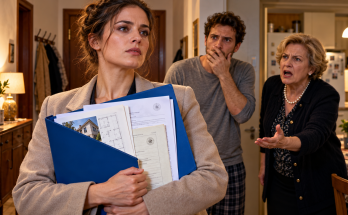
“Where is the turkey, Margo?”
Brenda's question arrived so forcefully that I moved the phone away from my ear. I was standing in my mother's kitchen, watching her stack containers of leftovers in the refrigerator. Sandra had gone home to collect a casserole dish she wanted to lend us, and Theo was asleep in the living room. The apartment smelled of roasted herbs and coffee. Through the open doorway, I could see my son's small hand resting against the sofa cushion.
“Good evening, Brenda,” I said. There was a brief silence, the sort that comes when someone expects an immediate apology and receives an ordinary greeting instead. Then she asked whether I understood that people were arriving for dinner. Her voice had acquired an urgency absent from our earlier conversation. At the Hendricks' house, she had inspected my cooking as though it were an inconvenience. Now, apparently, that same cooking had become essential.
“I understand there are guests,” I answered. “I knew that when I brought the turkey.” Brenda made an exasperated sound. I could hear movement behind her, followed by Renee saying something indistinct. Brenda lowered her voice slightly and informed me that Walter had been sent to the grocery store to see whether anything suitable could be found. Most places were closing early. The meal they had planned was no longer possible without the dish I had taken.
For a moment, I pictured Walter standing beneath fluorescent supermarket lights, examining whatever prepared food remained in the refrigerated cases. The image might have amused me if the conversation had not been so painful. I had never wanted to ruin their dinner. I had wanted a Thanksgiving afternoon without being diminished before I even removed my coat. I wondered whether Brenda understood that distinction, or whether she believed the inconvenience itself proved I had behaved unforgivably.
“You had no business taking our dinner away,” she said. The word our caught my attention. I looked toward the counter, where Mom had placed the last few slices of turkey into a small container. “I purchased the bird,” I said. “I prepared it in my kitchen. I got up before sunrise to cook it. I carried it into your house because Graham told me you needed help.” Brenda interrupted, saying that nobody had questioned how much work I had done.
I waited until she finished. “You didn't have to question it,” I replied. “You acted as though the result wasn't worth much.” Brenda insisted that she had only been making an observation. Renee had done the same. Neither of them had intended to hurt my feelings. I had heard the argument in countless forms before, and I was suddenly tired of trying to separate intention from consequence. If someone stepped on my foot repeatedly, I thought, the pain would not disappear simply because they called each step an accident.
I moved closer to the window, away from the kitchen where Mom was working. “I'm not demanding that you admire everything I make,” I told Brenda. “I don't need applause for cooking a meal. But I do expect to be treated with ordinary courtesy.” She responded that I was being dramatic and that families did not need to thank one another for every small contribution. I closed my eyes. The turkey had occupied most of my day. Calling it a small contribution was precisely the problem.
“Brenda,” I said, “I have been trying to make you happy for seven years. I remember everyone's birthdays. I bring food when you ask. I change plans when gatherings are moved. I listen when you comment on my clothes, my work, and how I raise Theo. I have worked very hard to be a good daughter-in-law. Today I brought you the main course, and the first thing your daughter did was insult it.”
She began to speak, but I continued. I reminded her of the meat pie and the questions about whether I had made the pastry myself. I mentioned the afternoon she had criticized Theo's boots while he was standing close enough to hear. I remembered the birthday celebration when she commented that our son might inherit patience from Graham's side of the family. That remark had been delivered with a smile, but her eyes had remained on me. I had spent the following hour wondering whether anyone else noticed.
Brenda grew quiet. I could hear a television playing somewhere in the background. Finally, she said that she had never realized I remembered such insignificant things. I leaned against the wall. “That's because they're not insignificant to the person who hears them,” I replied. “You say something and move on. I go home thinking about it. Sometimes I spend days trying to understand what I should have done differently.”
She told me that she considered me part of the family and always had. I looked around my mother's apartment, at the old kitchen cupboards and the familiar photograph of Dad beside the living-room lamp. There was no elaborate dining arrangement here, no beautifully polished silverware, no expectation that guests should arrive carrying evidence of their usefulness. Mom had opened the door and made room for us without asking what we had brought or why our plans had changed.
“If this family is supposed to be my home,” I said, “you have made it very difficult for me to feel welcome.” Brenda did not answer immediately. I wondered whether she was angry, hurt, or simply searching for a response that would restore her authority. I did not try to fill the silence. For years, whenever one of our conversations grew uncomfortable, I had rushed to soften my own words. I had apologized for things I did not believe were wrong because ending the tension felt easier than enduring it.
Eventually, Brenda asked what she was supposed to tell the guests. The question confirmed that her attention remained fixed on the practical consequences. I felt disappointed, but not surprised. “Tell them there was a change in dinner plans,” I said. “There are grocery stores nearby. You may still be able to buy something.” She accused me of being sarcastic. I told her I was offering the only suggestion I had. The turkey was already carved, and much of it had been eaten.
Another silence followed. Then Brenda asked whether Graham was coming home with me. I explained that he was still at her house as far as I knew. She seemed taken aback, perhaps realizing that I had left without waiting for him. I did not discuss our marriage with her. Graham and I had our own conversation ahead of us, and I would not let her direct it. I wished her a peaceful evening, ended the call, and turned the phone to silent before returning to the table.
Mom was waiting beside the sink. She had not listened openly, but the thin walls of her apartment made complete privacy difficult. She handed me a mug of tea and asked whether I was all right. I said I was not sure. My body felt tired in a way that had little to do with cooking. She pulled out a chair and sat opposite me. “You don't need to explain why you came here,” she said. “I'm glad you did.” I looked at the tea and nodded.
I told her I was worried about Graham. I had left him standing outside his parents' house, and I knew he would be angry. Mom did not immediately offer an opinion. She had always liked my husband and believed he was a good father. She also knew how often I returned from family gatherings subdued and withdrawn. “He may be upset,” she said. “That doesn't mean he can't listen.” I thought about the many conversations in which he had listened just long enough to explain why his mother had meant no harm.
A little after eight, someone knocked at the apartment door. Mom was in the kitchen, and Theo had been moved into the spare bedroom so he could sleep without the television disturbing him. I looked through the peephole and saw Graham standing in the corridor. He had removed his tie, and the collar of his shirt was slightly creased. His expression was tired, serious, and difficult to read. I opened the door and stepped aside to let him enter.
He greeted Mom quietly, accepted her offer of water, and sat on the sofa. For several moments, neither of us spoke. I could hear the radiator clicking beneath the window. Graham rested his elbows on his knees and rubbed his hands together. Finally, he said that the family had ordered pizza. I nodded. It seemed an ordinary solution to an inconvenient problem. He added that Brenda had cried for nearly twenty minutes after I left.
I waited for the familiar expectation that I would express remorse and promise to make things right. Graham looked at me, and I could see how thoroughly the afternoon had unsettled him. “You should have seen the house,” he said. “Everyone kept asking what happened.” I asked what he had told them. He answered that I was upset about the remarks and had decided to take the turkey to my mother. I felt a small measure of relief that he had not invented something worse.
Then he asked, “Do you realize how embarrassing that was?” His words were not shouted, but they landed with a familiar heaviness. I looked at him across the small room. “For whom?” I asked. He frowned. “For everyone. Mom had people coming. You walked out with the food.” I considered the answer before speaking. I wanted him to understand, not simply surrender because he was tired. “I've felt embarrassed in that house for years,” I said. “You just haven't been the one experiencing it.”
Graham leaned back and folded his arms. He said he understood that his mother could be difficult, but removing the main course seemed excessive. I asked whether he considered the afternoon an isolated incident. He hesitated. “It was about the turkey,” he said. “No,” I replied. “The turkey happened today. The rest has been happening since before we were married.” He looked down, and I could see him preparing the explanation he had used so many times before.
I stopped him. Not sharply, but firmly enough that he raised his eyes. “Please listen to the whole thing before you tell me what your mother meant.” The room fell quiet. Mom had moved into the kitchen to give us privacy, leaving the television low. Graham unfolded his arms. He nodded once. I took a moment to gather my thoughts, aware that the conversation could change something important between us. I had spent years asking him to understand, but I had rarely insisted that he remain with me through the uncomfortable part.
I started with Walter's meat pie. I described the weekends I spent practicing the recipe, the effort of finding the right ingredients, and the humiliating conversation about the crust. Graham remembered the occasion. He said he had thought the pie was good. “You told me that later,” I reminded him. “After everyone else had decided what was wrong with it.” He opened his mouth, then stopped. I continued with the comments about my clothes and hair, the remarks about Theo, and the way Renee turned ordinary conversations into opportunities to make me feel foolish.
The hardest thing to explain was not any particular insult. It was the anticipation. I told Graham how I felt when we parked outside his parents' house, how I rehearsed answers to questions before walking through the door, and how I sometimes changed clothes three times because I could already imagine Brenda's comments. I explained that I did not want him to fight with his mother, humiliate his sister, or choose between people he loved. I wanted him to recognize what was happening and stop expecting me to absorb it without complaint.
Graham looked toward the hallway where Theo was sleeping. I followed his gaze. I wondered whether our son had already begun noticing the way adults spoke to me, whether he would eventually learn that being polite meant allowing other people to make you uncomfortable. I mentioned the birthday remark again and told Graham I had felt foolish for caring about it. He shook his head slowly. “I remember that,” he said. “I thought Mom was making a joke.” I asked whether he would have considered it funny if someone said the same thing about him.
He did not answer immediately. I watched the question settle. Graham had a habit of looking away when he felt cornered, but this time he remained facing me. He asked how long I had felt that way. The question hurt more than I expected. “I've told you,” I said. “For years.” He lowered his eyes. He did not accuse me of exaggerating or suggest that I should forget the past. For the first time that evening, he seemed to understand that my anger was not the result of one afternoon's disappointment.
I told him I loved him and wanted our marriage to remain a place where we could speak plainly. But I was no longer willing to treat silence as the price of keeping peace with his family. He listened without interruption. Then he said, very quietly, that he had not understood how completely the comments had affected me. I believed that he was sincere. I also knew sincerity would not be enough unless something changed. I told him I needed actions, not merely sympathy after another difficult holiday.
Graham sat with that for a while. The radiator began knocking again, and somewhere outside a car alarm sounded briefly before stopping. Finally, he nodded. “I owe you an apology,” he said. “Not for Mom. For myself. You kept telling me something was wrong, and I kept giving you reasons to ignore it.” I looked at him, uncertain what to say. His admission did not erase seven years of discomfort. But it was the first time he had acknowledged that his own response had contributed to it.
We talked long after the tea had gone cold. Graham asked questions rather than offering explanations. I answered some easily and others with difficulty. We did not resolve everything. We could not. Yet when the conversation finally slowed, he did not tell me to call Brenda. He did not ask me to apologize for taking the turkey. Instead, he asked whether I would be comfortable going home together after Theo woke. I told him I would, provided he understood that I needed time away from his family.
He agreed. And when I asked what he intended to say the next time his mother called, he looked directly at me and answered that he would tell her we were taking some space and that she needed to respect it. It was a small promise, but unlike the easy reassurances of previous years, it placed responsibility somewhere other than on my shoulders. I looked toward the spare bedroom, where our son was sleeping peacefully, and realized that the most difficult part of that Thanksgiving might not have been leaving the house. It might have been deciding what kind of family life I would accept when we returned.