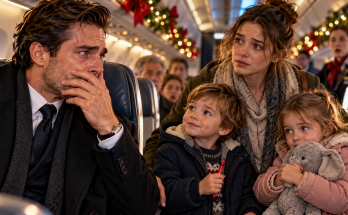
For several seconds after Captain Harper mentioned Kandahar, I could hear nothing except the engines. His voice continued through the cabin speakers, but the words seemed to arrive from a great distance. My fingers had closed around the armrest so tightly that the skin across my knuckles had turned white. Beside me, Maya was watching my face instead of the clouds. She had seen that expression before, although she was too young to understand what it meant. Sometimes, when a car backfired in our neighborhood or a helicopter passed unusually low over the house, my mind returned to places my body had left years earlier.
“During my final deployment,” Harper said, “I was involved in an incident that changed the course of my life. I have spoken about it very rarely, partly because there are things I still find difficult to describe.”
A faint rustle moved through the first-class cabin. The woman across the aisle lowered her book. Two rows behind us, someone stopped speaking in the middle of a sentence. The announcement was unusual enough to attract attention, but Harper's voice remained composed. He sounded like a man reading from a page he had revised many times and finally decided to put aside.
Maya rested her palm on my wrist. “Daddy, did you know him when you were a soldier?”
I swallowed. “I think I did.”
“Was he your friend?”
I looked toward the cockpit door. “I don't know yet, sweetheart.”
What I remembered most clearly about Afghanistan was the dust. It entered everything: boot seams, vehicle engines, the folds of a uniform, the corners of your mouth. In the summer, it rose from the roads in thick reddish clouds. At night, it settled on equipment like flour. I could still remember waking in a canvas shelter and finding a pale line of grit along my pillow. Certain memories had survived intact while entire days had disappeared.
Harper continued. “We were moving through a mountain corridor when our convoy was attacked. The lead vehicle was disabled almost immediately. Communications became difficult, visibility was poor, and several men were injured.”
My chest tightened. I knew that road. It ran between steep, broken ridges where the landscape left little room to maneuver. I remembered the smell of diesel and overheated brakes, the loose stones beneath my boots, and a young radio operator complaining that the batteries in his headset never lasted as long as they should.
The captain's voice grew quieter. “I was trapped inside one of the vehicles. A fire had started, and I could not free myself.”
The cabin around me seemed to shift. In its place came the metallic taste of smoke and the thunder of an explosion. I remembered falling onto my side and feeling gravel cut through my sleeve. Someone was shouting for a medic. A rifle lay several feet away, half-buried in dust. There was a burning vehicle near the edge of the road, and through the smoke I could see a figure struggling behind a damaged door.
I had spent years refusing to connect those images. My doctors called the gaps in my recollection consistent with severe trauma. The blast injury, blood loss, medication, and long recovery had affected my memory. Sometimes I remembered events in vivid fragments without understanding their order. Other times I knew that something had happened only because another soldier had described it afterward.
Harper said, “A sergeant from another vehicle reached me when the safest decision would have been to remain behind cover. I remember him forcing his way through smoke and fire. I remember telling him to leave because another explosion seemed inevitable.”
A cold sensation passed through me. My hand moved involuntarily toward the place where my left leg ended.
“I was frightened,” Harper continued. “There is no dignified way to describe that fear. I could hear the fire moving closer, and I believed I had reached the end of my life.”
I shut my eyes. Behind them, I saw a young officer through a cracked windshield. Blood streaked one side of his face. The vehicle's frame had twisted around his lower body. I remembered striking something with the butt of a rifle, once, then again. I remembered a man crying out when I pulled him by the shoulders.
But I could not see his face clearly.
“Daddy?” Maya whispered.
I opened my eyes. “I'm here.”
She touched my cheek. “You look sad.”
“I'm remembering something difficult.”
“About the war?”
“Yes.”
She glanced up at the speaker. “Is he remembering it too?”
I nodded. That much, at least, I knew.
Harper's announcement continued. “The sergeant got me out. He dragged me far enough away that the next explosion did not kill us both. But he was badly wounded. I remember trying to reach him afterward, and I remember people pulling me back because the area was still dangerous.”
The faint hum of the cabin became painfully loud. I looked down at my prosthetic, then at Elena's wooden box. I had always known the injury was connected to a convoy attack. Yet I had never known, with certainty, whose life I had been trying to save when the second explosion occurred.
My rehabilitation records contained descriptions of blast trauma, extensive tissue damage, and emergency surgery. I had read them only a few times. The clinical language was precise, but it offered no explanation for the final moments before I lost consciousness. I had once asked a doctor whether I would ever remember everything. He told me that some memories might return unexpectedly and others might remain inaccessible.
“After we were evacuated,” Harper said, “I tried to learn what happened to the man who saved me. I was told that his injuries were catastrophic. Later, while I was still recovering, I received information that led me to believe he had not survived.”
I lifted my head sharply.
The captain paused long enough that I heard someone clear his throat behind us.
“I carried that belief for years,” he said. “It affected every decision I made afterward. I left the Army, eventually trained as a commercial pilot, and tried to build a life that would honor the sacrifice I believed had been made for me.”
My pulse was beating hard against my collar. If Harper was describing the same incident, then somebody had made a terrible mistake. I had survived, although survival had required months in military hospitals, more surgeries than I cared to count, and a new understanding of what ordinary movement could cost.
The flight attendant approached our row. Her name badge read CLAIRE. She had been kind to Maya from the moment we boarded, and now she was studying me with unmistakable concern.
“Mr. Vance,” she said softly, “would you like some water?”
I shook my head, then changed my mind. “Yes. Please.”
She passed me a bottle and loosened its cap before placing it in my hand. I thanked her, but my eyes remained fixed on the cockpit door.
Harper resumed speaking. “This morning, before departure, I saw a passenger being treated in a way no person should be treated. At first, I knew only that a father and his young daughter were being pressured to surrender seats they had lawfully purchased. Then I heard his name.”
My throat closed.
“When I looked at him,” Harper said, “I recognized a face I had believed I would never see again.”
The woman across the aisle turned toward me. Her expression softened, but she said nothing. I appreciated her restraint more than I could explain.
Harper's voice faltered for the first time. “His name is Sergeant Marcus Vance. He was the man who pulled me from that burning vehicle.”
Maya's hand tightened around mine.
The cabin remained silent. No one moved. Even the low conversations coming from economy seemed to stop, although I knew the announcement had reached the entire aircraft.
I stared at the speaker above my seat, unable to form a response. I had spent years regarding my injury as the dividing line between the life I had planned and the life I was forced to build. Elena never described it that way. She insisted that the man she married had not disappeared in Afghanistan. Still, I sometimes found myself thinking of the explosion as the moment when everything had been taken.
Now a stranger was telling an aircraft full of people that something had also been saved.
Maya looked at me with wide eyes. “Daddy, you saved the captain?”
I took a breath that hurt. “It sounds that way.”
“Why didn't you tell me?”
“Because I didn't remember all of it.”
She glanced down at my leg, then back at the cockpit.
“Is that how you got hurt?”
I could not bear to give her an uncertain answer. “Yes, little bird. I think that's exactly how.”
Harper spoke again. “I have no intention of embarrassing Sergeant Vance or placing him in the position of having to answer questions from strangers. I want only to acknowledge what he did, and to make clear that he and his daughter are welcome aboard this aircraft.”
My eyes burned. I looked toward the window because I did not want Maya to see me cry, but she moved closer and leaned against my arm. Elena had taught her that tears were not something to be ashamed of. I had agreed with that lesson while finding it much harder to follow myself.
The captain ended his announcement without asking for applause. He thanked the passengers for their patience and said that the crew would continue normal service shortly. The speaker clicked off, leaving a silence that felt different from the one preceding it.
Then someone behind us began clapping.
The sound spread through the cabin. A man in row two stood halfway before remembering that the seat-belt sign was illuminated. Several passengers turned toward me. I heard a woman say, “Thank you for your service,” and another person quietly repeat the words.
I did not know what to do with their attention.
Maya, however, looked astonished. She glanced around at the applauding passengers, then lifted her hands and clapped too, Benjamin trapped between her elbow and her dress.
I leaned toward her. “You don't have to do that.”
“I know,” she said. “I want to.”
Something inside me loosened.
I reached for Elena's box and held it against my chest. If she had been beside me, she would have placed her hand over mine. She would have told me to accept the kindness without apologizing for being uncomfortable.
Instead, I heard her voice only in memory.
Claire waited until the applause faded before approaching again. “Captain Harper asked me to tell you that he'd like to speak with you after we land, if you're willing.”
I looked toward the cockpit. “I would like that.”
“He also asked me to assure you that your seats are secure and that nobody will disturb you for the remainder of the flight.”
“Thank him for me.”
She nodded. “I will.”
After she left, Maya leaned across the armrest. “Daddy, is the captain the man Mama told me about?”
I looked at her. “What man?”
She frowned, searching for the right words. “The one from your soldier pictures. She said there was someone you helped, and sometimes people don't know what happened to the people who helped them.”
A strange pressure settled behind my eyes. Elena had rarely spoken to me about Afghanistan unless I invited the conversation. I had assumed she avoided the subject because she knew how difficult it was. Perhaps she had understood more than I realized.
“What else did Mama say?”
Maya looked toward the ceiling, thinking. “She said people carry stories they haven't finished telling.”
I remembered Elena sitting beside me one evening with a folder of old photographs spread across the kitchen table. She had asked about a young lieutenant standing near the edge of one picture. I had shrugged and said I couldn't remember his name. She had not pressed me, but later I found the photograph placed carefully inside an envelope.
At the time, I thought nothing of it.
Now I wondered what she had been trying to discover.
Maya rested her head against my shoulder. “Do you think Mama knew the captain?”
“I don't know.”
“Maybe she wanted you to find him.”
I looked down at the mahogany box. The thought was almost unbearable.
Outside the window, the clouds opened to reveal a patchwork of fields far below. The aircraft moved steadily eastward, carrying us toward the coast Elena had loved. I had expected the journey to be about keeping one promise. Instead, a part of my past had returned without warning, asking questions I had never learned to answer.
I tried to remember the two taps Harper had made against the partition. The rhythm surfaced again, clearer now. It belonged to a signal used when radios failed or when noise made speech impossible. I remembered striking the frame of a damaged vehicle twice to tell someone trapped inside that help was close.
Two taps.
A pause.
Then the effort of pulling against twisted metal.
I looked toward the closed cockpit door.
Captain Harper had recognized the signal. He had given it back to me before the flight, not as a performance for the passengers, but as a private acknowledgment of something only the two of us had experienced.
For the first time in twelve years, I wanted to know everything that had happened that night.
And I knew the man who could tell me was sitting only a few yards away, guiding our aircraft toward Wilmington.