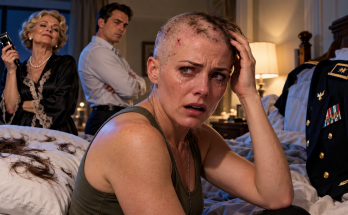
The sound of a key turning in the front door came to me through a heavy, unfamiliar darkness. At first I thought it belonged to a dream. I could hear movement somewhere beyond the room, footsteps crossing the threshold and a man's voice calling my name. I tried to open my eyes, but my eyelids felt impossibly heavy. The floor beneath my shoulder was cold. Something small and warm was resting against my chest.
“Sarah?”
The voice came again, louder this time.
A moment later, someone knelt beside me. I felt a hand near my face and heard a sharp intake of breath. When I finally managed to see clearly enough to recognize the person, I thought for an instant that my confused mind had invented him.
Arthur Harrison was leaning over me.
He was wearing a charcoal suit with a pale tie, the sort of clothing I usually saw him in at formal family gatherings. His silver hair was neatly combed, and his shoes had been polished to a high shine. But his expression was unlike anything I had ever seen. The controlled, almost intimidating confidence that normally defined him had disappeared. He was staring at the blood around me with open horror.
“Sarah, can you hear me?”
I tried to say his name. My throat was so dry that the word emerged as little more than a rasp.
He touched two fingers carefully to my neck, then looked toward the hallway. “I need medical assistance here immediately,” he said into his phone. “A woman six days post-cesarean, significant bleeding, weakness, possible loss of consciousness. Two young children are present. Send an ambulance.”
Even through my confusion, I noticed how different his voice sounded when he wasn't addressing a business meeting. There was urgency beneath every word. He gave the address twice, listened carefully to the dispatcher, and repeated the instructions aloud as he began assessing what he could safely do while help was coming.
Emily stirred beside my legs.
She had spent the night curled close to me on the hardwood, her stuffed rabbit trapped between her arms. Arthur reached toward her, then stopped when she lifted her head. For a moment, she looked at him without recognition. Then her face changed, and she began to cry.
“Grandpa!”
Arthur gathered her against him. He held her firmly but gently, one hand supporting the back of her head. Emily buried her face in his shoulder and clung to him with the desperate strength of a child who had been frightened for too long.
“Mommy fell,” she sobbed. “I tried to wake her up.”
“I know, sweetheart. You're safe with me now.”
“She's broken.”
Arthur closed his eyes briefly. When he opened them, he looked older. He kissed the top of Emily's head, then turned his attention toward Leo, who was still lying against my chest. The baby's cries had become weak and intermittent, and Arthur checked him carefully before lifting him into his arms.
“Both children are alive,” he told the emergency dispatcher. “The infant needs examination as well.”
I watched him move between us, following the dispatcher's instructions while trying to keep Emily calm. Arthur had always seemed like a man who expected other people to handle practical emergencies. Yet he managed the scene with surprising steadiness, bringing a blanket over me, speaking quietly to the children, and refusing to move me unnecessarily until the medical team arrived.
“Where is Mark?” he asked.
The question landed with all the weight of the night behind it.
I closed my eyes. “Hotel.”
Arthur leaned closer. “What hotel?”
“The Grand Ridge.”
“Why is he there?”
I swallowed. “Birthday party. The penthouse.”
His jaw tightened. I saw him glance toward the staircase, the scattered bottles, and the phone lying on the floor. The scene explained more than I could manage with words, but there was one thing I desperately needed him to know.
“He took Emily's money,” I whispered.
Arthur went completely still.
“What did you say?”
“Her savings. Fifteen thousand. He used it for the party.”
For several seconds, he didn't answer. He was looking at Emily, whose tearstained face rested against his shoulder. She had stopped crying long enough to listen, though I doubted she understood the details. Her small hands remained clenched in the fabric of his jacket.
“Daddy didn't come home,” she said. “Mommy kept calling him.”
Arthur drew a slow breath. “How many times?”
“Twenty,” I managed.
He looked toward the abandoned phone, then at the blood beneath me. Something hardened in his expression. It wasn't loud anger or sudden rage. It was the unmistakable look of a man making a decision from which he would not retreat.
When the paramedics arrived, Arthur stepped aside immediately and answered their questions. They assessed my breathing, blood pressure, and level of consciousness while another responder checked Leo. I remember one of them asking about the timing of the surgery and whether I had experienced increasing pain or bleeding before the fall. Arthur listened to my answers, then repeated details when my voice faded.
I was taken to the hospital for urgent evaluation and treatment. Arthur insisted that the children remain under proper supervision, arranging for his household staff and a pediatric nurse to assist while Leo was examined. Emily refused to release his hand until he promised she would see me again. He made that promise without hesitation.
The ambulance ride came to me in fragments. A bright light overhead. The measured voices of the medical crew. The unfamiliar smell of the vehicle. I remember asking whether Leo had been hurt, and someone assuring me that he was being checked. I tried to ask about Emily next, but exhaustion pulled me under before I could finish.
When I woke again, I was lying in a hospital bed with clean sheets tucked around my legs. A monitor sounded softly beside me, and an intravenous line ran into my arm. The sharpest edge of the pain had eased, though my abdomen remained deeply sore. A physician explained that the bleeding and problems at the surgical wound required treatment, and that I had become dangerously weak and dehydrated. They would continue observing me while determining what additional care was necessary.
I listened, occasionally asking a question, but my thoughts kept returning to the children.
“Where are they?”
A nurse smiled reassuringly. “Your father-in-law is arranging everything. Your baby has been seen, and your daughter is safe. He asked us to tell you that as soon as you woke.”
I turned my face toward the window. Morning sunlight had climbed across the wall. The ordinary brightness of it seemed almost offensive after the night I had survived. Somewhere in the city, people were buying coffee, commuting to work, and beginning their day. Mark was probably still sleeping in the penthouse, unaware that his wife had been taken to a hospital and his father had found his children on the floor.
I felt a sudden urge to cry, but the tears would not come.
Later, Arthur entered the room carrying a paper cup of coffee and a small bag containing some of my belongings. He looked as though he had not slept. His tie was gone, and the cuffs of his white shirt were rolled back. On one sleeve, near his wrist, I noticed a faint rust-colored stain.
He saw me looking at it. “Your blood,” he said quietly. “I haven't had time to change.”
“I'm sorry.”
The words came out automatically. I had spent so many years apologizing for circumstances I had not created that the habit survived even this.
Arthur set the coffee aside. “You have nothing to apologize for.”
I looked down at my hands. They were clean now, with faint bruises where the medical staff had struggled to find a vein. “I should have called an ambulance sooner.”
“Yes,” he said. His honesty startled me. Then his expression softened. “But that doesn't excuse what my son did. You were frightened, injured, and alone. You should never have been placed in that position.”
I began explaining how the evening had unfolded. I told him about Leo's feeding difficulties, Emily being sick, and the increasing pain around my incision. I described Mark standing in front of the mirror, his expensive suit immaculate, while I begged him to stay. Arthur listened without interruption, his coffee growing cold beside him.
When I reached the part about Emily's savings, his gaze shifted toward the window.
“Mark told me he'd replace the money when his bonus arrived,” I said.
Arthur gave a short, humorless breath. “His bonus isn't guaranteed. He knows that.”
The statement confirmed what I had suspected. Mark had offered repayment as a convenient excuse rather than a dependable plan. I remembered the bank notification and felt sick all over again.
“Arthur, Emily doesn't understand what happened. She thinks she did something wrong because she called for me.”
“Then we'll make certain she understands that she did nothing wrong.”
“She's scared.”
“I know.”
There was a pause. Arthur moved the chair closer to my bed and sat down, an unusual gesture from someone who generally preferred standing while he spoke. I studied him, trying to understand why he had arrived at our house that morning. He had not been expected, and Mark certainly hadn't asked him to check on us.
“How did you know to come?” I asked.
Arthur glanced at the window before answering. “I was going to visit after breakfast. I wanted to see Leo and bring Emily something she'd left at my house. I called Mark first, but he didn't answer. Then I tried you. When neither of you responded, I decided not to wait.”
My throat tightened. The entire difference between the night I had endured and the morning in which I was receiving care rested on an ordinary decision to visit his grandchildren. Had Arthur postponed that visit, Emily might have remained beside me much longer, not knowing how to summon help.
“I used the spare key,” he continued. “The one you gave me when Emily was born.”
I remembered that afternoon clearly. Mark had complained that his father didn't need access to our home, but I had insisted. I wanted someone nearby who could reach us in an emergency. For years, the key had remained unused. Now it had opened the door when I could no longer reach it myself.
Arthur reached for his phone. “The children are being cared for. Emily has eaten, and Leo's pediatric nurse is monitoring him. As soon as the doctors allow it, you'll join them at my estate. I've arranged for medical support there during your recovery.”
I looked at him. “At your house?”
“Yes.”
“Mark will be furious.”
Arthur's expression did not change. “Mark's opinion is not part of this decision.”
I studied the clean lines of his face, searching for hesitation. Arthur was accustomed to organizing other people's lives, sometimes without asking whether they agreed. Ordinarily, that tendency made me cautious around him. But he was also the only adult who had come when my children needed help.
“I don't want Emily caught between you and her father,” I said.
“She already has been,” Arthur replied. “Not because of you.”
I thought of Mark's cheerful face in the video, the woman in the silver dress, and the words he had posted about escaping his children. I had not yet told Arthur about her. The memory was too humiliating, too raw. But he seemed to know there was more.
“Sarah, I need you to be clear with me about something,” he said. “Do you want to go back to that house when you leave the hospital?”
I opened my mouth, then stopped. Until that moment, I had been thinking only about surviving and getting the children settled. I had not imagined choosing anything beyond the next day. The house contained our furniture, our photographs, Emily's drawings taped to the refrigerator, and the nursery we had prepared for Leo. Leaving felt like admitting that my marriage had become something irreparable.
Then I remembered Emily asking whether I was going to die.
“No,” I whispered.
Arthur nodded once, as if that answer were enough. “Then you won't.”
He stood and crossed toward the door, but I called him back. I needed to know whether he understood the full extent of what Mark had done.
“There's a video,” I said. “From the party. Mark was with another woman.”
Arthur stopped.
“He was holding her,” I continued. “It wasn't professional. He was laughing about getting away from the children. I watched it while I was lying on the floor.”
For the first time, Arthur looked genuinely shaken. His hand tightened around the back of the chair. Then he lowered himself into it again and asked whether he could see my phone.
I told him where I had left it. He said he had already recovered it from the house and placed it on a charger. With my permission, he opened the messages and recent calls, then found the video. I watched his face as he studied the screen. His features remained still, but a flush rose slowly along his neck.
He viewed the recording without speaking. Then he looked at the call log.
Twenty attempts.
He read the times aloud, quietly enough that I could barely hear them, as though each one were evidence he needed to understand.
When he finished, he put the phone down and sat motionless for a long moment.
“What are you going to do?” I asked.
Arthur looked at me. “First, I'm going to make certain that you and the children are safe. Then I'm going to find out exactly what Mark has done with the money entrusted to this family.”
He left soon afterward. That afternoon, a financial investigator working for him reviewed the records he was legally authorized to inspect, and Arthur called to confirm what we already feared. Mark had transferred fifteen thousand dollars from Emily's education account. Hotel charges, entertainment arrangements, and catering payments accounted for the withdrawal.
Arthur's voice had changed by the time he spoke to me again.
He told me he had contacted Victor, his attorney, and instructed him to examine the financial arrangements linking Mark to the family business. He wanted every legitimate avenue of protection explored, including the possibility of emergency legal measures concerning the children.
“Don't worry about the expense,” he said. “Focus on healing.”
I thanked him, but the words felt inadequate.
After the call ended, I lay staring at the hospital ceiling. Mark had always presented his father's influence as a burden, an obstacle to the independent life he wanted. Yet much of his lifestyle rested on advantages Arthur had quietly supplied. His position at the firm, his company vehicle, his expensive credit arrangements, even the house we lived in were connected in one way or another to the Harrison family's resources.
I began to understand what Arthur meant when he said he wanted to examine those arrangements.
By evening, Victor had gathered the first set of financial documents, and Arthur came to my bedside with a tablet. He showed me the transaction record, along with evidence of the suite reservation and the entertainment expenses. Each figure corresponded to something I had seen or heard the previous night.
Then Arthur opened Mark's employment and account agreements.
“There's something you should know,” he said. “Your husband has been living as though every privilege he enjoys belongs to him personally. It doesn't.”
I looked at the documents on the screen. Mark's name appeared repeatedly, followed by authorizations and guarantees connected to Arthur's business.
Arthur closed the tablet.
“He's about to discover the difference.”