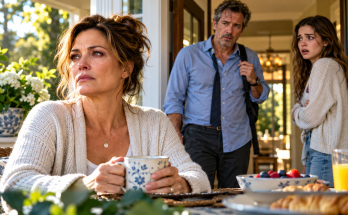
Daniel's dessert remained untouched between us. Around the restaurant, conversations continued, glasses clinked against plates, and a waiter laughed quietly with a table near the door. I watched my husband absorb what I'd said about not wanting to live together again. He stared down at his hands, then folded his napkin with unnecessary care. I recognized the impulse. When emotions became too difficult to manage, Daniel had always preferred doing something practical. This time, however, there was no appointment to arrange or broken appliance to repair. The problem was that I no longer wanted the future he was hoping to recover.
He asked whether I was certain. I said I had become increasingly certain, though that didn't make the decision painless. Daniel nodded, then looked toward the window. After a long silence, he asked whether things might have been different if he'd confessed months earlier. I considered the question. Perhaps they would have been. Honesty at the beginning might have prevented much of the damage that followed. But neither of us could return to that point and make different choices. I told him I couldn't build our future around a version of the past that hadn't happened.
He pressed his fingertips against his eyes. For a moment, I thought he might begin pleading. Instead, he lowered his hands and said he had been hoping that enough time and effort would gradually bring us back together. I told him I knew. His counseling, his honesty about Rachel, and the changes he'd made at work were meaningful. But they couldn't require me to resume being his wife. He looked at me directly and said he was beginning to understand that. Hearing it brought no triumph. I felt grief for both of us, and for the marriage we'd once believed would last our entire lives.
We left the restaurant separately. Daniel walked me to my car and asked whether we could continue the conversation after we'd both had time to think. I agreed. He didn't reach for my hand or ask for a hug. He simply stood a few feet away, his shoulders slightly stooped, and said he was sorry. I thanked him for listening. As I drove home, I felt shaken but strangely steady. I'd finally spoken a truth I'd been approaching for weeks. It had hurt him, but I hadn't said it to hurt him. I'd said it because continuing to imply that reconciliation remained equally possible would have been dishonest.
At home, I changed into comfortable clothes and sat on the edge of the bed. The velvet ring box remained in the dresser drawer. I opened it and looked at the gold band inside. Our wedding day came back to me in fragments: Daniel's nervous smile, the flowers my mother had helped arrange, and the warmth of his hand around mine. We had made our promises sincerely. I didn't believe the marriage had been a lie from the beginning. It had contained years of love, loyalty, laughter, and shared work. The knowledge made its ending more painful, not less.
I turned the ring gently between my fingers. When I'd removed it after counseling, I hadn't been ready to declare what the gesture meant. Now I understood that I was moving toward a permanent decision. I would not return the ring to my finger merely to preserve the appearance of marriage. Still, I couldn't bring myself to treat it as something worthless. I placed it back in the box and closed the lid. The ring belonged to my history, and I wasn't required to destroy that history in order to begin another chapter of my life.
The following week, I met Dr. Avery and described the conversation at the restaurant. I expected her to ask whether I was acting from anger. Instead, she asked how the decision felt when I imagined living with its consequences. I told her it felt sad, frightening, and increasingly right. I would miss parts of Daniel's companionship and the shared identity we'd built over twenty-three years. But the possibility of living independently no longer seemed like a desperate escape. It seemed like a future I could deliberately choose.
We discussed whether my decision was based on fear of another betrayal. I acknowledged that the fear existed. Daniel had lied repeatedly, and trust couldn't be restored simply because he now recognized the damage. But I also told her that even when I imagined a future in which Daniel remained completely honest, I couldn't summon a genuine desire to resume our marriage. I wanted his well-being. I wanted us to treat one another respectfully. I wanted Emma to retain a loving relationship with both parents. I no longer wanted to share the daily responsibilities and intimacy of being his wife.
Dr. Avery allowed the silence after my answer to remain. Then she asked whether I could accept that Daniel might become a better person without remaining my husband. I looked toward the courtyard outside her office. During our separation, he'd begun taking responsibility in ways I once longed to see. He was listening to Emma more carefully, attending counseling, and recognizing how often he'd relied on excuses. I hoped those changes endured. But I was finally beginning to understand that appreciating them didn't create an obligation to offer him another chance at marriage.
At work, I continued handling the office's increasingly busy schedule. My supervisor asked whether I'd consider maintaining my regular hours through the following year. I agreed. The position offered stability, and I enjoyed it. Afterward, I stood beside the copier with a stack of appointment forms and realized that my decision about Daniel hadn't diminished my ability to participate in ordinary life. I was still capable of solving problems, laughing with colleagues, and planning for the future. The marriage was ending, but my life wasn't stopping.
I called Megan that evening. She listened while I explained that I believed I wanted a divorce. She didn't sound surprised, though she was quiet for several moments. Finally, she asked whether I felt peaceful about the decision. I told her peace wasn't exactly the word. I felt sad about what we'd lost, but I was no longer searching for a way to persuade myself that returning would be right. Megan said she would support me through the practical difficulties. Then she reminded me that I had pottery class the following Tuesday. I laughed, grateful that the future still contained ordinary commitments.
Daniel contacted me two days later. He had spoken with his therapist about our dinner and wanted to know whether I would attend one more joint session so we could discuss our next steps carefully. I agreed, provided the appointment wasn't intended to persuade me to reconsider. He said he understood. There was no resentment in his voice, only fatigue. He admitted that he'd spent several nights imagining different arguments he might make. Eventually, he'd realized that trying to convince me would repeat the pattern we'd been working to change. He wanted to hear my decision without turning it into another negotiation.
When we met with Dr. Harris, Daniel spoke first. He said he understood that his recent efforts couldn't undo the affair or guarantee reconciliation. He had hoped the marriage would survive, but he now recognized that I might choose otherwise. He looked at me while he spoke. I could see how difficult the words were, yet he did not ask me to reassure him. Dr. Harris thanked him for explaining his position, then turned to me. I told them I believed we should end the marriage rather than continue a separation whose purpose had changed.
Saying the words aloud felt different from thinking them. My throat tightened, and I paused before continuing. I explained that I hadn't reached the decision because Daniel's recent efforts were meaningless. They mattered, and I hoped he would continue changing. But the trust that once supported our marriage had been damaged over many months, and the life I'd begun building independently felt more authentic than the future I imagined if we reunited. I didn't want us to remain suspended between possibilities simply because accepting an ending was painful.
Daniel began crying quietly. I had seen him emotional during our separation, but this was the first time he seemed to stop resisting the full meaning of my choice. He wiped his face and said he understood. Then he asked whether I believed there was any possibility of changing my mind. I took time before answering. I didn't want to offer false hope out of kindness. I told him I'd considered the question for months, through counseling, conversations, and evenings spent together. I was ready to move forward with divorce. Daniel nodded slowly, and Dr. Harris allowed us a moment of silence.
The counselor asked how we wanted to handle the transition. We agreed that respectful communication mattered, especially concerning shared property and our adult daughter. Daniel said he didn't want the divorce to become a struggle in which we tried to punish one another financially. I agreed, though I reminded him that fairness required complete information and proper professional advice. We would each seek legal guidance and work through the necessary decisions carefully. Neither of us wanted to make promises in the counseling room that might later prove impractical.
Before the session ended, Daniel asked whether we could speak about Rachel one final time. I felt a brief tightening in my stomach but agreed. He said the affair had ended and that he had no intention of returning to her. He wanted me to understand that his personal changes weren't dependent on whether I remained married to him. I told him I hoped that was true. What he did next would be his responsibility. I no longer intended to measure my own worth by whether he chose to remain faithful. That chapter of my life was closing.
We left the office together and stood in the parking lot for a few minutes. Daniel looked toward the road, where traffic moved steadily through the late afternoon. He said he was sorry we'd reached this point. I told him I was too. He asked whether the good years still meant something to me. I looked at him, surprised that he needed reassurance about that. I said they would always matter. Our marriage hadn't been entirely defined by its ending. We'd raised Emma, cared for one another through difficult times, and shared moments of genuine happiness. Those memories deserved honesty, not erasure.
Daniel seemed relieved. He told me he hoped we could eventually remember one another without allowing the final year to overshadow everything that came before. I said I hoped so too, though I couldn't promise how quickly that would happen. We exchanged a quiet goodbye. As I drove home, I felt the strange weight of having chosen a future that neither of us had imagined when we married. The decision was painful, but it was no longer uncertain. We were going to divorce, and the practical work of ending our marriage would now begin.
I contacted Laura Bennett the following morning. She explained the information we would need to prepare the necessary documents and review our shared assets. Daniel arranged separate legal advice, and we agreed to provide complete financial records. Our goal was a fair agreement rather than an argument conducted through attorneys. I knew the process might still involve difficult decisions. The house, retirement accounts, savings, and other obligations represented decades of work. But we had finally stopped pretending that postponing those questions would make them disappear.
The house became the most difficult issue. Laura reviewed the mortgage and the information we'd gathered about its approximate value. I considered keeping it, but doing so would require substantial financial adjustments and the ongoing cost of maintaining a larger property than I needed. Daniel was willing to discuss arrangements that might allow me to remain, yet I couldn't ignore the practical burden. I had begun enjoying a simpler life, and maintaining the house indefinitely might consume resources I wanted to use elsewhere. The decision wasn't only financial. Every room held a version of our family's history.
One evening, I walked through the house with a notebook. I stood in the kitchen where Emma had learned to bake and Daniel had confessed the affair. I looked into her old bedroom, where photographs and books still occupied familiar shelves. In the living room, the graduation picture stood beside the photograph from kindergarten. Upstairs, the main bedroom contained furniture we'd chosen together years earlier. I felt the pull of every memory. Yet I also noticed the unused rooms, the maintenance we'd postponed, and the amount of space one person no longer needed.
Selling the house would mean saying goodbye to the maple tree. That thought brought tears more quickly than I expected. Daniel had planted it when Emma was six, and we'd watched it grow through summers, storms, and long winters. Its shade had become part of our Sunday breakfasts. I stood beneath it that evening, resting my hand against the bark. I remembered Emma riding her bicycle across the driveway while Daniel waited nearby. Those moments had happened here, and leaving wouldn't make them less real. The tree could remain even if our family no longer lived beneath it.
Daniel and I discussed the house several days later. He admitted that he'd been hoping I would choose to keep it because the possibility of returning for family occasions comforted him. I understood the feeling. But neither of us could responsibly arrange our finances around nostalgia alone. After reviewing the options with our advisers, we agreed that selling would be the most practical way to divide the value and allow both of us to establish stable separate homes. Daniel looked sad when we reached the decision. I did too. There was no need to pretend it was easy.
The next conversation belonged to Emma. We arranged to meet her for lunch near her apartment, choosing a quiet place where she would feel comfortable. Daniel arrived separately. Before discussing the decision, we congratulated her on receiving a promising job offer from one of the employers she'd interviewed with. She was excited and nervous about beginning full-time work. We listened while she described the position and the people she'd met. I wanted her to experience our pride before hearing news that would undoubtedly hurt.
When the meal was nearly finished, I told Emma that her father and I had decided to divorce. She looked down at her plate. For several seconds, she didn't speak. Then she asked whether we were both certain. Daniel said we'd spent months considering the future and had reached the decision after counseling and careful conversations. I told her I wasn't making the choice in anger. I believed it was the right direction for my life. Emma nodded slowly, though I could see tears gathering in her eyes.
She asked whether we'd continue getting along and whether she'd have to choose where to spend holidays. I told her we would make arrangements respectfully and that she would never be asked to take sides. Daniel agreed. He said our marriage was ending, but our love for her wasn't. Emma wiped her eyes and told us she'd been frightened this might happen, even while hoping it wouldn't. I reached across the table and took her hand. Daniel sat quietly beside us, allowing her to express sadness without trying to change it.
Then Emma asked about the house. I explained that we intended to sell because it was the most practical choice. Her face crumpled briefly. She said she'd imagined bringing her own children there someday, though she didn't know whether she even wanted children. The admission broke my heart. I told her I understood. We had all imagined futures connected to that house. But the memories it held would remain part of us, and we could create new traditions wherever we lived. She nodded, still crying, then asked whether she could help sort through her old belongings before the sale.
We agreed she should have as much time as she needed. Daniel offered to help her move boxes and said she could keep anything from her childhood room that mattered to her. Emma looked at him and thanked him. Their relationship remained cautious, but I could see that she appreciated his willingness to respect her wishes. We finished lunch quietly, discussing practical matters rather than trying to make the decision feel less significant. Before leaving, Emma hugged each of us. Her embrace was long and tight, and I felt her grief as clearly as my own.
That evening, I returned home and opened the cupboard containing Daniel's blue mug. It had remained there since he moved out. I took it down and ran my thumb carefully around the chipped handle. Emma had chosen it when she was nine, and Daniel had used it for years. I remembered the Sunday mornings when I prepared his coffee automatically, even while wondering whether he'd come home. The mug had become associated with waiting, but it also belonged to a happier period of our family. I decided to set it aside for Daniel rather than pack it with the household dishes.
I placed the mug in a small box with several other belongings he'd left behind. Then I took out the blue-gray pottery cup I'd made with Megan. Its rim was uneven, and one side was slightly thicker than the other. I filled it with tea and carried it onto the porch. The evening air was warm, and the maple leaves moved softly overhead. I sat there thinking about the difference between the two cups. One belonged to years of shared routines, some loving and some painful. The other represented something I'd chosen and made myself. I could honor the first without surrendering the second.
Over the following weeks, we gathered financial records, reviewed household possessions, and began preparing for the sale. There were moments of tension, especially when decisions involved objects with sentimental value. Daniel wanted to keep a small cabinet his father had given us. I wanted several photographs and the dining table if it would fit wherever I moved. We discussed the differences without allowing them to become arguments about the affair. Sometimes one of us needed time before deciding. We were learning that ending a marriage respectfully required more care than simply agreeing that it should end.
At the beginning of autumn, a real estate agent visited to evaluate the house. She walked through the rooms, measured spaces, and discussed repairs that might help prepare it for sale. Daniel joined us for the appointment. We answered questions about the roof, furnace, and recent maintenance. The agent complimented the mature maple tree, saying it gave the front yard considerable character. I looked out the window while she spoke, remembering the sapling Daniel and Emma had planted together. The tree had become part of the house's identity, just as our family had once been.
After the agent left, Daniel and I stood in the kitchen surrounded by the ordinary objects of our marriage. He asked whether I was ready to list the property. I looked around slowly. I wasn't emotionally ready in the sense of feeling no sadness. I doubted such readiness would ever arrive. But the decision was considered, practical, and consistent with the future we'd chosen. I told him yes. We signed the listing documents the following afternoon, agreeing to begin the process of selling the home where we'd raised our daughter.
When the agent later placed the sign near the front walkway, I stood behind the living-room window and watched. Its metal frame sank into the grass a few feet from the maple tree. The house suddenly looked different, as though the life we'd lived inside it had become something other people might purchase and inhabit. I felt tears move down my cheeks, but I didn't look away. Daniel and I had made the decision together, without deception or threats. For the first time in a long while, a painful step had been taken because we both understood what it meant. The marriage was ending, and the home that had held it was preparing to belong to someone else.