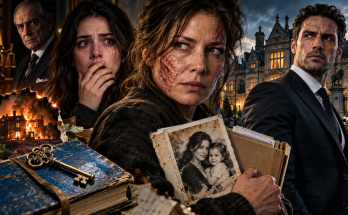
The photograph that had separated Emily and me for three years was lying inside a storage box marked with a meaningless account number. I recognized it the moment Miriam Shaw placed the newly recovered image on her conference table. There I stood outside the Ashford Hotel, wearing the charcoal coat Emily had bought me for my birthday, apparently handing a leather folder to a dark-haired woman. Her face was partly turned away, but the resemblance to Marianne Carter was unmistakable. I had never met Marianne at the time. The woman beside me had never stood there. Yet someone had made the encounter appear real enough to destroy everything Emily believed about me.
Miriam did not allow anyone to touch the original print. It remained inside a transparent protective sleeve, accompanied by an evidence inventory prepared during the examination of Martin Bell's private storage facility. The records had been obtained through lawful investigative procedures, and the original electronic materials were undergoing separate forensic analysis. I understood the precautions. We had already learned how convincingly false documents could imitate genuine ones. A photograph was no different. Its power came from persuading the viewer that the camera had captured something that actually happened.
Emily sat beside me, her hands clasped so tightly that the knuckles had turned white. She had asked to see the materials when investigators could release copies, and Miriam had obtained permission for this limited review. The original photograph from the Ashford inspection lay alongside the altered version. In the genuine image, I was speaking with a structural engineer named Daniel Reeves. His face had been replaced by that of a woman taken from another photograph. The angle of her shoulders had been adjusted, and part of the background had been reconstructed to conceal the alteration.
"I noticed the lighting," Emily whispered. "Afterward, when I began looking at it again. But by then I'd already left." She leaned closer without touching the image. "The first time I saw it, all I could think was that my mother was alive and you knew." Her voice broke slightly on the final words. I remembered waiting for her telephone call in the weeks after she disappeared, checking unfamiliar numbers and convincing myself she would eventually explain. We had been living inside opposite versions of the same lie.
David Mercer arrived carrying a separate folder containing payment records. Investigators had identified the company that prepared the altered image. It was a small commercial design service normally employed to produce presentation graphics, promotional composites, and architectural illustrations. Bell's office had commissioned the work through an intermediary, using a project description that referred to preparing reference material for a confidential property dispute. The invoice itself did not reveal the intended deception, but the accompanying instructions were considerably more specific.
Miriam turned to a printed message recovered from an archived project directory. The client had requested that the engineer in the original image be replaced with the supplied female subject. The replacement was to appear natural, with the subject's face sufficiently visible for recognition but not so clear that minor differences would become obvious. Another instruction asked the designer to retain the original date stamp. I stared at the words. Bell had not merely shown Emily a misleading photograph. Someone working for him had commissioned an image whose purpose depended upon appearing to document a real encounter.
"Who supplied the woman's photograph?" I asked. Miriam consulted the inventory. "A file submitted by Bell's office. The investigators are tracing its original source." Emily leaned forward. "Was it Mom?" Miriam shook her head. "We can't establish that from the image alone. The woman resembles Marianne, but the face may have been modified as well." I remembered the genuine photograph we had found of Marianne during her years of restricted medical treatment. Bell possessed access to numerous images of her. He could have selected one that supported the deception without needing her cooperation.
The materials also contained a correspondence file concerning delivery. A courier had been instructed to leave the photographs at Emily's office in an envelope that did not identify Bell's firm. The package included a copy of a vehicle-access record suggesting I had been at Whitmore House on the evening I was actually in New York. The supposed record was formatted to resemble an internal security report, although the original logs showed my assigned vehicle had remained elsewhere. Each piece reinforced the others, creating the appearance of independent evidence.
Emily studied the correspondence with a strained expression. "I remember the envelope," she said. "It was waiting on my desk after lunch. There was no letter, only the pictures and the security sheet." She looked at me. "I thought someone was warning me about you." Miriam nodded. "That appears to have been the intended impression." Emily lowered her eyes. "I spent the afternoon trying to find explanations that would make it less terrible. Then I decided there couldn't be an innocent one." I reached toward her hand, but she was still studying the photograph.
One recovered internal memorandum was dated the morning after Emily visited the estate. Its author reported that the target had approached the property but had not entered the main residence. The document also referred to her departure in a private car and recommended continued observation until she ceased contacting people associated with the Ashford investigation. The memorandum did not use Emily's name, but the date, vehicle description, and sequence of events matched her account. I felt anger rising slowly as I read it. Someone had watched her arrive, hesitate, and drive away.
"Keene's team?" I asked. Miriam nodded cautiously. "The file came from a security folder connected to his former company. The investigator is examining who prepared it." I looked at Emily. "You said someone followed you back to your car." She nodded. "I heard footsteps behind me. I didn't see anyone clearly." For three years, that memory had been part of her private terror. Now there was documentary evidence that someone connected to Bell's security arrangements had been observing her movements that night.
Another file contained instructions for monitoring certain telephone numbers and professional contacts. Several belonged to Emily's research colleagues. One number was associated with Clara, though she had not yet begun working at my house. Bell's operation had apparently tracked family connections long before Emily disappeared. Miriam pointed out that possession of a contact list did not establish that every number had been intercepted or monitored unlawfully. Still, the records showed an organized effort to identify the people Emily might approach for help.
"Did he know I was considering telling Lucas?" Emily asked. Miriam looked through the correspondence. "There is a note saying you attempted to contact an executive office after receiving the photographs." Emily frowned. "I called Whitmore Development. I asked whether Lucas had returned from New York." She looked at me. "Someone said you were unavailable." I remembered that week. I had been in meetings, but I never received a message saying Emily had called with an urgent question. She shook her head. "I thought you were avoiding me because you knew what I'd discovered."
I asked whether the original telephone records could establish who handled her call. Miriam said investigators were examining surviving office logs and any archived communication records. It was unlikely that every detail from three years earlier remained available. We might never learn precisely what the receptionist said or whether anyone deliberately withheld the message. Yet Bell's team had documented Emily's attempt to contact the company. Someone knew she was seeking confirmation, and that knowledge had entered the same private file as the fabricated photographs.
For several minutes, Emily remained silent. Then she asked to see the altered image again. Miriam placed the sleeve closer. Emily studied the woman's face, the folder, and the position of my hand. "They used the photograph from the preservation report," she said. "I helped prepare some of the historical material for that report." She looked at me with an expression of painful recognition. "I may have given them access to the image myself, without knowing what they intended." I shook my head. "That doesn't make you responsible for what they created."
"I understand that," she said. "But it's strange to see how ordinary things became part of it. A photograph for a project report. A call to your office. A car parked where I expected yours to be." She touched the edge of her notebook. "None of those things should have been enough to make me disappear." I considered my response carefully. "You were being threatened and deliberately misled. We can acknowledge that you made a terrible decision without pretending someone didn't work very hard to bring it about."
Emily looked at me for several seconds. Then she nodded. Her eyes filled, but she remained composed. "I don't want the explanation to become an excuse," she said. "I want to understand why I believed it." I thought of my own misplaced trust in Bell, the years I accepted his assurances because they allowed me to concentrate on buildings and contracts. Emily had trusted a photograph because it appeared to confirm what she already feared. I had trusted a lawyer because his explanations made my life simpler. Both weaknesses had been exploited.
David returned to the financial records. The design company had been paid through a consulting account connected to Northbridge Capital Holdings. The invoice was small compared with the disputed trust transfers, but its value as evidence was considerable. It connected the production of the misleading photograph to the same financial network that handled Marianne's accommodation, Keene's security payments, and the questioned Ashford debt. The investigation no longer depended solely on Emily remembering how an anonymous envelope reached her office.
"We can trace payment authorization, file delivery, and the contractor's instructions," David explained. "That's a sequence independent of anyone's interpretation of the picture." He paused. "The investigators still need to establish who knew what and who intended the image to deceive. But the documents provide a direct route to those questions." I looked at the payment date. It fell within the final week before Emily vanished. The planning had not been casual. The photograph was commissioned at exactly the moment her investigation threatened to connect the original trust to the modern accounts.
Miriam brought out one final folder from the storage inventory. It contained drafts of letters prepared after Emily disappeared. Several were addressed to me but never sent. One suggested that Emily had voluntarily left Boston for personal reasons and wanted no further contact. Another presented itself as a confidential message from someone close to her, asking me to stop searching. None contained her genuine signature. I remembered receiving vague information from people who claimed Emily wished to be left alone, but no document that could be authenticated. These drafts showed how someone had considered shaping my understanding as well.
I studied the unsent letters. Their tone was cold, almost contemptuous. The person writing them had attempted to make Emily sound impatient with our relationship, as though she regarded my confusion as an inconvenience. Nothing about the language resembled her actual voice. "Why weren't they sent?" I asked. Miriam shook her head. "We don't know. Perhaps Bell's office decided direct impersonation was too risky. Perhaps the drafts were abandoned once you stopped making inquiries." I remembered how my father had encouraged me to accept Emily's departure. I wondered whether Bell had been relieved when I finally obeyed.
An attachment to the folder contained a later security summary noting that my search for Emily had largely ended. The entry was dated several months after her disappearance. I read it twice, remembering the miserable week when I canceled the private investigator and returned to work full-time. I had convinced myself I was respecting Emily's choice. Now I understood that someone had been waiting for exactly that surrender. I put the paper down because my hands had begun to shake.
Miriam gave us time alone in the conference room. Emily stood beside the window, watching pedestrians move across the street below. I approached her slowly. "You once told me the worst thing about losing someone was not knowing when the last ordinary moment had already happened," I said. She turned toward me. "I remember." "I thought our last ordinary moment was the dinner before you disappeared. I kept replaying it, trying to find what I'd missed." She looked down. "I was already frightened then."
"I know." I stopped beside her. "But someone was trying to make both of us believe we had lost the other by choice." Emily wiped her eyes. "And we both accepted it eventually." I nodded. "For different reasons." She looked at me. "I won't ask you to stop being angry." I took her hand. "I'm not angry every time I look at you anymore." The admission surprised me. It was not forgiveness completed, but it was true. Her fingers closed around mine.
When we returned to Miriam's table, she had prepared a list of records still requiring examination. The most significant was a separate correspondence file containing communications sent to Emily after she went into hiding. It included references to threats against Clara and Marianne, but some messages appeared to have been received through intermediaries whose identities remained uncertain. Emily examined the dates and recognized several communications she had preserved in handwritten notes. Miriam wanted to compare the recovered originals with her copies.
We arranged a separate review because Emily was visibly exhausted. She had spent the morning confronting the machinery of a lie that governed three years of her life. I asked whether she wanted to return to Marianne and Clara. She nodded, then stopped beside the photograph. "May I take a copy?" Miriam explained that investigators could provide an approved duplicate without disturbing the evidence. Emily accepted it carefully. "I don't want to keep looking at it," she said. "But I want to remember that something can look certain and still be false."
At the temporary accommodation, Clara listened as we explained the photograph and the payments connecting it to Bell's network. She did not interrupt until Emily described the security memorandum documenting her visit to the estate. "They knew where you were," Clara said. Emily nodded. "At least that night." Clara looked toward Marianne, who was helping Rosie build a tower from wooden blocks. "And they knew Mom was alive while telling us she wasn't." I could see anger gathering in her expression. This time, however, it did not turn toward her sister.
Clara reached across the table. "I wish you'd called me," she told Emily. "I might have been frightened, but we could have been frightened together." Emily accepted her hand. "I know." They sat like that while Rosie announced that her tower was taller than the house. Marianne laughed softly, and Mrs. Dalton moved closer to admire the construction. The sound of ordinary conversation made the recovered photographs seem even more cruel. Bell had taken a family already damaged by loss and deliberately widened every separation.
That evening, David sent Miriam the preliminary financial connection between the photograph contractor and Northbridge. The same approval account had been used for a payment made shortly after Emily disappeared, described as confidential relocation assistance. The recipient was an intermediary who had communicated with Emily while she was hiding. It was not yet clear whether that person knowingly worked for Bell or believed they were helping someone in danger. The distinction mattered, but the payment suggested Bell's financial network remained involved after Emily left.
I called Emily when Miriam shared the information. "Do you remember who helped you find your first place to stay?" I asked. She was quiet for a moment. "A woman contacted me through someone connected to the historical preservation project. She said she knew a safe apartment." "Did she ask you to avoid contacting me?" Emily exhaled. "Yes. She told me people associated with Whitmore Development were watching my calls." I looked at the payment record. "That warning may have come from the same people who were watching you."
Emily said nothing for several seconds. Then she answered, "I was frightened enough to accept help without asking who arranged it." Her voice was not defensive. It was weary. "I thought I was escaping them. Maybe I walked directly into something they controlled." I looked toward the library window. "You did eventually find your own evidence and your mother." "Yes," she said. "But it took me far too long to understand which warnings were real and which were designed to keep me away from you."
Before ending the call, I promised that Miriam would review the relocation records without exposing any current address unnecessarily. Emily thanked me. I remained in the library afterward, thinking about how Bell's control had depended on making each person believe they were acting independently. He did not need to lock every door. He needed to decide which doors people believed were safe to open. Emily had found shelter while remaining within reach of his network. Marianne had received medical care while being denied an independent life.
Near midnight, Miriam called again. The correspondence file contained a message prepared nearly two years after Emily disappeared, around the time she began questioning the altered photograph. It instructed an intermediary to warn Emily that renewed contact with me would create immediate consequences for Clara and Rosie. The attached records included a photograph of mother and child entering a neighborhood shop. Emily had described receiving that very image, but investigators had never possessed the original file.
I stood motionless beside the desk. Rosie would have been an infant at the time. Bell's people had not simply threatened Clara in vague language. They had shown Emily proof that they could identify her sister and niece during ordinary errands. Miriam's voice was quiet. "This helps explain why she remained hidden even after she stopped believing you were involved." I looked at the photograph of Emily in my jacket pocket, the one she had left behind Margaret's portrait.
For years I had asked why she did not return when she began doubting the deception. Now a documented threat against a child provided a direct answer. It did not excuse every choice, and it did not restore the years we lost. But it showed the danger Emily believed she faced was not a fantasy constructed by guilt. Someone had watched Rosie, photographed her, and used that image to silence the woman who loved us both. I asked Miriam to preserve the evidence and ensure Clara could learn what had happened through a careful conversation, rather than another surprise.