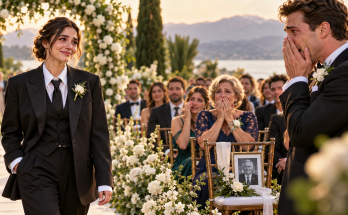
Claire found me at the dining room table after midnight.
Wedding gifts still occupied half the room. A stack of thank-you cards leaned against the wall beside a blender Aaron had already threatened to borrow. My laptop sat open in front of me, and Dad’s watch lay beside it because I had taken it off after showering.
I had rewritten the victim-impact statement four times.
Claire stood behind my chair and read the last paragraph over my shoulder.
“You changed it again.”
“Yes.”
“What did you remove?”
“The part about punishment.”
She pulled out the chair beside me.
“Why?”
“Because I realized I was writing what I thought the judge should do.”
“And you don’t want to?”
“I don’t know enough.”
That answer would have infuriated me a week earlier.
Now it felt responsible.
I scrolled upward.
The statement began with facts.
I was twenty when Marcus used my identity.
He stole money my grandfather had intended for me.
When I discovered it, I decided to tell my father and police.
Marcus knowingly gave an intoxicated seventeen-year-old keys to Thomas’s truck and directed him toward me.
Marcus followed me.
He deliberately moved his car into mine while trying to force me to stop.
Seconds later, Evan ran a red light and struck my vehicle.
Afterward Marcus approached my unconscious body, removed my backpack and the folder containing evidence of his fraud, and left without calling emergency services.
Every sentence had evidence behind it.
No adjectives necessary.
Then came the part that was harder.
For fourteen years, I had believed the crash began with Evan.
Because of Marcus, I also lost the chance to know what I had already decided before the collision.
I wrote:
The money mattered less than the removal of my own history. Until this week, I did not remember that I had discovered the theft, confronted Marcus, and chosen to report him. Those facts were preserved in documents and a voicemail that Marcus kept while I forgot them.
Claire read the paragraph silently.
“Keep that.”
“I plan to.”
“It’s the clearest part.”
I nodded.
The next section concerned Dad.
I had hesitated to include him.
Then I understood that leaving him out would create the same distorted story everyone had lived with for fourteen years.
So I wrote that my father concealed information after the accident because of fear, guilt, and misguided protection.
I wrote that his silence harmed me even though he believed at first he was helping.
I wrote that Marcus later exploited that silence.
And I wrote that discovering my father’s mistake did not reduce Marcus’s responsibility any more than Marcus’s conduct erased my father’s.
Claire tapped the screen.
“That sentence.”
“What?”
“Read it aloud.”
I did.
“Responsibility is not a scale where one person’s wrongdoing makes another person lighter.”
She nodded.
“That’s the whole week.”
I leaned back.
“Dad would hate that sentence.”
“Too abstract?”
“Too many syllables.”
Claire smiled.
“He’d say, ‘Everybody owns their own mess.’”
I stared at her.
“That is annoyingly accurate.”
“You married me for a reason.”
“Your modesty?”
“Obviously.”
I returned to the final paragraph.
This was where I had been stuck.
I did not want to ask the court for vengeance.
I also did not want to perform generosity.
Forgiveness could become another kind of theater when demanded publicly.
Finally I wrote:
I am not asking the court to make Marcus suffer because I suffered. I am asking that what happened be named accurately. He made choices that endangered me, stole from me, and helped conceal the truth afterward. I want whatever consequence the law still permits to reflect those choices, not the person he claims he intended to be.
Claire read it.
Then she looked at me.
“That’s it.”
“You think?”
“Yes.”
“No dramatic ending?”
“You have had enough dramatic endings.”
Fair.
I saved the document.
For once, I did not immediately reopen it.
The next morning, I sent it to Harold.
His reply came thirteen minutes later.
Good. Stop editing.
I showed Claire.
She laughed.
“He knows you.”
“Everyone knows me now, apparently.”
Later that afternoon, Evan called.
Not Thomas.
Evan.
“Do you have time?”
“Yes.”
“I need to give you something before you leave for the honeymoon.”
I glanced at Claire.
She mouthed, What?
I shook my head.
“Another document?”
“No.”
“Key?”
“No.”
“Cassette?”
He laughed.
“No.”
“Suit?”
“What?”
“Never mind.”
We met at a coffee shop near our house.
Evan arrived alone.
He looked less tense than the first time I saw him at Thomas’s kitchen table.
Still cautious.
But no longer moving as though one wrong sentence might cause the floor to open beneath him.
He carried a thin white envelope.
I stared.
“You promised it wasn’t another document.”
“It’s technically paper.”
“I hate you.”
That startled a laugh out of him.
It was the first time either of us had joked without immediately regretting it.
We sat.
Claire ordered coffee for all three of us.
Evan placed the envelope between us.
“My letter.”
The one he wrote four years ago after Dad died.
TO DANIEL — EVAN.
I had carried it from Thomas’s house but had never opened it.
Somewhere during the movement between lawyers, statements, and recovered evidence, Evan had asked Thomas for it.
I had not noticed.
“You want me to read it?”
“No.”
That surprised me.
“I want to take it back.”
I stared.
“Why?”
“Because I wrote it for the wrong reason.”
Claire remained quiet.
Evan turned the envelope beneath his fingers.
“I wrote it after Richard died because I thought I’d lost my only chance to do what he expected.”
“To meet me.”
“Yes.”
“So?”
“I spent most of the letter explaining.”
My chest tightened.
“The leukemia?”
“Yes.”
“The panic?”
“Yes.”
“The EMT work?”
“Yes.”
“All true.”
“True isn’t the same as useful.”
Dad’s lesson again.
Evan looked embarrassed.
“I wrote about how guilty I felt. How many crashes I’d responded to. How becoming a father changed me.”
“And?”
“And none of that was about you.”
I understood.
The letter had been another attempt to make my pain carry the weight of his transformation.
Not maliciously.
But still.
“I want to destroy it.”
I pushed the envelope toward him.
“It’s yours.”
He picked it up.
Then stopped.
“There is one thing I do want to say.”
I waited.
“I’m sorry I drove after drinking.”
Simple.
“I’m sorry I ran the red light.”
His hands stayed flat on the table.
“I’m sorry I left you.”
No qualification.
“I’m sorry I made your father hear my voice on your phone and wonder whether you were dying because of something I had done.”
My throat tightened.
Evan continued.
“I’m sorry I let fear make me run a second time after I had come back.”
He swallowed.
“And I’m sorry that for fourteen years you didn’t know enough to decide what any of it meant.”
That last part landed hardest.
I looked at him.
He did not say he had changed.
Did not mention his daughter.
Did not remind me he became a paramedic.
Did not ask me to forgive him.
Dad would have approved.
Maybe that was why I finally knew what I wanted to say.
“I forgive you.”
Evan stared.
Claire’s hand stopped halfway toward her coffee.
I surprised myself too.
The words did not create music.
No physical release.
No magical reduction in memory.
They simply sat between us.
Evan shook his head.
“You don’t have to.”
“I know.”
“You said you weren’t ready.”
“I wasn’t.”
“Are you now?”
I considered.
“Enough.”
His eyes filled.
I continued before forgiveness became something larger than I intended.
“I forgive the seventeen-year-old who hit me and ran.”
He waited.
“I’m not saying what you did was okay.”
“I know.”
“I’m not promising I’ll never be angry about it again.”
“I know.”
“I’m not asking anybody else to forgive you.”
“I know.”
“And I’m definitely not saying cancer caused the crash.”
“It didn’t.”
“But I don’t want to keep you at the intersection anymore.”
Evan looked down.
A tear fell onto the envelope.
He wiped it away quickly.
“Thank you.”
I shook my head.
“Don’t make it a reward.”
He looked back up.
“It isn’t.”
Good.
Claire smiled at me.
I immediately became defensive.
“What?”
“Nothing.”
“You’re doing the face.”
“What face?”
“The I’m emotionally impressed with my husband face.”
“I have no such face.”
“You absolutely do.”
Evan laughed quietly.
The moment became survivable.
After coffee, we stood outside.
Evan still held the sealed letter.
“What are you going to do with it?”
“Shred it.”
“Good.”
He looked toward the parking lot.
“My juvenile review is next month.”
“I heard.”
“I don’t know what they’ll decide.”
“Neither do I.”
“If there’s restitution or community service or anything—”
“Do it.”
He nodded.
“I will.”
Then he said, “Richard once told me something I never wrote in the statement.”
My body tightened automatically.
Evan saw it and laughed.
“Not a secret.”
“Good.”
“In the garage, after he asked what I was going to do next, I told him I didn’t know whether I’d live long enough to do anything.”
My chest tightened.
“What did Dad say?”
“He said, ‘Then quit wasting the part you know you have.’”
I looked away.
That was so completely Dad that hearing it from Evan hurt.
“Did it help?”
“Not then.”
“When?”
“Later.”
We stood quietly.
Then I reached out.
Evan looked at my hand.
For a second, neither of us moved.
Then he shook it.
No embrace.
No symbolic brotherhood.
A handshake.
Enough.
Claire and I drove home.
Halfway there, she said, “You forgave him.”
“Yes.”
“You okay?”
“Yes.”
“Was that planned?”
“No.”
“Good.”
“Why good?”
“Because if you had scheduled forgiveness, there would’ve been a spreadsheet.”
“That’s offensive.”
“It would have had columns.”
“Stop.”
“Factors supporting forgiveness. Factors against.”
“I’m divorcing you.”
“After the honeymoon.”
We reached home.
I carried Dad’s recorder from the desk to the bedroom.
Claire watched.
“Tonight?”
I looked at the padded case.
“No.”
She nodded.
This time, not listening did not feel like avoidance.
It felt like permission.
The next morning, Harold called.
Marcus had formally accepted responsibility for the fraud, identity theft, deliberate sideswipe, concealment of the folder, and supplying the vehicle key to Evan.
He continued to deny intending the later truck collision.
So did the prosecution.
There was no evidence strong enough to say otherwise.
The truth, at last, had boundaries.
I appreciated them.
“What happens now?”
Harold explained.
Legal proceedings would continue beyond our honeymoon.
Restitution would be addressed.
Sentencing could take months.
There might be testimony.
Appeals.
Paperwork.
Life.
I looked toward our suitcases.
For once, “later” did not mean buried.
It meant scheduled inside a process larger than me.
“That’s fine.”
Harold became quiet.
“What?”
“You sound different.”
“I got married.”
“That fast?”
“Apparently.”
He laughed.
Before hanging up, he said, “Richard would—”
“Don’t.”
He stopped.
“I know.”
“Good.”
Then Harold surprised me.
“He loved you.”
My throat tightened.
“I know.”
“That is not legal advice.”
“Good.”
“Free of charge.”
“Even better.”
I ended the call.
Claire emerged from the bedroom carrying Dad’s travel notebook.
“You packed this?”
“Yes.”
“Why?”
“You wanted a trip without schedules.”
“That notebook contains schedules.”
“Exactly. We need an antagonist.”
I laughed.
She dropped it into my bag.
Dad’s watch was already on my wrist.
His wedding suit remained hanging in the guest room.
I looked toward the closet.
For the first time, I did not feel Dad waiting inside it.
Just fabric.
Useful fabric.
Memory without weight.
Then Claire took my hand.
“Airport.”
“Flight is at two-twenty.”
“I know.”
“We should leave by eleven-fifteen.”
“Daniel.”
“What?”
“No spreadsheet.”
“I can still know departure time.”
“Barely.”
I grabbed our bags.
At the door, I checked my phone.
No missed calls.
No new evidence.
No urgent message.
I put it in my pocket.
Claire opened the door.
For the first time since our wedding, we left the house without following anything my father had left behind.