PART 1 — THE WIDOW WHO REFUSED TO SELL HER LAST HOPE
Kansas, September 1874.
“Three cents a bushel. That’s my final offer.”
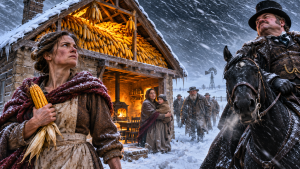
Cyrus Pemberton sat proudly on his black horse, looking down at the exhausted widow standing outside her barn.
Behind her lay four hundred bushels of golden corn.
It was everything Nettie Burgess had left.
Her husband, James, had died working to bring that harvest in. His final summer had been spent beneath a merciless sun, pushing himself through illness because he believed one good crop could save their little farm.
Now James was buried beneath a cottonwood tree.
And a wealthy grain merchant was offering his widow twelve dollars for an entire year’s work.
“Twelve dollars?” Nettie whispered.
Pemberton adjusted his expensive coat.
“The market has collapsed, Mrs. Burgess. Take the money while someone is still willing to offer it.”
Nettie looked toward the empty fields.
The grasshoppers had destroyed crops across Kansas. Desperate farmers were selling whatever remained, and men like Pemberton were buying everything for almost nothing.
“Eight cents a bushel,” Nettie said quietly. “That’s what it cost us to grow.”
Pemberton laughed.
“Your expenses are not my concern.”
He leaned forward in his saddle.
“Your mortgage comes due before spring. Your taxes won’t wait. And without a husband, I doubt you’ll survive another winter.”
Nettie’s fingers tightened around her apron.
“Then I’ll find another way.”
The merchant smiled coldly.
“Winter has a way of changing a woman’s mind.”
He turned his horse.
“When the sheriff auctions this farm, Mrs. Burgess, I’ll be there.”
And with that, he rode away.
Nettie remained standing until the dust disappeared.
Then she entered the barn, sank beside the mountain of corn, and finally allowed herself to cry.
She had promised James she would keep their land.
But promises didn’t buy firewood.
And memories couldn’t fill an empty stomach.
That evening, Nettie walked toward the creek, where she found the one person who had never treated her poverty like a personal failure.
Aunt Birdie Tatum.
Birdie was sixty-three, a formerly enslaved woman who had come from Mississippi to Kansas seeking a life she could call her own.
She lived in a small cabin, washed clothes for neighboring families, gathered medicinal plants, and possessed something money could never purchase.
Knowledge earned through survival.
Birdie listened as Nettie described Pemberton’s offer.
“Four hundred bushels,” the older woman repeated.
“And not a buyer willing to pay a fair price.”
Birdie studied the water flowing between the stones.
“Child, who told you corn was only good for selling?”
Nettie frowned.
“What else am I supposed to do with it?”
Birdie smiled.
“Come to my house.”
Inside Birdie’s little cabin, Nettie immediately noticed something strange.
It was warm.
Unusually warm.
Although the September evening had turned bitterly cold, the small stove held only a modest fire.
Then Nettie looked upward.
Her mouth fell open.
Dried ears of corn hung beneath the rafters.
Above them, the attic was packed with more corn.
“Birdie! Why is there corn in your ceiling?”
“Because winter comes every year,” Birdie answered.
She explained that dried corn, arranged in the enclosed overhead space, helped slow the escape of warmth.
The trapped air made a difference in her little cabin.
“And when spring comes?” Nettie asked.
“I bring down the corn, grind it, and eat.”
Nettie stared upward.
“You mean your ceiling is also your pantry?”
Birdie’s eyes sparkled.
“It’s food when I’m hungry, and it helps keep me warm when I’m cold.”
For the first time since James died, Nettie felt something stronger than grief.
Hope.
But Birdie caught her wrist before she could rush outside.
“Don’t mistake an idea for an easy task. Four hundred bushels weigh more than most roofs can bear. Your house is not my cabin.”
Nettie nodded.
She knew the old ceiling James had built. She knew how much work would be required before any such plan could be considered.
Yet that night, lying alone beneath the cold roof, she kept thinking about Birdie’s words.
What if the harvest wasn’t worthless?
The following morning, Nettie began working.
She inspected the attic, studied its aging supports, and spent days preparing the space. With Birdie’s help and advice from an experienced neighboring carpenter, she made the extensive reinforcements their plan required.
Then came the exhausting work of moving the harvest.
Basket after basket.
Day after day.
She carried the dried corn from the barn into the prepared attic.
Her shoulders throbbed.
Her hands blistered.
More than once, she sat on the floor, trembling with exhaustion.
And every time, she remembered James.
“I won’t lose it,” she whispered.
“Not after everything we gave.”
By late October, the harvest was stored overhead.
Nettie stood in the middle of her sod house, looking at the ceiling.
Hundreds of bushels of corn rested above her.
She had no money.
Very little firewood.
And no guarantee that Birdie’s unusual idea would work in her larger home.
Then the first serious cold arrived.
Nettie lit the stove.
For years, heat had escaped through her poorly insulated ceiling almost as quickly as she produced it.
But that evening, something changed.
The room remained warmer.
The next morning, the air wasn’t nearly as cold as usual.
Nettie pressed both hands against her mouth.
Then she laughed.
For the first time in months, she laughed until tears ran down her cheeks.
It was working.
When Cyrus Pemberton returned in November, he found Nettie chopping wood outside.
“Where’s your corn?” he demanded, noticing the empty barn.
“In my attic.”
He stared.
“You did WHAT?”
“It’s helping keep my house warm. And in spring, I’ll have food.”
Pemberton shook his head.
“You’ve lost your mind.”
“Perhaps,” Nettie replied. “But I haven’t lost my farm.”
The merchant departed furious.
Yet the happiness of that small victory did not last.
December arrived with heavy snow.
January brought temperatures twenty degrees below zero.
Blizzards swallowed fences, buried roads, and turned isolated farms into islands of desperate human suffering.
Families ran out of fuel.
Children became sick.
Food disappeared.
And although Nettie’s home remained warmer than many others, she could hear the wind pounding against its walls every night.
Then one February evening, someone began hammering on her door.
Nettie lifted the lantern.
“Nobody should be outside in this weather,” she whispered.
The pounding grew frantic.
She pulled open the door.
Aunt Birdie stood in the blizzard, her face covered with frost.
And in her arms was a small child who appeared barely alive.
“Birdie!”
The old woman staggered forward.
Nettie caught her just before she collapsed.
Birdie looked up, her voice breaking.
“The Hendersons burned their barn trying to stay warm.”
Nettie stared at the child.
It was little Ruth Henderson.
Her lips were blue.
Her breathing was shallow.
And then Birdie spoke six words that changed everything.
“Nettie, there are more of them out there.”
PART 2 — THE NIGHT THE CORN-FILLED ATTIC BECAME A LIFELINE
The words seemed to freeze the air inside the cabin.
Nettie looked at little Ruth Henderson.
The child’s eyelashes were coated in ice. Her tiny hands hung motionless.
“Where are her parents?”
Birdie struggled to answer.
“Halfway down the eastern road. Their barn is gone. Their house is freezing. I found Ruth by the fence, but her father and mother are still out there.”
Nettie felt her heart pounding.
Outside, the blizzard howled like a living animal.
Nobody could see more than a few yards.
But she remembered what James used to say.
When your neighbor’s light goes out, yours must burn twice as bright.
She carried Ruth toward the stove and wrapped her carefully in warm blankets.
“Stay with her,” Nettie told Birdie.
“Where are you going?”
“To bring the others home.”
“Child, you’ll freeze!”
“Then pray I don’t.”
She tied a length of rope around her waist, secured the other end to the porch post, and stepped into the storm.
The wind struck her so violently that she nearly fell.
Snow filled her eyes.
Her lantern flickered.
She called for Mr. Henderson until her throat burned.
No answer.
Then, through the roaring darkness, she heard something faint.
“Help!”
Nettie stumbled toward the sound.
Beyond the reach of her rope, she discovered Thomas Henderson crouched beside his wife, Martha.
Martha could barely stand.
Thomas had wrapped his coat around her shoulders, leaving himself dangerously exposed.
“Our daughter,” he whispered.
“She’s alive,” Nettie answered. “She’s inside my house.”
Thomas began to weep.
Together, they struggled toward the cabin.
At the porch, Birdie pulled open the door.
Warm air rushed toward them.
Martha fell to her knees when she saw Ruth breathing beneath the blankets.
“My baby!”
She crawled across the floor and gathered the child into her arms.
For several minutes, nobody spoke.
They listened to the wind.
They watched Ruth’s chest rise and fall.
And they cried.
Then Thomas noticed something strange.
“Your stove isn’t burning much wood.”
Nettie glanced toward the ceiling.
“James left me a farm. Birdie taught me how to make the harvest serve more than one purpose.”
Thomas followed her gaze.
“The corn?”
“All four hundred bushels.”
For the first time that terrible night, the exhausted farmer smiled.
Outside, the Henderson barn was ashes.
Inside, the harvest Pemberton had valued at twelve dollars was helping shelter five human beings.
But the storm wasn’t finished.
Snow continued gathering against the house.
Nettie noticed a thin line forming near the edge of the ceiling.
She stared at it.
The house had endured weeks of brutal weather.
Now it held the weight of a packed attic, deep snow, and the relentless force of the wind.
Birdie followed her gaze.
“Nettie?”
A soft creaking sound came from above.
Thomas slowly stood.
“Has it always made that noise?”
Nettie shook her head.
The sound came again.
Louder.
A few grains of dust floated down beside the stove.
Then the roof gave a sudden shudder.
Thomas grabbed Ruth.
Birdie reached for Martha.
Nettie stared upward as a crack spread across the ceiling.
And then, directly above their heads, something snapped.
PART 3 — THE TERRIFYING SECRET ABOVE THEIR HEADS
The sound was like a rifle shot.
Everyone froze.
A thick wooden beam split down the middle.
The ceiling sagged.
Then another beam groaned.
“Get away from the center!” Nettie screamed.
Thomas grabbed his wife and daughter.
Birdie stumbled toward the door.
Nettie remained standing beneath the ceiling, staring at the place where James had once repaired the roof.
She had spent months trying to save the farm.
But now she feared her desperate plan might bury everyone beneath it.
“NETTIE!”
Birdie’s voice snapped her out of her thoughts.
She ran.
The five of them rushed outside into the blizzard.
The wind swallowed their cries.
Nettie led them toward the old root cellar beside the barn, where the earth offered some protection from the storm.
They huddled together in the darkness.
Ruth was crying.
Martha was shaking.
Thomas stared at Nettie.
“Your house…”
Nettie could not answer.
She had lost the roof.
She had lost the warmth.
And perhaps she had lost the only thing that remained of James.
Birdie placed a hand on her shoulder.
“Child, the house is not the farm.”
Nettie looked at her.
“What?”
“The house can be rebuilt. The people cannot.”
Those words stayed with Nettie.
She looked around the cellar.
At the Hendersons.
At Birdie.
At the people who had trusted her enough to seek shelter.
Then she remembered the barn.
The barn still stood.
And it was full of something.
Something that could save them.
“Thomas,” she whispered.
He turned.
“What?”
“The corn.”
He stared at her.
“Your corn is in the attic.”
“Not all of it.”
Nettie stood.
“I kept the seed corn separate. The best of the harvest. Enough to plant again in spring.”
Thomas shook his head.
“What are you thinking?”
Nettie looked toward the barn.
“We need to get there.”
PART 4 — THE BARN THAT BECAME A WINTER FORTRESS
The journey to the barn was dangerous.
The snow had buried the path.
The wind tore at their clothes.
But they moved together.
Thomas carried Ruth.
Martha held Birdie’s arm.
Nettie walked ahead, following the fence line she knew by heart.
When they reached the barn, Nettie pulled open the heavy doors.
Inside, the air was cold.
But it was sheltered.
The corn stood in tall stacks along the walls.
And above them, the hayloft remained dry.
Nettie stared at the space.
It was not a house.
But it was a shelter.
Thomas looked around.
“Can we stay here?”
Nettie nodded.
“If we can keep the wind out.”
They worked through the night.
They used old blankets to cover gaps in the walls.
They dragged hay into the loft.
They placed the corn in a protected corner, away from dampness and the stove.
Birdie helped them organize the space.
The barn slowly became a place where people could survive.
Nettie lit a small fire in a carefully cleared area.
Thomas gathered wood from the broken fence.
Martha wrapped Ruth in every blanket they could find.
And for the first time since the storm began, they were no longer completely helpless.
By morning, the blizzard had eased.
But the worst of winter was still ahead.
Nettie stepped outside.
The world had disappeared beneath snow.
The road was gone.
The fields were gone.
The fences were gone.
She looked toward the distant farms.
Somewhere out there, families were still trapped.
Some had no firewood.
Some had no food.
Some had no roof.
And many had no idea where to go.
Nettie turned to Thomas.
“Can you help me?”
He nodded.
“With what?”
“Finding them.”
PART 5 — THE WIDOW WHO OPENED HER DOORS TO THE ENTIRE TOWN
The first people arrived two days later.
An elderly couple.
Their cabin had lost its roof.
They had spent the night in a wagon, wrapped in blankets.
Nettie welcomed them into the barn.
Then came a mother with two children.
Then a young farmhand whose hands had been badly injured by the cold.
Then three brothers who had walked miles through the snow.
The barn filled slowly.
Nettie shared what she had.
Cornmeal.
Warm water.
A little dried meat.
Whatever she could spare.
She made a sleeping area in the loft.
She organized the food.
She asked Thomas to help repair the barn doors.
Birdie cared for the sick and exhausted.
Martha watched over the children.
And Nettie worked from dawn until darkness.
Soon, people began calling her barn the Winter House.
But not everyone admired what she was doing.
Cyrus Pemberton heard about the growing shelter.
He rode out as soon as the weather allowed.
When he arrived, he found Nettie standing outside the barn, her clothes patched and her face exhausted.
Behind her, people were moving between the sleeping area and the cooking fire.
Pemberton stared.
“What is this?”
“A shelter.”
“You’ve turned your farm into a charity house?”
Nettie looked at him.
“People are freezing.”
“People are always poor. You cannot save everyone.”
“Perhaps not.”
She stepped aside.
“But I can save the ones who come to my door.”
Pemberton’s face darkened.
“Your mortgage is still due.”
“I know.”
“And if you don’t pay, the sheriff will take this land.”
Nettie looked toward the barn.
Then toward the people inside.
“Then you’ll have to take it from all of us.”
Pemberton laughed.
“You think these people will stand with you?”
He turned his horse.
“Wait until spring, Mrs. Burgess. You’ll discover that gratitude is worth less than money.”
He rode away.
But Nettie no longer feared him as she once had.
She had discovered something he could not buy.
People who cared about one another.
PART 6 — THE SECRET THAT MADE THE MERCHANT TREMBLE
As the days passed, the Winter House became more than a shelter.
It became a place where people shared stories.
The elderly couple told the children about their journey west.
Thomas taught the young men how to repair broken tools.
Birdie showed the women how to dry herbs and preserve food.
Nettie began teaching everyone how to prepare cornmeal for bread and porridge.
The harvest that Pemberton had called worthless was now feeding dozens of people.
And every night, when the wind howled, Nettie remembered the ceiling that had collapsed.
She knew the lesson.
A good idea could save lives.
But it could also become dangerous if people ignored its limits.
She would never again place a heavy harvest above a roof without understanding the structure beneath it.
Instead, she used the barn.
The corn remained stored safely on the ground.
The people slept above it, where the hay and timber helped shelter them from the cold.
They built a proper sleeping platform.
They strengthened the doors.
They covered the worst gaps.
And slowly, the Winter House became safer.
Then came the news that changed everything.
A rider arrived from the neighboring county.
He was exhausted.
His horse was nearly spent.
He carried a letter from the sheriff.
The letter announced that Cyrus Pemberton had filed a claim against Nettie’s farm.
The auction would take place as soon as the roads reopened.
Nettie read the letter twice.
Then she folded it.
She knew the merchant was coming for her land.
But this time, she wasn’t alone.
PART 7 — THE AUCTION THAT NO ONE EXPECTED
By early March, the blizzards had finally begun to weaken.
The snow still covered the fields.
But the roads were becoming passable.
Pemberton announced the auction.
He expected the farm to sell cheaply.
He expected Nettie to stand alone.
He expected the people she had sheltered to return to their own homes and forget her.
But when the auction day arrived, something unexpected happened.
People came.
The Hendersons.
The elderly couple.
The young farmhands.
The mothers and children who had spent the worst nights of their lives in Nettie’s barn.
They came carrying what they could.
Some brought money.
Some brought tools.
Some brought livestock.
Some brought seed.
They stood together outside the farmhouse.
Pemberton arrived in his expensive coat.
He looked at the crowd.
“What is this?”
Thomas stepped forward.
“We’re here to bid.”
Pemberton laughed.
“With what money?”
Thomas held up a small leather pouch.
“With what we have.”
The auction began.
Pemberton offered the first bid.
A man from the crowd raised it.
Then another.
Then another.
The price climbed.
Pemberton’s smile disappeared.
He looked around.
The people he had dismissed as poor and desperate were standing together.
They were not asking him for mercy.
They were outbidding him.
Finally, Thomas raised his hand.
A silence fell.
The sheriff announced the final bid.
The farm belonged to Nettie Burgess.
Pemberton stood motionless.
He had come expecting to take the land.
Instead, he had watched the people he considered worthless save it.
Nettie looked toward the cottonwood tree where James was buried.
Her eyes filled with tears.
She whispered:
“We kept our promise.”
PART 8 — THE SPRING THAT BROUGHT A MIRACLE
Spring arrived slowly.
The snow melted.
The fields emerged.
The roads reopened.
The people who had sheltered in Nettie’s barn began returning to their homes.
But they did not leave empty-handed.
They carried seed corn.
They carried food.
They carried the knowledge that no family should face winter alone.
Nettie planted her fields.
Thomas helped repair the barn.
Martha and Birdie worked together to prepare meals for the planting crews.
And little Ruth Henderson, now healthy and laughing, ran through the fields beside Nettie.
The farm began to recover.
But the most remarkable change was not in the fields.
It was in the community.
People began building stronger homes.
They repaired roofs.
They stored food.
They prepared for winter together.
They made sure no elderly neighbor was left without firewood.
And Nettie’s barn became the center of a new tradition.
Every autumn, families gathered to share their harvest.
They stored corn, grain, and dried food.
They checked the roofs.
They repaired the walls.
They helped the widows and the elderly prepare for the cold.
The winter that had nearly destroyed them had taught them how to survive.
PART 9 — THE LAST VISIT OF CYRUS PEMBERTON
Years passed.
Nettie grew older.
Her farm prospered.
Her fields produced more corn than she had ever imagined.
But she never forgot the winter when four hundred bushels had become the difference between life and death.
One autumn afternoon, Cyrus Pemberton returned.
He was no longer riding the same proud black horse.
His hair had turned gray.
His shoulders had weakened.
He stood outside the barn, looking at the place where the Winter House had once sheltered dozens of people.
Nettie came out to meet him.
“Mrs. Burgess,” he said.
“Mr. Pemberton.”
He looked toward the fields.
“I heard your farm has become one of the most productive in the county.”
Nettie said nothing.
He shifted uneasily.
“I came to ask you something.”
“What is it?”
He hesitated.
“Why didn’t you sell the corn?”
Nettie looked at him for a long moment.
Then she smiled.
“Because you were looking at the price.”
She pointed toward the barn.
“Birdie taught me to look at what it could do.”
Pemberton lowered his eyes.
For the first time, he had no clever answer.
He turned to leave.
But Nettie called after him.
“Mr. Pemberton.”
He stopped.
“Winter comes for everyone.”
He looked back.
Nettie continued.
“Some people prepare by buying everything they can. Others prepare by making sure nobody freezes alone.”
Pemberton stood silently.
Then he nodded.
And rode away.
PART 10 — THE SECRET THAT LIVED ON
Many years later, when Nettie Burgess was an old woman, children from the neighboring farms would gather around her stove.
They would ask her about the terrible winter.
They would ask how she had survived.
They would ask whether it was true that she had filled her attic with corn.
Nettie would smile.
“Yes,” she would say.
“But the corn wasn’t the secret.”
The children would lean closer.
“Then what was?”
Nettie would look toward the barn.
Toward the fields.
Toward the cottonwood tree where James rested.
And she would answer:
“The secret was learning that something worthless to one person might be priceless to another.”
She would tell them about Birdie.
About the cold nights.
About the roof that collapsed.
About the people who came to her door.
And about the auction where a whole community stood together.
Then she would say something the children never forgot.
“Never laugh at a poor person’s idea. You don’t know what kind of winter they’re preparing for.”
Because the greatest miracle of that terrible winter was not that corn helped keep a house warm.
It was that one widow, who had almost lost everything, discovered she still had something powerful enough to save others.
Her courage.
Her compassion.
And a harvest she refused to surrender.
The winter of 1874–1875 became a story passed from one generation to another.
A story about a widow who was mocked for filling her attic with corn.
A story about a merchant who believed poverty made people powerless.
A story about a community that learned to stand together.
And a story about the woman who proved that the greatest wealth is not what you keep for yourself.
It is what you are willing to share when everyone else is freezing.
THE END.