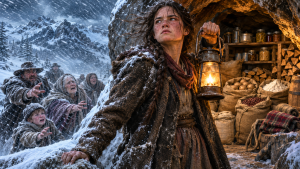
Part 1 The first thing Marin Pasco carried into th…
Not a blanket. Not a coat.
Not even the little iron candleholder her dead father
had carried into the silver mines. Potatoes.
Because at seventeen years old,
Marin had already learned something most people in Sable Creek, Idaho,
had never been desperate enough to understand.
Cold could make a person miserable. Hunger could make a person foolish.
And foolish people did not survive mountain winters.
The sack dragged against her shoulder as she climbed the
rocky trail above the valley. Her boots slipped on frozen mud.
The wind pushed through her thin wool coat,
finding every opening she had failed to button. Below her,
nearly two hundred people lived in a cluster of wooden houses surrounding a church,
a blacksmith’s shop, and the only general store for thirty miles.
Smoke drifted lazily from their chimneys. They were warm.
They had families. They had doors they could close against the weather.
Marin had none of those things.
Three weeks earlier, her stepfather had thrown her out.
He had not shouted. He had not struck her.
He had simply crossed her name off a piece of paper.
And somehow, that had hurt worse. It happened on a Thursday evening,
with the smell of boiled cabbage filling the kitchen.
Silas Rener sat at the table where Marin had eaten
supper every night since her mother remarried.
He was a narrow-faced man with thinning brown hair, careful hands,
and an almost religious faith in numbers.
He worked as a bookkeeper for the remaining mining operations.
He kept records of everything. How much flour they purchased.
How many sticks of firewood they burned.
How much lamp oil disappeared between Monday and Sunday.
That evening, he had prepared another calculation.
Marin stood beside the table while he pushed the paper toward her.
“Read it.” She looked down. On one side were the household provisions.
Flour, dried beans, salted venison, potatoes, candles, firewood.
On the other were the people those supplies needed to feed.
Silas. Ruth. His younger son from his first marriage,
who was staying with relatives until the winter roads closed.
And Marin. A black line had been drawn through her name.
She stared at it. “What does this mean?”
“It means we cannot feed everyone until spring.”
Marin looked toward her mother.
Ruth sat by the stove, holding a dish towel in both hands. “Mother?”
Ruth did not answer. Silas folded his hands.
“There are too many mouths and not enough provisions.
Someone must make other arrangements.” “Other arrangements?”
“You are nearly grown. You can work.
Perhaps someone in town needs help.” “Winter is coming.”
“I am aware.” “Where am I supposed to sleep?”
Silas looked uncomfortable for the first time.
“That is something you will have to determine.”
Marin felt the room tilt. She had known Silas was a hard man.
She had known he resented feeding another man’s daughter.
But she had never imagined he would send her into the
cold as casually as a farmer turned an unwanted animal out of a barn.
“My father helped build this town,” she whispered. Silas sighed.
“Your father made many poor decisions.”
The words struck her like a slap.
Tomas Pasco had died two years earlier when a section of
the Widowmaker Drift collapsed inside the silver mine.
He had gone back into an unstable tunnel because three
other men were trapped there. All four died.
Marin still remembered the morning they carried his body
home beneath a canvas sheet. She remembered her mother’s scream.
She remembered the miners standing in the yard with their hats pressed against their chests,
unable to look at the girl whose father had saved others at the cost of his own life.
“He died trying to save people,” Marin said.
“He died because he ignored the danger.”
For one terrible moment, she wanted to overturn the table.
Instead, she looked at Ruth. “Are you going to let him do this?”
Her mother’s fingers tightened around the towel. “Marin…”
“Please.” Ruth’s mouth trembled. But she said nothing.
That silence followed Marin long after she packed her belongings.
Two dresses. Her father’s wool shawl.
A folding knife with a bone handle.
A little pouch containing a lock of his hair.
And the iron miner’s candleholder he had always called his sticking Tommy.
She slipped it into her bag because leaving it behind
felt like abandoning him a second time. At the doorway, she waited.
Surely her mother would stop her.
Surely someone would understand what was happening.
But the kitchen remained quiet. Marin stepped outside. The door closed.
And no one followed.
For three nights, she slept wherever she could find shelter.
The first night, inside an abandoned equipment shed near the mine.
Wind whistled through the loose boards.
She spent hours rubbing her hands together,
terrified that if she fell asleep, she might never wake.
The second night, beneath an old wagon behind the feed lot.
The ground was so cold that her back ached until morning.
The third night, in a damp root cellar that smelled of spoiled turnips.
She woke with her skirt wet and her teeth chattering.
By then, the cold had begun doing something strange to her thoughts.
She would forget what she had intended to do.
She would stand in the road staring at nothing,
unable to remember where she was going. Once,
she caught herself wondering whether sitting down in the snow might be easier than walking another mile.
That frightened her enough to keep moving. She tried asking for help.
Corbin Wade, a widowed woodcutter raising a seven-year-old son,
gave her a piece of warm cornbread.
“I’m sorry, Marin,” he said, standing in the doorway of his tiny house.
“If I had another room…” “I know.” He looked ashamed.
She thanked him anyway. At the parsonage,
Levvenia Reed allowed her to sleep one night beside the stove.
The following morning,
the minister’s wife served her coffee and explained that she could not make exceptions.
“If I shelter you all winter,
every struggling family will expect the same kindness.”
Marin watched steam rise from her cup.
“So because you cannot help everybody, you cannot help me?”
Levvenia’s expression tightened. “That is not what I said.”
But it was exactly what she meant.
By the fourth morning, Marin had stopped knocking on doors.
She climbed into the hills searching for fallen branches
she might sell or burn.
That was when she noticed the strange opening in the rock.
It was little more than a narrow crack,
hidden behind dead brush and a leaning slab of stone.
But something about it made her stop. Air was moving out of it.
Not warm air exactly.
Just air that felt noticeably less cold than the wind outside.
She remembered something her father had once told her.
“The mountain keeps its own weather, little bird.
Deep rock doesn’t know whether it’s July or January.”
Marin dropped to her knees.
With her little grease lamp held ahead of her, she squeezed into the opening.
The first ten feet were miserable. Stone scraped her shoulders.
Her coat caught on sharp edges. Then the passage widened.
She stood upright.
The light revealed a chamber large enough to hold several families.
The floor was mostly dry.
A natural opening high above one wall appeared to draw air upward.
There were old blackened stones arranged around a
fireplace and evidence that someone had once used the
chamber for shelter. Marin walked slowly around the room.
Along the back wall,
someone had carved hundreds of short marks into the stone.
Beside them was a date. 1853. Thirty years earlier.
She touched the marks. Someone had survived here before.
Someone had endured enough lonely weeks to count them one by one.
She sat down beside the old fire pit and cried.
Not because she was frightened.
Because for the first time since leaving home,
she could imagine waking up somewhere without wondering whether she would freeze before morning.
The cave was dark, hidden, and lonely. But it was a roof.
And it was hers.
The following day, Marin returned carrying the potatoes.
She nearly lost the sack twice on the steep path.
Each time, she caught the rope and dragged it higher.
By the time she reached the entrance,
her shoulders were bruised and her palms had split.
She pushed the potatoes through the narrow passage and
stacked them against the rear wall.
Then she sat beside them, breathing hard. Sixty pounds. It was not much.
But it was a beginning.
Outside, the first geese were already flying south.
Three weeks earlier than anyone expected.
Marin watched them disappear beyond the mountains. Something was coming.
And she intended to be ready.
Part 2 Within a week,
the people of Sable Creek had begun laughing at Marin Pasco.
They saw her pulling a homemade sled through the streets.
They watched her purchase flour, dried beans, salt pork, and old blankets.
They noticed the heavy bundles of firewood disappearing up the mountain trail.
But nobody knew exactly where she was taking them.
Cade Marsh, the town blacksmith, stopped her outside his workshop one morning.
He was thirty-one, broad-shouldered,
and accustomed to being the loudest man wherever he stood.
“Building yourself a palace up there, Marin?”
She tightened the rope around her sled. “Something like that.”
Cade laughed. “With what? Rocks and rabbit bones?”
Several men outside the diner joined in.
“Maybe she’s turned into a mountain animal,” one suggested.
Marin kept pulling. “Good luck when the snow comes!” Cade shouted.
She did not look back.
Every mocking word reminded her that the people laughing
had roofs over their heads. She had only what she could build.
The cave slowly changed.
She raised her sleeping blankets off the stone floor on
a platform made from scavenged boards and branches.
She cut shelves into rough timber supports and arranged
her supplies where they would remain dry.
She gathered deadwood from sheltered places,
split larger pieces with borrowed tools,
and stacked everything within easy reach of the entrance.
She collected buckets, old cooking pots, candles, lamp oil,
and matches protected from moisture.
She learned to inspect every corner for dampness.
She learned which provisions needed to be kept away from rodents.
She learned to work while hungry because resting too
long meant losing precious daylight. At night, she counted her food.
Beans. Potatoes. Flour. Salt pork. Dried apples.
A few jars of preserves. Then she counted the days until spring.
The numbers frightened her. There was still not enough.
But unlike Silas,
she did not decide that the answer was to sacrifice another person.
She decided to work harder.
The general store belonged to Ambrose Thorne,
a merchant who served on the town council.
Ambrose liked to remind people how dependent they were on him.
The nearest competing store was a difficult day’s journey away.
During ordinary seasons, he extended credit to struggling families.
When winter came, he collected. He knew who owed money,
who was behind on payments,
and who would be forced to accept whatever prices he demanded.
Marin entered his shop one afternoon with her father’s remaining coins.
“I need twenty pounds of flour.” Ambrose studied her.
“You’ve been buying an unusual amount of food.” “I’m paying for it.”
“That isn’t the point.” “What is?” He leaned forward.
Marin looked at the sacks piled behind him
Marin looked at the sacks piled behind him.
“Families buy provisions for winter.”
“Families have established households.” “And I don’t?”
He did not answer. She understood.
Silas had removed her from one household.
Now Ambrose was questioning whether she had the right to
maintain one of her own. She paid for the flour and left.
Outside, someone caught her sleeve.
It was Dela Thorne, Ambrose’s nineteen-year-old daughter.
Dela had been Marin’s closest friend since childhood.
They had picked berries together,
stolen apples from the orchard behind the church,
and sat beside the creek discussing the lives they hoped to have someday.
Dela glanced toward the store window. “Come around back.”
Behind the building, she pushed a wrapped package into Marin’s hands.
Salt pork. “Take it.” “Your father will notice.”
“He counts the flour more carefully.”
“Dela, I can’t let you get in trouble.” “You’re already in trouble.
Let somebody help you.” Marin stared at her friend.
It had been weeks since anyone had offered her anything
without explaining why they could not offer more. She swallowed hard.
“Why is he doing this?” Dela looked toward the building.
“Because he’s afraid.” “Of me?” “Of what you prove.” Marin frowned.
Dela lowered her voice. “If you survive without depending on him,
other people may begin wondering why they’ve spent their whole lives afraid of crossing him.”
That evening,
Marin thought about those words as she arranged the pork beside her other provisions.
Perhaps the town was not merely laughing at a foolish girl.
Perhaps some people were angry that she had refused to disappear.
A few days later, she learned how right Dela had been.
Returning from the creek after sunset,
Marin noticed lamplight inside the rear stockroom.
Through a narrow window,
she saw Ambrose moving sacks of flour behind a newly built wooden partition.
There were barrels of dried beans, packages of salt pork,
lamp oil, and other supplies hidden from public view.
He was creating a private reserve.
Marin watched him nail the boards into place.
The same man who had accused her of hoarding was
concealing enough provisions to sustain several households.
She wanted to march into the diner and tell everyone.
But she knew what would happen. Ambrose would deny it.
The council would support him.
And the town would believe the wealthy merchant instead
of the homeless girl living somewhere in the mountains.
So she continued preparing. One afternoon,
an elderly widow named Odessa Kel approached her near the edge of town.
Odessa was sixty-eight, thin, sharp-eyed,
and known for saying unpleasant truths without apologizing.
“You found shelter?” she asked. Marin hesitated. “Yes, ma’am.”
“Underground?” Marin stared. Odessa gave a small smile. “Smart girl.”
From her basket, she removed two jars of peach preserves.
“Take these.” “I couldn’t pay you.” “Didn’t ask you to.”
Marin accepted the jars. Odessa studied the northern mountains.
“When I was twelve, my family got trapped in a storm crossing west.
My mother burned our wagon piece by piece to keep us warm.
The seats. The sideboards. Eventually even the wheels.”
“How did you survive?”
“By understanding that a wagon can be replaced and a child cannot.”
She looked directly at Marin. “I’ve never been afraid of winter, child.
I’ve been afraid of people too stubborn to prepare for it.”
Those words stayed with Marin.
So did the unexpected gifts that began appearing outside her cave.
The first was a skinned rabbit hanging from a low branch.
Beside it lay a coil of sturdy rope. There was no note.
Only large bootprints in the frost.
Several days later, someone left a piece of tanned deerhide.
Then a small hatchet. Then matches wrapped carefully against moisture.
Marin began sleeping with her father’s knife within reach.
She appreciated the gifts.
But an unknown person who could find her hidden home was
also someone who might threaten it.
One morning, she rose before sunrise and waited beside the entrance.
A tall figure appeared among the trees.
He was an older man wearing a patched deerskin coat. His beard was gray.
His face was deeply weathered.
He moved with the deliberate confidence of someone who
had spent more years outdoors than inside. He stopped thirty yards away.
Marin kept one hand on her knife. “Who are you?” “Ransom Teal.”
She recognized the name. A trapper. A loner.
A man who lived beyond the northern ridge and rarely came into town.
“Why have you been leaving things?” He looked toward the cave.
“Because I know what it’s like to live there.” Marin stared.
“You lived in my cave?” “Thirty years ago.” “The marks on the wall?”
“Mine.” He sat on a fallen tree. “Spent two winters in that place.
Counted every week because I couldn’t think of anything better to do.”
“Why did you leave?” Ransom looked away.
“Found out a man can survive alone long enough to forget how to be human.”
He showed her how to arrange her firewood to warm the
surrounding stone without wasting fuel.
He explained the importance of keeping the chimney
passage clear and watching carefully for smoke entering the chamber.
“Fire can save you,” he said. “Smoke can kill you.
Don’t ever forget the difference.” She listened closely.
Her father had taught her much about the mountains,
but Ransom knew things that only decades of hard living could teach.
Before leaving, he placed another rabbit on the ground.
“Don’t go trusting every stranger you meet, girl.” Marin almost smiled.
“That includes you?” “Especially me.” But he returned.
Sometimes with food. Sometimes with advice.
Sometimes only to sit quietly outside while she worked.
He never asked to enter the cave.
Marin gradually stopped reaching for her knife when she heard his footsteps.
Then, two weeks before the first major snowfall,
Ambrose Thorne refused to sell her anything else.
“Council decision,” he said.
Marin stood at the counter holding her remaining coins.
“I haven’t done anything wrong.”
“Provisions must be reserved for established households.”
“I am a household.” “You’re a child living in the wilderness.”
“And you’re keeping food behind your wall.” The merchant went still.
For a moment, neither moved. Then his expression hardened.
“Get out of my store.” Marin left.
That evening, Dela met her on the road. Her face was pale.
“He knows somebody’s been helping you.”
Marin looked at the little sack in her friend’s hands. “Dela, stop.
He’ll throw you out.” “Maybe.” “Then why keep doing it?”
Dela looked toward the lights of town.
“Because every time I watch him decide who deserves to eat,
I hear myself making excuses for him. And I’m tired of hearing them.”
They embraced beside the road. Then Marin climbed back toward the cave.
Her supplies were almost complete. The geese were gone.
The first hard frost had killed the last crops.
And the northern horizon had turned an ugly shade of gray.
One evening, Odessa stopped her beside the diner. “Storm’s coming.”
“How bad?” The old woman rubbed her wrist,
which had been broken during a winter crossing decades earlier.
“Bad enough that I’d be filling every empty shelf I had.”
Marin looked toward the mountains.
The clouds were stacking in dark layers.
She could feel something changing.
The next morning, she entered the diner while the men were eating breakfast.
“A serious storm is coming,” she announced.
“You need more firewood and food. Don’t wait.” Conversation stopped.
Ambrose looked up from his coffee.
“Well, gentlemen, our mountain girl has come down to instruct us.”
A few men laughed. Cade shook his head.
“We’ve got proper houses and stoves, Marin. What have you got?”
“A place that may survive what your houses can’t.”
The laughter grew louder. Levvenia Reed spoke from near the counter.
“These men have lived through more winters than you’ve seen, dear.”
Marin looked around the room.
Corbin Wade sat at a table near the window. He did not laugh.
But he did not speak either. Marin waited one more moment.
Then she turned and left. She had warned them.
If they refused to listen, there was nothing more she could say.
That evening, she climbed the hill and secured the last of her supplies.
She sat beside her fire with her father’s old candleholder in her lap.
Outside, the wind began to howl.
And before dawn, the mountain disappeared behind a wall of snow.
Part 3 The blizzard arrived on a Tuesday night.
It did not begin with gentle flakes drifting past the windows.
It came with a roar.
The wind struck the mountains so violently that Marin
felt pressure change inside the cave. Her little lamp flickered.
Then the snow began driving sideways.
Within an hour, the entrance was nearly blocked.
Marin crawled through the narrow passage and pushed away
the accumulating snow with a wooden shovel. The world beyond was white.
She could not see the trees twenty feet away. She retreated inside,
cleared the passage as carefully as she could, and returned to the fire.
For the first time since finding the cave,
she was grateful for every exhausting trip she had made up that hillside.
The potatoes. The flour. The firewood. The blankets.
All of it had seemed painfully small while she was collecting it.
Now it was the difference between life and death.
She warmed soup over the coals and listened to the storm.
Somewhere below,
people were huddled inside houses that had never been built to withstand weather like this.
Marin tried not to imagine what was happening to them.
But memories kept coming. Cade laughing at her sled.
Levvenia telling her she could not shelter everyone.
Ambrose refusing to sell her flour.
Silas crossing her name off his household list.
And her mother looking down at the floor.
By dawn, she had slept scarcely an hour.
A scraping sound came from the entrance. Marin grabbed her knife.
Something large was pushing through the snow.
She backed against the wall.
A man crawled into the chamber, his beard crusted with ice. Ransom Teal.
He rose slowly and brushed snow from his shoulders. “Morning.”
Marin stared at him. “Your cabin?” “Lost part of the roof.”
He held his hands toward the fire.
“Figured your mountain was better built than my little shack.”
She poured him hot water. “What happened down below?”
Ransom’s expression darkened. “Church roof’s torn open.
Some chimneys are blocked.
Wade’s place is having trouble keeping a fire going.”
Marin thought of Corbin’s young son. Micah.
He had once given her a crooked little drawing of a horse.
She pictured him sitting beside a cold stove. Ransom accepted the cup.
“If this storm lasts another three days, people will start dying.”
Marin looked down at her food stores. “I’ve prepared enough for myself.”
“I know.” “Maybe enough for two.” “I know that too.”
“If I open this place to everyone, we’ll run out.”
Ransom remained quiet. She felt anger rising. “They threw me away.”
“Yes.” “They laughed at me.” “Yes.”
“Ambrose wouldn’t even sell me food.” “I remember.”
She looked straight at him. “Then tell me why I should save them.”
Ransom studied the fire. For a long time, he said nothing.
Then he began telling her about the winter he had spent
in that same cave thirty years earlier.
He had heard of people struggling down in the valley.
He had enough food to help some of them.
But he had kept his shelter hidden. “No one died that winter,” he said.
“Found that out afterward.” “Then you didn’t do anything wrong.”
He shook his head.
“I didn’t know they would survive when I made my choice.”
He rubbed his weathered hands together.
whether someone was freezing down below
whether someone was freezing down below. And I did nothing.”
Marin watched him.
“I’ve spent thirty years wondering what kind of man that made me.”
“You were afraid.” “I was.” “You wanted to survive.” “Sure did.”
“That’s not a crime.” “No.” He looked toward the cave entrance.
“But surviving isn’t the same thing as living with yourself afterward.”
The fire cracked softly.
Marin thought of her father entering that collapsing mine.
For years, she had resented his final decision.
He had saved men who returned home to their families while she lost hers.
There had been nights when she wished he had simply walked away.
But she remembered his hands.
The way he had helped elderly neighbors split wood without accepting payment.
The way he carried injured animals home.
The way he always told her that someone else’s trouble
was not necessarily someone else’s responsibility alone.
Marin stared at the fire.
“If I leave them outside when I know I can help,
I’ll be doing what Silas did to me.” Ransom said nothing.
“I don’t want to become that kind of person.” She stood.
“Help me clear the entrance.” The next morning,
while the wind still raged, Marin saw a figure struggling up the slope.
At first, she could barely make it out.
A person bent nearly double, falling into the snow and rising again.
Then the figure collapsed. Marin seized a rope and shouted to Ransom.
“Someone’s out there!” He hurried toward the entrance.
“I’ll anchor this. Don’t go farther than you can safely return.”
Marin tied the rope securely and pushed into the storm.
The cold struck her so violently that she gasped.
She followed the line downhill,
struggling through drifts that reached her thighs.
When she reached the fallen figure, her heart nearly stopped.
Odessa Kel. The elderly woman lay face down, her coat covered in ice.
Marin dropped beside her. “Odessa!” The widow barely moved.
“Odessa, open your eyes!” Her eyelids fluttered. “Thought…”
she murmured. “Thought you were up here.” Marin swallowed a sob.
“You foolish old woman. You should have stayed home.”
Odessa tried to smile. “Home got mighty cold.”
Marin wrapped the rope around them and called to Ransom.
Getting back up the hill was agony.
More than once, Marin lost her footing.
Ransom hauled from above while she pushed and dragged
Odessa toward the entrance.
When they finally reached the cave, Marin could scarcely feel her hands.
Ransom helped carry Odessa inside. They removed her wet outer clothing,
wrapped her carefully in dry blankets,
and began warming her gradually while checking that she remained awake and breathing.
For a long while, the widow could do little more than shiver.
Then her eyes moved around the chamber. The shelves. The firewood.
The sacks of provisions. The orderly arrangement of blankets and tools.
Her mouth opened. “Good heavens, child.” Marin knelt beside her.
“What?” “You truly built all this.” Marin looked around.
The cave was smoky in places, cramped, and rough.
It was hardly a home anyone would have admired in ordinary circumstances.
But she felt a small swell of pride. “Yes, ma’am.”
Odessa squeezed her hand. “Your father would have been proud.”
That nearly undid her.
The storm trapped them together for two more days.
Ransom melted clean snow for water.
Odessa took responsibility for organizing meals once her strength returned.
Marin maintained the fire and checked their supplies.
They ate carefully. Nobody wasted anything.
When Odessa repaired a torn blanket with a needle she kept inside her coat,
Marin smiled for the first time in weeks. “What are you smiling at?”
“Nothing.” “Then you’re a terrible liar.” Marin laughed.
It was a small sound. But it changed the atmosphere of the cave.
By the third morning,
the wind had weakened enough for them to see partway down the mountain.
What Marin saw frightened her more than the storm itself.
Sable Creek was nearly buried. Snow covered fences and roads.
Barn roofs had collapsed. Several chimneys stood silent.
Smoke rose from only a handful of houses. Odessa stood beside her.
“They’re in trouble.” Marin nodded. She had already made her decision.
But another problem remained. Nobody knew where her cave was.
She had hidden it too well.
Corbin knew the lower section of the trail because he
had quietly left dried corn near a marker every Thursday.
Ransom knew the upper slopes.
Together, they might guide people to safety.
Marin scratched a rough map into the dirt.
“Ransom, you take the eastern ridge when the wind allows it.
Look for families stranded there.” He nodded.
“I’ll find Corbin,” she continued.
“We can bring people along the lower path.”
“And how will they find the entrance?” Marin studied the old fireplace.
Until now, she had kept her fires small to avoid drawing attention.
That was about to change. “We’ll make smoke.” Ransom raised an eyebrow.
“You spent all autumn hiding smoke.” “Now I need everyone to see it.”
They built a carefully controlled signal fire near the sheltered entrance,
keeping the passage open and the smoke outside.
A dark column rose against the white sky.
From the valley, it would be visible for miles whenever the snowfall eased.
Marin wrapped herself in her father’s shawl and began descending the mountain.
Halfway down, she found Corbin Wade. He was carrying Micah on his back.
The little boy’s face was pale. His eyes were half closed.
Corbin’s boots were soaked. His hands were stiff with cold.
When he saw Marin, he stopped. “Marin?” She hurried to him.
“Give me your arm.” “The chimney stopped drawing,” he said.
“I couldn’t keep the stove going.” “We have a fire.”
His eyes lifted toward the black smoke above them. “That’s yours?”
“Come on. We need to keep moving.” They climbed together.
By the time they reached the cave, Corbin was nearly collapsing.
Marin helped Micah out of his frozen outer blankets.
Odessa brought warm soup. Ransom guided Corbin closer to the fire.
The little boy stared at the chamber. “Is this your house, Miss Marin?”
She smiled. “Yes, Micah.” “It’s better than a castle.”
His father lowered his face into his hands.
For several minutes, he could not speak. That evening,
after Micah had fallen asleep beneath warm blankets,
Corbin approached Marin. “I owe you something.”
“You’ve already given me corn.” He looked startled. “You knew?”
“Every Thursday.” His eyes filled.
“I should have spoken up in the diner.” Marin listened.
“I knew you were right about the weather,” he continued.
“But Ambrose controls my credit.
I was afraid he’d punish me if I defended you.” He swallowed.
“I let them laugh.” Marin sat beside him.
“You helped me when you could.” “I didn’t help enough.”
“No,” she said gently. “You didn’t.” He lowered his head.
“But you’re here now,” she added. “And there’s work to do.”
The following morning, Corbin began clearing the trail.
By noon, three more people had reached the cave.
A mother and two daughters.
Then a young couple from an isolated homestead.
Before nightfall, others followed the smoke. Among them was Cade Marsh.
The big blacksmith crawled through the passage carrying his six-year-old sister,
Posie. He stood in the chamber, stunned. “You built all this?”
Marin nodded. He looked at the food shelves and the fire.
Then at the little girl trembling in his arms. “I called you crazy.”
“I remember.”
“I said you were no better than an animal living in a hole.”
“I remember that too.” Cade swallowed. “Reckon I was the fool.”
Marin reached for Posie. “Bring her to the fire.”
He handed over his sister. And for the first time in his life,
Cade Marsh obeyed Marin Pasco without arguing.
Part 4 By the fifth day of the blizzard,
the cave had become a small village beneath the mountain.
Eleven people slept close together on blankets and raised wooden platforms.
Children occupied the warmest safe places near the fire.
Adults took turns preparing food, melting snow, clearing the entrance,
and repairing clothing.
The atmosphere was crowded, uncomfortable, and tense.
But everyone was alive.
Marin stood beside her supplies one evening, studying what remained.
Her heart sank. The potatoes were disappearing quickly.
The flour sacks had become noticeably lighter.
And the firewood that she had expected to last months
was being consumed far faster than planned. Ransom watched her counting.
“How bad?” “Bad.” “How bad is bad?”
She looked toward the sleeping children.
“We can’t feed everyone this way until spring.” Ransom nodded.
“No.”
She waited for him to say that she should never have opened the cave.
He did not.
Instead, he asked, “How long until we have a chance to move?”
Marin stared at the fire. “I don’t know.”
That uncertainty was harder than any physical labor she had endured.
For three months, every decision had depended on herself.
If she worked, she gained supplies.
If she made a mistake, she bore the consequences.
Now the lives of other people rested on her judgment.
She had become responsible for the very community that
once refused to claim her.
The following morning, she gathered the adults.
“We need to ration everything,” she said. Cade shifted uncomfortably.
“Children get enough first.” “Yes.” “Then the older folks.”
“Yes.” “And the rest of us manage.” Marin looked around.
Nobody argued. She began assigning work.
Corbin and Cade reinforced the entrance and kept the snow from blocking it.
Ransom watched the changing weather. Odessa supervised meals.
The young women repaired blankets, arranged sleeping spaces,
and helped care for the children. Marin coordinated the food and fuel.
Every person who could contribute was given something useful to do.
By evening, the mood had changed. Fear had not disappeared.
But helplessness had.
On the sixth night, someone began knocking weakly against the outer passage.
Marin hurried forward.
A young woman crawled into the opening, shaking violently. “Dela?”
Her friend collapsed into her arms. Marin dragged her into the chamber.
Dela’s hair was stiff with frost.
Her gloves were wet, and she held a small cloth sack against her chest.
“What happened?” Dela tried to speak, but her teeth were chattering.
Marin wrapped her in blankets and helped her settle
where she could warm slowly.
Only after some time did Dela manage to answer. “I brought food.”
She opened the sack. Flour. Dried corn. A little salt pork.
A handful of sugar. Marin stared.
“You came through that storm carrying this?” Dela nodded.
“Father found out.” “Found out what?” “That I’d been giving you food.”
Her voice broke. “He said I was stealing from him.
He told me if I cared so much about hungry people, I could go live with them.”
Marin felt anger surge through her. “He threw you out?”
Dela looked down. “He opened the door and told me to leave.”
For a moment,
Marin saw herself standing on Silas Rener’s porch three months earlier.
The cold. The silence.
The terrible certainty that the people who were supposed
to love you had decided you were expendable. She took Dela’s hands.
“You’re staying here.” Dela began crying. “I’m sorry.” “For what?”
“Everything. For not standing up to him sooner.” Marin embraced her.
“You stood up when it mattered.” Dela clung to her.
And Marin held her friend until the trembling eased. Later that night,
while everyone else slept, the two young women sat near the entrance.
Dela watched Marin studying the remaining supplies. “Are you afraid?”
“Yes.” “Of dying?” Marin considered the question. “Partly.”
“What else?” She looked toward the sleeping families.
“I’m afraid they’ll forget.” Dela frowned. “Forget what?”
“How they treated me.
When the storm ends, they’ll go back to their houses and their ordinary lives.
Then they’ll go back to calling me the girl who wa…
Then they’ll go back to calling me the girl who was thrown away.”
Dela shook her head. “They won’t.” “You don’t know that.”
“Some things change a town forever, Marin.” She looked around the cave.
“This is one of them.” Marin wanted to believe her.
But believing other people was still difficult.
The seventh day was the worst. The food stores were dangerously low.
Several adults surrendered portions of their meals so the children could eat.
The storm continued, though Ransom believed its strength was weakening.
Marin spent much of the day checking the provisions and
trying to stretch the remaining fuel.
At one point, she sat alone beside the rear wall and began crying silently.
She had done everything she knew how to do. She had built a shelter.
She had gathered food.
She had saved Odessa, Corbin, Micah, Dela, and the others.
But she could not manufacture flour.
She could not command the storm to stop.
And if it continued much longer,
she would be forced to watch people suffer inside the very place she had promised would protect them.
Ransom found her there. He sat beside her without speaking.
Finally, she whispered, “I made a mistake.” “What mistake?”
“Letting everyone in.” He looked around the cave. Children sleeping.
Adults resting after another difficult day.
People who would likely have frozen without the shelter.
“Do you believe that?” She covered her face. “I don’t know anymore.”
Ransom waited.
Then he said, “Thirty years ago, I made the opposite choice.
Kept the door closed. Had more than enough food afterward.”
Marin lowered her hands. “Was it worth it?” He shook his head.
“Not for a single day.” He rested one hand on her shoulder.
“You don’t know how this storm ends. Neither do I.
But you know what you’ve done.” She looked toward Micah.
The boy was sleeping peacefully beside his father.
Ransom followed her gaze.
“You gave that child another morning with his daddy.” Marin swallowed.
“You gave Odessa another chance to sit in the sunshine.
You gave Cade’s little sister another chance to grow up
and become just as stubborn as he is.” Despite herself, Marin smiled.
“Lord help us if she does.” Ransom chuckled.
Then his expression grew serious.
“Whatever happens tomorrow, nobody can take those things away from you.”
Marin sat beside him for a long while.
She remembered her father’s voice. She remembered the mine.
She remembered the piece of paper with her name crossed out.
For months, she had thought survival meant proving Silas wrong.
But the cave had changed that. Survival now meant something larger.
She had discovered that one person could build a refuge.
And that people who worked together could turn it into a community.
Near midnight, the wind began to soften. The howling diminished.
The pressure in the chamber eased.
Ransom rose and moved toward the entrance. He listened carefully.
Then he looked at Marin. “It’s turning.” She stood. “Are you sure?”
“Been listening to mountain storms longer than you’ve been alive.”
He tilted his head. “This one’s almost finished.”
Marin looked toward the passage.
For the first time in eight days, she allowed herself to imagine the sun.
But she did not celebrate. Beyond the cave, Sable Creek lay buried.
Families were missing. Homes were destroyed.
And the man who had controlled the valley’s food supply
had spent the storm behind locked doors.
Marin remembered the hidden stockroom. The false wall.
The sacks piled where nobody could see them.
She knew the storm had not only tested the strength of buildings.
It had revealed something about the people inside them.
And when the sky finally cleared,
the whole valley would have to face what it had become.
Part 5 The blizzard ended on the eighth morning.
Marin woke because of the silence.
For more than a week, the wind had filled every corner of her world.
Now there was nothing.
She rose from her blankets and hurried through the narrow passage.
Outside, the sky was pale blue. Sunlight touched the mountains.
The snow stretched across the valley in enormous white drifts.
For a long moment, Marin simply stood there.
She had forgotten how beautiful ordinary daylight could be.
Then she looked down toward Sable Creek. And the beauty vanished.
Barns had collapsed beneath the snow. The church roof was torn open.
Wagons lay overturned. Fences had disappeared.
Some houses were buried almost to their roofs. Others stood exposed,
their windows broken and doors hanging crookedly from their hinges.
Only a few chimneys were smoking. Marin pulled her shawl tight.
Behind her, people began emerging from the cave. Cade carried Posie.
Corbin held Micah’s hand. Odessa stood beside Dela.
They looked down at their ruined town. Nobody spoke.
Finally, Marin said, “We’d better get to work.” The descent was slow.
Snow lay deep across every familiar road.
Where wooden fences had once guided travelers, there were only white mounds.
But the people from the cave worked together to open a path.
Cade and Corbin broke the heavier drifts.
Ransom helped mark the safest route.
Marin moved between them, checking that nobody became separated.
When they reached the first houses, survivors came out to meet them.
Some wept. Others stood in exhausted silence.
Families began asking about missing relatives.
Marin helped organize search parties and encouraged
people to bring their remaining supplies to a central meeting place.
By afternoon,
several rescued families were sharing what little they possessed.
Then Cade returned from the general store. His expression was furious.
“Marin. You need to see something.”
They walked toward Ambrose Thorne’s building.
Unlike many houses, the store had survived almost untouched.
Additional timber braces reinforced its walls.
The windows remained intact. And the door was locked.
A crowd had already gathered. Cade stood before the entrance.
“Ambrose!” No answer. “We know you’re in there!”
A face appeared briefly at the window. Then disappeared.
Cade stepped closer. “Open this door!”
After a long silence, the lock turned. Ambrose appeared in the doorway.
He looked thinner than before,
but his clothing was dry and his cheeks had color.
“What is the meaning of this?” Cade pointed toward the ruined town.
“People have been freezing while you sat in here with food.”
Ambrose straightened. “This is private property.”
A murmur ran through the crowd. Marin stepped forward.
“Is there food inside?” Ambrose’s eyes narrowed.
“That is none of your concern.”
“I saw you building a hidden stockroom before the storm.”
The merchant went still. Several people turned toward her.
She continued. “You told the town that provisions were scarce.
You refused to sell to me because you said I was hoarding.”
“That was a council decision.”
“You kept food behind a false wall while families were
trying to survive without enough to eat.”
Ambrose looked toward the crowd.
“Every businessman has a right to protect his inventory.”
Corbin stepped forward. “My son nearly froze to death.”
Ambrose said nothing.
“If Marin hadn’t taken us in, I might have buried him.”
Another man raised his voice.
“My wife and daughters spent two nights without a proper fire.”
A woman called from the crowd.
“You told us there wasn’t any more flour!”
Ambrose’s expression hardened. “These accusations are absurd.”
Cade pushed past him and entered the store. The other men followed.
Marin remained at the doorway.
Moments later, Cade shouted from the back room. “Come look at this!”
Behind the wooden partition lay sacks of flour, beans, salted meat,
and other provisions. More food than many families had seen in months.
The crowd fell silent. Then the shouting began.
Ambrose tried explaining that the supplies were reserved for emergencies.
But there had been an emergency. And he had kept the door locked.
Marin moved between him and the angry townspeople. “Stop.”
Cade looked at her. “He deserves—” “I know what he deserves.”
Her voice remained steady.
“But breaking his bones won’t feed a single family.” The crowd quieted.
Marin faced Ambrose.
“You said I was harming this community by preparing to survive.”
He looked away.
“You refused me food because you decided I didn’t belong.” No answer.
“Then the storm came. And when people needed shelter, I opened mine.”
She looked toward the hidden provisions. “You kept yours closed.”
Ambrose’s face reddened. Marin asked one final question.
“Which one of us endangered this town?”
For the first time since anyone could remember, Ambrose Thorne had no answer.
Corbin stepped forward.
“I move that Ambrose be removed from responsibility for
the town’s winter provisions.” Cade raised his hand. “So do I.”
Others followed. The minister’s wife raised hers.
Then more hands went up throughout the crowd.
Marin watched the merchant count them.
He had spent years believing that controlling the town’s
supplies meant controlling its people.
Now the people were standing together.
He could no longer divide them so easily.
The vote was not the formal legal process required to remove an elected official,
but the town’s message was unmistakable.
The remaining council members agreed to begin the proper
proceedings and place the disputed emergency stores
under supervised distribution while their ownership and
the merchant’s conduct were reviewed.
Ambrose stood in his doorway as the crowd dispersed.
His daughter remained beside Marin. He looked toward Dela.
“You’ve chosen your side, then.” Dela’s eyes filled.
“I chose to help people, Father.” “You stole from me.”
“I brought food to children who were hungry.”
For a moment, father and daughter stared at each other.
Then Dela turned away. Marin followed her without speaking.
By evening,
the town had begun distributing food and blankets among the worst-affected families.
Marin helped organize the work.
She measured flour into smaller sacks and helped identify households with young children,
elderly residents, and people who had lost their homes.
Cade repaired damaged stoves. Corbin cleared chimneys.
Odessa organized women who knew how to stretch a small
quantity of provisions into nourishing meals.
Ransom guided parties through the mountain trails to check isolated cabins.
And something remarkable happened.
People began helping one another without first asking who owed money.
They worked because the work needed doing.
For the first time in her life,
Marin saw Sable Creek acting less like a collection of frightened households and more like the community her father had once believed it could become.
But there was one house she had not visited. Silas Rener’s.
For three days, she avoided the road leading to it.
Then Odessa approached her while she was measuring beans.
“Your mother is still alive, child.” Marin looked up. “I know.”
“Have you seen her?” “No.” Odessa studied her.
“You don’t owe that man forgiveness.” “I know.”
“But sometimes there are things worth doing that have
nothing to do with what we’re owed.” Marin looked down at the beans.
She thought of Ruth standing in the kitchen. The silence.
The door closing. For months, she had imagined returning to that house.
In some versions, she would be wealthy and successful.
In others, she would stand on the porch while Silas begged her to come home.
But the real moment arrived without triumph.
She loaded a sled with flour, dried beans, potatoes, and firewood.
Cade offered to help her pull it. They reached the house near sunset.
Marin stood on the porch and knocked. Silas opened the door.
He looked much older. His cheeks were hollow, his shoulders narrow.
Behind him, the stove burned weakly. He stared at Marin.
The table stood exactly where it had been
The table stood exactly where it had been.
She could still remember the paper lying across its surface.
The line through her name. “No,” she said quietly.
“I came to see whether my mother needs food.” Silas lowered his eyes.
For several moments, he said nothing. Then he looked at the sled.
“You brought all that?” “Yes.” “For us?” “For her.
And for anyone in this house who’s hungry.” The old man swallowed.
“I never thought…” He stopped. Marin waited.
“I never thought you’d survive.” She felt the words settle inside her.
Once, they would have broken her. Now they only made her sad.
“You were right about one thing, Silas.” He looked at her.
“There wasn’t enough food in this house.” He nodded slowly.
“But you were wrong about what that meant.” She stepped closer.
“You looked at me and saw another mouth to feed.
You never considered that I might be another pair of hands.”
Silas stared at the sacks of food. “Your father…” he began.
Marin’s expression tightened. “Leave my father out of it.”
He nodded. For the first time, he obeyed without argument.
Then Ruth appeared behind him. She was thinner than Marin remembered.
Her hair had more gray in it.
But her eyes were fixed directly on her daughter. “Marin.”
For a moment, neither moved. Then Ruth stepped around her husband.
“I thought you were dead.” Marin’s throat tightened.
“You didn’t come looking.” Ruth began crying. “No.”
“You didn’t say anything when he sent me away.” “I know.”
“Mother, I waited.” The words came out before Marin could stop them.
“I stood on the porch waiting for you to call me back.”
Ruth covered her mouth. “I know, sweetheart.” Marin felt tears rising.
“I thought you didn’t want me anymore.” Ruth shook her head desperately.
“Oh, Marin. No.” She reached toward her daughter, then stopped.
“I was afraid. I was weak.
I let him make a terrible choice because I didn’t know
how we would survive without him.” Marin stared at her.
Ruth drew a shaking breath.
“After you left, I took that paper off the table.”
Silas looked toward his wife.
“I didn’t know what else to do,” Ruth continued.
“I couldn’t bear seeing your name crossed out.” Her voice cracked.
“So I burned it.” Marin blinked. Ruth looked toward the stove.
“I watched every piece turn to ash.
It was the only thing I had the courage to do that night.”
The kitchen fell silent.
Marin wanted to tell her mother that burning a piece of
paper had not kept her warm. It had not filled her stomach.
It had not brought her home. And yet, beneath the anger,
she could see the frightened woman her mother had become after years of loss and poverty.
Ruth had not stopped loving her. She had simply failed to protect her.
Those were different things.
And Marin was old enough now to understand that love did not erase failure.
She reached for her mother’s hand. Ruth gripped it tightly.
“I am sorry,” she whispered. Marin stood still. Then she said, “I know.”
It was not complete forgiveness. Not yet. But it was a beginning.
They carried the supplies inside.
Marin placed them on the same table where Silas had once
calculated that she was expendable. Then she stepped toward the door.
“Won’t you stay for supper?” Ruth asked. Marin shook her head.
“I’m not ready.” Her mother nodded. “I understand.”
At the doorway, Marin turned. “You’re welcome to visit me.”
Ruth’s eyes filled again. “At the cave?” “Yes.”
Marin gave a small smile. “It’s a home now.”
She returned up the mountain that evening.
Behind her, the windows of Sable Creek glowed against the snow.
There were still damaged houses to repair. Still roads to clear.
Still families that needed help. But the valley had changed.
In the weeks that followed,
the remaining council members established a shared emergency food reserve beneath the church.
Every household was encouraged to contribute what it could.
Supplies would be checked and rotated throughout the year,
and emergency assistance would no longer depend on a family’s social standing or credit account.
Levvenia Reed volunteered to maintain the records.
One afternoon, she approached Marin outside the church.
“I owe you an apology.” Marin looked at her.
“When you came to my door, I told myself I was being practical.”
Levvenia’s voice shook.
“But I was really afraid of being responsible for someone else’s suffering.”
She glanced toward the church.
“I left you outside because helping you might have cost me something.”
Marin listened quietly. Levvenia wiped her eyes.
“I hope you’ll forgive me someday.”
Marin looked toward the new supplies being carried into the cellar.
“Make sure nobody else has to stand on your porch
wondering where they’ll sleep.” Levvenia nodded. “I will.”
Dela did not return to her father’s store.
She stayed at the cave with Marin, helping repair shelves,
prepare meals, and plan for spring.
But near the end of winter, Ambrose became ill.
For days, he remained inside his store. Few people visited him.
One morning, Dela stood near the cave entrance with her coat in her hands.
“I’m going down to see him.” Marin looked up from the table.
“Are you sure?” “He’s still my father.” “He hurt you.” “I know.”
Dela’s expression was tired but determined.
“That doesn’t mean I want him to die alone.” Marin nodded.
She understood better than most. Dela walked down to the store.
She found Ambrose coughing beside a cold stove,
his once immaculate surroundings neglected. Without asking permission,
she built a fire, cleaned the kitchen, and prepared broth.
Her father watched her. Finally, he asked, “Why did you come back?”
Dela set a bowl beside him. “Because somebody had to.”
He did not answer. But after that winter,
Ambrose never again held the same power over Sable Creek.
He remained a difficult man.
He never delivered the grand apology people might have wanted.
Yet as the seasons changed,
small sacks of flour and dried beans occasionally appeared near the community reserve without a name attached.
Dela recognized the marks on the sacks. She said nothing.
Some changes were too small to announce. But they mattered anyway.
Spring came slowly to the Idaho mountains.
Snow retreated from the southern hillsides.
The creek began flowing freely. Birds returned to the trees.
On the first warm afternoon of April,
Odessa climbed the path to Marin’s cave carrying a cloth bag.
Marin hurried down to help her. “You’re getting too old for this hill.”
Odessa snorted.
“Keep talking like that and I’ll leave you to carry your own presents.”
They sat together outside the entrance.
Below them, Sable Creek was rebuilding. New chimneys rose.
Barns were repaired. Families planted gardens.
And along the eastern ridge,
men were beginning construction on additional storm shelters.
Odessa opened her bag. Inside were packets of seeds. Tomatoes.
Beans. Squash. Carrots. Marin turned them over in her hands.
“What are these for?” “Your garden.” “I don’t have a garden.”
“Not yet.” Marin smiled. Odessa looked toward the valley.
“You spent all winter learning how to survive.” “Yes, ma’am.”
“Now it’s time you learned how to grow something.”
The old woman took her hand.
“Surviving isn’t only about enduring hard times, Marin.
It’s about making certain there’s something worth living for afterward.”
Marin looked at the seeds. They weighed almost nothing.
Yet for the first time in months,
she was thinking about a future that did not begin and end with the next snowfall.
She could grow food. Build a proper shelter beside the cave.
Make a place where travelers could rest.
Perhaps one day have a family of her own.
Not because someone finally decided she was worth keeping.
But because she had already proven to herself that she was.
That evening, Marin returned to the chamber. The fire glowed softly.
Dela was mending a blanket beside the entrance.
On the shelves were the remaining winter supplies,
carefully reorganized for the coming season.
Marin walked toward the old marks on the stone wall.
Hundreds of little lines.
Each one carved by Ransom Teal thirty years earlier.
Weeks spent surviving alone.
She took her father’s folding knife from her pocket.
Then she carved one new mark beside them. A single straight line.
Dela looked up. “What are you doing?” Marin studied the mark.
“Remembering.” “Remembering what?” Marin smiled faintly.
“That I don’t have to count the weeks anymore.”
She placed the knife away and took her father’s iron
candleholder from the shelf.
With careful hands, she secured it in a natural seam beside the fireplace.
Then she placed a fresh candle in the holder and lit it.
The flame stood straight in the still air.
Her father had once carried that iron into the dark
places of the earth to earn a living.
Now it held a light in the shelter his daughter had created.
A place where people had found warmth.
A place where frightened children had slept safely.
A place where old wounds had begun to heal.
The town eventually gave the cave a name. Hearthstone.
Nobody remembered exactly who suggested it first. But the name stayed.
Every autumn afterward,
when the geese flew south and the northern wind began to change,
people climbed the path to Hearthstone. They brought firewood.
They carried sacks of flour and potatoes.
They checked the entrance and repaired the shelves.
They did these things without being ordered or paid.
Because everyone in Sable Creek remembered the winter of 1883.
They remembered the seventeen-year-old girl they had laughed at.
The girl whose stepfather had crossed her name off a list.
The girl who had spent months dragging food and firewood
into a hidden cave while everyone called her foolish.
And they remembered what happened when the eight-day blizzard came.
Their houses had failed.
Their carefully guarded provisions had run short.
Their certainty had disappeared beneath the snow.
But high above the valley, the girl they had abandoned had opened her door.
Years later, people told the story differently.
Some exaggerated the storm. Some forgot the names.
Some remembered only the hidden cave and the extraordinary supplies.
But those who had been there knew the truth.
The greatest thing Marin Pasco did was not surviving alone in the mountains.
It was refusing to let cruelty teach her to become cruel.
One bright spring morning, Marin woke before sunrise and stepped outside.
The last patches of snow glittered beneath the trees.
Near the cave entrance, she noticed footprints. Large boots.
A familiar, deliberate stride. Ransom Teal had visited during the night.
He had left no rabbit, no rope, no food.
Only tracks showing that he had climbed the hill,
checked that the entrance was clear, and returned to the woods.
Marin looked after them. Then she turned toward the valley.
Smoke rose from the chimneys. The church bell rang.
Somewhere below, children were laughing.
She touched the wool shawl around her shoulders. Her father’s shawl.
For so long,
she had believed that being cast out meant she no longer belonged anywhere.
Now she understood.
Belonging was not something a man could erase with a line of ink.
It was something people built through courage, work, kindness,
and the decision to stand beside one another when life became hard.
Marin went back into Hearthstone. She added another stick to the fire.
And above the hearth, her father’s candle continued burning.
Not as a reminder of everything she had lost.
But as a light for everyone who might someday need to find their way home.
Disclaimer:
This story is fictional and created for entertainment purposes only.
Any names, characters, places, or events are fictitious or used fictitiously.