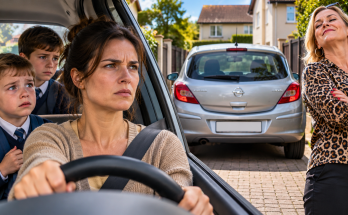
The first morning in my car was worse than the night before.
During the night, I had managed to convince myself that I was simply resting.
That I would wake up and find a sensible solution.
That I had survived difficult things before.
But morning removed those comforting thoughts.
I opened my eyes to a pale sky through the windshield.
My neck hurt.
My legs were stiff.
The coat I had used as a blanket had slipped onto the floor.
For a moment, I forgot where I was.
Then I saw the steering wheel.
And remembered everything.
Lilia's hand.
David's silence.
The way neither of them had followed me outside.
I sat up slowly.
My face hurt when I touched it.
I lowered the sun visor and examined my reflection.
The mark was still visible.
I stared at it longer than I should have.
I had worked in a diner long enough to recognize what people did when somebody hurt them.
Some people became angry.
Some became quiet.
Some started explaining away the person who had caused the pain.
I realized I was already doing the third.
Lilia had probably been stressed.
David was worried about money.
They had been arguing.
It had happened quickly.
I heard those excuses forming in my own mind.
Then I touched my cheek again.
None of them made what happened acceptable.
I drove away from the parking lot before people began arriving for the day.
I bought something small to eat.
I washed my face.
I checked my bank balance on my phone.
The money was still there.
I could rent an apartment.
I could look for work if I needed to.
I knew those things.
But knowing them didn't mean I could arrange a home by lunchtime.
I had no lease waiting.
No furniture.
No plan.
And I was frightened of making a decision while my thoughts were so confused.
The day passed in small, pointless movements.
I drove.
I parked.
I looked at places where I might find somewhere inexpensive to live.
Then I drove again.
Each time my phone made a sound, I checked it.
I told myself I was waiting for practical information.
Perhaps David would ask where he could send my mail.
Perhaps he would want to return something I had forgotten.
But that wasn't the truth.
I wanted him to ask whether I was safe.
He didn't.
By evening, I was back in another parking lot.
I found a place beneath a light.
I checked the door locks twice.
Then I tried to sleep.
The second night felt longer.
I kept waking.
Every passing headlight made me open my eyes.
Every sound outside the car reminded me how little protection a locked door could provide.
I had spent years worrying about David when he was young.
Whether he had eaten enough.
Whether he had made it home.
Whether he was warm.
Now I was sitting in my own car wondering whether anyone would notice if I didn't come home.
That thought frightened me more than I wanted to admit.
On the third day, I tried to imagine returning to the house.
I pictured myself ringing the doorbell.
Lilia opening it.
David standing behind her.
I could almost hear the conversation.
They would ask whether I had reconsidered.
Not whether I had been hurt.
Not whether I needed help.
Whether I was ready to pay.
I couldn't do it.
I would rather sit in the Honda another night than buy permission to live under their roof.
That realization surprised me.
I had spent so long giving in that I hadn't known how much strength refusing could require.
The third night was cold.
I pulled my coat closer.
I watched condensation gather on the window.
I remembered David at three years old, sleeping against my shoulder.
After his father left, he had struggled at bedtime.
He would wake and call for me.
I would sit beside him until he settled.
Sometimes I was so tired after work that I fell asleep sitting up.
Back then, I had promised myself he would never feel abandoned.
I had kept that promise as well as I could.
Now I wondered whether I had confused protecting him with preventing him from ever feeling responsible for somebody else.
It was a painful question.
And it came too late to make those nights easier.
On the fourth morning, I couldn't bear another hour in the parking lot.
I started the engine before the sun had fully risen.
I drove without any particular destination.
At some point, I found myself heading toward the harbor.
I hadn't planned to go there.
I simply wanted somewhere open.
Somewhere I could look at something other than buildings and parked cars.
The morning air smelled of salt.
The water moved gently beside the docks.
Large ships rose above the smaller vessels.
I parked the Honda and got out.
For the first time in days, I stood somewhere that didn't feel connected to David or Lilia.
Nobody knew what had happened to me.
Nobody expected an explanation.
I walked along the harbor and watched the crews working.
Luggage was being moved.
Passengers gathered near an embarkation area.
Workers called to one another as they prepared for another voyage.
There was something comforting about seeing people with places to go.
The activity had a purpose.
Everybody seemed to know where they belonged.
I wished I did.
Then I looked toward a cruise ship moored nearby.
Its name was Sea Star.
The letters were painted along the vessel.
I remember noticing how enormous the ship looked from the dock.
Its white decks stood high above me.
Windows caught the morning light.
A man in a captain's uniform was standing where he could see the harbor.
I wouldn't have looked at him twice if he hadn't turned his head.
Something about his face stopped me.
The silver hair was unfamiliar.
The straight way he stood was not.
I narrowed my eyes.
For a moment, I thought I was imagining it.
Then he turned completely.
And I knew him.
James Morrison.
I hadn't seen him in forty years.
The realization made me stop walking.
He had been part of my life when I was young enough to believe that love would make the rest of life simple.
He used to come to the diner where I worked.
Sometimes he waited outside after my shift.
We had talked about the future in the careless way young people do.
Then our lives had moved in different directions.
I had married someone else.
David was born.
James became part of a past I rarely allowed myself to revisit.
But standing beneath that ship, I recognized him.
Not only his face.
The way he watched people.
The way his expression changed when something surprised him.
He was looking directly at me now.
I felt suddenly embarrassed.
My hair wasn't properly arranged.
My clothes had been folded in a suitcase.
I had slept in my car for three nights.
Of all the mornings for somebody from my youth to see me, I couldn't imagine a worse one.
Then he smiled.
"Marlene?"
Hearing my name in his voice made my throat tighten.
He looked uncertain for a second.
Then he said my maiden name.
"Marlene Patterson?"
I nodded.
"James?"
He moved closer.
"I thought that was you."
I tried to smile.
"You're looking well."
He laughed softly.
"That's kind of you. It's been a long time."
I looked at his uniform.
"Apparently you've been busy."
His smile grew.
Then he studied my face.
Something in his expression changed.
"Are you all right?"
It was the first time anyone had asked me that since I left David's house.
I opened my mouth.
Nothing came out.
James didn't press me.
He glanced toward the ship.
"Would you like some coffee?"
I almost refused.
I was so used to worrying about taking up somebody's time.
But I was tired.
And I couldn't remember the last time I had sat somewhere comfortable.
"Yes," I said.
"I'd like that."
A short while later, I was aboard the Sea Star.
James led me into his quarters.
The room was tidy.
There were chairs, a desk, and a window looking toward the harbor.
Someone brought coffee.
I wrapped my hands around the cup.
It was hot enough to make my fingers ache.
James sat opposite me.
For a few minutes, we spoke about the years between us.
He told me a little about his work.
I answered a few questions about mine.
I mentioned the diner.
I mentioned David.
Then James looked at the mark on my face again.
"Marlene, what happened?"
I stared into the coffee.
I could have lied.
I had been doing a good deal of that lately.
Mostly to myself.
I could have said I fell.
I could have said I had an argument and needed some air.
Instead, I told him.
Not beautifully.
Not in any particular order.
I told him my daughter-in-law wanted fifty thousand dollars for a cruise.
I told him I had refused.
I told him she hit me.
I told him my son did nothing to stop it.
And I told him I had been sleeping in my Honda.
James listened without interrupting.
That was almost enough to make me cry.
I kept expecting him to ask why I had allowed things to reach that point.
Why I lived with my son.
Why I hadn't rented a room immediately.
Why I had kept helping people who treated me that way.
He asked none of those things.
When I finished, I looked at the window.
The harbor was bright beyond the glass.
I felt exposed.
"I know how it sounds."
James shook his head.
"I don't think you need to defend yourself."
I looked down.
My coffee had gone untouched while I spoke.
He waited.
Then he asked what I intended to do.
I told him the truth.
"I need somewhere inexpensive to live."
He nodded.
"And after that?"
"Probably find work again."
"What kind?"
I gave a tired laugh.
"Whatever I can manage."
James leaned back.
"What did you do at the diner?"
I looked at him.
"James, you remember. I served tables."
"For how long?"
"Most of my working life."
"And you dealt with customers?"
"Every day."
"Staff problems?"
"When somebody needed help."
"Complaints?"
I almost smiled.
"More than you can imagine."
He looked thoughtful.
I didn't understand why he was asking.
Then he told me something I hadn't known.
James wasn't simply the captain of the Sea Star.
He had an ownership interest in Morrison Maritime.
The company operated twelve cruise ships.
I stared at him.
"Twelve?"
He nodded.
I looked around his quarters.
Suddenly the uniform and the size of the ship seemed different.
I had assumed he was a captain who had built a successful career.
I hadn't imagined he was also an owner.
James explained that the company had been dealing with growing responsibilities in guest services.
There were employees to support.
Passenger concerns to manage.
Procedures to review across the fleet.
He needed somebody with practical experience dealing with people.
I listened politely.
At first, I assumed he was simply explaining his work.
Then he asked whether I would consider helping.
I thought he was joking.
"James, I haven't worked for a cruise company."
"I know."
"I don't have an impressive business background."
"I know that too."
"Then why would you ask me?"
He studied me for a moment.
"Because you've spent years dealing with people when they're tired, hungry, disappointed, and sometimes unreasonable."
I looked away.
He continued.
"That's experience, Marlene."
I didn't know what to say.
For years, I had thought of my work as ordinary.
Necessary.
Nothing more.
I had carried plates.
Remembered orders.
Balanced the register.
Helped new employees.
Calmed angry customers.
Covered shifts.
Solved problems before they became worse.
Nobody had ever described those things as qualifications for anything important.
James wasn't offering to make me captain.
He wasn't pretending I could run a cruise company without learning how it worked.
He was asking whether I might be willing to learn.
That distinction mattered.
"I wouldn't know where to begin."
"Then you'd begin with training."
I stared at him.
I was sixty-two.
I had two suitcases in the trunk of my car.
My son had just told me I was a burden.
And here was someone from forty years ago speaking as though my life might still have useful possibilities.
I wanted to believe him.
I was frightened to.
"What if I'm terrible at it?"
"Then we'll find that out honestly."
He didn't promise that everything would be easy.
He didn't tell me I was destined for something grand.
He simply offered me a chance.
For a while, neither of us spoke.
I looked down at the coffee cup.
It had warmed my hands.
I thought about the Honda waiting outside.
The photo albums in the trunk.
The money David believed he could claim.
Then I looked at James.
"Are you serious?"
"Completely."
I felt a strange pressure behind my eyes.
I had come to the harbor because I didn't know where else to go.
Now somebody was asking me what I could become.
I wasn't ready to call it a new life.
I wasn't ready to trust my own judgment again.
But I was ready to stop spending my nights in a parking lot.
I put down the cup.
"Then tell me what I need to learn."