PART 1 — THE NIGHT MY SON FINALLY TOLD ME THE TRUTH
My eight-year-old son came home from his mother’s house on a Sunday evening, walking as though every step hurt.
He was holding his fists so tightly that his knuckles had turned white.
At first, I thought he had fallen while playing.
But when I tried to hug him, he stepped backward.
And when I asked what had happened, he whispered six words that I will remember until I die.
“Daddy, please don’t send me back.”
My name is Andrew Bennett.
I’m thirty-eight years old, divorced, and the father of a little boy named Tommy.
For most of my adult life, I believed the worst thing that could happen to a father was losing custody of his child.
I was wrong.
The worst thing is discovering that your child has been begging for help while everyone around him insists he’s perfectly fine.
Lauren and I divorced two years earlier.
Our marriage had collapsed under arguments about money, trust, and the kind of resentment that grows when two people stop listening to each other.
Lauren received primary custody.
I had Tommy every other weekend and one evening during the week.
I hated the arrangement, but I tried to make the best of it.
I never wanted Tommy to feel that he had to choose between his parents.
He deserved to love both of us.
At least, that was what I believed.
Then Derek Lawson entered our lives.
Lauren introduced him as a successful businessman who understood children and wanted to help her build a stable home.
Derek always wore expensive watches.
He drove a dark gray pickup truck.
And he smiled whenever another adult was watching.
But something about that smile bothered me.
It disappeared too quickly.
The first time Tommy met him, my son told me that Derek was funny.
Three months later, Tommy stopped mentioning his name.
Six months later, he began begging me to let him stay an extra night.
By the end of that year, he no longer wanted to answer my questions about his mother’s house.
I noticed other changes.
He stopped asking for seconds at dinner.
He apologized whenever he spilled something.
He asked permission before opening the refrigerator.
Once, he accidentally knocked over a glass of milk and immediately covered his head with his arms.
I stood frozen beside the kitchen counter.
“Tommy, buddy, it’s only milk.”
He stared at the floor.
“I’m sorry.”
“It’s okay.”
“I didn’t mean to.”
“I know.”
He began crying.
That was when I realized something was terribly wrong.
I contacted Lauren.
She accused me of turning ordinary childhood behavior into evidence against her.
When I suggested counseling, she said I was trying to make her look like an unfit mother.
I spoke to my attorney.
I documented the changes.
I requested a custody review.
But without clear evidence, nothing changed immediately.
Then came that Sunday evening.
Lauren dropped Tommy off twenty minutes late.
She didn’t get out of the car.
She rolled down the window and called through the rain.
“He’s been difficult all weekend. Maybe you can teach him some manners.”
Before I could answer, she drove away.
Tommy stood beside my front door with his backpack hanging from one shoulder.
His face was pale.
His lips were pressed together.
And he was walking strangely.
“Champ, are you hurting?”
He shook his head.
I crouched in front of him.
“Look at me.”
He wouldn’t.
“Tommy.”
His eyes filled with tears.
“Please don’t be mad.”
My stomach tightened.
“Why would I be mad?”
He whispered, “Because I didn’t count right.”
I had no idea what he meant.
Then he tried to sit on the couch.
The moment his body touched the cushion, he cried out.
I didn’t ask another question.
I picked up my phone and called for medical help.
And that decision changed all our lives.
PART 2 — THE DOCTOR WHO REFUSED TO BELIEVE THE EXPLANATION
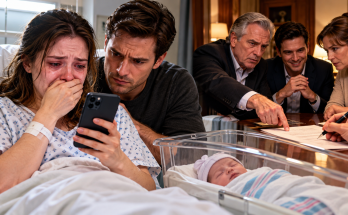
The emergency department smelled of disinfectant and burnt coffee.
Tommy sat beside me holding a stuffed blue dinosaur named Mr. Buttons.
I’d bought it for his fifth birthday.
Its neck was crooked, and one plastic eye had a scratch across it.
He had carried it everywhere when he was younger.
Then one day he stopped bringing it to his mother’s house.
When I asked why, he told me Derek thought stuffed animals were for babies.
That night, however, he held Mr. Buttons so tightly that his fingers trembled.
A nurse named Patricia brought us into a private examination room.
She spoke softly.
She didn’t rush him.
When she asked what hurt, Tommy looked at me before answering.
“Can Daddy stay?”
“Of course,” she said.
The doctor examined him carefully.
As the examination continued, his expression became increasingly serious.
He asked me to step into the hallway.
I immediately feared the worst.
“Is he okay?”
“He’s stable,” the doctor said. “But some of his injuries need further evaluation.”
He paused.
“Mr. Bennett, has Tommy ever told you that someone hurt him?”
I felt my throat tighten.
“Not directly.”
“Have you noticed changes in his behavior?”
I told him everything.
The nightmares.
The apologies.
The fear of returning to Lauren’s house.
The strange counting.
The doctor listened without interrupting.
Then he said something that made my knees weak.
“We’re concerned these injuries may not be accidental. We need to make sure Tommy is safe.”
I leaned against the wall.
For nearly two years, I had questioned myself.
Was I exaggerating?
Was I letting my anger toward Lauren influence my judgment?
Was Tommy simply struggling with the divorce?
Now a medical professional was telling me that my concerns were serious.
The hospital contacted child protection authorities and law enforcement.
Within an hour, Detective Sarah Miller arrived with her partner, James Carter.
Lauren arrived shortly afterward.
She marched down the hallway carrying her purse and demanding to know why police officers were involved.
“Tommy fell in the bathroom,” she announced.
Detective Miller asked when.
“Saturday evening.”
“And did you seek medical attention?”
“He wasn’t seriously hurt.”
I stared at her.
“Then why couldn’t he sit down when you brought him to my apartment?”
Lauren turned toward me.
“Because you’ve filled his head with nonsense!”
The doctor stepped between us.
“Please keep your voices down. Your son is frightened.”
For a moment, Lauren said nothing.
Then her phone began ringing.
I saw the name.
Derek.
She declined the call.
He called again.
And again.
Finally, a message appeared across her screen.
DID THE BOY SAY ANYTHING?
Lauren quickly turned the phone away.
But Detective Miller had noticed her reaction.
“Mrs. Bennett, we’d like to speak to you about Mr. Lawson.”
Lauren’s face changed.
“Derek hasn’t done anything.”
Nobody had accused him in front of her.
Not yet.
I looked toward Tommy’s room.
Through the small window, I could see him lying beneath a blanket.
He wasn’t sleeping.
He was watching the door.
And suddenly I understood that he wasn’t waiting for someone to come in.
He was afraid someone would.
PART 3 — THE BLUE DOOR
When the nurse finally allowed me back into the room, Tommy reached for my hand.
“Daddy?”
“I’m here.”
“Are you going to make me go back?”
“No one is making that decision tonight, buddy. The people here are going to help keep you safe.”
He studied my face.
“Even if Mom gets mad?”
“Even then.”
His eyes moved toward the doorway.
“Did Derek come?”
“Not into your room.”
Tommy began shaking.
I pulled my chair closer.
“You don’t have to tell me anything you’re not ready to tell.”
He stared at Mr. Buttons.
Then he whispered, “What if somebody else needs help?”
My chest tightened.
“What do you mean?”
He said nothing for several seconds.
Then he asked, “Can babies be scared when nobody can hear them?”
I felt cold all over.
Before I could answer, the nurse came back into the room.
Tommy turned toward her.
“There’s a baby at Mom’s house.”
The nurse sat beside his bed.
“Okay, sweetheart.”
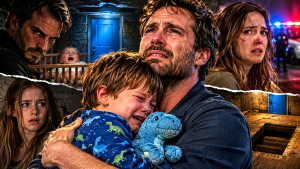
“She’s behind the blue door.”
I stopped breathing.
Tommy began crying.
“Sometimes she cries and cries. Derek says I’m not supposed to listen.”
The nurse quietly summoned the detective.
With trained staff guiding the conversation, Tommy shared what he felt able to say.
There was a room downstairs.
A blue door.
A baby.
And a rule that nobody was allowed to open it without Derek’s permission.
He had heard the baby crying.
He had tried to help.
And Derek had become furious.
Detective Miller immediately contacted officers near Lauren’s house.
The address was 218 Willow Creek Drive.
I had been there dozens of times.
I had stood in the driveway.
I had watched Tommy disappear through the front door.
I had even helped carry birthday presents into the kitchen.
But I had never been downstairs.
I looked at the detective.
“Please tell me you’re going to check.”
“We’re taking this seriously, Andrew.”
Twenty minutes later, her radio crackled.
Officers had arrived at the house.
The front door was unlocked.
Lauren wasn’t there.
Derek’s pickup was missing.
The officers searched the main floor.
Then they moved downstairs.
I stood beside Detective Miller in the hospital corridor, barely breathing.
A voice came through the radio.
“We have a blue door.”
I grabbed the edge of the nurses’ station.
The officer continued.
“Door is secured from the outside.”
Then came a long silence.
I heard footsteps.
Someone calling out.
Metal rattling.
And then—
A baby’s cry.
Detective Miller closed her eyes for one brief second.
“Get medical assistance there immediately.”
The radio crackled again.
“One infant located. Alive.”
I covered my face and cried.
There really was a baby.
My son had been telling the truth.
And somewhere inside that house, another child had been waiting for somebody to listen.
PART 4 — THE GIRL WHO KNEW WHAT HAPPENED
The police found more than a baby that night.
Behind shelves in the laundry room, officers discovered a concealed storage space.
There were notebooks.
Security monitors.
Old photographs.
A narrow mattress.
And pages of handwritten rules.
One rule appeared repeatedly.
COUNT TO TEN BEFORE YOU SPEAK.
Suddenly, Tommy’s strange behavior made sense.
The counting.
The silence.
The apologies.
But the most important development came from a sixteen-year-old girl named Emily Lawson.
She was Derek’s daughter.
Until that night, I hadn’t even known she existed.
She contacted me through a message sent from an unfamiliar number.
She knew my name.
She knew Tommy’s name.
And she knew about the blue door.
At first, I thought Derek was trying to frighten me.
Then Emily sent a photograph.
It showed that same basement room.
The same narrow mattress.
The same markings along the wall.
I handed the phone to Detective Miller.
She arranged for officers to locate Emily and bring her somewhere safe.
Emily had been living with a friend’s family.
She told investigators she had fled Derek’s house weeks earlier.
According to her account, Derek punished children for breaking rules he invented.
Sometimes the rules changed without warning.
Sometimes he demanded that they stand silently.
Sometimes he made them count.
And sometimes he locked doors.
Emily had tried to tell adults before.
But Derek had convinced people she was troubled and dishonest.
When Tommy arrived in the household, she tried to protect him.
She shared snacks with him.
She told him where to hide his favorite toys.
She taught him how to recognize Derek’s moods.
Then she saw a woman named Rebecca arguing with her father.
Rebecca was Derek’s younger sister.
She had recently given birth to a daughter named Lily.
Emily remembered Rebecca coming to the house, demanding to see her baby.
She remembered Derek shouting.
She remembered a crash inside the garage.
And then Rebecca disappeared.
Seven weeks passed without anyone seeing her.
The police had been investigating her disappearance.
Now an infant matching her daughter’s description had been found inside Derek’s house.
Detective Miller asked Emily whether she knew what happened to Rebecca.
Emily began crying.
“I heard her voice,” she said.
“Where?”
“Under the floor.”
The officers expanded their search.
Beneath the garage was a concealed passage leading to a locked room.
Inside, they found a woman lying on a thin mattress.
She was weak and dehydrated.
But she was alive.
Her name was Rebecca Lawson.
When rescuers asked what she needed, she whispered only one thing.
“My daughter.”
The paramedic told her they had found the baby.
Rebecca began crying.
And for the first time in weeks, she allowed herself to believe she might survive.
PART 5 — THE INSURANCE POLICY
I thought finding Rebecca would be the end of the nightmare.
It wasn’t.
At two in the morning, Detective Miller returned from a telephone call.
Her face was serious.
“Andrew, we need to discuss some documents recovered from Derek’s office.”
I sat upright.
“What documents?”
She placed a folder on the table.
Inside were copies of paperwork bearing my name.
My address.
My driver’s license number.
And a signature that looked disturbingly similar to mine.
I stared at the pages.
“I never signed those.”
“We’re investigating their authenticity,” she said.
Then she showed me another document.
It appeared to concern life insurance involving Tommy.
My stomach twisted.
“Why would Derek have that?”
“We’re trying to establish exactly what he intended.”
One page had a date circled in red.
November seventeenth.
The following day.
I looked at Detective Miller.
“What was supposed to happen tomorrow?”
She didn’t speculate.
But the police had found something else.
A suitcase packed with Tommy’s clothes.
A printed travel itinerary.
And messages describing a trip that Lauren and Derek had planned without telling me.
Lauren was questioned again.
This time, she admitted Derek had been preparing to take Tommy away.
He had told her it would be a short vacation.
He had also claimed I had agreed to changes in the custody arrangement.
I felt sick.
“Lauren, you know I would never agree without speaking to you directly.”
She began crying.
“Derek showed me papers.”
“Did you call my attorney?”
“No.”
“Did you call me?”
She shook her head.
“Then you knew something wasn’t right.”
She couldn’t answer.
Detective Carter later explained that investigators were examining whether Derek had tried to create a fraudulent financial arrangement and use forged legal documents.
No legitimate custody order had transferred my rights.
There was no evidence that I had authorized the supposed insurance arrangement.
And the date in red was enough to make investigators treat the planned trip as an urgent threat.
But then they uncovered another signature.
My older brother’s.
Michael Bennett.
I stared at it for several seconds before I recognized the handwriting.
Michael had helped me after the divorce.
He had watched Tommy when I worked late.
He had given me advice about court proceedings.
He was family.
I trusted him.
And now his name appeared on paperwork that someone had used to threaten my son.
My phone rang.
Michael.
I almost answered.
Detective Miller gently stopped me.
“Let us investigate before you speak to him.”
I nodded.
But something inside me had already broken.
Derek was a dangerous stranger.
Michael was my own brother.
And betrayal by someone you love feels different from betrayal by someone you never trusted.
PART 6 — MY BROTHER’S SECRET
Michael was forty-three years old.
He owned a small construction company and had spent the previous year struggling financially.
I knew business had been difficult.
I didn’t know he was drowning in debt.
Investigators found records showing that Michael and Derek had been communicating for months.
There were bank transfers.
Copies of legal paperwork.
And messages about my custody dispute.
Derek had apparently convinced Michael that he could help arrange financial benefits through a complicated guardianship and insurance scheme.
Michael later claimed he believed the documents were harmless drafts.
The investigators did not simply accept that explanation.
Neither did I.
What hurt most was discovering that Michael had helped Derek collect information about my schedule.
My work hours.
My apartment building.
Tommy’s school.
The weekends when my son stayed with me.
Michael knew all of it.
Because I had trusted him.
And he had passed that information to a man who frightened my child.
When the police finally interviewed Michael, he admitted signing documents he hadn’t properly reviewed.
He also acknowledged receiving money from Derek.
But he insisted he had never known anyone intended to harm Tommy.
Whether that was true became a question for investigators and the courts.
For me, one fact was already beyond dispute.
My brother had put his financial desperation ahead of protecting my son.
Three days later, Michael asked to speak with me through his attorney.
I refused.
Not because I had nothing to say.
Because I had too much.
I wanted to ask him how much money my son’s safety had been worth.
I wanted to ask whether he had ever noticed Tommy becoming quiet around Derek.
I wanted to ask whether he had thought about what those documents might allow someone to do.
But none of those questions would undo what had happened.
So I stayed at the hospital.
I helped Tommy choose breakfast.
I sat beside his bed when he couldn’t sleep.
And I learned that sometimes the most important thing a father can do is stop chasing explanations from adults and focus on the child who needs him.
PART 7 — WHAT REBECCA TOLD ME
Rebecca remained in the hospital for several days.
Her daughter Lily was receiving medical care in a separate unit.
Both were recovering.
When Rebecca was strong enough, she asked to meet me.
I didn’t know what to expect.
She was sitting in a wheelchair beside a window when I entered.
She looked exhausted.
Her hands trembled around a paper cup.
But when she saw me, she smiled.
“You’re Tommy’s father.”
“Yes.”
Her eyes filled with tears.
“He’s a brave little boy.”
I sat across from her.
“I wish he hadn’t needed to be.”
Rebecca looked down.
Then she told me what she remembered.
She had become worried about Derek after visiting Lauren’s house.
Tommy had been unusually quiet.
He watched Derek before answering questions.
And one afternoon, when a baby’s bottle fell from the kitchen counter, Tommy immediately claimed it was his fault.
Rebecca knew he hadn’t touched it.
She had knocked it over herself.
But Tommy kept apologizing.
He seemed terrified.
When Rebecca challenged Derek, he became angry.
She warned him that she would report what she had seen.
Soon afterward, her daughter disappeared.
Rebecca went to confront him.
She never made it home.
Her brother had isolated her in the concealed area beneath the garage and kept her there through threats and coercion.
The full details would take investigators months to establish.
What mattered to Rebecca was simple.
She had tried to protect Tommy.
And Tommy had tried to protect Lily.
Even while frightened, my son had found small ways to help the baby.
He had brought blankets.
He had looked for someone willing to listen.
And he had remembered the blue door.
Rebecca reached across the table.
“Andrew, he told me something once.”
I swallowed.
“What?”
“He told me that when he got back to his daddy, everything would be okay.”
I looked away.
Because I had spent so many nights thinking I had failed him.
Rebecca continued.
“He trusted you enough to keep hoping.”
I covered my eyes.
For the first time since the hospital admission, I cried without trying to hide it.
PART 8 — THE FIRST NIGHT HOME
The investigation did not end when Derek was arrested.
There were interviews.
Court hearings.
Medical appointments.
Child protection assessments.
And questions that no one could answer quickly.
Temporary orders were put in place to protect Tommy.
Eventually, after further proceedings, he was allowed to return to my care under arrangements designed to keep him safe.
I prepared his room.
I washed his favorite blanket.
I put his dinosaur on the pillow.
I bought the cereal he liked.
Then I stood in the doorway and wondered why ordinary things suddenly felt so important.
The first evening back, Tommy asked whether he could have two cookies.
I said yes.
He looked surprised.
“Even though dinner’s soon?”
“Even though dinner’s soon.”
He took one cookie.
Then he asked if he could save the other for later.
I showed him a small container in the kitchen.
“You can put it here.”
He looked at me carefully.
“Nobody will take it?”
“No, buddy.”
He placed the cookie inside.
Then he asked, “Do I have to write my name?”
I shook my head.
He stared at the container for a long time.
Finally, he closed the lid.
That night, he couldn’t sleep.
At eleven, I heard footsteps outside my bedroom.
He stood in the doorway wearing blue pajamas.
“Can I stay here?”
I moved over.
He climbed into bed beside me, carrying Mr. Buttons.
For several minutes, neither of us spoke.
Then he whispered, “Daddy?”
“Yeah?”
“Do grown-ups always know when they’re doing something bad?”
I thought about Derek.
About Lauren.
About Michael.
About all the people who had seen something wrong and chosen silence.
“Sometimes they do,” I said. “Sometimes they make excuses. But adults are responsible for their choices.”
He considered that.
“Was it my fault?”
I turned toward him.
“No.”
“Not even when I broke the rule?”
“Not even then.”
He began crying softly.
I held him until he fell asleep.
And I stayed awake for hours, listening to his breathing.
PART 9 — THE COURTROOM
Months passed before the criminal case reached its decisive stage.
The investigation had produced a large collection of evidence.
Medical records.
Documents.
Witness statements.
Electronic messages.
Financial transfers.
And the testimony of people who had finally been given a safe place to speak.
Derek faced serious charges related to the confinement of Rebecca, the mistreatment of the children, threats, and alleged financial fraud.
Michael also faced legal consequences for his involvement in the paperwork and financial transactions.
Lauren’s actions were examined separately.
She acknowledged that she had ignored warning signs, accepted Derek’s explanations, and failed to protect Tommy when he needed her.
Her fear of Derek was considered.
But fear did not erase the consequences of her choices.
The custody proceedings were difficult.
I wanted to hate Lauren.
Some days, I did.
But eventually I realized that anger would not help Tommy recover.
He still loved his mother.
He also feared her house.
Those two feelings could exist at the same time.
With guidance from professionals, his contact arrangements were handled carefully.
The court prioritized his safety.
I focused on giving him a home where he didn’t have to guess which version of an adult would walk through the door.
When Derek’s case was resolved, the outcome brought accountability, but it did not magically heal anyone.
Rebecca still struggled with the effects of her captivity.
Emily still had nightmares.
Lily needed continued care.
Tommy continued seeing a therapist.
And I continued learning how to be a better father to a child whose trust had been damaged.
One afternoon, after a difficult appointment, Tommy asked me a question in the car.
“Dad, will I ever stop being scared?”
I pulled into a parking lot.
I turned off the engine.
“I think it can get easier,” I told him. “And you don’t have to do it by yourself.”
He nodded.
Then he reached for my hand.
We sat there for several minutes.
No radio.
No rushing.
Just the two of us.
PART 10 — THE DAY I HEARD HIM LAUGH AGAIN
Nearly a year after that terrible Sunday evening, Tommy turned nine.
He wanted a small birthday party.
Nothing fancy.
A chocolate cake.
Pizza.
Three friends from school.
And a trip to the park.
I asked whether he wanted a magician or a bounce house.
He shook his head.
“Can we just play baseball?”
“Of course.”
On the morning of his birthday, I woke early and decorated the kitchen.
Blue balloons.
Paper streamers.
A banner over the window.
I placed his presents on the table.
Then I heard footsteps behind me.
Tommy was standing in the doorway.
His hair was messy.
He was wearing the same blue pajamas he had worn on his first night back.
He looked around the room.
“Is all this for me?”
“Every bit.”
He smiled.
Not the careful smile he used to give when he was checking whether an adult was pleased.
A real smile.
The kind that begins in the eyes.
He ran toward me and wrapped his arms around my waist.
“Thank you, Daddy.”
I hugged him.
And for a moment, I couldn’t speak.
Later that afternoon, we played baseball in the park.
Tommy hit the ball into the grass.
He ran as fast as he could.
When he reached second base, he stumbled.
My heart stopped.
But he jumped up laughing.
“I’m okay!”
Then he kept running.
I stood beside the field, watching him.
I realized I was crying.
Not because he had fallen.
Because he wasn’t afraid of falling anymore.
That evening, after everyone went home, we sat together on the couch.
Mr. Buttons was between us.
Tommy leaned against my shoulder.
“Dad?”
“Yeah, champ?”
“Remember when I came home and I couldn’t walk right?”
I swallowed.
“I remember.”
He looked at his dinosaur.
“I thought you wouldn’t believe me.”
I turned toward him.
“I’m sorry you ever had to worry about that.”
He nodded slowly.
Then he said something that stayed with me.
“But you did.”
I put my arm around him.
“Always tell me when something is wrong, okay?”
He smiled.
“Okay.”
A few minutes later, he fell asleep against my shoulder.
I looked at the little boy beside me.
He had survived things no child should experience.
He still had difficult days.
He still needed reassurance.
He still asked questions I couldn’t always answer.
But he was healing.
And I was learning that protecting a child is not only about fighting danger.
Sometimes it means being patient.
Sometimes it means listening.
Sometimes it means making breakfast after a nightmare.
Sometimes it means showing up for another appointment.
And sometimes it means believing a little boy when the adults around him insist he is lying.
I used to think being a good father meant giving my son everything he wanted.
A nice room.
Good toys.
Birthday parties.
Vacations.
Now I know what he needed most.
Someone who listened.
Someone who believed him.
Someone who stayed.
That Sunday night, my son walked through my door with clenched fists and a terrified expression.
He thought he was bringing shame into our home.
Instead, he was bringing us the truth.
And that truth saved more than one life.
It saved Tommy.
It saved Lily.
It helped Rebecca find freedom.
And it finally gave Emily the chance to be heard.
I can’t change what happened.
I can’t give my son back the nights he spent afraid.
But every morning, when he comes downstairs and calls, “Dad, what’s for breakfast?” I get another chance to show him what home is supposed to feel like.
Safe.
Warm.
Ordinary.
And full of love.
THE END