Part 1: The Door Everyone Laughed At
The first man to reach Clara Bennett’s winter door had spent three months calling her a fool.
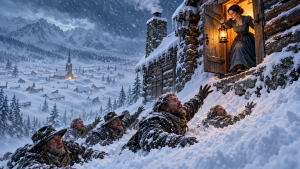
Now he was buried to his waist in snow, reaching toward the warm light spilling from a doorway twelve feet above the ground.
“Clara!” he shouted through the blizzard. “Please! Open the door!”
Behind him, four other men struggled up the mountainside. Their coats were stiff with ice, their faces gray from the cold, and their boots had long since disappeared beneath the snow.
One man had lost his hat. Another was crawling on his hands and knees. The oldest could barely stand.
Below them, the entire valley had vanished beneath a white wilderness.
And above them stood the strangest house in Montana Territory.
A wooden cabin built into the mountainside, with its lower rooms buried beneath earth and stone, its chimney rising through a roof thick with snow, and a small wooden door opening from the upper floor directly onto the hillside.
There was no staircase outside.
No ordinary porch.
Only a narrow platform beneath the door and a steep slope of snow leading toward it.
Three months earlier, the men had laughed when Clara built that door.
They had called it useless.
They had called it dangerous.
One had even offered her five dollars to tear it down before she embarrassed herself further.
But now, with the worst blizzard in thirty years swallowing their town, that ridiculous door was the only entrance they could reach.
Clara stood in the opening, holding an oil lantern.
Her dark hair was pinned loosely behind her head, and her faded blue wool dress was tied at the waist with a leather belt. Warm firelight illuminated her face while snow whipped around the wooden frame.
She recognized the first man immediately.
Walter Briggs.
The merchant who had refused to sell her lumber on credit.
The man who had told everyone in town that a woman living alone on the mountain would never survive her first winter.
“Mrs. Bennett!” Walter cried. “We need shelter!”
Clara looked past him at the others.
She saw Daniel Mercer, the blacksmith, struggling to support an exhausted neighbor. Behind them came Thomas Reed, the schoolmaster, and two ranch hands whose names she barely knew.
Then she looked toward the valley.
Through the snow, she could barely distinguish the shapes of buried rooftops.
The storm had done exactly what she feared.
It had swallowed the lower doors of every house in the valley.
And it was still rising.
Clara lifted her lantern.
“Come closer!” she shouted. “One at a time!”
Walter reached for the platform.
His fingers slipped against the frozen timber.
“Please,” he gasped. “I can’t feel my hands!”
Clara set down the lantern and grabbed the heavy rope she had secured to an iron ring inside the doorway.
She threw it toward him.
“Tie it beneath your arms!”
He stared at her.
“Now, Walter!”
For the first time since she had arrived in the valley, he obeyed without argument.
Clara braced her boots against the floor and pulled.
When Walter finally tumbled through the doorway, he collapsed onto the wooden boards, shaking uncontrollably.
His eyes wandered around the small upper room.
There was a neatly made bed beneath a patchwork quilt, a wooden chair, a little oil lamp, and a narrow staircase leading downward into a golden glow.
Warmth rose through the floorboards.
The smell of bread drifted up from below.
Walter looked back at Clara.
“How?” he whispered.
Clara was already reaching for the rope again.
“Questions later,” she said. “There are four more men outside.”
What Walter did not know was that the door had been built for precisely this moment.
And what Clara did not yet know was that before the storm ended, twenty-three more desperate people would come climbing toward it.
Part 2: The Widow Who Inherited a Mountain
Three months earlier, in September 1886, Clara Bennett had arrived in the little settlement of Pine Hollow with forty-three dollars, two trunks, and a deed to six acres of mountainside.
She was twenty-nine years old.
Her husband, Samuel, had died the previous spring after an accident at a sawmill in eastern Oregon.
For seven years, Clara had worked beside him, keeping accounts, repairing clothing, tending a garden, and saving every coin they could spare.
They had planned to purchase a small farm.
Instead, Clara had spent most of their savings settling debts and arranging his burial.
The only property left to her came from Samuel’s uncle, a reclusive stone mason named Elias Bennett.
Elias had died the previous winter, leaving Clara a cabin in Montana Territory.
The letter accompanying the deed was brief.
The house is not beautiful, but it is honest.
The mountain protects what the valley cannot. If you are willing to learn its ways, you will never need to fear winter.
Clara had read those words dozens of times during her journey west.
When she finally saw the property, she understood why no one else wanted it.
The cabin stood halfway up a steep, wooded hillside.
Its lower walls were built from thick fieldstone, partly sunk into the earth. Above them rose a timber-framed sleeping room beneath a sharply pitched roof.
The roof sagged beneath old moss and weathered shingles.
The lower porch leaned toward the slope.
The front door opened onto a narrow path that disappeared beneath fallen branches.
Inside, dust covered the furniture.
The fireplace was cold.
A broken chair lay beside a small wooden table.
Yet the structure was remarkably solid.
Elias had built the lower rooms directly against a natural rock shelf, with stone walls nearly three feet thick.
The upper sleeping loft stood above them, supported by massive beams.
Clara walked through the rooms slowly.
In the lower level, she found a stone hearth, a cooking stove, shelves filled with empty jars, and a long wooden table.
A narrow ladder led to the sleeping room above.
Behind the stove stood a thick masonry wall that seemed unusually warm despite the chilly September morning.
Clara pressed her palm against it.
The stones held the faint heat of the afternoon sun.
She smiled.
“Perhaps you knew something the others didn’t, Uncle Elias.”
That afternoon, she walked down to Pine Hollow to purchase supplies.
The settlement consisted of a general store, a blacksmith shop, a church, a small schoolhouse, and perhaps thirty homes scattered along the valley floor.
At Briggs General Merchandise, she met Walter Briggs.
He was a broad-shouldered man in his fifties with a neatly trimmed beard and a habit of looking at people over the rims of his spectacles.
When Clara explained where she intended to live, his expression changed.
“The Bennett place?”
“Yes.”
“Up on the north slope?”
“That’s right.”
Walter shook his head.
“Ma’am, that cabin has been empty for two years.”
“Then it’s time someone lived in it.”
A rancher standing beside the counter laughed.
“You’ll change your mind when the snow comes.”
Clara ignored him.
“I need nails, lamp oil, flour, salt, and some lumber.”
Walter examined her list.
“That’s a great deal of work for one woman.”
“I know.”
“You have a husband coming?”
“No.”
“A brother?”
“No.”
Walter sighed.
“Then perhaps you ought to sell that property and rent a room in town.”
Clara placed her money on the counter.
“Perhaps you ought to sell me the supplies I asked for.”
The rancher laughed again.
Walter did not.
But he filled her order.
As Clara carried her purchases outside, she heard him mutter to the other man.
“She’ll be back before Christmas.”
Clara continued walking.
She had heard worse predictions.
And she had survived worse things than winter.
Part 3: The Strange Instructions Beneath the Floor
During her first week at the cabin, Clara discovered that Elias Bennett had left more than a house.
Beneath a loose floorboard near the fireplace, she found a wooden box wrapped in oilcloth.
Inside were a folded map, several pages of handwritten notes, and a small iron key.
The notes were written in Elias’s uneven script.
The mountain remembers every winter.
In the winter of 1864, snow reached the lower windows.
In 1871, it covered the porch.
In 1879, the drifts rose higher than the roof of the stable.
Do not trust a door built at ground level.
Clara read the final sentence twice.
Then she unfolded the map.
It showed the cabin in cross-section.
The lower rooms were shaded beneath the hillside.
The upper room stood above them.
And on the eastern wall of the sleeping loft, Elias had drawn a rectangle.
Beside it, he had written:
Winter entrance.
Clara climbed the ladder and examined the eastern wall.
At first, she saw only rough wooden boards.
But when she removed a narrow strip of trim, she discovered a line of old nail holes forming a rectangle.
Someone had once planned to install a doorway there.
The opening would face directly onto the rising mountainside.
In summer, it would stand nearly twelve feet above the lower porch.
In winter, if the snow accumulated deeply enough, the hillside itself would become a staircase.
Clara stood silently for a long time.
Then she laughed.
Not because the idea was foolish.
Because it was brilliant.
She returned to Elias’s notes.
Another page explained the purpose.
The upper door must open inward.
Snow pressing against an outward-opening door will hold it shut.
Keep the opening clear from inside.
Fasten a rope above the threshold.
Build a small platform beneath the door, but no permanent stairs.
The snow will provide the approach.
Clara looked toward the window.
Beyond it, the mountain rose steeply into a forest of spruce and pine.
She imagined the slope buried beneath twelve feet of snow.
The lower porch would disappear.
The path would vanish.
But the upper door would remain accessible.
She knew immediately what she had to do.
Unfortunately, she had never built a doorframe in her life.
That was how she met Daniel Mercer.
Part 4: The Blacksmith Who Asked No Questions
Daniel Mercer was thirty-six, tall, broad through the shoulders, and quieter than most men in Pine Hollow.
He owned the blacksmith shop beside the creek.
His wife had died five years earlier, and he lived alone in a small cabin behind the forge.
When Clara arrived carrying Elias’s drawings, Daniel studied them without speaking.
Finally, he looked up.
“You want to cut a doorway into the upper wall?”
“Yes.”
“Twelve feet above the porch?”
“Yes.”
“And you don’t want stairs?”
“No.”
Daniel examined the drawing again.
“Why?”
Clara explained the snow records.
She showed him the notes about the winters of 1864, 1871, and 1879.
Daniel listened carefully.
Then he leaned back in his chair.
“My father used to talk about the winter of ’71,” he said. “He said people walked over fences without realizing they were there.”
“Then Elias wasn’t exaggerating.”
“No. He wasn’t.”
Clara waited.
“Will you help me?”
Daniel rubbed his jaw.
“I can make the hinges and reinforce the frame. But you’ll need good timber.”
“I have some.”
“And a proper header above the opening.”
“I know.”
“And if you cut through the wall without supporting the roof, the whole upper corner could settle.”
Clara smiled.
“That’s why I came to you.”
For the first time, Daniel smiled back.
“Fair enough.”
He agreed to help her for two dollars and a promise of fresh bread whenever she baked.
Clara considered the price.
“Two dollars is fair. But I won’t promise bread unless you promise not to complain about the crust.”
Daniel laughed.
“Deal.”
Over the next two weeks, they worked together whenever Daniel could leave the forge.
Clara removed old boards and cleaned the timber.
Daniel fitted a heavy frame into the wall.
They installed an inward-opening oak door reinforced with iron straps.
The hinges were placed on the inside.
A thick wooden bar could secure it against the wind.
Daniel forged an iron ring into the main support beam for a rescue rope.
Outside, they built a narrow landing supported by heavy diagonal braces.
It was barely wide enough for two people to stand.
The work attracted attention.
People passing along the valley road could see the new doorway high above the porch.
Soon the jokes began.
“Planning to welcome flying visitors, Mrs. Bennett?”
“Expecting a ladder from heaven?”
“Maybe she’s afraid of ordinary guests!”
Clara ignored them.
But one afternoon, Walter Briggs rode up the path to inspect the work.
He stood beneath the platform, staring upward.
“Mercer,” he called, “I thought you were a sensible man.”
Daniel continued tightening a bolt.
“I try to be.”
“Then why are you building a door in the middle of the air?”
Clara leaned out of the opening.
“It’s a winter door.”
Walter removed his hat.
“A what?”
“A winter door.”
He looked at the bare hillside.
“There’s no way to reach it.”
“Not yet.”
Walter stared at her.
Then he began to laugh.
“Mrs. Bennett, winter doesn’t make staircases.”
Clara looked toward the mountain.
“Sometimes it does.”
Walter shook his head.
“I’ll give you five dollars to tear that foolish thing down.”
Clara smiled politely.
“Keep your money, Mr. Briggs. You may need it for firewood.”
The laughter stopped.
Daniel lowered his hammer to hide his grin.
Walter climbed onto his horse and rode away.
By evening, half the town had heard the story.
Clara Bennett had built a door twelve feet above the ground.
And she expected snow to bring her visitors.
Part 5: The Warmth Hidden Inside the Mountain
The winter door was only one part of Elias Bennett’s design.
As Clara continued repairing the cabin, she discovered why its lower rooms had been built so deeply into the hillside.
The thick stone walls did more than support the house.
They insulated it.
During warm September afternoons, the lower room remained cool.
During cold October nights, it stayed noticeably warmer than the upper loft.
The rock and earth surrounding the walls slowed the movement of heat.
Elias had also built a central masonry chimney that passed through both floors.
A cast-iron stove stood in front of the thick stone mass.
When Clara burned wood in the stove, the surrounding masonry absorbed heat and released it gradually after the flames died.
The chimney still required regular firing, but the room stayed comfortable longer than a cabin with thin wooden walls.
Clara found another note in the box.
Heat the stone, not merely the air.
She began experimenting.
Instead of feeding the stove constantly, she burned a hot, controlled fire in the evening, then let the heavy stonework hold warmth through the night.
She repaired gaps around the windows with strips of cloth and clay.
She hung thick wool blankets over the lower door.
She fitted shutters to the windows and added a second layer of boards to the roof.
With Daniel’s help, she repaired the chimney and checked the stove pipes.
They also installed a small vent near the upper roofline and made sure the stove could draw fresh air safely.
By late October, the cabin was transformed.
The lower room glowed with warm lamplight.
Shelves held jars of preserved vegetables, dried apples, beans, flour, and salted meat.
A stack of split firewood stood beside the hearth.
Above, the sleeping loft contained a bed, a wooden chair, and a small table.
The winter door waited silently on the eastern wall.
Outside, Clara built a woodshed against the stone foundation.
She also stored extra logs beneath a covered overhang near the upper platform.
When Daniel saw the supplies, he whistled.
“You’re preparing for a siege.”
“I’m preparing for winter.”
“Most people don’t prepare this much.”
“Most people haven’t read Elias’s notes.”
Daniel looked toward the valley.
“You think it’ll be that bad?”
Clara hesitated.
“I don’t know.”
“Then why all this work?”
She looked at him.
“Because if I’m wrong, I’ll have a warm house and extra food.”
“And if you’re right?”
Clara glanced at the winter door.
“Then I hope someone remembers where I live.”
Daniel said nothing.
But the following week, he began storing additional coal and firewood at his forge.
Part 6: The First Warning
November arrived with cold rain.
Then came sleet.
By the middle of the month, snow covered the distant mountains.
Clara began recording the weather in a small notebook.
She measured snowfall using a wooden stake driven into a level patch near the cabin.
She watched the wind direction.
She studied the clouds gathering above the northern ridge.
On November 19, she noticed something that troubled her.
The wind had shifted.
Instead of blowing down the valley, it came steadily from the northeast.
Snow accumulated against the eastern hillside, where the winter door stood.
The drift grew deeper every day.
By Thanksgiving, the lower path was difficult to walk.
Clara went into town to purchase lamp oil and deliver a loaf of bread to Daniel.
At the general store, she found several men discussing the weather.
Walter Briggs stood behind the counter.
“Early snow,” he said. “But it’ll settle.”
Thomas Reed, the schoolmaster, disagreed.
“My grandfather said winters that begin this way can become dangerous.”
Walter waved a hand.
“Every old man remembers a winter worse than the last.”
Clara placed her supplies on the counter.
“Elias Bennett kept records. Some winters buried the porches completely.”
Walter rolled his eyes.
“Here we go again.”
Clara continued calmly.
“You should make sure your doors can open inward. And clear the snow from your roofs before it becomes too heavy.”
A ranch hand chuckled.
“Maybe we should all build doors in the sky.”
Several men laughed.
Clara looked at Walter.
“Do you have an upstairs window?”
“Yes.”
“Keep it accessible. And store a rope beside it.”
Walter sighed.
“Mrs. Bennett, I’ve lived here twenty-three years.”
“Then you’ve had twenty-three years to learn how quickly weather can change.”
The store fell quiet.
Walter’s face reddened.
“You seem determined to frighten everyone.”
“No,” Clara replied. “I’m determined to keep them alive.”
She paid for her supplies and left.
Daniel followed her outside.
“You didn’t have to argue with him.”
“I wasn’t arguing.”
“You were warning him.”
“Yes.”
Daniel glanced toward the dark clouds.
“Perhaps he’ll listen.”
Clara shook her head.
“Not until he has to.”
Part 7: The Storm That Came Without Mercy
The blizzard began on December 8.
At first, it seemed ordinary.
Snow fell steadily through the morning.
By afternoon, the wind strengthened.
By evening, the valley disappeared behind a curtain of white.
Clara secured the shutters, checked the stove, and carried additional firewood into the lower room.
She filled buckets with water.
She prepared a large pot of bean soup and baked two loaves of bread.
Then she climbed to the upper loft and opened the winter door.
Outside, snow was already piling against the hillside.
The lower porch remained visible, but the path had vanished.
Clara measured the depth near the platform.
Nearly four feet.
She closed the door and barred it.
The wind howled through the night.
By morning, another three feet had fallen in sheltered places.
Clara could no longer see the lower steps.
She went downstairs and tried the main door.
It opened inward, but the outer passage was packed with snow.
She could not reach the porch.
The lower entrance was effectively buried.
Clara stood for a moment, listening to the wind.
Then she returned upstairs.
The winter door opened easily.
Outside, the snow had risen almost to the bottom of the platform.
The hillside was becoming a broad white ramp.
Clara looked toward the valley.
Nothing moved.
Smoke rose faintly from a few chimneys.
The church steeple was barely visible.
She whispered, “Please, let them be ready.”
But the storm was only beginning.
For the next three days, snow fell without interruption.
The wind drove it into enormous drifts.
Some sheltered places received less snow than others, but the slopes around Pine Hollow accumulated terrifying depths.
Fences disappeared.
Wagons vanished beneath white mounds.
Stable doors became impossible to open.
Roofs groaned under the weight.
On the fourth morning, Clara climbed to the winter entrance and saw that the snow had reached the platform.
She could step directly onto the hillside.
The door Elias had planned years earlier was now the only practical way into or out of her home.
She stood in the opening, looking across the buried valley.
Then she heard something.
A faint shout.
She listened.
Another shout.
From below.
“Help!”
Clara grabbed her lantern.
Through the blowing snow, she saw a dark shape moving up the slope.
Then another.
And another.
Five men.
One of them raised his arm.
“Clara Bennett!”
She recognized Walter Briggs’s voice.
The winter door had received its first visitors.
Part 8: The Men Who Climbed Through the Snow
Walter Briggs collapsed onto the upper floor, coughing and trembling.
Clara dragged him away from the doorway and wrapped him in a wool blanket.
Then she pulled Daniel Mercer inside.
Daniel’s beard was covered with ice.
His left hand was bleeding from a cut he had received while breaking a frozen window.
Behind him came Thomas Reed and the two ranch hands, Andrew Collins and James Porter.
When the final man entered, Clara slammed the door and secured the wooden bar.
The storm immediately became a distant roar.
Warm air rose from the lower room.
For several seconds, no one spoke.
Then Walter looked around.
“It’s warm.”
Clara nodded.
“Yes.”
“How can it be warm?”
“There’s a stove downstairs.”
“But the lower rooms are buried!”
“Exactly.”
Daniel managed a weak smile.
“I told you she knew what she was doing.”
Clara helped the men down the ladder and staircase.
They gathered around the stove while she brought blankets and hot broth.
Walter stared at the thick stone walls.
He had expected a damp cellar.
Instead, he found a comfortable room lit by oil lamps, with shelves of food, a crackling fire, and a table set for supper.
He looked toward the ceiling.
“The whole house is inside the hill.”
“Partly,” Clara explained. “The earth protects the lower walls from the wind.”
Daniel held his hands near the fire.
“And the chimney stores heat.”
Clara nodded.
“Uncle Elias built it that way.”
Walter lowered himself into a chair.
For the first time, he looked ashamed.
“I thought you were wasting your money.”
Clara handed him a bowl of soup.
“You weren’t the only one.”
Walter accepted it.
His hands shook so badly that some spilled onto the table.
Clara placed a steadying hand beneath the bowl.
“Eat slowly.”
Daniel looked toward the door.
“Clara, there are others.”
She turned.
“How many?”
“We don’t know.”
Thomas Reed answered.
“The church roof collapsed yesterday. Several families moved into the schoolhouse.”
“And the schoolhouse?”
“The front entrance is buried. The rear windows are almost covered.”
Clara felt her stomach tighten.
“How many people?”
“Perhaps twenty.”
Walter swallowed.
“My store’s roof gave way over the storage room. I escaped through an upstairs window.”
He looked down.
“I left three neighbors sheltering in the back.”
Clara set down her own bowl.
“Where?”
“Near the creek.”
“How far?”
“Half a mile.”
Daniel stood.
“Clara, we need to go back.”
She looked at the men.
They were exhausted.
Their clothes were soaked.
Their hands were stiff.
Going outside immediately could kill them.
“No,” she said firmly. “Not yet.”
Daniel stared at her.
“There are people down there.”
“I know. And if you go out like this, there will be more people to rescue.”
She pointed toward the stove.
“Warm yourselves. Eat. Dry your gloves. Then we’ll make a plan.”
Walter looked up.
“We?”
Clara met his eyes.
“Yes, Walter. We.”
Part 9: The Rope Across the Mountain
Clara’s rescue plan began with Elias Bennett’s old survey map.
She spread it across the table.
The map showed the cabin, the wooded ridge, the creek, and the main road into Pine Hollow.
The most direct route to town followed the steep lower path.
That route was now buried beneath unstable drifts.
But a second route followed a line of trees along the upper hillside.
It was longer, yet more sheltered from the wind.
Daniel leaned over the map.
“I know this trail.”
“Can you follow it in the snow?”
“If I can see the trees.”
Clara pointed to a narrow ridge.
“What about this section?”
Daniel shook his head.
“Too exposed.”
They discussed alternatives.
Finally, Clara opened a storage chest and removed three coils of heavy rope.
Daniel stared.
“You’ve been collecting rope?”
“Since October.”
“For what?”
Clara looked at him.
“For whatever winter required.”
They agreed to establish a marked route between the cabin and the nearest stand of tall spruce trees.
From there, Daniel and Andrew would search for stranded neighbors.
Thomas would remain at the cabin to help receive survivors.
Walter, whose hands were still numb, would assist Clara inside.
Before the men left, Clara insisted they eat another bowl of soup.
She also made them carry dry mittens, bread, and a small flask of warm broth wrapped in cloth.
Daniel fastened the rope around his waist.
Clara held the other end.
“Don’t take chances,” she told him.
Daniel looked at her.
“You know I have to try.”
“I know. But I need you to come back.”
Something softened in his expression.
“I intend to.”
He stepped through the winter door.
The storm swallowed him almost immediately.
Clara watched the rope disappear into the white.
She waited.
Minutes passed.
Then the line pulled taut.
A signal.
Daniel had reached the first tree.
Clara secured the rope to the iron ring above the doorway.
Thomas helped her brace the knot.
The route was open.
For the next two hours, Clara moved constantly between the stove and the upper entrance.
She warmed blankets.
She prepared more soup.
She cleared snow from the platform.
She listened for signals through the rope.
Then, shortly after noon, the line jerked three times.
Someone was coming.
Clara opened the door.
A woman appeared through the snow.
She was wrapped in a dark coat, her face pale and frightened.
Behind her came Daniel, supporting an elderly man.
Clara reached for the woman.
“Come inside!”
The woman stumbled through the doorway.
“My husband,” she gasped. “He’s still down there!”
Daniel looked at Clara.
“We found him trapped beneath a fallen beam. Andrew stayed to help.”
Clara’s heart sank.
“Is he alive?”
“Yes.”
“Then we’ll bring him home.”
The woman stared at her.
“Home?”
Clara glanced toward the warm room below.
“For tonight,” she said, “this is everyone’s home.”
Part 10: Twenty-Three Strangers Beneath One Roof
By evening, twelve people had reached Clara’s cabin.
They crowded around the lower stove, wrapped in blankets and spare clothing.
Some sat on the floor.
Others leaned against the thick stone walls.
Clara moved the table against the shelves to create more space.
She spread mattresses, quilts, and folded rugs across the floor.
The upper sleeping room became a place for those who needed quiet and rest.
The lower room became a communal shelter.
Walter Briggs, who had spent the morning trembling beside the fire, began helping distribute food.
Thomas Reed kept a list of everyone who arrived.
Daniel and Andrew continued searching the hillside.
As darkness fell, Clara counted the supplies.
She had enough flour for several weeks if she was careful.
Beans, potatoes, dried apples, and preserved vegetables filled the shelves.
But feeding twelve people would consume provisions much faster than feeding one.
And more were coming.
At seven o’clock, another group reached the winter door.
Three ranch hands.
A seamstress named Margaret Ellis.
An elderly couple from the southern end of town.
Then came a woman carrying a basket of bread she had managed to save from her buried kitchen.
By midnight, nineteen people were inside.
The room was crowded.
The air smelled of wet wool, smoke, and soup.
But everyone was alive.
Clara stood beside the stove, exhausted.
Walter approached her quietly.
“You should sleep.”
She shook her head.
“Daniel’s still outside.”
“He’ll return.”
“I know.”
Walter hesitated.
“Mrs. Bennett…”
Clara looked up.
“I owe you an apology.”
She waited.
Walter glanced toward the ceiling.
“I laughed at your door.”
“Yes.”
“I told people you were foolish.”
“Yes.”
“I refused to sell you lumber on credit.”
“I remember.”
He swallowed.
“And now I’m standing in your house because that door saved my life.”
Clara studied his face.
There was no arrogance left in it.
Only exhaustion and regret.
“Walter,” she said gently, “you can apologize by helping me keep the fire going.”
He nodded.
“I can do that.”
“Good. The woodpile is beside the stove.”
He turned toward it immediately.
Clara smiled faintly.
Some lessons required more than words.
Part 11: The Man Who Did Not Return
Daniel Mercer was supposed to return before midnight.
He did not.
At one o’clock, Clara climbed to the winter door.
The storm was worse than before.
Snow swept across the hillside in thick, blinding sheets.
She lifted her lantern.
Nothing.
She called his name.
The wind carried her voice away.
At two o’clock, Andrew Collins returned alone.
His face was white with exhaustion.
Clara grabbed his coat.
“Where’s Daniel?”
Andrew struggled to speak.
“He went toward the mill.”
“Why?”
“Someone saw smoke near the old mill house.
He thought people might be trapped.”
“Did you go with him?”
“We tried. The wind was too strong. He told me to bring the others back.”
Clara looked into the darkness.
“How long ago?”
“Nearly three hours.”
Her chest tightened.
Three hours in that storm could be fatal.
Walter climbed the stairs behind her.
“Clara, close the door.”
She did not move.
“Clara.”
She turned.
“Daniel helped build this entrance.”
“I know.”
“He believed me when everyone else laughed.”
Walter lowered his eyes.
“I know.”
“And now he’s out there because he believes these people deserve help.”
Walter took a slow breath.
“Then we must help him properly.”
Clara stared at him.
“What do you mean?”
Walter pointed toward the rope.
“We have men here who know the mountain. We have lanterns. We have dry clothing. And we have your map.”
Clara looked toward the lower room.
Several men were already standing.
They had heard the conversation.
Thomas Reed stepped forward.
“Tell us what to do.”
For the first time that night, Clara felt the weight of the entire room behind her.
Not laughing.
Not doubting.
Waiting.
She spread the map across the table.
They planned a search along the sheltered tree line.
Three men would go.
Two would remain at the cabin to manage the rope.
Clara wanted to join them.
But Walter shook his head.
“You’re the only one who knows how to manage this house. We need you here.”
She hated that he was right.
Before the search party left, she handed them a lantern, rope, and food.
Then she stood at the winter door and watched them disappear.
The hours crawled.
Clara fed the stove.
She checked the supplies.
She helped Margaret prepare bread.
But every few minutes, she returned upstairs.
At dawn, the rope moved.
Once.
Twice.
Three times.
Clara opened the door.
A dark shape emerged from the snow.
Then another.
And finally, between them, Daniel Mercer.
He was barely conscious.
His coat was torn.
His beard was frozen.
But he was alive.
Clara rushed forward.
“Daniel!”
His eyes opened slightly.
“Found them,” he whispered.
“Who?”
“The mill workers.”
Clara looked past him.
Two more figures appeared through the storm.
A man and his wife.
Both exhausted.
Both alive.
Daniel tried to smile.
“Told you I’d come back.”
Then his knees buckled.
Clara caught him with Walter’s help.
And for the first time since the blizzard began, she began to cry.
Part 12: The Secret Beneath the Hearth
By the sixth day, twenty-three people were sheltering in Clara’s cabin.
The storm showed no sign of ending.
Food remained sufficient, but firewood was becoming a concern.
The pile beside the stove had shrunk considerably.
The woodshed outside was buried.
Although Clara had stored extra logs near the upper platform, reaching them during the storm was difficult.
Walter examined the remaining wood.
“Perhaps three days,” he said.
Clara shook her head.
“Four if we’re careful.”
“And after that?”
She did not answer.
Daniel, recovering near the stove, looked toward the thick chimney.
“Elias built this house to conserve heat.”
“Yes.”
“Did he leave anything else in his notes?”
Clara remembered the wooden box.
She climbed upstairs and retrieved it.
They examined every page.
Most contained weather records and construction sketches.
But one drawing caught Daniel’s attention.
It showed the lower fireplace and a narrow space behind the stone wall.
Daniel leaned closer.
“What’s this?”
Clara studied the drawing.
“A storage passage?”
“Maybe.”
The sketch showed a small door behind the hearth.
But Clara had never seen one.
They moved a shelf away from the wall.
Behind it, partially concealed by old boards, was a small iron latch.
Clara’s heart quickened.
She took the iron key from Elias’s box.
It fit.
With Daniel’s help, she pulled open the narrow wooden panel.
A cool, dry draft emerged.
Beyond it lay a stone-lined storage chamber built into the mountain.
Clara lifted her lantern.
Inside were neatly stacked logs.
Dozens of them.
Perhaps enough to keep the stove burning for another two weeks.
There were also sacks of charcoal, spare tools, and several sealed barrels.
Walter stared.
“Well, I’ll be…”
Clara stepped inside.
On the wall, Elias had carved a short message.
For the winter that comes after I am gone.
She stood silently before the words.
Then she pressed her palm against the stone.
The old man had prepared for a winter he would never see.
He had left a door above the porch.
He had built thick walls into the mountain.
He had stored food, tools, and firewood.
And somehow, years after his death, his careful work was keeping twenty-three people alive.
Clara closed her eyes.
“Thank you, Elias.”
Behind her, Daniel spoke softly.
“He knew.”
Clara turned.
“What?”
“He knew someone would need this place.”
She looked around the chamber.
Then back toward the crowded room.
“Yes,” she whispered. “I think he did.”
Part 13: The Night the Roof Began to Groan
The seventh night brought a new danger.
Shortly after midnight, Clara heard a deep cracking sound above the upper loft.
She froze.
Another crack followed.
Then a long, heavy groan.
Daniel looked up from the stove.
“The roof.”
Clara climbed the stairs.
Snow had accumulated heavily along the roof’s eastern edge.
The timber beams were strong, but the weight had become dangerous.
A section near the chimney was beginning to sag.
Clara examined the rafters.
One support beam had developed a narrow split.
She hurried downstairs.
“We need to relieve the weight.”
Walter stared at her.
“In this storm?”
“If we wait, the roof may fail.”
Daniel stood.
“We can brace the beam from inside.”
They gathered spare timbers from Elias’s storage chamber.
With the help of Andrew and Thomas, Daniel fitted temporary supports beneath the damaged rafter.
Clara directed them from the loft.
“Move that post six inches toward the wall.”
Daniel adjusted it.
“Here?”
“Yes. Now wedge it tightly.”
The beam settled against the support.
The groaning stopped.
But the snow remained.
At dawn, when the wind briefly weakened, Daniel and Andrew climbed onto a sheltered section of the roof, secured by ropes.
They carefully removed snow from the most heavily loaded areas, working in small sections to avoid creating an uneven load.
Clara watched from the upper doorway.
Every movement made her heart pound.
The men worked for nearly an hour.
When they finally returned, Daniel’s face was exhausted but relieved.
“The roof should hold.”
Clara looked at him.
“You said that like a man who isn’t certain.”
He smiled.
“I’m certain enough to sleep beneath it.”
She laughed.
It was the first real laughter anyone had heard in days.
From downstairs, Margaret Ellis called out.
“Then come down before your breakfast freezes!”
The entire room erupted in tired, grateful laughter.
For a moment, the blizzard seemed far away.
Part 14: The Stranger at the Winter Door
On the eighth afternoon, Clara heard a sound she had begun to recognize.
Three knocks against the upper door.
Not the signal from the rescue rope.
Actual knocks.
She hurried upstairs.
When she opened the door, a stranger stood on the snow-covered platform.
He was a tall man in a dark coat, his hat pulled low.
His face was hidden behind a scarf.
Behind him stood a tired horse, partially sheltered among the trees.
The man looked astonished.
“Good heavens,” he said. “Someone actually lives here.”
Clara held the door open.
“Come inside.”
He hesitated.
“I was looking for Pine Hollow.”
“You found it. Or what’s left of it.”
The stranger stared toward the valley.
“I couldn’t see a single building.”
“Most of them are buried.”
He stepped inside.
“My name is Nathaniel Price. I’m a surveyor from Helena.”
Clara introduced herself.
Nathaniel removed his scarf and looked around the cabin.
His eyes widened as he saw the warm lower room crowded with people.
“How many are here?”
“Twenty-three, counting me.”
He stared.
“All in this house?”
“Yes.”
Nathaniel slowly turned toward the upper doorway.
“And that’s how they entered?”
Clara nodded.
“Most of them.”
He walked to the edge of the platform and looked down at the buried porch.
Then he returned inside.
“Who designed this?”
“Elias Bennett.”
Nathaniel frowned.
“The stone mason?”
“You knew him?”
“Only by reputation. He helped build mountain roads and retaining walls years ago.”
Clara showed him Elias’s notes.
Nathaniel studied the drawings with increasing interest.
“This is remarkable.”
Daniel approached.
“It’s a door.”
Nathaniel shook his head.
“No. It’s a complete winter shelter design.”
He pointed to the drawings.
“The earth-sheltered lower rooms reduce exposure to wind. The masonry stores heat. The upper entrance remains usable when the lower access is buried.”
Clara smiled.
“That was the idea.”
Nathaniel looked at her.
“And you completed it?”
“With help.”
He glanced at Daniel.
Daniel shrugged.
“She did most of the thinking.”
Nathaniel returned his attention to Clara.
“Mrs. Bennett, do you realize what you’ve built?”
Clara looked around at the exhausted people sleeping near the stove.
“A place where people can stay warm.”
Nathaniel smiled.
“Something more than that.”
But Clara shook her head.
“No,” she said. “That’s enough.”
Part 15: The Last Rescue
The storm finally began to weaken on the ninth morning.
The wind dropped.
The clouds thinned.
For the first time in more than a week, Clara could see the distant mountains.
But the danger had not passed.
Snow covered the valley in enormous drifts.
Some rooftops were barely visible.
Others had collapsed.
The creek was hidden beneath ice.
Daniel stood beside Clara on the upper platform.
“It’s beautiful,” he said quietly.
Clara looked at the silent white landscape.
“And terrible.”
He nodded.
Then they heard a faint bell.
Clara turned.
“Did you hear that?”
Daniel listened.
There it was again.
A thin metallic sound drifting from the valley.
A bell.
Walter climbed the stairs.
“That’s the church bell.”
Clara frowned.
“The church roof collapsed.”
“The bell tower didn’t.”
Another ring.
Then another.
Walter’s expression changed.
“Someone’s signaling.”
Nathaniel Price joined them.
“Can we reach it?”
Daniel studied the slope.
“With ropes and snowshoes, perhaps.”
Clara looked at the people gathered behind her.
Most were stronger now.
Several men had recovered enough to help.
They had food.
They had rope.
They had a safe shelter to return to.
She made her decision.
“We go.”
This time, no one laughed.
No one questioned her.
No one suggested that a woman should remain behind.
Daniel simply asked, “What do you need?”
Clara looked at the valley.
“Three teams. One stays here. Two search the town.”
They worked through the morning.
Using ropes and long poles to test the snow, they followed the safest visible routes.
Near the church, they found an elderly couple sheltering in a narrow upper room.
The bell had been rung by a man who had climbed through a broken window.
Farther down the valley, they discovered two ranch hands trapped inside a stable loft.
By afternoon, five more people had been brought to Clara’s cabin.
The total number of survivors sheltering there rose to twenty-eight.
Clara had never imagined so many people inside her little mountain home.
The lower room was crowded.
The upper loft was full.
The storage chamber had been cleared to make space for supplies.
But the stove burned steadily.
Bread baked in the oven.
Soup simmered in a heavy iron pot.
And the winter door remained open whenever someone needed help.
Part 16: When the Snow Finally Melted
The blizzard ended after ten days.
The valley did not return to normal immediately.
For weeks, Pine Hollow struggled beneath the snow.
Men dug paths between buildings.
Families repaired damaged roofs.
The blacksmith shop reopened.
The general store was cleared.
The schoolhouse needed extensive work.
But the town had survived.
And everyone knew why so many people had made it through the storm.
By late March, the snow began to retreat from Clara’s hillside.
The upper platform slowly emerged above the white slope.
The lower porch reappeared.
Then the steps.
Then the narrow path leading toward the valley.
One warm afternoon, Clara stood outside her cabin, watching water drip from the roof.
Daniel approached carrying a wooden box.
“What’s that?” she asked.
“Something the town asked me to make.”
He opened it.
Inside lay a small iron plaque.
The letters had been carefully hammered into the metal.
BENNETT WINTER HOUSE
A PLACE OF SHELTER
EST. 1886
Clara stared.
“Daniel…”
He smiled.
“Walter paid for the iron.”
She laughed in disbelief.
“Walter Briggs?”
“The very same.”
“He must be ill.”
Daniel chuckled.
“He’s changed.”
Clara ran her fingers over the letters.
“It’s beautiful.”
Daniel looked toward the upper doorway.
“Where shall we put it?”
Clara considered.
Then she pointed to the wall beside the lower porch.
“There.”
Daniel frowned.
“Not beside the winter door?”
“No.”
“Why not?”
She smiled.
“Because I hope people remember they can come here in summer, too.”
Daniel laughed softly.
Then he grew serious.
“Clara, there’s something else.”
She looked at him.
“The town council met yesterday.”
“And?”
“They want to help you expand the house.”
Clara blinked.
“Expand it?”
“They’re offering lumber, stone, and labor. They want to build a second shelter room into the hillside.”
“Why?”
Daniel looked at her as though the answer were obvious.
“Because the next winter will come.”
Clara stared at the mountain.
Then she smiled.
“Yes,” she said. “It will.”
Part 17: The Man Who Finally Understood
In April, Walter Briggs arrived at Clara’s cabin carrying a large bundle wrapped in canvas.
Clara met him at the lower door.
“Good morning, Walter.”
He removed his hat.
“Morning, Mrs. Bennett.”
She smiled.
“Clara.”
He hesitated.
“Clara.”
He carried the bundle inside and placed it on the table.
“I brought something.”
She unwrapped it.
Inside were heavy iron hinges, a new latch, several lengths of chain, and a coil of strong rope.
Clara looked up.
“What are these for?”
Walter cleared his throat.
“I’ve been thinking about my store.”
She waited.
“The upper storage room has a window facing the hill.”
“Yes.”
“I was thinking of replacing it with a door.”
Clara tried not to smile.
“A winter door?”
Walter looked embarrassed.
“Yes.”
She examined the hinges.
“They’re good quality.”
“Daniel made them.”
“Of course he did.”
Walter shifted his weight.
“I was hoping you might help me plan it.”
Clara looked at the man who had once offered her five dollars to tear down her own door.
For a moment, she remembered his laughter.
Then she remembered him carrying firewood, distributing soup, and helping strangers climb through the snow.
She smiled.
“I’d be glad to.”
Walter exhaled.
“Thank you.”
He turned toward the doorway, then stopped.
“Clara?”
“Yes?”
“I was wrong about you.”
She folded the canvas around the hinges.
“You were wrong about the door.”
Walter shook his head.
“No. I was wrong about you.”
Clara looked at him.
He continued quietly.
“I thought because you were alone, you must be helpless. I thought because you were a woman, you couldn’t understand building or weather better than the men in town.”
He lowered his eyes.
“And I was foolish enough to say it aloud.”
Clara considered his words.
Then she answered gently.
“Walter, being wrong isn’t the worst thing a person can be.”
He looked up.
“What is?”
“Being too proud to learn.”
Walter stood silently for a moment.
Then he nodded.
“I suppose I learned a great deal this winter.”
Clara smiled.
“We all did.”
Part 18: A House Built for More Than One Heart
Spring brought new life to Pine Hollow.
The creek ran high with melting snow.
Wildflowers appeared along the hillside.
Birds returned to the spruce trees.
And the Bennett Winter House became the center of an unusual building project.
Daniel supervised the timberwork.
Nathaniel Price drew plans for an additional stone-lined room.
Walter supplied nails, hinges, and hardware at cost.
Margaret Ellis organized meals for the workers.
Thomas Reed helped maintain records of the winter, including the names of everyone who had sheltered in the cabin.
The new room was built into the slope beside the original structure.
Its walls were thick.
Its roof was heavily braced.
Its windows were small but carefully placed.
And, of course, it had a second winter entrance.
This one opened from a sheltered upper passage, several feet above the summer walkway.
When the work was finished, Clara stood outside with Daniel.
The expanded cabin looked much like the original, only stronger and more welcoming.
Smoke rose from the chimney.
Fresh wood gleamed beneath the eaves.
The new iron plaque hung beside the lower door.
Daniel folded his arms.
“Elias would be proud.”
Clara looked toward the mountain.
“I hope so.”
They stood quietly for a while.
Then Daniel spoke.
“Clara, there’s something I’ve been meaning to ask you.”
She turned.
His expression was unusually serious.
“Go on.”
He removed his hat.
“I’ve spent a great deal of time up here.”
“You have.”
“More than I expected.”
Clara smiled.
“Are you complaining about the bread?”
“No.”
“Then what?”
Daniel took a breath.
“When I first met you, I thought you were stubborn.”
“I am.”
“And determined.”
“Yes.”
“And perhaps a little reckless.”
Clara raised an eyebrow.
“Daniel Mercer, is this your way of paying me a compliment?”
He laughed nervously.
“I’m trying.”
She waited.
He looked at the house.
“After my wife died, I thought I understood what loneliness was. I thought a man could grow accustomed to an empty home.”
Clara’s expression softened.
“But then I started coming here,” he continued. “Helping with the door. Repairing the chimney. Eating your bread.”
“Even the crust?”
“Especially the crust.”
She laughed.
Daniel stepped closer.
“And somewhere along the way, this place began to feel more like home than my own house.”
Clara looked at him silently.
He swallowed.
“I don’t want to presume anything. I know how much you’ve built here. I know how hard you’ve fought to make this place yours.”
He paused.
“But if there might be room in your life for someone who wants to help you keep building…”
Clara felt tears gather in her eyes.
“Daniel…”
“I don’t need an answer today.”
She reached for his hand.
He stopped speaking.
Clara looked toward the upper winter door.
“I built that entrance because I was afraid of being trapped,” she said quietly.
Daniel listened.
“After Samuel died, I thought the only way to survive was to depend on no one.”
She looked back at him.
“But this winter taught me something.”
“What?”
“That a strong house isn’t one that keeps everyone out.”
She squeezed his hand.
“It’s one that can let people in.”
Daniel’s expression softened.
Clara smiled through her tears.
“And yes, Daniel. I think there may be room.”
He smiled.
“Good.”
“Though you’ll have to keep chopping firewood.”
He laughed.
“I expected nothing less.”
Part 19: The Winter That Changed Pine Hollow
By the autumn of 1887, Pine Hollow looked different.
Several homes had been reinforced with better roof supports.
Families stored emergency food and firewood in dry, accessible places.
The schoolhouse had a new upper entrance.
Walter Briggs had installed his own winter door above the store’s rear porch.
The town established a winter shelter committee.
Daniel helped forge iron rings and sturdy hinges for houses on exposed slopes.
Nathaniel Price sent Clara a set of improved plans showing how to build safe elevated entrances and earth-sheltered storage rooms.
And Clara began teaching neighbors how to prepare for severe weather.
She showed them how to seal drafts.
How to protect firewood from snow.
How to keep a safe emergency exit accessible.
How to store food where dampness and animals could not ruin it.
And how to understand that snow could be both a danger and, in certain conditions, a means of reaching higher ground.
People listened.
Not because Clara spoke loudly.
But because she had already proved what careful preparation could accomplish.
One afternoon, Thomas Reed brought his class of older students to visit the Bennett Winter House.
They stood beneath the upper platform, looking at the doorway.
One young man raised his hand.
“Mrs. Bennett, why didn’t you build stairs?”
Clara smiled.
“Because permanent stairs would have been buried or damaged by the drifts. The entrance was designed for the snow level we expected during a severe winter.”
Another asked, “Weren’t you afraid everyone would laugh?”
Clara considered.
“Yes.”
“Then why did you build it anyway?”
She looked toward Daniel, who stood near the woodpile.
Then she looked at the house.
“Because I was more afraid of needing it and not having it.”
The students fell quiet.
Thomas Reed smiled.
“That,” he said, “is a lesson worth remembering.”
Part 20: The Door Above the Porch
Twenty years later, travelers passing through Pine Hollow still stopped to look at the unusual house built into the mountainside.
Its lower rooms were surrounded by stone and earth.
Its upper loft stood beneath a steep roof.
Warm light glowed from the windows.
And high above the lower porch was a sturdy wooden door.
Some visitors thought it was a mistake.
Others assumed it had once connected to a staircase that had been removed.
But the older residents knew the truth.
They remembered the winter of 1886.
They remembered snow rising above fences and swallowing entire porches.
They remembered the terrible cold, the buried roads, and the houses that could no longer be entered through their ordinary doors.
And they remembered a young widow standing in an upper doorway with a lantern.
A woman who had been mocked for building an entrance that seemed to lead nowhere.
A woman who had trusted the records of a dead stone mason when everyone else trusted their own confidence.
A woman who had turned an abandoned mountain cabin into a refuge.
Over the years, the Bennett Winter House sheltered travelers, ranchers, and families during storms.
Clara and Daniel continued improving it.
They added a larger kitchen, a covered wood storage area, and a second masonry heater.
They planted an orchard below the slope.
They built a workshop near the creek.
And every autumn, before the first snow, Clara climbed to the upper doorway and checked the hinges.
She tested the latch.
She inspected the rope.
She made certain the door could still open inward.
Daniel would watch her from below.
“Still expecting another terrible winter?” he would ask.
Clara would smile.
“Not expecting.”
“Then what?”
“Preparing.”
And Daniel would laugh.
Because he had learned long ago that there was a difference.
One November evening, many years after the great blizzard, Clara stood beside the winter door watching snow fall gently over the valley.
Her hair had turned silver.
Her hands bore the marks of decades of work.
But her eyes were as sharp as ever.
Daniel approached carrying two cups of hot coffee.
He handed one to her.
“Thinking about that first winter?”
Clara nodded.
“A little.”
He looked toward the snow-covered hillside.
“Funny, isn’t it?”
“What?”
“How everyone thought the door was foolish.”
Clara smiled.
“Not everyone.”
Daniel laughed.
“I suppose I was foolish enough to help build it.”
“You were wise enough to listen.”
He leaned against the frame.
Below them, the lower porch was still visible.
The snowfall was light.
The valley was peaceful.
No one was climbing desperately through the drifts.
No one was calling for help.
But the winter door stood ready.
Daniel looked at Clara.
“Do you ever wonder what would have happened if you hadn’t found Elias’s notes?”
She was quiet for a moment.
Then she answered.
“I think someone else might have found a way.”
“Perhaps.”
“But I’m glad it was us.”
Daniel took her hand.
“So am I.”
They stood together as the first stars appeared above the snowy pines.
From the lower room came the comforting sound of a fire crackling in the stove.
Bread cooled on the kitchen table.
A lantern glowed beside the stairs.
And the heavy stone walls held the day’s warmth against the growing cold.
Clara looked once more at the winter door.
It had never been beautiful in the ordinary sense.
It was plain oak, reinforced with iron, set high above a porch that disappeared beneath snow every few years.
In summer, it seemed to lead nowhere.
In winter, it could lead to safety.
And that was the lesson Pine Hollow never forgot.
Sometimes the wisest thing a person builds is the very thing everyone else laughs at—until the day they need it.
The people of Pine Hollow had once believed Clara Bennett’s strange doorway was proof that she did not understand the mountain.
But when the snow buried the steps, the paths, and the ordinary entrances of their homes, they finally understood.
Clara had not built a door too high.
She had built it high enough for the winter that was coming.
And when that winter arrived, she opened it to everyone.
THE END