PART 1: THE DAY MY SON CLOSED THE DOOR IN MY FACE
“Mom, you can’t stay here.”
Those six words changed everything.
My name is Helen Carter. I am sixty-eight years old, and until that morning, I still believed that no matter how difficult life became, a mother would always have a place in her child’s home.
I was wrong.
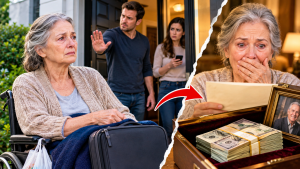
I sat in my wheelchair at the entrance of my son’s beautiful suburban house. A small suitcase rested on my lap, and a pharmacy bag hung from the handle of my chair. My hands were trembling, partly because of the cold morning air and partly because I was afraid of what my son might say.
Michael stood in the doorway.
He didn’t smile.
He didn’t ask whether I was feeling better.
He didn’t even move aside to let me enter.
Instead, he looked at my wheelchair, glanced at the suitcase, and sighed.
“Mom, what are you doing here?”
I tried to smile.
“Michael, sweetheart, I called you yesterday. I explained that things have become difficult at home. I thought perhaps I could stay here for a little while until I figure everything out.”
He rubbed his forehead.
“Mom, we already talked about this.”
“No, Michael. We didn’t really talk. You said you would discuss it with Ashley and call me back.”
“And I haven’t had time.”
Behind him, I could see my daughter-in-law, Ashley, standing in the hallway with her phone in her hand.
She looked uncomfortable.
Not worried.
Not concerned.
Uncomfortable.
“Hello, Helen,” she said politely.
I nodded.
“Hello, Ashley. I’m sorry to arrive unexpectedly. I really don’t have anywhere else to go right now.”
Ashley looked at the suitcase.
“Well, this is rather difficult. The children have school, Michael has work, and we have our own routine.”
I swallowed.
“I understand. I don’t need much. Just a small room downstairs. I can manage most things myself.”
Michael shook his head.
“Mom, this isn’t a good arrangement.”
I stared at him.
“Why?”
“Because we aren’t equipped to take care of someone who needs assistance.”
I felt something tighten in my chest.
“I am not asking you to become my nurse. I only need a safe place to stay while I arrange proper care.”
Ashley stepped closer.
“Perhaps you should consider a specialized facility. They have professionals who can help with your condition.”
I looked at her.
“I have already checked. I cannot afford those places with what I currently have.”
For a moment, nobody spoke.
Then Michael said something I will never forget.
“Mom, we have our own family to think about.”
I lowered my eyes.
Our own family.
As if I were no longer part of it.
For forty-three years, my husband Robert and I had worked hard to raise Michael. Robert was a mechanic. He spent most of his life repairing cars, changing engines, and coming home with grease under his fingernails.
We were never extravagant.
We bought secondhand furniture, repaired broken appliances, and saved whatever money we could.
When Michael married Ashley, we helped them purchase their first home.
We gave them $20,000.
It was a significant amount for us, but Robert and I wanted our son to have a comfortable beginning.
I remembered Robert sitting at our kitchen table, carefully checking the numbers.
“Are you sure we should give them this much?” he asked.
I smiled.
“He’s our son, Robert. We should help him.”
Robert eventually agreed.
Now, standing outside that same son’s beautiful home, I wondered whether he remembered any of it.
“Michael,” I whispered, “I am frightened of being alone.”
He looked away.
“I understand, Mom, but we can’t change our entire household overnight.”
I looked past him.
My grandchildren were standing in the hallway.
My youngest grandson started walking toward me.
“Grandma!”
But Ashley quickly called him back.
“Sweetheart, go finish your breakfast.”
I wanted to hug him.
I wanted to tell him that I loved him.
Instead, I sat quietly while my son stood between me and the doorway.
Finally, I nodded.
“All right, Michael. I understand.”
He seemed relieved.
“Let’s stay in touch. I’ll look into some options.”
I forced a small smile.
“Thank you.”
Nobody offered to help me return home.
Nobody carried my suitcase.
Nobody asked whether I had enough money for a taxi.
I called the accessible transport service myself.
As I waited at the end of the driveway, I looked once more at the house.
The curtains were beautiful. The garden was perfectly maintained. Through the windows, I could see the warm lights of the dining room.
My family was inside.
And I was outside.
When the taxi finally arrived, the driver helped me into the vehicle.
“Are you comfortable, ma’am?” he asked.
I nodded.
“Yes, thank you.”
It was a simple question.
But after what had just happened, it nearly made me cry.
That evening, I returned to my small house.
The house where Robert and I had spent most of our married life.
Since his death, everything had become more difficult. My health had deteriorated, and I could no longer use the stairs safely. I slept on the living-room sofa because our bedroom was upstairs.
My medical expenses were increasing.
My savings were disappearing.
I had less than $300 in my checking account.
I placed my medication beside the sofa and looked at the photograph on the mantel.
Robert was smiling in the picture.
Michael was standing between us, perhaps twelve years old.
I touched the glass.
“Robert, what am I supposed to do now?”
Of course, there was no answer.
But I remembered something my husband used to say.
Whenever a problem seemed impossible, he would sit down with a notebook and start looking for facts.
“Don’t panic, Helen,” he always told me. “First, find out exactly what you’re dealing with.”
So I decided to do what he would have done.
I began searching through our old financial documents.
I opened drawers, boxes, folders, and envelopes.
Most of the papers were ordinary things: electricity bills, insurance documents, receipts, and old tax records.
Then, at the bottom of Robert’s desk drawer, I found something unusual.
A thick business card.
It belonged to a private financial institution I had never heard of.
On the back, Robert had written several numbers and a short instruction.
I stared at his handwriting.
Why had he kept this?
Why had he never mentioned the bank?
I turned the card over again.
There was also a handwritten note:
“Helen — In case you ever find yourself without another option, contact this institution personally. Do not allow anyone else to speak on your behalf.”
My heart started beating faster.
I read it three times.
Then I looked at the photograph of Robert.
“What were you hiding from me?”
I had no idea that the small card in my hand would lead me to a fortune worth millions of dollars.
And I had absolutely no idea that my husband’s secret would expose something deeply disturbing about our own son.
PART 2: THE BANKER WHO RECOGNIZED MY HUSBAND’S NAME
The next morning, I called an accessible taxi and traveled downtown.
The bank was located inside a modern building with glass walls and polished floors.
I felt out of place.
I was wearing an old brown coat, comfortable shoes, and a simple scarf. My wheelchair made a quiet sound as I moved across the lobby.
A receptionist approached me.
“Good morning. How may I help you?”
I showed her the business card.
Her expression changed slightly.
“May I ask whose card this is?”
“My husband’s. His name was Robert James Carter.”
She looked at the card again.
“Please wait here for a moment.”
She made a telephone call.
A few minutes later, a woman came out of a private office.
“Mrs. Carter?”
“Yes.”
“My name is Laura. Mr. Whitmore would like to speak with you.”
She guided me through a corridor and into a large office.
Behind a polished desk sat a man in his fifties.
He stood immediately.
“Mrs. Carter?”
“Yes.”
“My name is Daniel Whitmore. I’m the director of this branch.”
He looked at the card.
Then he looked at me.
“May I confirm your husband’s full name?”
“Robert James Carter.”
Daniel slowly nodded.
“Would you mind providing some identification?”
I handed him my documents.
He examined them carefully, made several calls, and opened a locked cabinet.
When he returned, he was carrying a thick file.
“Mrs. Carter,” he said, sitting down, “your husband maintained a relationship with this institution for more than twenty-six years.”
I stared at him.
“That cannot be right. My husband was a mechanic.”
Daniel smiled gently.
“Yes. We have records confirming that he worked in the automotive repair industry.”
“Then why did he have an account here?”
Daniel opened the file.
“Your husband was also an investor.”
I felt confused.
“An investor?”
He turned a document toward me.
There were several columns of numbers.
Investment portfolios.
Commercial properties.
Business partnerships.
Long-term financial holdings.
Then my eyes reached the total.
I leaned closer.
I thought I had misunderstood the number.
I adjusted my glasses.
Then I read it again.
$8,742,615.38.
I couldn’t speak.
Daniel waited patiently.
Finally, I whispered:
“What is this?”
“That is the estimated value of your husband’s financial portfolio and associated assets, subject to final verification.”
I stared at him.
Eight million dollars.
My husband had left more than eight million dollars.
The same man who repaired his own washing machine.
The same man who refused to replace our old car because it still had a few good years left.
The same man who sometimes worked extra weekends to pay unexpected bills.
He had been wealthy.
And I had never known.
“Why?” I asked.
Daniel folded his hands.
“That is something I cannot answer on your husband’s behalf.”
I began crying.
Not because of the money.
Because I remembered all the times I had worried about our finances.
I remembered postponing dental treatment.
I remembered refusing to buy a better wheelchair because I didn’t want to spend too much.
I remembered calculating grocery expenses while my husband apparently had millions in investments.
“Did he not trust me?” I asked.
Daniel shook his head.
“I don’t believe that is what the documents suggest.”
He opened another folder.
Inside was a sealed cream-colored envelope.
My name was written across the front.
Helen.
I recognized Robert’s handwriting immediately.
Daniel explained that my husband had deposited the letter three years before his death.
He had given specific instructions.
It was to be delivered only after my identity had been verified and I personally requested information about his financial arrangements.
My hands trembled as I opened it.
The first sentence nearly broke my heart.
My dearest Helen, if you are reading this, I am probably no longer beside you. Before you become angry, I want you to know that I loved you more than anything in this world.
I continued reading.
Robert explained that he had started investing when he was young.
An old industrial warehouse had been his first major opportunity. He had purchased a small share with money saved from his mechanic’s salary.
Over the years, the property increased in value.
He reinvested the profits into other projects.
Some investments failed.
Others became extremely successful.
He never changed our lifestyle because he wanted to keep our family away from the pressure that wealth could create.
But then I reached a paragraph that made me stop.
Robert had written:
Helen, there is something else you must understand. I did not leave these arrangements in place simply because I wanted to give you money. I wanted to make certain that nobody could take control of your future without your knowledge or permission.
I read that sentence again.
Nobody?
Who was he talking about?
Then I saw another line.
Please be especially careful about signing financial documents presented by family members. Even someone you love may have interests that are different from your own.
My stomach tightened.
I looked at Daniel.
“Did my husband have problems with someone in our family?”
Daniel hesitated.
“There are some additional records that I believe you should review with the attorney who handled his estate.”
“Which family member?”
He looked down at the file.
Then he answered quietly.
“Your son, Michael, appears in several documents.”
My entire body went cold.
Michael?
My son?
The same boy I had carried to school?
The same child whose hospital bed I had slept beside?
The same man who had just refused to let me into his house?
I couldn’t understand it.
“What did he do?”
Daniel carefully closed the folder.
“Mrs. Carter, I don’t want you to reach a conclusion before reviewing all the evidence. But your husband specifically requested that certain documents be preserved.”
I looked at the envelope again.
Robert had known something.
And he had been preparing for a day when I might need to protect myself.
PART 3: THE DOCUMENT THAT MADE ME QUESTION EVERYTHING
Daniel arranged an appointment with Robert’s estate attorney, Patricia Ellis.
She was a serious woman in her early sixties, with silver hair and a calm voice.
She greeted me warmly.
“Mrs. Carter, your husband trusted you very much. He wanted you to have complete control over your future.”
I nodded.
“I wish he had told me all of this while he was alive.”
Patricia looked at me sympathetically.
“I understand.”
She placed several documents on the table.
The first was dated six years earlier.
I recognized the date immediately.
It was the year Robert underwent major surgery.
He had spent several weeks recovering.
During that period, Michael had visited us twice.
He had offered to help organize our finances.
At the time, I thought it was wonderful.
I remembered telling Robert:
“Our son is becoming such a responsible man.”
Robert had simply nodded.
Now, six years later, I was looking at a document containing Michael’s signature.
Patricia explained that Michael had proposed a financial arrangement that would give him broader authority over certain family assets.
At first, the proposal sounded reasonable.
He claimed he wanted to help us manage our investments as we grew older.
But the wording was concerning.
Some of the proposed permissions were unusually broad.
They could have allowed him significant influence over financial decisions involving money that was supposed to protect Robert and me.
Robert had refused to approve the arrangement.
“Did Michael know about the refusal?” I asked.
“According to the correspondence, he was informed that the proposal would not be accepted in its original form.”
I looked down.
My son had known.
But I still wanted to believe there was an innocent explanation.
“Maybe he was simply trying to help us.”
Patricia nodded.
“That is possible. We should not assume motives without evidence.”
Then she opened another folder.
“This is something your husband asked us to preserve separately.”
Inside were copies of emails.
They had been exchanged between Michael and Ashley.
The dates were several months before Robert’s death.
I began reading.
At first, the messages were ordinary.
They discussed household expenses, credit card bills, renovations, and financial pressure.
I felt sorry for them.
I knew raising children was expensive.
I had no desire to judge my son’s family for struggling financially.
But then I reached a message that made my fingers go numb.
Michael had written that his father’s investments were sitting untouched while his own family was struggling.
Ashley replied that Robert was becoming increasingly stubborn about money.
Then came another sentence.
She wrote that I didn’t really understand how much money Robert had.
I stopped reading.
Patricia waited.
I continued.
In another message, Ashley suggested that they should wait until Robert and I needed more assistance.
She believed that if our health deteriorated, we might become more willing to accept someone else managing our affairs.
I read the sentence twice.
Then a third time.
My eyes filled with tears.
They had discussed my possible dependence as an opportunity.
Not as a reason to help me.
As an opportunity to gain influence.
I put the papers down.
“Patricia, is this real?”
She nodded.
“The documents appear authentic, but the complete circumstances and their legal implications still need to be verified.”
I looked at my son’s signature.
I recognized every curve.
I had seen it on birthday cards, school forms, and Christmas presents.
Now it was attached to words I never imagined he would write.
“Did they take any money?”
Patricia shook her head.
“The records reviewed so far do not establish an unauthorized withdrawal. Your husband successfully prevented the proposed expansion of financial authority. Further checks are still required.”
I breathed slowly.
At least Robert had protected the assets.
But my heart was breaking.
I remembered the morning I arrived at Michael’s house.
The way he looked at my wheelchair.
The way Ashley glanced at my suitcase.
The way they talked about finding somewhere else for me to live.
Suddenly, their words sounded different.
I couldn’t prove that their refusal had been planned.
But I now understood that they had previously discussed the possibility of me becoming dependent on others.
And I had been the person they were discussing.
Patricia handed me a tissue.
“Mrs. Carter, you don’t have to make any decisions today.”
I wiped my eyes.
“No. I think I need to make one decision today.”
“What is that?”
I looked directly at her.
“I will not allow anyone to control my money or my life without my permission. Not even my own son.”
For the first time in months, I felt something stronger than fear.
I felt determination.
PART 4: MY HUSBAND’S FINAL VIDEO REVEALED WHY HE HAD BEEN SO AFRAID
Before I left the bank, Daniel handed me another envelope.
It contained a small USB drive.
Robert had recorded a video message.
I stared at it.
“Is this another letter?”
“No, Mrs. Carter. Your husband specifically requested that you watch this recording with his attorney present.”
The following morning, I returned to the bank.
Patricia joined us through a secure video meeting.
Daniel placed a laptop in front of me.
Then he pressed play.
Robert appeared on the screen.
He was sitting in his old office at home, wearing the blue shirt I had bought him for his birthday.
His hair was thinner.
His face looked tired.
But his eyes were exactly the same.
I immediately reached toward the screen.
“Robert…”
My voice broke.
He began speaking.
“If you’re watching this, Helen, then I suppose you’ve finally found the card I left behind.”
He smiled faintly.
“I wish I could be sitting beside you. I wish I could explain all of this over a cup of coffee, like we always did.”
I started crying.
He continued.
“First, I want you to know that I am sorry. I should have told you about the investments. I convinced myself that keeping everything secret would protect our ordinary life. But I now understand that I made decisions about our future without giving you the opportunity to participate.”
I lowered my head.
Even after death, Robert was apologizing.
He explained how he had built his wealth.
The first investment had been an old industrial warehouse. He had purchased a small share when he was still working full-time as a mechanic.
The property had eventually become part of a major commercial development.
He reinvested the profits.
Over the next two decades, he invested in commercial property, business partnerships, and other long-term opportunities.
He had made mistakes.
He had lost money on certain projects.
But he had also made several investments that became extraordinarily valuable.
He had never wanted to become a businessman who spent his days showing off his wealth.
He loved repairing engines.
He loved our little house.
He loved our Sunday breakfasts and our quiet evenings.
Then his expression changed.
“There is something else I need to tell you, Helen.”
I leaned forward.
“Six years ago, after my surgery, Michael approached me about managing our finances.”
Robert explained that he had initially appreciated the offer.
He understood that our son wanted to help.
But when he reviewed the proposed documents, he discovered that some of the permissions went much further than ordinary assistance.
He became concerned that someone else could eventually make important decisions about the assets that were meant to protect us.
“I asked Michael why he needed such broad authority. He told me it was for convenience. I wanted to believe him.”
Robert paused.
“But I wasn’t comfortable.”
He explained that he refused to sign the proposal and arranged for independent legal advice.
Then he said something that made my stomach tighten.
“Helen, I don’t want you to hate our son. I don’t know everything that is in his heart. I know he has good qualities. I’ve seen him love his children. I’ve seen him work hard. But I also know that wanting something can sometimes make people forget what is right.”
He looked directly into the camera.
“Please don’t let anyone convince you that your age or your physical condition means you cannot make your own decisions.”
Tears ran down my face.
“Your wheelchair doesn’t make you helpless. Needing assistance doesn’t mean you should surrender your independence.”
I covered my mouth.
Those words were exactly what I needed to hear.
Robert continued.
“I have arranged for you to have full authority over the financial resources intended for your security. You can hire professionals. You can buy a suitable home. You can receive the best care available. You can help people if you choose. But please, Helen, never allow anyone to pressure you into signing something you don’t understand.”
He paused for a long moment.
Then his voice softened.
“And one more thing, my love. You are allowed to say no.”
I started sobbing.
For forty-three years, Robert had known me better than anyone.
He knew I found it difficult to refuse people.
He knew I often sacrificed my own comfort to make everyone else happy.
He knew I would rather suffer quietly than become a burden.
“I love you, Helen,” he said. “I always have. Please live the rest of your life without feeling guilty for needing help.”
The screen went dark.
Nobody spoke.
Daniel quietly closed the laptop.
Patricia handed me another tissue.
I sat there for several minutes, holding Robert’s letter.
I had just heard my husband’s voice again.
But I had also learned something important.
He had not simply left me money.
He had left me the power to choose.
And now I intended to use it.
PART 5: THE CALL FROM MY SON CAME TOO LATE
Three days after discovering the inheritance, my phone rang.
It was Michael.
I stared at his name for several seconds before answering.
“Hello, sweetheart.”
“Mom! Finally. I’ve been trying to reach you.”
His voice sounded unusually cheerful.
“Is everything okay?”
“Where are you? I went to your house yesterday, but nobody answered.”
“I am staying somewhere else.”
“Where?”
“That’s not important right now.”
There was a pause.
Then he asked:
“Mom, did you find something in Dad’s paperwork?”
My fingers tightened around the phone.
“What do you mean?”
“Well, I’ve been sorting through some family matters. Dad had a lot of investments, didn’t he?”
I said nothing.
Michael continued.
“There’s probably quite a bit of paperwork that needs organizing. I could come over and help you.”
I almost laughed.
A few days earlier, I had been sitting outside his house with a suitcase.
He hadn’t offered me a bed.
Now he wanted to organize my paperwork.
“That’s kind of you, Michael.”
“Of course, Mom. We’re family.”
Those words hurt more than I expected.
I looked at the small hotel room around me.
The accessible bathroom.
The comfortable bed.
The medication arranged neatly beside me.
Everything I had needed was finally available.
And I had arranged it without his help.
“Michael,” I said quietly, “I have already hired an attorney and a financial adviser.”
He became silent.
“An attorney?”
“Yes.”
“Why would you need an attorney? I’m your son.”
“Because your father’s estate is complicated.”
He laughed nervously.
“Mom, you don’t need to pay strangers to handle everything. I know how these things work.”
“I know you do.”
“Then let me help.”
I took a deep breath.
“Michael, I need to ask you something.”
“Sure.”
“Do you remember the day I came to your house with my wheelchair and my suitcase?”
Another silence.
“Mom, we already discussed that.”
“Yes. I remember.”
“I explained that the house wasn’t suitable.”
“You did.”
“Well, I was under a lot of pressure.”
“I understand.”
He sighed.
“So what’s going on?”
I looked at the photograph of Robert that I had placed beside my bed.
Then I asked:
“If I had arrived at your house that morning with eight million dollars in my bank account, would you have let me inside?”
The silence was immediate.
Long.
Uncomfortable.
“Mom, that’s not fair.”
“Why?”
“Because money has nothing to do with this.”
I closed my eyes.
“Then why are you asking about your father’s investments?”
He didn’t answer.
Finally, he said:
“I just think we should discuss the estate together.”
I replied calmly.
“We can discuss family matters. But my financial decisions will be handled by professionals I choose.”
His voice became sharper.
“Who has been telling you these things?”
“Nobody needs to tell me anything, Michael. I am perfectly capable of reading documents.”
He became quiet again.
Then he said:
“Mom, Ashley and I are worried about you.”
I almost believed him.
For one brief moment, I wanted to believe him.
Then I remembered the emails.
The messages discussing my future dependence.
The suggestion that I might become easier to influence if I needed assistance.
I took a breath.
“Thank you for your concern. But I am safe.”
He ended the call shortly afterward.
That evening, Patricia contacted me.
She had received confirmation that several documents from Robert’s estate were ready for formal review.
She also had a recommendation for an accessible apartment.
It was on the ground floor of a quiet residential building.
It had wide doorways, a modern bathroom, a small garden, and an emergency assistance system.
I visited the property the following morning.
The moment I entered, I knew.
This was where I wanted to live.
For the first time in months, I could imagine waking up without worrying about falling.
I could make coffee in a kitchen designed for my needs.
I could reach the bathroom without asking someone to move furniture.
I could sit near the window and watch the sunlight enter the room.
I signed the lease after receiving the necessary financial approvals.
Then I began arranging professional care.
I hired a home-care assistant for the hours I needed help.
I arranged regular medical transportation.
I purchased a comfortable adjustable bed.
And I finally bought a wheelchair that fit my body properly.
It was the first time in years I had made a major purchase without feeling guilty.
But one thing remained unresolved.
My son.
I still loved him.
I simply no longer knew whether I could trust him.
PART 6: THE FAMILY DINNER THAT EXPOSED EVERYTHING
Two weeks later, Michael called again.
This time, he sounded angry.
“Mom, we need to talk.”
“About what?”
“About Dad’s estate.”
I looked at the papers on my kitchen table.
“What about it?”
“I’ve heard you’re making some major financial decisions without consulting the family.”
I almost smiled.
“Michael, I am the person making those decisions.”
“But Dad would never have wanted us to be divided.”
I looked at his photograph.
“Your father wanted me to be safe.”
Michael sighed.
“Can we meet? Ashley and I would like to come over.”
I thought about refusing.
But I decided that it was time for an honest conversation.
“All right. Come on Saturday.”
On Saturday afternoon, I prepared coffee and arranged a few chairs in the living room.
My home was still new to me, but I was beginning to feel comfortable.
At exactly two o’clock, the doorbell rang.
Michael and Ashley stood outside.
Ashley carried a large bouquet of flowers.
“Hello, Helen!” she said brightly.
Michael leaned forward and kissed my cheek.
“Mom, you look much better.”
“Thank you.”
They sat down.
For a few minutes, we discussed ordinary things.
The children.
Michael’s work.
The weather.
Then he finally said what he had come to say.
“Mom, we think it would be best if we helped you manage Dad’s assets.”
I placed my coffee cup on the table.
“Why?”
“Because it’s complicated.”
“I have professionals helping me.”
“Professionals don’t know our family.”
I looked at him.
“That’s true. But they know the law.”
Ashley interrupted.
“Helen, we aren’t trying to take anything from you. We just want to make sure everything is handled properly.”
I nodded.
“Then I’m sure you won’t mind if I ask you something.”
She smiled.
“Of course.”
“Why did you discuss the possibility of me becoming dependent on other people in those emails you exchanged with Michael?”
Her smile disappeared.
Michael shifted in his chair.
“What emails?”
I looked directly at him.
“The emails between you and Ashley. The ones discussing your father’s investments and the possibility that I might eventually need someone else to manage my affairs.”
Ashley turned toward Michael.
He looked at her.
Then back at me.
“Mom, where did you get those?”
“From your father’s estate records.”
“Those were private conversations!”
I nodded.
“Yes. They were.”
He stood up.
“You had no right to read them!”
I remained seated.
“Your father preserved them as part of his legal records. I am entitled to understand the documents concerning my own future.”
Ashley folded her arms.
“You’re taking everything out of context.”
“Then explain it.”
Neither spoke.
I waited.
Finally, Michael said:
“We were worried about you and Dad. We were trying to make plans.”
I nodded.
“Perhaps. But why did those plans involve giving you control over money that wasn’t yours?”
He looked frustrated.
“Because you don’t understand how complicated these things can become!”
I looked at him for a long moment.
“Michael, I may need a wheelchair. I may need assistance getting dressed or preparing meals. But that does not mean I have lost my mind.”
His face changed.
I continued.
“I understand what I read. I understand what your father refused to sign. And I understand that when I arrived at your house needing a safe place to stay, you sent me away.”
Ashley looked down.
Michael rubbed his face.
“Mom, I made a mistake that day.”
I nodded.
“Yes. You did.”
He looked surprised that I didn’t immediately forgive him.
Then he said:
“We’re still family.”
I replied:
“That is exactly why it hurts.”
For the first time, nobody had an answer.
I stood as much as my body allowed and reached for the folder on the table.
Inside were copies of the documents and the correspondence.
I placed them in front of Michael.
“Your father didn’t leave me this money so I could punish you. He left it so I could live safely and make my own decisions.”
Michael looked at the papers.
I continued.
“I am not going to demand that you repay the twenty thousand dollars we gave you for your house. It was a gift. Your father and I gave it because we loved you.”
He looked up.
“But I will not give you control of my inheritance. I will not sign documents I don’t understand. And I will not allow anyone to decide where I live or what happens to my money.”
Ashley finally spoke.
“So you’re cutting us out?”
“No,” I said. “I’m setting boundaries.”
She didn’t respond.
I looked at Michael.
“You can visit me. You can call me. You can bring the children. I will always love my grandchildren. But you must understand that love does not give you ownership of another person’s life.”
Michael’s eyes became wet.
For a moment, I saw the little boy I remembered.
But then he looked away.
“We’ll talk another time.”
He stood.
Ashley picked up her handbag.
They left without finishing their coffee.
And for the first time, I didn’t feel guilty about allowing someone to walk out of my house.
PART 7: THE LETTER THAT CHANGED HOW I SAW MY SON
Three days after that meeting, Patricia called me.
“Mrs. Carter, there is one more document your husband wanted you to receive.”
I felt nervous.
“What is it?”
“A personal letter. It was written shortly before his final hospitalization.”
I asked her to send it to my new address.
The letter arrived the following morning.
I recognized Robert’s handwriting immediately.
It was only two pages long.
I opened it slowly.
My dearest Helen,
If you have reached this point, I hope you have found a place where you feel safe. I hope you have someone helping you when you need it. Most importantly, I hope you have stopped apologizing for needing assistance.
I smiled through my tears.
Then I continued.
There is something I never told you about Michael.
When he was younger, he was a good boy. He had a generous heart, and I believed he would grow into a man who understood the meaning of responsibility.
I still believe there is goodness in him. But somewhere along the way, I began to notice that he measured success by what people owned rather than what they were willing to do for others.
I tried to speak with him about it. Sometimes he listened. Sometimes he became defensive.
I do not know whether he will change. I hope he does.
But Helen, please remember this: you can love someone without giving them the power to hurt you repeatedly.
I stopped reading.
My hands were shaking.
Robert continued.
I have arranged the inheritance so that your needs come first. After you have secured your home, your medical care, and your future, I would like you to consider helping people who have no family to turn to.
You have always had a generous heart. Do not lose that part of yourself because someone failed to appreciate it.
The final paragraph read:
I wish I could grow old beside you. I wish I could sit in our garden, complain about the weather, and drink coffee with you every morning. But if I cannot, I want you to live. Really live, Helen. Do not spend the rest of your life waiting for someone else to make room for you.
You deserve a place of your own.
Forever yours,
Robert.
I folded the letter and held it against my chest.
For the first time since his death, I felt that he was still beside me.
Not because he had left me millions.
Because he had reminded me that I mattered.
PART 8: THE GRANDCHILDREN CAME WITHOUT THEIR PARENTS
A month passed.
My new apartment was beginning to feel like home.
I had photographs of Robert on the walls.
I had planted flowers in the small garden.
My home-care assistant, Maria, came every morning to help me with breakfast and household tasks.
I had enough money to cover my medical needs, and my financial advisers were carefully organizing the remaining assets.
I was no longer frightened every time I opened a bill.
But I missed my grandchildren.
One afternoon, I received a phone call from my granddaughter, Emily.
“Grandma?”
I smiled immediately.
“Hello, sweetheart!”
“Can I come and visit you?”
“Of course you can.”
“Mom says you’re busy.”
I looked at the clock.
“I’m not busy at all.”
“Can I bring Noah?”
“Absolutely.”
An hour later, the doorbell rang.
Emily and her younger brother stood outside.
Emily was holding a small paper bag.
Noah carried a drawing.
I opened the door.
“Grandma!”
They rushed toward me.
I hugged them both.
For several minutes, nobody said anything important.
We simply laughed.
Emily gave me the paper bag.
“I brought you cookies.”
Noah handed me his drawing.
It showed a house with a garden, a wheelchair, and three people standing together.
At the top, he had written:
GRANDMA’S HAPPY HOUSE.
I started crying.
“Do you like it?” he asked.
“I love it, sweetheart.”
We spent the afternoon together.
They told me about school, their friends, and a science project.
I prepared hot chocolate while Maria helped me arrange some snacks.
Then Emily asked a question.
“Grandma, why don’t you live with us anymore?”
I paused.
I wanted to tell her everything.
But children shouldn’t have to carry the emotional burdens of adults.
So I simply said:
“Sometimes grown-ups have difficulty understanding what other people need. Grandma has a lovely home now, and I am doing well.”
Emily nodded.
Then she asked:
“Are you still sad?”
I looked at her.
“Sometimes. But I’m getting better.”
She hugged me.
“Then we’ll visit more often.”
I kissed her forehead.
“That would make me very happy.”
When they left, I watched them walk toward the car.
Michael wasn’t there.
Ashley wasn’t there.
But my grandchildren had come because they wanted to see me.
That meant more than I could explain.
PART 9: MY SON FINALLY UNDERSTOOD WHAT HE HAD LOST
Six months later, Michael appeared at my door.
He came alone.
He looked tired.
His expensive clothes were still perfectly pressed, but something about his expression had changed.
“Mom, can we talk?”
I invited him inside.
He sat across from me.
For several minutes, he looked at his hands.
Then he said:
“I owe you an apology.”
I remained quiet.
He continued.
“I’ve been thinking about what happened. About the day you came to my house.”
I nodded.
“I remember.”
“I should have let you in.”
“Yes.”
“I should have helped you.”
“Yes.”
He swallowed.
“I was selfish.”
I looked at him.
He continued.
“Ashley and I were having financial problems. We had debts, and I was worried about maintaining everything. I kept thinking about what Dad had built and how much money was sitting there.”
I listened without interrupting.
“I convinced myself that I was protecting our family. But I wasn’t thinking about you. I was thinking about what I wanted.”
His eyes became wet.
“I saw you in that wheelchair, and instead of seeing my mother, I saw another responsibility. I hate admitting that.”
I felt tears gathering in my eyes.
Because those were the words I had needed to hear.
Not excuses.
Not explanations.
The truth.
Michael looked at me.
“Can you forgive me?”
I took a slow breath.
“I don’t know yet.”
He lowered his head.
“But I want to.”
He nodded.
“I understand.”
I reached for his hand.
“Michael, I have loved you since the day you were born. Nothing will change that.”
He began crying.
“But loving you doesn’t mean I can pretend that nothing happened. You hurt me deeply. And rebuilding trust will take time.”
He nodded again.
“I know.”
We sat together for a while.
Then I asked him something.
“Do you remember when your father and I helped you buy your house?”
He nodded.
“Of course.”
“We didn’t give you that money because we expected something in return. We gave it because we wanted you to have a good life.”
“I know, Mom.”
“Then understand this. I don’t need you to repay me. I don’t need you to give me a room in your house now that you know about the inheritance. I don’t need you to pretend to be a perfect son.”
I squeezed his hand.
“I only need you to treat me like a human being. Not a burden. Not a bank account. Not a problem that needs to be transferred somewhere else.”
He cried quietly.
“I understand.”
I wanted to believe him.
But I knew that forgiveness and trust were not the same thing.
So I allowed him to leave that afternoon without making any promises.
It was a beginning.
Not a happy ending.
A beginning.
PART 10: WHAT I DID WITH THE $8.7 MILLION
A year after that terrible morning, my life looked completely different.
I still used my wheelchair.
I still needed help with certain daily activities.
I still missed Robert every single day.
But I no longer felt helpless.
I had a comfortable accessible home.
I had excellent medical support.
I had a financial team protecting the inheritance.
And I had finally learned to make decisions without asking whether everyone else would approve.
I also remembered Robert’s final wish.
He wanted me to help people who had nowhere else to turn.
So I established a small charitable foundation in his name.
The foundation focused on elderly people living alone, especially those who had mobility difficulties and limited financial resources.
We helped provide accessible home improvements, emergency transportation, medical equipment, and temporary accommodation.
I didn’t want to build a huge organization.
I wanted to make a real difference in people’s everyday lives.
One morning, I met an elderly woman named Margaret.
She was seventy-four and had recently lost her husband.
She was struggling to pay for a wheelchair-accessible bathroom renovation.
She sat across from me in our little foundation office, holding a folder of medical documents.
“I’m sorry to ask for help,” she whispered.
I reached across the table and held her hand.
“Please don’t apologize.”
She looked at me.
“I don’t want to be a burden.”
I smiled sadly.
“Neither did I.”
Then I told her something I had learned.
“Needing help doesn’t make you a burden. It makes you human.”
We approved assistance for her renovation.
A few weeks later, she sent me a photograph of her new bathroom.
She was smiling.
I printed the photograph and placed it beside Robert’s picture.
Sometimes I wondered what he would think.
I imagined him standing in the doorway, wiping his hands on an old workshop towel.
He would probably smile and say:
“Well, Helen, I suppose you finally found something useful to do with all that money.”
I laughed every time I imagined it.
Michael and I slowly began rebuilding our relationship.
He visited occasionally.
Sometimes he brought the children.
Sometimes he came alone.
I never gave him control over my finances.
I never signed away my independence.
And I never again felt obligated to accept treatment that made me feel unwanted.
Ashley eventually apologized as well, although our relationship remained distant.
I learned to accept that some relationships could improve without returning to what they once were.
My grandchildren continued visiting.
Emily grew older and became interested in volunteering at the foundation.
Noah still occasionally brought me drawings.
One afternoon, he drew another picture of my house.
This time, there were flowers everywhere.
He wrote:
GRANDMA IS HAPPY BECAUSE SHE IS HOME.
I placed it beside Robert’s photograph.
Then I sat quietly by the window.
The sunlight was falling across the garden.
My wheelchair was beside the table.
My coffee was still warm.
And for the first time in a very long time, I felt completely at peace.
I thought about the morning I had arrived at Michael’s house.
I remembered the suitcase on my lap.
The cold driveway.
The closed door.
And the words:
“Mom, you can’t stay here.”
Back then, I believed those words meant I had nowhere left to go.
But I was wrong.
I had somewhere to go.
I had a life to rebuild.
I had choices to make.
And I had finally discovered that my worth was never determined by how much money I had, how healthy I was, or how convenient I was to the people around me.
Robert had left me $8.7 million.
But his greatest gift was something money could never buy.
He reminded me that I had the right to choose my own future.
And I promised myself that I would never again stand outside someone’s door, begging to be treated like family.
Because family should never make you feel that you have to earn a place at the table.
THE END.