Part 1
The letter arrived on a Tuesday morning, tucked between an overdue electric bill and a grocery store advertisement.
Sarah Whitmore almost threw it away.
At thirty-six, she had learned that official envelopes rarely carried good news. They usually meant another payment she couldn’t afford, another deadline she was about to miss, or another reminder that raising an eight-year-old boy alone was harder than she had ever imagined.
But the return address caught her attention.
Blackwater County, Pennsylvania.
She hadn’t heard that name since childhood.
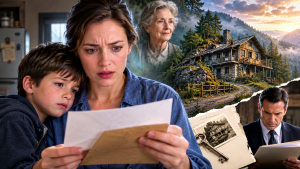
Sarah stood in her cramped apartment kitchen, still wearing the blue uniform shirt from her overnight shift at a nursing home, and opened the envelope.
Inside was a letter from the county probate office.
She read the first paragraph.
Then she sat down.
According to the document, she had inherited a house and nearly seventeen acres of wooded hillside from Eleanor Bennett, her grandmother’s older sister, who had died the previous autumn at ninety-three.
There was only one problem.
Sarah had never met Eleanor.
And the property had been abandoned for almost fifty years.
The letter described it as an uninhabitable structure of uncertain historical classification. There was no estimated market value, no photographs, and no indication that the place had electricity, running water, or even a functioning roof.
She had sixty days to accept the inheritance.
Otherwise, the county would begin proceedings to dispose of the property.
Sarah stared at those words.
A house.
For the first time in years, she had been offered something that belonged to her.
Yet the longer she studied the paperwork, the more it looked like another burden.
“Mom?”
She looked up.
Her son, Daniel, stood in the kitchen doorway, rubbing his eyes. His pajamas were too short at the ankles, and his dark hair stuck up on one side.
“Are we in trouble again?” he asked.
Sarah quickly folded the letter.
“No, sweetheart. Why would you think that?”
Daniel looked toward the pile of bills.
“Because you always get quiet when the mail comes.”
The words struck harder than any accusation.
She forced a smile.
“Come on. I’ll make breakfast.”
There were two slices of bread left.
She toasted them, spread the last peanut butter across both, and placed the plate in front of Daniel.
“Aren’t you eating?” he asked.
“I had something at work.”
It was a lie.
Sarah hadn’t eaten since the previous afternoon.
But Daniel needed breakfast more than she did.
She poured herself another cup of coffee and watched him eat.
He had been a cheerful little boy once.
Before the divorce.
Before his father, Michael, decided that supporting a family interfered with the life he wanted.
Before the child support payments stopped arriving and every unexpected expense became an emergency.
Now Daniel spoke carefully, as though he feared that asking for too much might make their fragile world collapse.
Sarah hated that most of all.
That evening, she called her mother.
“Do you remember Aunt Eleanor Bennett?”
Silence filled the telephone.
Then her mother sighed.
“Where did you hear that name?”
“Apparently she left me her house.”
“Oh, Sarah.”
The disappointment was immediate.
“That place should have been torn down decades ago.”
“What kind of house is it?”
“Something your great-grandfather built into a mountain. Nobody ever understood why. Your grandmother called it the hill house.”
“Did anyone live there?”
“Years ago. Eleanor lived there when she was young. After her husband died, she moved away. Nobody wanted to go back.”
“Why?”
Her mother hesitated.
“Because it’s isolated. Because the roads are terrible. Because the family spent years arguing over something that was never worth anything.”
Sarah looked around her apartment.
The peeling paint above the sink.
The heater that rattled all night.
The window that leaked cold air whenever the wind blew.
Her landlord had already mentioned another rent increase.
In four months, she might not be able to afford the place.
“Maybe I should at least see it,” she said.
“Sarah, listen to me. You have a child to think about. Don’t drag him into the mountains chasing some fantasy.”
“I’m not chasing a fantasy.”
“Then decline the inheritance.”
Her mother’s voice softened.
“That house never did anybody any good.”
After they hung up, Sarah sat beside the kitchen window for a long time.
Outside, city traffic crawled through freezing rain.
A siren wailed somewhere in the distance.
Daniel was asleep in the next room.
She unfolded the letter and studied the property description again.
Seventeen acres.
An old house.
A road that might not be maintained.
And a woman named Eleanor who had somehow chosen Sarah, rather than anyone else in the family, to inherit it.
What troubled her most was that final detail.
Eleanor had nieces, nephews, and distant relatives with more money and better connections.
Why leave the property to a struggling single mother she had never met?
Three days later, Sarah received another letter.
This one came from a law office.
Inside was a single handwritten note.
The handwriting was shaky but remarkably neat.
Dear Sarah,
I know this place may look like another hardship. But your grandmother believed that one day somebody in our family would need what the hillside could offer.
If you choose to go, please do not judge the house from the outside.
And before you let anyone convince you to sell it, find out why your great-grandfather built it the way he did.
Some things have value that money cannot measure.
With hope,
Eleanor.
Sarah read the note three times.
Then she noticed something written beneath the signature.
The warmest room is not the one closest to the fire.
She couldn’t understand it.
But she folded the letter carefully and placed it in her coat pocket.
Two weeks later, on a bitter Saturday morning, Sarah loaded everything she could carry into her twelve-year-old Chevrolet.
Three suitcases.
A box of canned food.
Two sleeping bags.
Blankets.
A toolbox that had belonged to her father.
And a small framed photograph of Daniel at four years old, smiling between parents who still appeared to love one another.
She told herself they were only visiting.
Just long enough to inspect the property.
Just long enough to decide whether the inheritance was worth accepting.
But when she turned the key and looked at Daniel sitting beside her, she understood that something deeper was happening.
For the first time since her marriage ended, she was driving toward a possibility instead of running from another problem.
The journey took almost five hours.
The highway became a county road.
The county road narrowed into gravel.
Then the gravel disappeared beneath a thin layer of snow.
Bare trees crowded the shoulders.
The last farmhouse vanished behind them.
Her phone lost service.
“Mom,” Daniel whispered, “are we lost?”
Sarah glanced at the printed directions.
“No, honey. We’re almost there.”
She hoped she was telling the truth.
At the final bend, the road climbed sharply through a stand of ancient hemlocks.
Then Daniel pointed through the windshield.
“There!”
Sarah stopped the car.
At first, she couldn’t see a house.
Only a dark arrangement of timber, stone, and earth rising in uneven terraces against the mountainside.
Then the building revealed itself.
Three levels were visible from the front, their small windows set beneath heavy wooden beams. The sides seemed to disappear directly into the hill.
Moss covered the stonework.
Wild vines tangled around the entrance.
Snow rested across a roof that looked less like a roof than an extension of the ground above it.
Sarah turned off the engine.
The silence was extraordinary.
No traffic.
No neighbors.
Only the wind stirring branches overhead.
Daniel leaned forward.
“Is somebody living inside the mountain?”
Sarah gave a nervous laugh.
“No, sweetheart. I think that’s our house.”
They climbed out.
The cold immediately bit through Sarah’s jacket.
She approached the heavy front door and fitted the old key from the attorney’s envelope into the lock.
It turned reluctantly.
The door opened with a deep wooden groan.
Sarah stepped inside.
Then she stopped.
The room was warmer than the air outside.
Not comfortably warm.
Not like a heated apartment.
But unmistakably warmer.
There was no fire burning.
No electricity humming.
No furnace.
The stone floor was dry.
The wooden beams looked old but solid.
A narrow passage sloped upward into darkness.
Daniel slipped past her.
“Mom, look!”
He crouched beside a shelf carved directly into the stone wall.
Someone had left a small wooden horse there.
One ear was broken, and the paint had faded almost completely.
Daniel lifted it carefully.
“Do you think a kid lived here?”
Sarah looked at the toy.
Then at the walls around them.
“I think several did.”
They spent the afternoon exploring.
The lowest room contained a large stone hearth, a rough wooden table, and shelves that had been built into the walls.
The second level held two small chambers with narrow windows facing south.
Above those, another passage led toward a room Sarah couldn’t fully enter because fallen boards blocked the doorway.
Everywhere she looked, the house seemed strange.
There were openings near the ceilings.
Unusual grooves along the walls.
Small sealed panels that appeared to serve no obvious purpose.
And despite the freezing air outside, the deeper rooms never felt as cold as they should have.
As evening approached, Sarah checked the stove and chimney as best she could, but decided not to risk lighting a fire until somebody had inspected them.
She spread their sleeping bags on the stone floor and warmed canned soup over a portable camping burner near the open doorway, keeping it away from combustible surfaces.
They ate by flashlight.
Daniel held the old wooden horse in his lap.
“Mom?”
“Yes?”
“Do you think we could stay here?”
Sarah looked toward the dark passage.
She thought about the unpaid bills waiting in their apartment.
The rent increase.
The exhausting shifts.
The constant fear of failing her child.
“I don’t know, sweetheart.”
Daniel rested his head against her shoulder.
“I like it.”
“Even though it’s old?”
He nodded.
“It’s quiet.”
Sarah wrapped her arm around him.
For the first time that day, she let herself imagine what staying might mean.
Then, just before midnight, she woke to an unfamiliar sound.
A low humming noise seemed to move through the walls.
She sat upright.
The wind had grown stronger outside.
Snow tapped against the windows.
But the sound wasn’t coming from the roof.
It was somewhere behind the stonework.
She pressed her hand against the wall.
Warm.
Not hot.
Just warm enough to feel strange against her palm.
She followed the sound with her ear until she reached a section beneath the stairs.
There, almost invisible in the darkness, was a narrow vertical seam.
Someone had sealed something behind the wall.
And for reasons she couldn’t yet understand, warm air seemed to be moving through it.
Sarah returned to Daniel’s side.
He was sleeping peacefully, the little wooden horse tucked beneath his arm.
She lay awake listening to the mountain.
And she remembered Eleanor’s words.
The warmest room is not the one closest to the fire.
For the first time, Sarah wondered whether the strange old house had been abandoned because it was worthless.
Or because nobody had ever understood what it was.
Part 2
By Monday morning, Sarah had decided not to leave.
At least, not yet.
The old house needed work. There were cracked window frames, damaged interior boards, missing fixtures, and a roofline she didn’t trust.
But the main walls appeared remarkably sturdy.
And the strange, steady temperature inside fascinated her.
She drove to the nearest town, a small community called Mill Creek, where a hardware store, diner, post office, and elementary school shared the main street.
The school stood twenty minutes from the house.
Sarah parked outside and sat for a moment with both hands on the steering wheel.
Enrolling Daniel would make this real.
It would mean explaining their circumstances.
Admitting that their new home was a long-abandoned hillside structure.
Accepting that the decision she had called a temporary visit might become a permanent change.
Daniel looked at her.
“Do you think they’ll like me?”
She turned toward him.
“Of course they will.”
“What if they don’t?”
Sarah reached over and straightened his collar.
“Then give them time to learn who you are.”
Inside, the principal, Mrs. Helen Porter, was a gray-haired woman with patient eyes and reading glasses hanging from a chain.
She reviewed Daniel’s paperwork.
Then she examined the address.
“The Bennett place?”
Sarah nodded.
“My great-aunt left it to me.”
Mrs. Porter looked up.
“You’re living there?”
“We’re considering it.”
“With your boy?”
“Yes.”
The principal studied her for a long moment.
Sarah braced herself for judgment.
Instead, Mrs. Porter closed the folder.
“My grandfather used to talk about that house. Said the man who built it knew more about keeping warm than half the engineers in Philadelphia.”
Sarah leaned forward.
“Really?”
“He also said people called him crazy.”
The principal offered a small smile.
“People around here have always been quick to say things like that.”
Daniel started school the following Wednesday.
His first days were difficult.
The other children already knew one another. They had grown up attending the same birthday parties, riding the same buses, and visiting the same churches.
Daniel spoke little.
He ate lunch alone twice.
On Friday, one boy asked whether he lived in the haunted house on the mountain.
Daniel came home unusually quiet.
Sarah found him sitting beside the window, turning the wooden horse over in his hands.
“What happened?”
“Nothing.”
“Daniel.”
He looked down.
“They said our house is where the crazy people used to live.”
Sarah sat beside him.
“Sometimes people are afraid of things they don’t understand.”
“Is our house crazy?”
She looked around the room.
“No. I think our house might be very smart.”
Daniel considered that.
Then he smiled.
It was small, but she hadn’t seen that smile in weeks.
Meanwhile, Sarah began learning the difficult realities of mountain living.
The nearest grocery store was nearly forty minutes away.
The dirt road became slippery whenever the temperature dropped.
Water had to be carried from an old spring-fed collection point until the property’s plumbing could be evaluated and restored.
She bought bottled drinking water and borrowed a water-testing kit from the county extension office.
Her savings shrank quickly.
She repaired window seals with inexpensive materials and cleaned the lower rooms one at a time.
The work exhausted her.
Her hands developed blisters.
Her shoulders ached.
At night, after Daniel fell asleep, she sat at the rough wooden table and calculated expenses on the back of old envelopes.
She had a little over twelve hundred dollars remaining.
That money had to cover food, fuel, insurance, and repairs until she could find work.
She had applied for part-time positions at the school cafeteria, the local care center, and a small medical clinic.
None had answered.
One afternoon, as she struggled to lift a fallen beam from the entrance to the upper room, a truck engine sounded outside.
Sarah froze.
Nobody had visited since they arrived.
She stepped toward the door.
A dark green pickup sat near her car.
Beside it stood a tall man in his late forties wearing a forest-service jacket, heavy boots, and a weathered cap.
He raised one hand.
“Afternoon, ma’am.”
“Can I help you?”
“Name’s Thomas Reed. I’m a ranger assigned to this district.”
He glanced at the house.
“You’re Eleanor Bennett’s family?”
Sarah nodded cautiously.
“Her great-niece.”
Thomas studied the building.
“I figured somebody had moved in. Saw tire tracks coming up the road.”
“Is there a problem?”
“Not necessarily.”
He paused.
“That road gets dangerous after a heavy snow. Wanted to make sure whoever was staying up here knew what they were getting into.”
Sarah folded her arms.
“We’re managing.”
Thomas glanced at the fallen timber near the doorway.
“Looks like it.”
His tone carried no mockery.
That somehow embarrassed her more.
“I didn’t mean—”
“I know what you meant.”
He pointed toward the roofline.
“Have you had the chimney inspected?”
“Not yet.”
“Don’t use it until you do. That old flue could have cracks you can’t see.”
She nodded.
He looked again at the structure.
“Interesting place.”
“You know it?”
“My grandfather did.”
Sarah waited.
Thomas rubbed his jaw.
“He used to say that Benjamin Bennett built the only house in the county that could survive a hard winter without eating a forest’s worth of firewood.”
Benjamin Bennett.
Sarah recognized the name from the inheritance records.
Her great-grandfather.
“Why would he build something like that?”
Thomas shrugged.
“That’s the part nobody seems to remember.”
He handed her a card with the ranger station’s number.
“If the road gets bad or you run into trouble, call when you’ve got a signal.”
Then he returned to his truck.
Sarah watched him drive away.
She was grateful for the warning.
But she also felt exposed.
Somebody had seen how little she knew.
And somewhere beneath that shame was the familiar fear that another adult might decide she wasn’t capable of caring for her son.
The next week brought the first serious storm.
Snow began falling shortly after noon.
By four o’clock, it had covered the road.
By sunset, the trees bent beneath the weight.
Sarah had planned to drive into town for groceries the following morning.
Now she wasn’t sure she could get down the mountain.
She counted their supplies.
Rice.
Oatmeal.
Six cans of beans.
Four cans of soup.
Potatoes.
Flour.
A jar of peanut butter.
Enough for several days if she was careful.
Daniel watched her from the table.
“Are we going to run out?”
Sarah forced herself to sound calm.
“No, sweetheart. We’re just going to use what we have wisely.”
The next morning, the snow reached halfway up the front steps.
Sarah shoveled a narrow path to the car.
The cold burned her lungs.
After twenty minutes, she had cleared barely fifteen feet.
Her gloves were soaked.
Her back throbbed.
She leaned against the shovel, fighting tears.
In the apartment, she could have called maintenance.
There would have been roads, stores, neighbors.
Here, a single snowstorm could trap them.
For the first time, she wondered whether her mother had been right.
Maybe the house really was another mistake.
Inside, Daniel was sitting beside the small stove they had recently had inspected and approved for safe use.
The flame burned low.
He looked up.
“Mom, you look tired.”
“I’m all right.”
He stood and walked toward her.
Then he wrapped both arms around her waist.
“You don’t have to do everything today.”
Sarah closed her eyes.
She hadn’t realized how badly she needed to hear those words.
That afternoon, the sound of a truck engine reached the house.
Thomas Reed climbed out carrying a sack of potatoes and a bundle of split firewood.
“Road’s worse than I expected,” he said.
Sarah stared at the supplies.
“I can’t pay you for those.”
“Didn’t ask.”
“I don’t like taking charity.”
Thomas set the wood down.
“Then don’t call it charity.”
“What should I call it?”
He looked toward the forest.
“Call it what people do when somebody’s trying to get through a winter.”
She didn’t answer.
He carried the wood under the sheltered overhang.
Then he noticed Daniel standing in the doorway.
“Well, hello there.”
Daniel held up the wooden horse.
“Do you know who made this?”
Thomas examined it.
His expression changed.
“Where’d you find that?”
“In the house.”
Thomas took the toy carefully.
“Well, I’ll be.”
Sarah stepped closer.
“What?”
“My grandfather had one just like it.”
Daniel frowned.
“Was he a kid here?”
“No. But he used to tell me that Benjamin Bennett made wooden animals for his children during the winter.”
Thomas handed it back.
“He carved them because store-bought toys were too expensive.”
Sarah studied the horse.
Suddenly it wasn’t just an old object.
It was proof that another family had once struggled inside these walls.
Children had played here.
A father had worked with his hands to give them something beautiful.
The house had held lives before hers.
That evening, Thomas stayed for supper.
Sarah made thick potato soup and bread from the last of her flour.
They ate at the old table beneath the low wooden beams.
Daniel asked endless questions about deer, foxes, and bears.
Thomas answered each one patiently.
Then, as Sarah poured tea, he looked toward the upper passage.
“Feels warmer up there.”
Sarah stopped.
“You noticed?”
“Hard not to.”
“I thought I was imagining it.”
Thomas stood.
“Mind if I take a look?”
Together they climbed the narrow passage.
The higher they went, the more noticeable the warmth became.
Thomas removed his cap.
“There’s no fire up here.”
“No.”
He touched the wall.
Then he examined a small opening near the ceiling.
“Air movement.”
Sarah nodded eagerly.
“That’s what I thought.”
Thomas crouched beside the opening.
“Somebody planned this.”
They studied the room in silence.
Then Thomas looked at her.
“Sarah, I don’t think your great-grandfather was building an ordinary house.”
“What was he building?”
Thomas considered the question.
“I don’t know.”
He looked down the dark passage.
“But I think he was trying to solve a problem.”
That night, after Thomas had gone, Sarah walked alone through the upper rooms.
She carried Eleanor’s letter.
At the highest accessible level, she found a narrow window facing the winter sky.
The room was warmer than the rest of the house.
She pressed her palm against the earthen wall.
And for the first time, she felt something stronger than curiosity.
She felt responsibility.
Whatever Benjamin Bennett had built, whatever Eleanor had wanted preserved, it was now in her hands.
Outside, the snow continued falling.
Sarah stood beneath the old beams and whispered into the empty room.
“I don’t know what you wanted me to find.”
Then she folded Eleanor’s letter.
“But I’m going to keep looking.”
Part 3
The winter grew harder.
By January, snowdrifts stood almost four feet high along parts of the access road.
Sarah learned to measure her days by what could be accomplished before dark.
She rose at five-thirty, boiled water, prepared Daniel’s breakfast, checked the weather radio, and cleared enough snow for the car to reach the road whenever school was open.
Some mornings, the county canceled classes.
On those days, she let Daniel work beside her.
He sorted old nails by size, carried small pieces of wood, and carefully brushed dirt from the carved shelves.
Sarah gave him a notebook and encouraged him to record what they discovered.
He drew the house room by room.
He marked every unusual opening.
Every narrow passage.
Every place where the temperature changed.
It gave him something to be proud of.
And slowly, it gave him a sense of belonging.
At school, things improved.
A boy named Owen Miller began sitting beside him at lunch.
Owen’s father owned a small repair shop in town.
One Friday, Owen invited Daniel to his birthday party.
Daniel brought the invitation home folded carefully inside his coat.
“Mom?”
Sarah was washing dishes.
“Yes?”
“I got invited somewhere.”
She turned.
He held out the paper.
His hand was shaking slightly.
Sarah dried her fingers and read it.
Then she knelt and hugged him.
“Of course you can go.”
Daniel smiled so widely that she nearly cried.
For the first time since the divorce, her son was beginning to feel like an ordinary child.
Not a boy waiting for the next bad thing to happen.
A child with friends.
A school.
A home.
But Sarah’s finances remained precarious.
The care center in Mill Creek offered her a part-time position helping elderly residents with daily routines.
She accepted immediately.
The pay was modest.
The hours were irregular.
And winter travel made every shift a calculation.
Still, the money allowed her to buy groceries and necessary supplies without constantly counting pennies.
Thomas continued stopping by when his patrols brought him through the area.
Sometimes he helped clear fallen branches.
Sometimes he brought information about road conditions.
Sometimes he simply shared a cup of coffee.
Sarah gradually learned his story.
He had been married once.
His wife, Margaret, had died of cancer eight years earlier.
They had no children.
After her death, Thomas had buried himself in work.
The forest gave him a routine.
A reason to get out of bed.
A place where grief didn’t need to be explained.
One evening, as they sat near the stove, Sarah asked why he had never moved away.
Thomas stared into his coffee.
“Margaret loved these mountains.”
He smiled faintly.
“Used to say the trees made more sense than most people.”
Sarah laughed softly.
“She sounds like somebody I would’ve liked.”
“You would have.”
He paused.
“After she passed, leaving felt like losing her twice.”
Sarah understood.
She looked toward Daniel, asleep on a blanket near the stove.
“When my husband left, I thought the worst part was going to be the money.”
Thomas listened.
“But it wasn’t. It was watching my boy realize somebody could just stop showing up.”
Her voice tightened.
“He used to sit by the window every Friday because Michael said he’d come get him. Sometimes he’d wait for hours.”
Thomas said nothing.
Sarah swallowed.
“Eventually he stopped asking.”
The silence between them was heavy but not uncomfortable.
Finally Thomas spoke.
“Children remember who stays.”
Sarah looked at him.
He wasn’t smiling.
And for some reason, his words remained with her long after he left.
A few days later, Daniel discovered something unusual.
He had been sketching the upper rooms when he noticed that one wall didn’t match the room beneath it.
The dimensions were wrong.
“Mom, come here.”
Sarah climbed the passage.
Daniel held up his notebook.
“If this room goes all the way to the back, why is the downstairs wall farther out?”
She studied the drawings.
He was right.
The upper room appeared several feet shorter than the space below.
At first, she assumed the difference came from the hillside’s irregular shape.
But when she examined the wall, she noticed a line beneath the packed earth.
A nearly invisible seam.
She brushed away dust.
Then more.
Beneath the dirt was a narrow wooden frame.
A sealed panel.
Sarah crouched beside it.
“Daniel, go get my flashlight.”
He returned immediately.
She shone the beam along the edges.
The panel had been closed deliberately.
Not boarded over during repairs.
Not damaged by settling.
Someone had meant to hide the opening.
She resisted the urge to pry it loose.
The surrounding earth looked old and fragile, and she didn’t know whether the panel concealed anything structural.
Instead, she photographed it and called Thomas when she reached a place with phone reception.
He arrived the next afternoon.
Together they examined the wall.
Thomas traced the frame with his fingers.
“That’s intentional.”
“Can we open it?”
“Maybe. But carefully.”
He examined the adjoining beams and took photographs for a local preservation contractor he knew. After the contractor confirmed that the panel itself was not supporting the wall, they removed the old fasteners by hand.
The panel shifted.
A thin stream of warmer air brushed Sarah’s face.
Behind it was a narrow vertical shaft extending upward through the structure.
Thomas raised his flashlight.
The shaft had been carefully lined with stone.
Small openings branched into adjoining rooms.
There was no soot.
No chimney residue.
Nothing suggesting a conventional fireplace.
“This is ventilation,” Thomas murmured.
Sarah looked upward.
“But why hide it?”
“Maybe it wasn’t meant to be hidden originally.”
He examined the edges.
“Could’ve been covered after the system stopped being maintained.”
They spent the following days tracing the channel.
At several levels, they discovered similar openings concealed beneath dirt or old boards.
The shaft connected the house vertically.
Some passages seemed positioned to carry warm air upward from the lower rooms.
Others appeared designed to draw cooler air through protected channels within the hillside.
Thomas called a former colleague who now worked in historic preservation.
He described what they had found.
The man was interested enough to request photographs.
Three days later, he called back.
“Thomas, whoever built that structure understood passive environmental design.”
Sarah listened through the phone’s speaker.
“Meaning what?”
“It means the builder was using the earth’s relatively stable temperature, the building’s thermal mass, and controlled airflow to moderate indoor conditions.”
“Without a furnace?”
“Not necessarily without supplementary heating. But with far less dependence on it than a conventional house of that period.”
He paused.
“Do you know when it was built?”
Sarah checked the deed.
“According to the family records, construction began in 1891.”
The man became quiet.
“That’s unusually early for a documented example of this kind of design in that area.”
Sarah looked toward the wall.
“Is it valuable?”
“Historically? Possibly very.”
Her heart beat faster.
“Financially?”
“That depends on preservation status, condition, legal restrictions, and whether the documentation supports the history.”
The answer disappointed her.
Yet it also strengthened something inside her.
The house was not simply strange.
Somebody had built it with knowledge.
Patience.
Purpose.
And that somebody was her ancestor.
The following Saturday, Sarah and Daniel continued cleaning the upper level.
They moved an old cabinet away from the rear wall.
Behind it was another small wooden panel.
This one was set into a stone recess.
Daniel pointed.
“Mom, there’s a handle.”
Sarah brushed away the dust.
A rusted iron ring emerged.
She pulled gently.
The panel opened.
Inside sat a narrow metal box.
Its surface was dull with age.
Sarah lifted it carefully and carried it to the table.
Thomas arrived later that afternoon.
Together they opened the box.
Inside were several bundles wrapped in oilcloth.
The first contained property deeds dating back more than a century.
The second held letters.
The third contained a thick leather-bound notebook.
Sarah opened it.
The pages were covered in precise handwriting.
Measurements.
Diagrams.
Drawings of the hillside.
Cross-sections of the house.
Carefully labeled air passages.
And at the top of the first page, a name.
Benjamin E. Bennett.
Below it, in faded ink, were the words:
Construction journal, 1891.
Sarah turned another page.
There was a drawing of the house.
Not as it appeared today.
But as Benjamin had imagined it before a single stone had been laid.
The terraces fit into the slope.
The narrow windows faced winter sunlight.
The earth-covered walls formed a protective barrier.
And the vertical shaft they had discovered was marked with arrows showing the intended movement of air.
Thomas leaned forward.
“Sarah.”
She looked up.
“Do you realize what you’ve found?”
She shook her head.
Thomas touched the edge of the notebook.
“I think you’ve found the reason this place was never supposed to be sold.”
Sarah turned another page.
There, written beneath a detailed drawing, was a sentence that made her throat tighten.
I built this house because no family should have to choose between warmth and bread.
For a long time, nobody spoke.
Then Daniel asked quietly:
“Mom, was he poor like us?”
Sarah looked at the notebook.
At the worn pages.
At the careful drawings made by a man who had lived more than a century before her.
“Yes, sweetheart.”
She touched his shoulder.
“I think he understood exactly what that felt like.”
Part 4
For the next two weeks, Sarah lived with Benjamin Bennett’s notebook spread across the kitchen table.
Every evening after work, she read another section.
Some pages described construction methods.
Others contained household expenses, weather records, and observations about how different rooms responded to changes in temperature.
Several entries revealed that Benjamin had been a carpenter and millworker before illness forced him to abandon steady employment.
His wife, Clara, had suffered through two brutal winters in a poorly insulated farmhouse.
Their youngest daughter had developed pneumonia during a December storm.
Benjamin wrote about sitting beside her bed, feeding the stove with the last of their wood while the family food supply dwindled.
The doctor says the child needs warmth and rest. The merchant says wood costs money. I find myself wondering why keeping a family alive should require a man to purchase the same heat again every morning.
Sarah read the line twice.
She thought about the nights she had kept her apartment thermostat low because the electric bill was overdue.
She remembered covering Daniel with an extra blanket and telling him they were camping indoors.
The resemblance hurt.
Benjamin had not built the house to become famous.
He had built it because he was frightened of failing his family.
Just as Sarah had been.
The journal described years of experiments.
He studied the way stone retained warmth.
He observed sunlight striking the south-facing slope.
He built small models of air passages and tested them with smoke.
He learned from mine workers, stonemasons, and farmers who understood the land better than any textbook.
He made mistakes.
A retaining wall collapsed during the first winter of construction.
A drainage channel flooded.
One early ventilation design caused moisture to collect behind a beam.
Benjamin recorded each failure.
Then corrected it.
The more Sarah read, the more she understood why Eleanor had protected the place.
The notebook was not merely a collection of old drawings.
It was the record of a father refusing to surrender to circumstances.
But the discovery also brought danger.
One morning, Sarah found an official notice attached to the front door.
The county had received information that the property was being occupied despite its nonresidential classification.
A structural inspection had been scheduled.
Until the property was evaluated, its continued use as a dwelling was under review.
Sarah stood in the doorway reading the notice.
Her hands went cold.
Daniel was inside doing homework.
He had made friends.
He was sleeping through the night.
For the first time in years, he no longer asked whether they would have to move again.
Now the county might take all of it away.
She called the number on the notice.
A man named Richard Collins answered.
He identified himself as the county’s zoning administrator.
“Ms. Whitmore, the structure has not been approved for residential occupancy in decades.”
“But my family built it as a home.”
“That may be, but historical use doesn’t automatically establish present compliance.”
“It’s structurally sound.”
“That’s what the inspection will determine.”
Sarah swallowed.
“My son lives here.”
“I’m aware of that, ma’am.”
“Then please understand what you’re asking.”
His voice remained measured.
“I’m asking you to cooperate with the review. We have a responsibility to ensure the building is safe.”
She knew the words were reasonable.
That made them more frightening.
Sarah had seen enough negligence in her nursing-home work to understand that safety rules existed for a reason.
She couldn’t simply demand an exception because she loved the house.
But neither could she accept the county treating it as worthless without examining what made it unusual.
That evening, Thomas arrived.
She handed him the notice.
He read it carefully.
“Does this mean they can make us leave?”
“Eventually, depending on what they find.”
Sarah looked away.
“I can’t put Daniel through that again.”
Thomas placed the paper on the table.
“Then we give them a reason to look at this properly.”
He contacted the preservation specialist, Dr. Martin Hale, a retired architectural historian who had studied early energy-efficient rural buildings.
Dr. Hale agreed to visit.
He arrived three days later, driving an old Subaru with a trunk full of measuring equipment.
He was a thin man in his seventies with silver hair, thick glasses, and a notebook tucked beneath one arm.
He spent six hours inspecting the house.
He measured wall thickness.
Examined drainage channels.
Photographed ventilation openings.
Studied Benjamin’s drawings.
Then he asked Sarah to show him the original deed.
She placed it on the table.
Dr. Hale read slowly.
His expression became increasingly serious.
“Where did you find this?”
“In the box behind the wall.”
He examined the signature.
Then the legal description.
Then an attached document bearing the county seal from 1894.
“Well,” he murmured.
Thomas leaned forward.
“What is it?”
Dr. Hale adjusted his glasses.
“This is more interesting than I expected.”
The document identified the property as a family homestead and contained a detailed description of the building’s original use.
It also referenced a recorded agreement concerning access to the spring and the preservation of certain hillside drainage works.
Some of that language appeared absent from the county’s modern property summary.
Dr. Hale cautioned that the old deed did not exempt the building from modern safety regulations.
But it could help establish that the structure had historically been a residence and that its unusual features formed part of a deliberate engineered design.
“Why does that matter?” Sarah asked.
“Because a building that has been misdescribed for decades can be evaluated under the wrong assumptions.”
He closed the folder.
“And a historically significant structure may qualify for preservation review and carefully tailored rehabilitation requirements.”
Sarah felt a cautious flicker of hope.
“Can you help us?”
Dr. Hale looked at the notebook.
“I can document what you’ve found. I can also recommend independent structural and mechanical assessments.”
He smiled faintly.
“But I won’t promise an outcome before the evidence is reviewed.”
For the first time, Sarah appreciated an answer that wasn’t easy.
She didn’t need another false promise.
She needed someone willing to take the house seriously.
The inspection was scheduled for the following Tuesday.
In the days before it, Sarah worked almost without rest.
She cleared passageways.
Removed loose debris.
Organized repair receipts.
Prepared photographs showing the house before and after cleaning.
She made copies of Benjamin’s journal, the property deeds, and Dr. Hale’s preliminary report.
Thomas helped her obtain the name of a licensed structural engineer familiar with older masonry buildings.
The engineer’s fee consumed most of Sarah’s remaining savings.
She paid it anyway.
On Monday evening, Daniel found her sitting at the table surrounded by papers.
“Mom?”
She looked up.
“What’s wrong?”
He held the wooden horse against his chest.
“Are they going to take our house?”
Sarah felt the familiar urge to promise him that everything would be fine.
But she had made too many promises she couldn’t control.
She pulled out the chair beside her.
“I don’t know.”
Daniel’s eyes filled.
“But we worked so hard.”
“I know.”
“And Grandpa Benjamin built it.”
Sarah nodded.
“And now we have to prove it can be safe for us to live in.”
Daniel looked around.
“Do they know how warm it is?”
“We’re going to show them.”
He was quiet for a moment.
Then he reached across the table and touched the old journal.
“What if they don’t believe us?”
Sarah looked at her son.
At the boy who had once waited by an apartment window for a father who didn’t come.
At the child who had learned to expect disappointment before hope.
She took his hand.
“Then we keep telling the truth.”
The next morning, two county vehicles climbed the snowy road.
Richard Collins stepped out first.
He wore a dark coat and carried a thick folder.
Beside him was a building inspector named Mark Ellison.
Both men studied the unusual terraces with guarded expressions.
Sarah greeted them at the entrance.
Dr. Hale and the structural engineer were already waiting inside.
Thomas stood near the doorway.
The inspection began.
Ellison examined the masonry, measured openings, and photographed the passages.
He expressed concerns about emergency exits, ventilation, fire safety, and the building’s unconventional layout.
Sarah answered what she could.
Where she lacked expertise, she allowed the engineer to speak.
Dr. Hale explained the historical design.
He showed Benjamin’s drawings and described how the earth-sheltered structure moderated temperature.
Collins listened.
He asked questions.
Some were skeptical.
Others were surprisingly thoughtful.
At one point, he stood in the highest room, removed his coat, and looked toward the small south-facing window.
“It’s warmer here than downstairs.”
Sarah nodded.
“Yes.”
“And you say that’s intentional?”
Dr. Hale opened the journal.
“Quite intentional.”
He pointed to a drawing dated February 1893.
“Benjamin Bennett was testing the relationship between solar exposure, thermal mass, and controlled airflow.”
Ellison studied the diagram.
Then he examined the actual wall.
The same dimensions appeared in both places.
The same shaft.
The same openings.
For several minutes, nobody spoke.
Finally Collins closed his folder.
“We’ll need additional review.”
Sarah’s stomach tightened.
“Does that mean we have to leave?”
“It means we’re not making a final determination today.”
He looked toward Dr. Hale.
“The documentation changes the nature of the assessment.”
After the officials drove away, Sarah stood in the snow watching their taillights disappear.
Thomas came beside her.
“How do you feel?”
She gave a tired laugh.
“Like I’ve been holding my breath for three months.”
He nodded.
“Well, keep breathing.”
She looked toward the house.
“I thought finding the notebook would solve everything.”
“Most worthwhile things don’t work that way.”
Sarah knew he was right.
The discovery had not rescued them.
It had given them a chance to fight.
And now she had to endure the waiting.
A week passed.
Then another.
The county requested more information.
The engineer recommended repairs to one retaining wall, improvements to emergency access, and a safer ventilation arrangement for the heating equipment.
Sarah began preparing cost estimates.
She worried constantly about money.
One afternoon, her former husband called.
Michael had heard from her mother that Sarah was living in an abandoned mountain house.
“Are you out of your mind?” he demanded.
Sarah stood outside the school, waiting for Daniel.
“It’s a house, Michael.”
“It’s a ruin.”
“You haven’t seen it.”
“That doesn’t matter. You’re raising my son in the middle of nowhere.”
Sarah closed her eyes.
“Your son?”
“Don’t start.”
“You haven’t visited him in seven months.”
“I’ve been busy.”
“And the support payments?”
Silence.
Then Michael said, “Maybe I should talk to somebody about the living conditions.”
Sarah felt fear flare in her chest.
But beneath it, something steadier.
“You have every right to be concerned about Daniel’s safety. So am I. That’s why I’m having the house professionally inspected.”
She paused.
“But if you’re worried about him, start by calling him when you say you will.”
Michael muttered something and hung up.
Sarah lowered the phone.
Her hands were trembling.
But she did not cry.
She had spent years believing that being poor meant having no right to challenge anybody.
Now she understood something different.
She could be frightened and still stand her ground.
That evening, Thomas found her outside clearing snow from the steps.
He took the shovel from her only after she accepted his offer to help.
They worked side by side.
When they finished, the stars were bright above the trees.
Sarah looked toward the dark hillside.
“If they make us leave, I don’t know where we’ll go.”
Thomas leaned against the shovel.
“I know.”
She turned.
“You don’t have to keep helping us.”
“I know that too.”
“Then why do you?”
He looked toward the house.
Light glowed softly through the windows.
Inside, Daniel was setting the table.
Thomas was silent for a long moment.
“Because I’ve spent eight years going home to an empty house.”
He swallowed.
“And somewhere along the way, I forgot what it felt like to have people glad to see me.”
Sarah looked at him.
Thomas gave a small, embarrassed smile.
“Daniel asks whether I’m coming for supper. You save me a chair. That means more than you probably realize.”
Sarah felt tears rise.
She didn’t look away.
“Then come inside,” she whispered.
“We’ve got stew.”
He nodded.
And together they walked toward the warm light.
Part 5
The final decision arrived on an April morning.
Snow still lingered beneath the hemlocks, but sunlight had begun reaching the lower hillside.
Sarah had just returned from taking Daniel to school when she found a large envelope wedged beside the front door.
Blackwater County.
Her heart began pounding.
She carried it inside.
For several seconds, she couldn’t bring herself to open it.
Then she sat at the same rough table where she had first examined Benjamin Bennett’s notebook.
She slid a finger beneath the seal.
The letter contained the results of the county’s expanded review.
Sarah read the first paragraph slowly.
Then the second.
Her eyes filled before she reached the third.
The county had acknowledged that the property possessed documented historical significance.
The old records established that the building had been constructed and used as a residence, and the independent assessments confirmed that several unusual features were part of an intentional environmental design rather than evidence of deterioration.
The property would be referred for formal historic-preservation consideration.
More importantly, the county had approved a conditional path to lawful residential occupancy, subject to specific safety repairs, permits, and scheduled follow-up inspections.
There would be no immediate order requiring Sarah and Daniel to vacate.
She read the letter again.
Then once more.
The house was not fully cleared of every concern.
There was still work to do.
But the county had stopped treating it as a worthless ruin.
They had been given a legitimate way forward.
Sarah covered her mouth.
A sob escaped before she could stop it.
She thought of the first night on the stone floor.
The cold road.
The cans of beans.
The bills spread across the table.
The frightening possibility that she had brought her son into another disaster.
Then she thought of Benjamin Bennett, working by lamplight more than a century earlier, drawing the same walls she was sitting between.
He had not known her name.
He could never have imagined her life.
Yet his determination had reached across generations to protect a woman and child he would never meet.
Sarah picked up the telephone and called Thomas.
“Hello?”
She tried to speak.
No words came.
“Sarah?”
She laughed through her tears.
“We can stay.”
There was a pause.
Then Thomas exhaled.
“Well, I’ll be.”
“We have repairs to make. They want another inspection. But they recognized the house, Thomas.”
“I knew they had to look at the evidence.”
Sarah shook her head.
“You helped make them look.”
He was quiet.
Then he said, “I’ll come by after work.”
That afternoon, Sarah drove to school early.
Daniel emerged with his backpack bouncing against his shoulders.
He stopped when he saw her standing beside the car.
“Mom?”
She was smiling.
Not the tired smile she wore when trying to hide worry.
A real smile.
One he hadn’t seen in a long time.
“What’s happening?”
Sarah knelt in front of him.
“We’re staying.”
Daniel stared.
“Here?”
“Here.”
“In our house?”
“In our house.”
He threw himself into her arms.
Sarah held him tightly.
For months, she had measured success in small things.
A full cupboard.
A paid bill.
A safe road.
A good day at school.
Now, standing in the parking lot with her son pressed against her, she felt something she had almost forgotten.
Security.
Not because life had suddenly become easy.
But because the ground beneath them was finally beginning to hold.
There were still repairs to pay for, and Sarah needed more income.
Dr. Hale helped her contact a regional preservation organization interested in documenting the building.
The group arranged for an architectural survey and assisted her with applications for modest preservation grants.
None of the funding came quickly.
Nor did it cover everything.
Sarah kept working at the care center and saved what she could.
Thomas helped on weekends, though he was careful to keep his professional duties separate from the family’s private project.
A local contractor reinforced the damaged retaining wall.
A licensed heating technician completed necessary safety upgrades.
The county inspector returned twice.
Each visit ended with another list of tasks.
Sarah followed them patiently.
She had learned not to mistake slow progress for failure.
By late May, the house had become the subject of a small article in the county newspaper.
The headline read:
forgotten hillside home reveals century-old approach to energy-efficient living.
The article described Benjamin’s careful engineering, his reliance on the stable temperature of the earth, and the remarkable survival of his original drawings.
It also mentioned Sarah’s efforts to preserve the building while raising her son.
She was embarrassed by the attention.
But Daniel was delighted.
He carried a copy of the newspaper to school.
“That’s our house,” he told Owen.
“Your house is famous?”
Daniel grinned.
“Not famous. Just really old and smart.”
The article brought unexpected visitors.
A retired architect offered to review the original plans.
A local historical society requested permission to make digital copies of Benjamin’s notebook.
Two elderly residents remembered stories their grandparents had told about the Bennett family.
One woman arrived carrying a photograph taken in 1902.
It showed Benjamin and Clara standing outside the house with three children.
Benjamin wore work clothes and had a thick mustache.
Clara stood beside him, one hand resting on a little girl’s shoulder.
The children were dressed plainly.
But every one of them was smiling.
Sarah studied the photograph for a long time.
On the ground beside Benjamin sat a basket of wooden toys.
Among them was a little horse.
The same shape.
The same curved neck.
The same carved mane.
Daniel ran to retrieve the toy they had found.
He placed it beside the photograph.
They matched.
Sarah touched the faded image.
For the first time, the people who had built the house felt real.
Not names in documents.
Not distant ancestors.
A mother.
A father.
Children.
A family trying to make a life in difficult circumstances.
The elderly woman who brought the photograph watched Sarah quietly.
“My grandmother used to say Benjamin was a stubborn man.”
Sarah smiled.
“I think I would’ve liked him.”
“Oh, she said he was stubborn about the right things.”
The woman looked around the room.
“He believed a family ought to have a warm place to come home to.”
Sarah swallowed.
“He was right.”
As summer approached, the hillside changed.
The snow vanished.
Wildflowers appeared beside the path.
Birds returned to the trees.
And the house revealed another remarkable quality.
While the afternoons outside grew hot and humid, the interior remained comparatively cool.
The earth that had protected them from winter cold now moderated the summer heat.
Sarah opened the upper windows and watched the careful circulation of air through the old passages.
The house had been designed for more than one season.
Benjamin had thought about the entire year.
One Saturday, Thomas helped repair a section of the wooden fence near the spring.
Daniel worked beside them, carrying nails and asking questions.
When the job was finished, they sat in the shade with sandwiches and cold lemonade.
Daniel leaned against Thomas.
“Are you coming tomorrow?”
Thomas smiled.
“If your mother doesn’t have another fence for me to fix.”
Daniel looked up.
“You don’t have to fix things to come here.”
Sarah stopped chewing.
Thomas looked at the boy.
“No?”
Daniel shook his head.
“You can just come.”
For a moment, Thomas couldn’t answer.
Then he placed a hand gently on Daniel’s shoulder.
“Thank you, son.”
Sarah looked away, allowing them the privacy of that small exchange.
But something warm settled inside her.
She had worried that letting another man become important to Daniel might expose him to another disappointment.
Thomas had never demanded trust.
He had earned it through ordinary things.
Showing up when he said he would.
Listening.
Helping without taking over.
Staying when there was nothing to be gained.
One evening, after Daniel went to bed, Sarah and Thomas sat outside beneath the stars.
The forest was full of summer sounds.
Crickets.
Owls.
Wind moving softly through leaves.
Sarah held a cup of tea.
“I used to think I was bringing Daniel here because I couldn’t afford anywhere else.”
Thomas listened.
“Maybe that was part of it,” she continued. “But I think I was also tired of living somewhere we never felt settled.”
She looked toward the house.
“For years, everything felt temporary. The apartment. My job. Every little bit of happiness.”
Thomas nodded.
“I know what that feels like.”
Sarah turned toward him.
“Do you ever think about leaving these mountains now?”
He considered the question.
“Not as much as I used to.”
She smiled faintly.
“Why?”
Thomas looked at the warm windows.
Then at her.
“Because there’s somewhere I look forward to going.”
Sarah reached for his hand.
He took it.
Neither of them said anything more.
They didn’t need to.
By September, the county had completed its follow-up inspections.
The required safety work had been documented.
The approved residential occupancy conditions were satisfied.
Sarah framed the final notice and placed it beside Benjamin’s photograph.
The house remained subject to preservation requirements, but it was legally recognized as a home again.
And this time, Sarah knew it would not be forgotten.
The historical society completed its digital copies of the original documents, while Sarah kept the protected originals secured.
Dr. Hale wrote a detailed report explaining the structure’s design.
The report would help future generations understand why Benjamin had constructed the house in such an unusual way.
Sarah also found another letter among Eleanor’s papers.
It had been written years before Eleanor’s death.
She discovered it tucked inside the back cover of Benjamin’s journal, beneath a loose piece of leather.
The envelope bore Sarah’s name.
She opened it slowly.
Dear Sarah,
If you are reading this, then you have stayed long enough to understand something about this house.
Your grandmother told me how hard life became for you after your marriage ended. I wish I had been brave enough to reach out while I was still able.
I knew the house wasn’t ordinary. I knew my grandfather built it because our family had once faced terrible winters with very little money.
But I also knew that nobody would understand its value until someone needed it badly enough to listen.
I didn’t leave it to you because I thought you were helpless.
I left it to you because your grandmother always said you had the same stubborn heart as Benjamin.
He refused to let poverty decide what kind of life his children deserved.
I hope you will refuse too.
Love,
Eleanor.
Sarah lowered the letter.
For several minutes, she sat motionless.
Then she began to cry.
Not from fear.
Not from exhaustion.
But because a woman she had never known had seen something valuable in her before Sarah could see it herself.
Eleanor hadn’t given her a fortune.
She had given her a chance.
And Sarah had turned that chance into a home.
That autumn, Daniel turned nine.
For his birthday, Sarah invited Owen and several classmates to the hillside house.
The children played in the clearing beneath the trees.
Thomas built a small wooden table for the gathering.
Mrs. Porter brought a homemade cake.
Dr. Hale arrived carrying a book about early American architecture, which Daniel immediately began studying.
When the candles were lit, Daniel closed his eyes and made a wish.
Sarah watched him.
He looked healthy.
Happy.
Secure.
After the other children left, she asked what he had wished for.
Daniel grinned.
“If I tell you, it won’t come true.”
She laughed.
“Fair enough.”
He thought for a moment.
Then added, “But I can tell you something else.”
“What’s that?”
“I used to wish we could live somewhere nobody could make us leave.”
Sarah felt her throat tighten.
Daniel looked around the room.
“Now I don’t have to wish that anymore.”
She pulled him into her arms.
Outside, the first cool winds of autumn moved through the forest.
Soon the mountain would be covered in snow again.
There would be frozen roads, difficult mornings, and long evenings when daylight disappeared early.
There would still be bills.
There would still be work.
Life would not become effortless simply because they had found a place to belong.
But Sarah was no longer afraid of every coming winter.
She understood the house now.
She understood the careful channels that moved air through its walls.
The stone that absorbed warmth.
The earth that softened extreme temperatures.
The way every room had been shaped by a man who wanted his children to survive.
Most of all, she understood the difference between being rescued and being given the means to stand again.
The house had not handed her an easy life.
It had given her shelter while she built one.
On the first snowy evening of November, Sarah stood at the upper window.
Below, Thomas and Daniel were carrying firewood beneath the sheltered overhang.
Daniel was laughing at something Thomas had said.
The sound traveled clearly through the cold air.
Sarah watched them for a moment.
Then she turned toward the old wooden table.
Benjamin’s photograph rested beside the final occupancy notice.
The little wooden horse stood between them.
She picked it up.
Its paint was worn.
One ear was missing.
But the carving was beautiful.
A father had made it for his child more than a century earlier.
Generations had passed.
The world had changed.
And somehow, the small horse had survived, waiting in the darkness for another child to find it.
Sarah set it carefully back on the shelf.
Behind her, the front door opened.
“Mom!” Daniel called.
“Thomas says the snow might be deep tomorrow!”
“Then we’d better bring in the last of that wood.”
“Can we have potato soup?”
Sarah smiled.
“Of course.”
Thomas appeared in the doorway, stamping snow from his boots.
“Need any help with supper?”
She looked at him.
At Daniel.
At the walls that had stood for more than a hundred years.
Then she smiled.
“Yes,” she said. “I think I’d like that.”
They gathered around the stove as the evening darkened.
Daniel set the bowls.
Thomas sliced the bread.
Sarah stirred the soup.
Outside, the wind strengthened and snow began covering the road.
Inside, the house held its gentle warmth.
And Sarah thought of the sentence Benjamin Bennett had written so long ago.
No family should have to choose between warmth and bread.
He had never imagined that his work would one day shelter a single mother and her young son.
He had simply refused to accept that poverty should determine whether his children were safe.
That refusal had become his legacy.
Not gold.
Not wealth.
Not a grand estate.
A house that understood winter.
A home that endured.
And generations later, when Sarah Whitmore had almost nothing left, it had given her exactly what she needed.
A place to begin again.
That night, after Daniel fell asleep, Sarah stepped outside beneath the wooden overhang.
Snowflakes drifted through the yellow porch light.
The mountain was silent.
Thomas joined her, carrying two mugs of tea.
They stood together, looking out over the dark forest.
“Do you ever regret coming here?” he asked.
Sarah thought about the day she first received the letter.
How close she had come to throwing it away.
How frightened she had been.
How certain everyone seemed that the house was worthless.
She looked back through the window.
Daniel was asleep beneath a quilt.
The wooden horse rested on the shelf.
A lamp glowed beside Benjamin’s photograph.
“No,” she said softly.
“Not once.”
Thomas slipped his hand into hers.
And as winter settled over the mountain, the old house remained warm.
Not because life inside it was free from hardship.
Not because its walls could prevent every sorrow.
But because someone, long ago, had built it with love, intelligence, and the determination that his family would endure.
Now another family was living that promise.
And for the first time in years, Sarah knew that when morning came, she and her son would wake in a place that was truly theirs.
The house had waited more than a century to give its greatest gift again.
Not riches.
Not fame.
But something a struggling mother had once believed she might never find.
A home worth fighting for, and people worth coming home to.