ELEVEN STRANDS
The first thing Elsa did was protect Caspar’s tail.
Not cut it.
Not sell it.
Protect it.
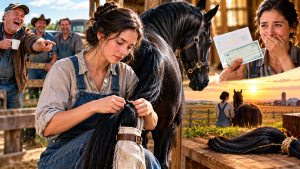
For two evenings, she sat on an overturned bucket behind the horse, patiently working dried mud and cockleburs from the long black strands.
She never pulled.
She never hurried.
When she finished, she loosely braided the tail, folded it upward, and slipped it inside a sleeve sewn from two empty flour sacks.
Then she tied the sleeve with a soft leather strap.
From the road, Caspar looked ridiculous.
At the feed store, Orville Pike nearly choked on his coffee when he heard about it.
“Now she’s dressing the horse!”
The men around him laughed.
Elsa heard the story later and continued with her work.
Every morning, Caspar received prairie hay and a small measure of oats.
Every Sunday, she unwrapped his tail, checked the hair, and braided it again.
She also put him to work.
Despite his elegant appearance, Caspar proved steady and surprisingly strong.
He pulled the harrow across her fields without complaint.
He carried supplies.
And when Elsa worked late, he waited quietly at the barn gate until she finished.
Nathan began appearing at the shared fence more often.
At first, he came to repair the stock tank.
Then he checked the water pipe.
By the fourth visit, Elsa folded her arms.
“Nathan, that valve’s been working perfectly for three weeks.”
“I noticed.”
“Then why are you here?”
He looked toward the horse.
“Thought you might need another pair of hands.”
“I usually do.”
“Then I’ll be back Tuesday.”
He was.
Elsa had known Nathan for six years, but they had rarely spoken beyond ordinary neighborly business.
He was thirty-one, quiet, and careful with his words.
His younger brother had joined the Civilian Conservation Corps to help support their widowed mother.
Nathan understood what it meant to stretch a dollar.
He also understood that Elsa hated being treated like a helpless woman.
So he never offered charity.
He repaired things.
Carried heavy sacks.
And left before she felt obligated to thank him.
By late June, Caspar’s tail had grown thick enough for Elsa’s first experiment.
She brought him into the barn, tied his halter loosely, and opened her grandfather’s wooden box.
The shears were still sharp.
Working beneath the outer layer of hair, she selected four small bundles of exceptionally long strands.
She tied each bundle tightly near its upper end before cutting, preserving the natural direction of the hair.
She removed so little that Caspar’s tail still appeared full.
Afterward, she washed the bundles in rainwater and mild soap.
She dried them in the shade.
Then she sat at the old workbench and sorted every strand.
Her grandfather’s voice seemed to return.
The root ends must face the same direction, Elsa. Every single one.
She worked until her eyes burned.
When she finished, she had slightly more than two ounces of usable black hair.
She wrapped it in muslin and mailed it to Chicago.
Then she waited.
Three weeks passed.
The wheat turned thin and pale.
The wind blew dust beneath the doors.
Mr. Harlan sent another reminder about the mortgage.
On a Thursday afternoon, the mail carrier stopped outside Elsa’s gate.
“Letter from Chicago.”
She took the envelope into the kitchen.
Inside was a check.
Nine dollars.
Exactly what she had paid for Caspar.
She sat down slowly.
Her first cutting had earned back the horse’s purchase price.
But the accompanying letter made her smile disappear.
Miss Brandt, the quality is exceptional. However, I discovered eleven strands facing the wrong direction.
Elsa read the sentence twice.
Reisner explained that even a few reversed hairs could affect how smoothly a bow played.
Her grandfather had warned her about that.
She had made a beginner’s mistake.
Still, Reisner wanted more.
He offered to purchase a larger shipment the following summer, provided she corrected the problem.
Elsa opened her notebook and wrote:
Never release the bindings before final sorting.
That evening, Nathan found her sitting on the porch.
“Good news?” he asked.
She showed him the check.
His eyebrows rose.
“From the horse?”
“From his tail.”
Nathan looked toward the barn.
“Well, I’ll be.”
For a moment, Elsa laughed.
It was the first genuine laugh he had heard from her in months.
Then she showed him the bank’s latest letter.
Nathan read it carefully.
“When’s the payment due?”
“September.”
“And the wheat?”
“Won’t cover half.”
He returned the letter.
“Then we’ll have to find another way.”
Elsa shook her head.
“There isn’t enough time to grow another tail.”
Nathan considered that.
“No,” he said. “But there are other horses.”
She looked at him.
The idea was so obvious she felt foolish for missing it.
Other horses.
Other tails.
Other farmers who might welcome a few extra coins.
Before she could answer, Nathan pointed toward the northern horizon.
The sky had turned an ugly yellow-brown.
“Elsa,” he said quietly, “I don’t like the look of that wind.”
Neither did she.
THE DAY THE SKY DISAPPEARED
On April 14, 1935, the afternoon turned black.
Elsa had seen dust storms before.
Every farmer in western Kansas had.
But this was different.
The darkness rose from the northern horizon like an enormous wall.
Birds flew ahead of it.
The wind carried a low, steady roar.
Elsa dropped her bucket and ran.
“Caspar!”
The horse was already pacing at the corral gate.
She grabbed his halter and pulled him toward the barn.
Behind them, the sky vanished.
She slammed the doors, stuffed damp sacks into the cracks, and covered Caspar’s nose with a wet cloth.
Then the storm struck.
Dust poured through every opening.
The barn groaned.
Elsa could barely see her own hands.
She stood beside Caspar for hours, one palm against his neck, speaking the German words her grandfather had taught her.
“Ruhig, Junge. Ganz ruhig.”
Easy, boy.
Stay calm.
By evening, the air was so thick that breathing hurt.
When Elsa finally reached the farmhouse, she hung wet sheets over the windows and lay awake listening to the wind.
Morning revealed a landscape she barely recognized.
Fence posts had disappeared beneath drifting soil.
The garden was buried.
The windmill stood motionless.
And the stock tank was empty.
Elsa climbed the windmill tower with a wrench, but the gearbox was packed with grit.
She couldn’t free it.
By noon, Caspar was desperate for water.
Elsa carried what remained in the kitchen bucket to his stall.
Then she heard a truck.
Nathan came across the yard carrying two water cans and a toolbox.
His face was gray with dust.
“Your pump’s stopped,” he said.
“I know.”
“Mine too.”
“Then why aren’t you fixing yours?”
He set down the toolbox.
“Because you’ve got a horse that needs water.”
He climbed the tower.
For three hours, Elsa passed him rags, tools, and kerosene.
Twice, he coughed so hard she begged him to come down.
“Not yet,” he called.
Finally, the windmill turned.
The pump sputtered.
Water flowed.
Caspar drank until Elsa gently pulled the bucket away.
Nathan descended the ladder with shaking hands.
Elsa caught his elbow.
“You could’ve fallen.”
“Didn’t.”
“You could’ve been killed.”
He looked at her.
“So could that horse.”
She wanted to argue.
Instead, she held his arm a moment longer.
The storm became known as Black Sunday.
In the following weeks, Elsa attended funerals.
Two children from a neighboring family died after severe dust-related illness.
An elderly farmer who had survived forty Kansas winters was buried beneath a sky still brown with drifting earth.
Elsa’s wheat crop was nearly gone.
But Caspar survived.
And when she removed his flour-sack tail covering, the hair beneath was remarkably clean.
That was when she made a decision.
She would not wait for Caspar alone to produce enough hair.
She would visit every farm with a suitable black gelding or stallion.
She began at the blacksmith’s shop.
Then the church.
Then the sale barn.
“Fifty cents,” she told the owners. “That’s what I’ll pay for a small cutting from underneath the tail. Your horse won’t even look different.”
Some men laughed.
Others needed the money.
By July, five owners had agreed.
Elsa traveled from farm to farm carrying her grandfather’s shears, waxed thread, and clean muslin.
Nathan occasionally drove her truck while she held the horses.
At night, she worked beneath the kitchen lamp.
She washed the hair.
Sorted it.
Checked the direction of every strand.
Marked each bundle.
Caspar’s own tail produced seven and a quarter ounces of long, usable hair that summer.
The other horses supplied considerably more.
By the end of July, she had mailed two packages to Chicago.
Then came the waiting.
In August, Reisner’s envelope arrived.
Elsa opened it beside the kitchen sink.
A check slipped onto the table.
Seventy-four dollars and fifty cents.
She stared.
Then she opened her wheat ledger.
Her entire 1935 wheat harvest had earned forty-one dollars.
The horsehair had brought in nearly twice as much.
For a long time, Elsa sat without moving.
Then she laughed.
And cried.
And laughed again.
But the most important part of Reisner’s letter wasn’t the check.
He explained that professional bass players had praised the hair’s performance.
Another bow maker in New York wanted to purchase from her.
And Reisner believed she could develop a reliable American supply business.
Elsa read those lines aloud when Nathan visited.
He listened quietly.
Then he said, “You ought to put your name on the packages.”
“My name?”
“Brandt Horsehair. Something like that.”
She smiled.
“Sounds rather grand for a woman working at her kitchen table.”
“Maybe the kitchen table’s getting too small.”
He was right.
But success attracted attention.
Within days, a horse trader from Garden City appeared at her farm.
He examined Caspar carefully.
Then he offered Elsa $125.
Cash.
Enough to make a serious payment on her mortgage.
Enough to buy seed.
Enough to survive another winter.
Elsa looked at the money.
Then at the horse.
“No,” she said.
The trader frowned.
“Lady, you’re making a mistake.”
“Perhaps.”
“That’s more than thirteen times what you paid.”
“I can count.”
The man left angry.
That evening, Elsa found a fresh notice nailed to her front door.
It was from the bank.
Her overdue balance had been reviewed.
Unless she paid the required amount within thirty days, foreclosure proceedings could begin.
Elsa stood in the doorway with the paper trembling between her fingers.
THE PRICE OF KEEPING CASPAR
Nathan found Elsa in the barn after sunset.
She was sitting on a feed crate, the foreclosure notice folded in her lap.
Caspar stood nearby, quietly chewing hay.
Nathan read the paper.
“How much?”
“Eighty-six dollars to bring the account current.”
“By when?”
“September twentieth.”
He did the arithmetic in his head.
“You’ve got the Chicago check.”
“Seventy-four fifty.”
“And the wheat money?”
“Most of it went to taxes, feed, and the seed bill.”
Nathan looked toward Caspar.
“The trader offered a hundred and twenty-five.”
“I know.”
“You turned him down.”
“Yes.”
He handed back the notice.
“Good.”
Elsa stared at him.
“Good? Nathan, they can take this farm.”
“I know.”
“Then don’t stand there pretending everything’s fine.”
“I’m not.”
She rose abruptly.
“My grandfather built this house. My father died trying to keep this land. And I’ve spent three years watching everything disappear.”
Nathan said nothing.
Elsa’s voice broke.
“I thought I’d finally found something the drought couldn’t destroy.”
He waited until she sat down again.
Then he pulled a small notebook from his pocket.
“I’ve been keeping track of the horses you’ve visited.”
She looked up.
“Why?”
“Because somebody ought to.”
He opened the notebook.
There were names, addresses, estimated tail lengths, and notes about the owners.
Thirty-one possible horses across three counties.
Elsa stared at the pages.
“You’ve been doing this without telling me?”
“I was going to show you when I knew the list was useful.”
She turned another page.
Some owners were willing to sell tail thinnings.
Others wanted payment after the hair was sold.
A few had already agreed to let Elsa inspect their animals.
Nathan pointed to the numbers.
“You’ve proved there’s a market. But you’ve only filled part of the orders.”
“Orders don’t pay bills until they’re delivered.”
“Then write Chicago and New York. Ask whether they’ll advance money against a confirmed shipment.”
Elsa hesitated.
Her grandfather had taught her that debts could become chains.
She already owed the bank more than she could bear.
Nathan seemed to read her expression.
“I’m not telling you to borrow money you can’t repay. I’m telling you to ask whether the buyers will purchase the next shipment in advance.”
That night, Elsa wrote two letters.
She explained the bank deadline.
She listed the horses available.
She promised no quantity she couldn’t reasonably supply.
Then she waited.
Ten days later, Anton Reisner replied.
He would advance fifty dollars against her next delivery.
The New York buyer, Mr. Sorenson, offered thirty-five more under similar terms.
Together, the advances totaled eighty-five dollars.
Elsa counted her remaining cash.
It was enough to cover the required bank payment, but left almost nothing for travel, feed, or paying horse owners.
She could save the farm for the moment.
Or she could use the money to expand the business that might save it permanently.
She couldn’t afford both.
The next morning, Elsa visited Mr. Harlan.
He sat behind his desk, surrounded by neat stacks of paper.
“I’ve brought the payment,” she said.
He looked surprised.
“All eighty-six dollars?”
“Yes.”
“Where did you get it?”
“From selling horsehair.”
He blinked.
“Horsehair?”
“For musical instrument bows.”
Mr. Harlan studied her.
“Miss Brandt, I hope you haven’t borrowed money against an uncertain business.”
“I’ve received advances from two established buyers.”
“Which means you owe them merchandise.”
“Yes.”
“And what happens if you can’t deliver?”
“I’ll have to find a way to repay them.”
He leaned back.
“Then you understand you’ve exchanged one obligation for another.”
“I do.”
For once, he didn’t argue.
He stamped her receipt.
The foreclosure deadline was withdrawn, provided she kept up with future payments.
Elsa walked out of the bank feeling neither victorious nor relieved.
She had bought time.
Nothing more.
That afternoon, she told Nathan what she’d done.
He nodded.
“Then we’d better get to work.”
For the next several weeks, they traveled dusty roads, inspecting horses and negotiating with owners.
Elsa refused to cut from any animal with damaged or unhealthy tail hair.
She refused to take too much from any horse.
And she refused to promise her buyers more than she could supply.
But near the end of their route, disaster struck.
Nathan’s truck broke an axle on a rutted county road.
The repair would cost twelve dollars.
They had less than four.
And the Chicago shipment was due in nine days.
Elsa stood beside the disabled truck, staring at the crates of carefully wrapped hair.
Nathan wiped grease from his hands.
“I can borrow a wagon.”
“From whom?”
“My cousin.”
“He lives twenty miles away.”
“I know.”
Elsa looked at the sinking sun.
Then she made a decision Nathan hadn’t expected.
“Go get the wagon,” she said.
“What are you going to do?”
“I’m going home.”
“How?”
She glanced toward the pasture where Caspar waited behind the fence.
“The county says he’s too pretty to work.”
Her mouth tightened.
THE HORSE THAT PAID MORE THAN THE WHEAT
Caspar pulled the loaded wagon into Dodge City three days later.
Elsa sat on the wooden seat, her hands wrapped around the reins.
Behind her were carefully packed bundles of black horsehair, each labeled with its source and prepared according to her grandfather’s instructions.
The horse moved steadily through the morning traffic.
His long mane lifted in the breeze.
His tail, safely braided inside its flour-sack covering, swayed gently behind him.
Outside the feed store, Orville Pike stopped sweeping.
“Well, I’ll be damned.”
Elsa pulled the wagon to a halt.
“Morning, Orville.”
He looked from the horse to the packages.
“That’s the nine-dollar horse.”
“Yes.”
“What’s he hauling?”
“His competition.”
Orville stared.
Then he laughed so loudly that two men came out of the store.
Elsa didn’t stay to explain.
She had a train shipment to arrange.
The hair reached Chicago on time.
Reisner inspected it, accepted the agreed quantity, and deducted his advance from the payment.
Sorenson did the same with his shipment.
There were no reversed strands reported this time.
No complaints about cleanliness.
No returned bundles.
Only letters asking when Elsa could supply more.
By winter, she had enough confirmed orders to plan the following year’s work.
She also had something she hadn’t possessed since her father’s death.
A reason to believe the farm might survive.
The next spring, Nathan helped her convert the unused north bedroom into a proper sorting room.
They built wooden drying racks.
Moved the workbench beneath the window.
And hung a small handwritten sign above the door.
BRANDT HORSEHAIR — DODGE CITY, KANSAS
Elsa stood looking at it.
“It’s crooked.”
Nathan stepped back.
“Only a little.”
“It’s very crooked.”
“Then I suppose you’ll have to hire a better carpenter.”
“I can’t afford one.”
He smiled.
“Good thing I’m cheap.”
She reached for his hand.
He looked down at their joined fingers.
Neither spoke for a moment.
By the summer of 1936, Elsa was purchasing carefully selected tail thinnings from thirty-one horses across Ford, Gray, and Hodgeman counties.
She paid owners fairly.
She kept detailed records.
And she inspected every bundle herself.
Not every cutting produced valuable hair.
Some strands were too short.
Others were damaged.
Some horses simply didn’t have the right kind.
Elsa rejected anything she wouldn’t have trusted in her grandfather’s workshop.
Her customers noticed.
Reisner began recommending her to other craftsmen.
Sorenson placed repeat orders.
A third buyer in Cincinnati joined them.
The income was modest compared with that of a large business.
But it was dependable enough to matter.
By the end of 1936, Elsa had brought her mortgage payments current and established a small reserve for the following year.
She no longer had to choose between buying seed and feeding Caspar.
She could do both.
One afternoon, Orville Pike drove up with his son’s black Percheron gelding.
He stood awkwardly beside the wagon while Elsa inspected the horse.
“Think there’s anything worth buying?” he asked.
“Possibly.”
She examined the tail.
“Come back in July. There should be enough length by then.”
Orville nodded.
Then he cleared his throat.
“Elsa?”
“Yes?”
“I reckon I owe you an apology.”
She looked at him.
“For what?”
“All that talk at the co-op. About you being foolish.”
Elsa rested one hand against the Percheron’s neck.
“You weren’t the only one.”
“Still wasn’t right.”
“No,” she said. “It wasn’t.”
Orville shifted his weight.
“You going to forgive me?”
She considered him.
“Bring the horse back in July, Orville.”
He smiled uncertainly.
“That a yes?”
“That’s business.”
After he left, Elsa went inside and laughed until she had to sit down.
Nathan found her there.
“What happened?”
“Orville Pike just asked me to buy his horse’s tail.”
Nathan grinned.
“Times are changing.”
“Some things take longer than others.”
That autumn, Nathan came to supper carrying two folded property maps.
Elsa had made potato dumplings from her grandmother’s recipe.
He ate three servings before pushing his plate aside.
“Elsa, I’ve been thinking.”
“That sounds dangerous.”
“Probably is.”
He unfolded the maps.
One showed his family’s farm.
The other showed hers.
Between them ran the old property line and the stock tank their fathers had built together in 1919.
Nathan pointed to it.
“Funny thing about that tank.”
“What?”
“It’s spent seventeen years sitting between two farms.”
“Yes.”
“Seems to me it might be happier in the middle of one.”
Elsa looked at him.
Then at the maps.
Then back at him.
“Nathan Rule, are you proposing marriage with a stock tank?”
“I had a better speech prepared.”
“Did you?”
“Forgot most of it when you looked at me.”
She laughed softly.
He reached across the table.
“I don’t want your farm, Elsa. And I don’t want your business. I want to build a life with you, if you’ll have me.”
Her expression changed.
For three years, every offer of help had seemed to carry a hidden price.
Sell the land.
Give up the horse.
Admit defeat.
But Nathan had never asked her to surrender anything.
He had climbed the windmill when the water stopped.
Driven dusty roads when she needed transportation.
Held horses while she worked.
And waited patiently while she learned to trust him.
Elsa squeezed his hand.
“Yes,” she said.
Nathan blinked.
“Yes?”
“Yes, I’ll marry you.”
He let out a breath.
Then she pointed at the maps.
“But the farms stay separately titled.”
Nathan smiled.
“I figured you’d say that.”
“And the horsehair business stays mine.”
“Wouldn’t dream of arguing.”
“And you’re fixing that crooked sign upstairs.”
He laughed.
“Anything else?”
She leaned across the table and kissed him.
“Not tonight.”
They married the following spring in a small church outside Dodge City.
There were no expensive flowers.
No elaborate reception.
Just neighbors, family, homemade food, and a fiddle player who had once sent his bow to Elsa’s grandfather for repairs.
Caspar remained on the Brandt farm.
He continued pulling the harrow each spring.
He continued standing patiently while Elsa inspected his tail.
And every summer, his long black hair contributed another small harvest.
Elsa never sold him.
Not when another trader offered two hundred dollars.
Not when money was tight.
Not even when he grew older and could no longer work the fields.
Years later, the wheat returned to the Kansas plains.
The rains improved.
The fields turned green again.
But Elsa kept the horsehair business.
It had become more than a way to survive.
It was the work her grandfather had taught her, brought back to life in the very room where she had first learned it.
She eventually trained two local women to help with sorting and packing.
One was a widow whose husband had died during the drought years.
The other was a young mother who needed income without leaving her children all day.
Elsa taught them exactly as Wilhelm had taught her.
Slowly.
Patiently.
Never allowing a single careless bundle to leave the house.
One evening, long after the worst years had passed, Nathan found Elsa standing in the barn beside an aging Caspar.
The horse’s black coat had begun to gray around his muzzle.
His steps were slower.
But his tail was still thick and carefully braided.
Nathan leaned against the stall door.
“Remember what they called him at the auction?”
“Too pretty to work.”
“Turns out he did more work than most horses in the county.”
Elsa smiled.
“He certainly earned his keep.”
Nathan glanced at the old flour-sack sleeve.
“Ever wonder what would’ve happened if you hadn’t raised your hand?”
She ran her fingers gently through Caspar’s mane.
“Sometimes.”
“And?”
She thought about the seven dollars she had carried home.
The failed wheat.
The bank notices.
The black dust that had swallowed the sun.
The first nine-dollar check.
And the eleven reversed strands that had taught her to be more careful.
Then she thought about her grandfather, sitting beside the north window, teaching a little girl how to tell one end of a horsehair from the other.
“I think,” she said, “Grandpa would have liked him.”
Nathan smiled.
“That’s all?”
Elsa looked toward the farmhouse, where warm light spilled through the kitchen windows.
“No,” she said. “But it’s enough.”
She gave Caspar one last pat and turned down the lantern.
Outside, the wheat moved gently beneath the evening wind.
And in the quiet barn, the old black horse stood with his tail safely wrapped, having given Elsa something no harvest ever could.
A second beginning.