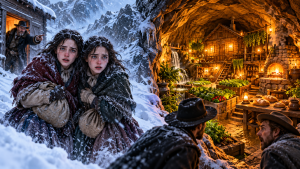
PART 1: THE SISTERS THE TOWN LEFT TO DIE
November 1873. Promise Creek, Montana Territory.
When the townspeople finally climbed the frozen mountain to look for the bodies of two young sisters, they expected to find something terrible.
Two frozen corpses.
Perhaps a few bones beneath the snow.
After all, the sisters had been driven from their home just as the worst blizzard in decades swallowed the valley.
Nobody had seen them for months.
Nobody believed they could possibly have survived.
But what those men eventually discovered inside the mountain would leave an entire town speechless.
There was a little wooden house.
A fire was burning.
Fresh bread was cooling beside a stone oven.
And beneath their frozen boots, the floor was strangely warm.
But the most astonishing part of the story was not how the sisters survived.
It was what they chose to do for the very people who had abandoned them.
To understand that extraordinary discovery, we must return to the bitter morning when their uncle closed his door.
Elspeth and Maeve were twenty years old.
They were identical twins, with the same dark hair, pale faces, and unusual gray eyes.
Ten years earlier, a fever had taken both their parents, leaving them under the care of their mother’s brother, Silas.
He had given them food, shelter, and work.
But affection was another matter.
For a decade, the girls had lived in his house like unwanted furniture.
They worked harder than anyone in Promise Creek, yet the townspeople regarded them with suspicion.
The reason was simple.
The sisters were different.
They rarely spoke unless necessary.
Sometimes, one sister would reach for a tool just as the other placed it in her hand.
They could work for hours without exchanging a single word.
And while other young women attended gatherings, the twins studied rocks, soil, weather patterns, and farming techniques.
Elspeth loved maps and geology.
Maeve understood plants and seeds.
Together, they seemed capable of solving problems that left everyone else helpless.
One autumn, they built a small wooden growing frame against their uncle’s smokehouse.
While every other garden in the valley died beneath the frost, theirs remained green.
People should have celebrated.
Instead, they whispered.
“There’s something unnatural about those girls.”
“No ordinary women can grow vegetables in freezing weather.”
Even Reverend Miller warned Silas that his nieces possessed knowledge best left unexplored.
And Silas, desperate to remain respected in his community, began to believe them.
Then came the morning that changed everything.
The sky was the color of bruised iron.
Snow was already sweeping down from the mountains.
Silas stood beside his open front door with two small flour sacks.
“Take these,” he said.
Elspeth looked at the sacks.
Inside were a little dried meat, some bread, and their few possessions.
“Where are we supposed to go?” Maeve asked.
Silas stared past her.
“You’re grown women. Find somewhere else.”
“There’s a storm coming,” Elspeth said quietly.
“I know.”
Those two words hurt more than anything he could have shouted.
He knew.
He understood exactly what would happen to two young women walking into the mountains without proper supplies.
And he was sending them anyway.
“You’ve never belonged here,” he continued. “The world has no place for two halves of the same soul.”
Maeve’s lips trembled.
“We’re your family.”
For a moment, something flickered in the old man’s eyes.
Then it vanished.
“Go.”
The wooden door slammed.
The iron latch clicked.
And the sisters were alone.
They stood together in the gathering snow, holding everything they owned.
Maeve carried a small tin of vegetable seeds.
Elspeth carried two books and a folded geological map.
Neither carried enough food for three days.
They began walking.
By afternoon, the snow had become a white wall.
The wind struck them so violently that breathing hurt.
Ice formed along their eyelashes.
Their fingers turned numb.
Every step became harder than the last.
Maeve stumbled repeatedly, but Elspeth always caught her.
After several hours, they found shelter beneath a shallow rock overhang.
They pressed themselves together, trembling.
“I can’t feel my feet,” Maeve whispered.
Elspeth pulled her sister closer.
“Keep moving your toes.”
“I can’t.”
For the first time that day, fear appeared in Elspeth’s eyes.
She knew what that meant.
Maeve was beginning to freeze.
Outside, the storm roared like an enormous living creature.
“We could go back,” Maeve murmured.
Elspeth said nothing.
“We could apologize to Uncle Silas.”
“Apologize for what?”
Maeve looked down.
Neither sister could answer.
For being intelligent?
For being different?
For growing vegetables when others could not?
They had committed no crime.
They had simply failed to become the people their town wanted them to be.
Maeve closed her eyes.
“I’m so tired.”
Elspeth touched her cheek.
“Don’t sleep.”
“Just a little.”
“Maeve. Look at me.”
But Maeve’s eyes were already closing again.
And suddenly Elspeth remembered something.
A sentence from her geological survey.
The book described a network of limestone caves beneath the northern ridge, where underground warmth could keep some chambers above freezing throughout winter.
Weeks earlier, Elspeth had noticed an unusual formation while exploring the mountains.
She had marked it on her map with one word.
BREATH.
Because she’d once seen a faint mist rising from a crack in the stone.
At the time, it had seemed nothing more than an interesting curiosity.
Now it might be their only hope.
Elspeth seized her sister’s shoulders.
“Get up.”
Maeve barely stirred.
“Please.”
“There’s a place I want to find.”
“Where?”
“Inside the mountain.”
Maeve opened her eyes.
“You’re talking about a cave?”
“Yes.”
“We’ll freeze in there.”
“Maybe not.”
Elspeth unfolded the map with shaking fingers.
The wind nearly tore it away.
She caught it against her chest.
“Trust me.”
Maeve looked at her sister’s face.
Then, with the last strength in her body, she stood.
They abandoned the mountain pass and descended into a narrow ravine.
Snow reached their knees.
Branches clawed at their coats.
Twice Maeve fell.
Twice Elspeth dragged her upright.
At last, through the curtain of snow, they saw a towering limestone cliff.
And beneath its overhanging edge was a narrow black opening.
Elspeth almost cried.
It was exactly where the map said it would be.
They hurried toward it.
Inside, the wind suddenly stopped.
The silence was so complete that both sisters froze in surprise.
Darkness stretched ahead.
A faint mineral smell drifted through the passage.
They moved slowly, touching the walls for balance.
Twenty yards.
Fifty.
Then farther.
Something changed.
Their breathing grew easier.
The painful cold gripping their faces began to lessen.
And when the narrow passage finally opened into a vast underground chamber, they stopped.
Far overhead, a crack in the ceiling admitted a pale column of daylight.
Snowflakes drifted through it.
But before reaching the ground, they melted into tiny droplets.
Maeve stared upward.
“Elspeth…”
Her sister was already kneeling.
She removed her glove and pressed one hand against the stone.
Then she looked up, her gray eyes widening.
Outside, a blizzard was killing everything it touched.
Yet here, deep beneath the mountain, something extraordinary was happening.
The sisters had discovered what might be the only place in the entire valley where winter could not reach them.
But would it keep them alive long enough to build a home?
And what would happen when the people who had abandoned them eventually discovered their secret?
PART 2: THE IMPOSSIBLE HOME BENEATH THE MOUNTAIN
Beneath Maeve’s trembling palm, the stone floor was warm.
Not hot like a fireplace, but gently warm compared with the frozen earth outside.
For the first time since their uncle had thrown them into the storm, the sisters felt something they had almost forgotten.
Hope.
They explored the cavern carefully.
In a lower passage, they discovered fresh water trickling through limestone into a natural basin.
Above the central chamber, daylight entered through the enormous crack in the ceiling.
Nearby, a narrow natural vent rose toward the surface.
Elspeth studied everything.
Then she turned to Maeve.
“We can live here.”
Maeve stared at the empty chamber.
“With what?”
Elspeth lifted her flour sack.
“With what we know.”
And so began the hardest winter of their lives.
They collected fallen timber from the sheltered ravine and slowly constructed a small cabin inside the cave.
Without proper tools, every piece of wood required hours of labor.
They shaped a fireplace from stone and clay, connecting it to the natural vent to carry smoke away.
Maeve built wooden planting boxes and filled them with soil collected outside.
Into those boxes went her precious seeds.
For weeks, the sisters worked until their hands blistered.
They were cold, hungry, and exhausted.
But they were free.
Nobody called them strange.
Nobody ordered them to stop thinking.
And nobody told them their ideas were unnatural.
By January, the first pale green leaves had appeared in the sheltered growing beds beneath the cave’s natural openings.
Maeve cried when she harvested their first radish.
Elspeth cut it into two tiny pieces.
They ate without speaking.
It was the finest meal either could remember.
Soon afterward, using their remaining flour and a carefully preserved sourdough starter, they baked their first small loaf.
The smell filled the cavern.
Maeve stood beside the oven, tears streaming down her face.
“We made a home,” she whispered.
But the flour was almost gone.
Then, one afternoon, a sixteen-year-old trapper named Thomas discovered their hidden valley.
He had followed a rabbit’s tracks through the snow.
When he stepped into the cavern and saw the wooden cabin, the growing vegetables, and the warm oven, his mouth fell open.
“How?” he asked.
Elspeth handed him a slice of bread.
“Hard work,” she answered.
Thomas, whom the townspeople often mocked for being slow and quiet, understood immediately.
He began trading animal pelts for the sisters’ vegetables and bread, using the proceeds to obtain flour, salt, and other necessities.
Before long, word reached Promise Creek.
The impossible sisters were alive.
And they had food.
While the town suffered through dwindling supplies, the women everyone had feared were growing vegetables beneath a mountain.
Even Mr. Henderson, the skeptical storekeeper, began exchanging precious flour for their loaves.
Reverend Miller warned against accepting food from such an unnatural place.
But hunger proved stronger than suspicion.
Weeks passed.
More families needed help.
The sisters sent what they could.
Then, near the end of February, Thomas appeared at the cave entrance with another visitor.
Their uncle.
Silas.
The man who had sent them into the blizzard stood trembling before the warm little cabin.
He looked thinner and older.
Elspeth and Maeve watched silently.
Finally, he raised his head.
“Please,” he whispered. “I need your help.”
Elspeth’s expression did not change.
“Who is sick?”
Silas began crying.
“The Reverend’s family. All of them. But the baby…”
His voice broke.
“Reverend Miller’s baby is dying. And she won’t survive until morning.”
PART 3: THE GREATEST GIFT WAS GIVEN TO THOSE WHO LEAST DESERVED IT ❤️
For several seconds, nobody moved.
The only sound inside the cavern was the quiet crackling of the fire.
Silas stood before the two women he had abandoned, his face wet with tears.
“The baby is dying,” he repeated.
Elspeth looked at Maeve.
Neither sister spoke.
Both remembered Reverend Miller standing in church, warning the congregation that their strange knowledge was dangerous.
They remembered the whispered accusations.
The hateful looks.
The way people crossed the street to avoid them.
And they remembered the morning their uncle had pushed them into the blizzard.
Reverend Miller had done nothing to stop him.
Now that same man needed their help.
Silas seemed to understand what they were thinking.
“I know what we did,” he whispered. “I know we have no right to ask you for anything.”
Elspeth looked toward the small fire.
For a moment, she was twenty years old again, standing outside a locked door with snow gathering on her shoulders.
Then Maeve asked a simple question.
“How old is the baby?”
“Eight months.”
“Has she been eating?”
Silas shook his head.
“Hardly anything. Her mother’s too weak to care for her. They’ve been burning furniture to stay warm.”
Elspeth turned toward her sister.
“Get the large pot.”
Maeve was already moving.
Silas stared.
“You’re going to help?”
Elspeth looked at him.
“There’s a child who needs food and warmth. Why wouldn’t we?”
Silas opened his mouth.
Nothing came out.
For the first time, he understood how completely he had misunderstood the two girls he had raised.
He had mistaken their silence for coldness.
Their intelligence for arrogance.
Their independence for pride.
But the women he had sent into the wilderness had become the only people willing to help his neighbors without demanding anything in return.
Maeve opened the oven.
Inside were six loaves of bread, baked that morning from flour Thomas had obtained through trading.
She wrapped four in clean linen.
Then she carried a large pot to the hearth and began preparing broth from carrots, greens, and the small amount of dried meat they had saved.
Elspeth collected extra firewood, a bundle of dried herbs, and two thick wool blankets.
Thomas began arranging everything on his sled.
But as Maeve reached for the final loaf, Elspeth caught her arm.
“Wait.”
Maeve looked at her.
“That’s our bread for tomorrow,” Elspeth said.
Maeve glanced toward the nearly empty flour barrel.
They both understood the problem.
The mountain had protected them from the cold, but it could not magically fill their pantry.
Every loaf they gave away brought them closer to hunger.
Every sack of flour required a dangerous journey.
They had enough for themselves if they were careful.
But the town contained dozens of frightened, hungry people.
Maeve looked at the bread in her hands.
Then she placed it on the sled.
“We can bake again,” she said.
Elspeth gave the smallest nod.
“And tomorrow,” she answered, “we must find a way to feed more people.”
Silas suddenly sank onto a wooden bench.
He covered his face with both hands.
“I don’t deserve this.”
Elspeth approached him.
“That may be true.”
He looked up.
“But the baby didn’t choose what happened to us,” she continued. “Neither did the other children.”
Silas began crying harder.
Maeve placed a cup of warm broth in his trembling hands.
“Drink,” she said.
He obeyed.
It was the first kindness he had accepted from either niece in years.
And somehow, it hurt more than anger would have.
### The book he had hidden for ten years
As Thomas finished loading the sled, Silas reached beneath his coat.
“I brought something.”
He removed a small, worn leather book.
Its cover was cracked.
Its pages were yellowed.
Elspeth recognized it instantly.
Her mother’s sketchbook.
She had not seen it since she was ten years old.
Her breath caught.
“Where did you get that?”
Silas stared at the book.
“It was your mother’s.”
“We know.”
“I kept it after she died.”
Maeve stepped closer.
“All these years?”
He nodded.
“I couldn’t bring myself to throw it away.”
Elspeth slowly took the book.
Inside were familiar drawings.
Wildflowers growing beside the creek.
Clouds above the northern ridge.
An old oak behind their childhood home.
Then came a drawing of two small girls sitting beside a basket of apples.
Elspeth and Maeve.
Their mother had sketched them when they were only four.
Underneath, in delicate handwriting, were the words:
My two little wonders. Always watching. Always learning.
Maeve pressed her fingers against the page.
Her eyes filled with tears.
“She wasn’t afraid of us,” she whispered.
Silas shook his head.
“No.”
“She thought we were wonderful.”
“She did.”
The old man’s voice broke.
Elspeth turned another page.
There was a drawing of their mother holding both daughters against her chest.
For ten years, the sisters had almost forgotten what it felt like to be held that way.
Maeve began to cry openly.
Elspeth closed the book before her own tears could fall onto the paper.
“Why didn’t you give this to us sooner?” she asked.
Silas looked toward the ground.
He had no answer that would make sense.
Because he had been selfish?
Because every time he opened the book, he remembered the sister he had lost?
Because giving the girls their mother’s drawings would have required him to acknowledge that they needed more than food and shelter?
He finally whispered, “It belongs with you.”
Elspeth held the book against her chest.
Then she stepped aside.
“Thomas knows the safest way down. Go before the light fades.”
Silas rose slowly.
He waited, perhaps hoping for something else.
A promise that everything was forgiven.
A word of affection.
An invitation to stay.
None came.
Instead, Maeve tightened the blankets around the supplies and handed him a small package.
“That bread is for you,” she said.
Silas stared at it.
“But—”
“You look hungry.”
He lowered his head.
And with Thomas leading the way, he walked out of the warm cavern into the bitter afternoon.
Behind him, the sisters returned to work.
There was another batch of bread to prepare.
### The longest night in Promise Creek
By the time Thomas and Silas reached the Reverend’s house, darkness had swallowed the valley.
The building was freezing.
One window had been covered with a blanket where the glass had cracked.
The fireplace held only a weak flame.
Mrs. Miller lay beneath several quilts, too exhausted to sit upright.
Her older children huddled together on the floor.
And in a wooden cradle beside the fire lay the baby.
She was frighteningly still.
Reverend Miller rose when he saw Silas enter.
“Did you find them?”
Silas nodded.
“Yes.”
The Reverend’s eyes moved toward the food.
For an instant, relief crossed his face.
Then shame followed.
“They sent all this?”
“Yes.”
“Even after everything?”
Silas began unloading the sled.
“They didn’t ask who deserved it.”
The Reverend lowered his eyes.
Thomas knelt beside the cradle.
He had seen fever in isolated cabins before.
He knew the family needed nourishment, fluids, warmth, and medical attention if a physician could be reached.
He made no promise that the baby would recover.
Instead, he helped Silas build a stronger fire, warmed the room, and assisted the exhausted parents in offering the infant small amounts of fluid as she could tolerate them.
They gave Mrs. Miller some of the broth.
Her hands shook so badly that Silas had to steady the cup.
The older children ate bread in silence.
Reverend Miller took a loaf and held it close to his face.
It was still faintly warm.
He inhaled.
Then he started crying.
Not because the bread was extraordinary.
But because it was ordinary.
Simple food.
Made by ordinary hands.
Given freely by the people he had publicly condemned.
“All these weeks,” he whispered, “I’ve told everyone that those women were dangerous.”
Nobody answered.
Outside, the wind shook the house.
The baby stirred weakly in her cradle.
The Reverend dropped to his knees.
“Please,” he whispered. “Please let her live.”
Thomas remained beside the cradle for much of the night.
The hours passed slowly.
At midnight, the child’s breathing remained shallow.
By two in the morning, her parents feared the worst.
Mrs. Miller wept against her husband’s shoulder.
And then, shortly before dawn, the baby opened her eyes.
She gave a small, exhausted cry.
Her mother reached for her.
This time, the child responded.
She managed a little more nourishment.
Her breathing seemed easier.
No one knew whether she would survive the illness, but for the first time that night, there was reason to hope.
The Reverend held his daughter and wept.
By the following afternoon, she was still alive.
Over the next several days, her strength slowly returned.
And when Thomas finally carried news of her improvement back to the mountain, Maeve sat down beside the oven and covered her face.
Elspeth put one arm around her shoulders.
Neither sister said anything.
They had lost their own mother to fever.
They knew too well what it meant for a child to be separated from a parent.
This time, at least, one family had been spared that grief.
### Then came the second terrible discovery
Saving one family did not solve the town’s problems.
Promise Creek was starving.
Its flour was nearly gone.
Several barns had collapsed beneath the snow.
The mountain passes remained blocked.
And half the adults were too weak to work.
Thomas returned with requests from families who had once refused even to speak to the sisters.
Elspeth read every note.
Some asked for bread.
Others begged for vegetables.
One mother offered her wedding ring in exchange for food for her children.
Maeve placed the ring back in its wrapping.
“Tell her to keep it.”
Thomas nodded.
But Elspeth understood that generosity alone would not be enough.
The sisters had only a small underground garden and limited supplies.
They needed organization.
They needed the whole town to contribute whatever remained.
So Elspeth took a sheet of paper and began drawing columns.
Flour.
Beans.
Dried meat.
Seed grain.
Firewood.
Families.
Children.
She sent the list to Mr. Henderson, the general storekeeper.
“Tell him to count everything people can spare,” she instructed Thomas. “Not just what he has in his store. Everything in the valley.”
Thomas returned two days later with disturbing news.
Some families still had hidden grain.
Others had livestock feed that could be exchanged for usable food.
Several households possessed supplies they had refused to share because they feared having nothing left for themselves.
Meanwhile, children in neighboring cabins were going hungry.
Maeve listened quietly.
Then she said, “Fear makes people foolish.”
Elspeth examined the inventory.
“No. Fear makes people think only about tomorrow. We must make them think about everyone.”
Through Thomas and Mr. Henderson, the sisters proposed a shared emergency store.
Those with flour could trade it for vegetables.
Those with firewood could receive bread.
Those strong enough to work could help elderly neighbors.
And the sisters would contribute what they could produce inside the mountain.
The plan was not popular at first.
Some men refused.
Others demanded to know why two young women living in a cave should tell the town how to survive.
But hunger was a persuasive teacher.
Within a week, more families joined.
Soon, the general store became a distribution point instead of a place where frightened neighbors competed for the last scraps.
The sisters’ cave was still producing food.
The town was finally sharing what it already had.
And slowly, Promise Creek began to endure.
### The day the snow finally melted
Spring arrived late in 1874.
When the mountain passes reopened, the valley looked as though a war had passed through it.
Fences lay broken.
Fields were waterlogged.
Several cabins stood empty.
The winter had taken lives, livestock, and entire livelihoods.
But it had also changed something deeper.
One clear morning, Elspeth heard unfamiliar voices outside the cavern.
She stepped onto the wooden porch.
A small group stood near the entrance.
Mr. Henderson.
Three farmers.
Several women.
And Reverend Miller.
Behind them stood Silas.
They carried tools, sacks of grain, folded cloth, and two young goats.
Maeve appeared beside her sister.
“What do they want?” she whispered.
Elspeth studied the visitors.
“I suppose we’ll find out.”
Reverend Miller stepped forward.
He seemed older than he had the previous autumn.
His face was pale.
But his voice was steady.
“I’ve come to thank you.”
Elspeth said nothing.
“My daughter is alive because people refused to give up on her,” he continued. “And your food gave our family strength when we had almost none.”
Maeve glanced at the little bundle Mrs. Henderson carried.
Inside was a sleeping baby.
Mrs. Miller had come too, standing behind the others.
When she saw Maeve, she gently lifted the child.
“Her name is Miriam,” she said.
Maeve stepped down from the porch.
Mrs. Miller placed the baby in her arms.
The little girl opened her eyes and wrapped one tiny hand around Maeve’s finger.
For the first time in months, Maeve smiled without restraint.
Reverend Miller watched silently.
Then he removed his hat.
“I told our town to fear you,” he said. “I made ordinary knowledge sound like evil because I did not understand it.”
He swallowed.
“I was wrong.”
The cavern became completely quiet.
No one in Promise Creek had ever heard Reverend Miller admit such a thing.
He looked at Elspeth.
“I cannot undo what I said. But I can tell the truth now.”
Elspeth studied him for a long moment.
Then she said, “The soil doesn’t care whether you understand it, Reverend. It grows when you give it what it needs.”
A few people smiled.
The Reverend lowered his head.
“What can we give you?”
Elspeth looked at the sacks and tools.
Then at the thin faces of the people standing behind him.
“Don’t give us gifts because you’re ashamed.”
The Reverend waited.
“Bring your questions,” she said. “Bring your children. We’ll show you what we’ve learned.”
And that was how the transformation of Promise Creek truly began.
### The cave that became a classroom
Throughout the spring and summer, people climbed the mountain to visit the sisters.
At first, they came out of curiosity.
They wanted to see the remarkable underground cabin.
The stone oven.
The sheltered growing beds.
The natural stream.
But soon they began bringing notebooks.
Elspeth showed farmers how to observe drainage patterns and improve exhausted soil.
Maeve taught families how to save seeds, rotate crops, and protect young vegetables against early frost.
They demonstrated simple cold frames like the one that had once frightened their neighbors.
And the people who had called their skills unnatural began using those same techniques in their own gardens.
Thomas became their most trusted assistant.
He transported supplies, maintained the mountain trail, and learned to read the girls’ diagrams.
Although reading words remained difficult for him, he could recognize every trail, slope, animal track, and change in weather.
Elspeth never treated him as foolish.
One afternoon, a visiting farmer laughed when Thomas struggled to read the label on a seed packet.
Elspeth quietly took the packet from his hand.
“Thomas can find his way through this mountain in complete darkness,” she told the farmer. “Can you?”
The man shook his head.
“Then perhaps intelligence has more than one shape.”
Thomas looked at her.
He never forgot those words.
Years later, when he had children of his own, he taught them that lesson before teaching them how to set a trap.
### What happened to Uncle Silas?
Silas never became a talkative man.
He did not suddenly transform into the affectionate uncle the twins had needed as children.
Some regrets were too deeply buried for easy speeches.
But he began visiting the cave.
At first, he brought firewood.
Then tools.
Then he repaired the path leading to the entrance.
He never asked to move in.
He never asked the sisters to return to his cabin.
One summer afternoon, Maeve found him struggling to repair a fence near their growing beds.
His hands were shaking with age.
She watched him for a moment.
Then she picked up a hammer.
“You’re holding that post crooked,” she said.
Silas looked up.
For an instant, he almost smiled.
“Then you’d better straighten it.”
They worked together until sunset.
When the final nail was driven, Silas sat on a fallen log.
Maeve handed him a piece of bread.
He accepted it.
After a long silence, he whispered, “Your mother would have been proud.”
Maeve stared toward the mountains.
“Yes,” she said quietly. “I think she would.”
It was not a declaration that everything had been forgotten.
Some wounds remained.
But the sisters no longer allowed the cruelty of one winter to decide every day that followed.
They had built lives large enough to hold both memory and mercy.
### Sixty years beneath the mountain
The years passed.
The little wooden cabin expanded.
Additional rooms were constructed beneath the high limestone ceiling.
The growing beds multiplied.
Eventually, the sisters developed a much larger system of sheltered gardens, using the naturally protected chambers and available daylight wherever it could reach.
They raised goats and chickens.
They improved their ovens.
Elspeth designed a small waterwheel beside the underground stream, creating a mill for grinding grain.
And Maeve kept planting.
Spring after spring.
Winter after winter.
The cave that had once sheltered two freezing young women became one of the most remarkable homesteads in the region.
During severe winters, families still made the journey to trade for fresh food.
During difficult harvests, the sisters helped neighbors preserve seeds and rebuild their gardens.
Over their lifetime, they supported Promise Creek through seven periods of famine or severe winter hardship.
But they never allowed anyone to call them miracle workers.
“Nothing here is magic,” Elspeth would say.
And Maeve would add, “You only have to learn what the earth is telling you.”
They never married.
They never returned to live in town.
They had found a place where their unusual way of thinking was not merely tolerated.
It was useful.
It was valued.
And it was loved.
### The final winter
In the winter of 1934, Elspeth and Maeve were eighty years old, approaching their eighty-first birthdays.
Their hair had turned completely white.
Their hands were bent with age.
But every morning, they still sat together on the small porch overlooking the great cavern.
They watched daylight descend through the opening in the ceiling.
They listened to the underground stream.
And when the oven was lit, the familiar scent of fresh bread still drifted through the stone passages.
One morning, Maeve opened their mother’s old sketchbook.
Its pages were fragile now.
She found the drawing of two little girls sitting beside a basket of apples.
“Do you remember this?” she asked.
Elspeth smiled.
“Mother made us sit still for nearly an hour.”
“You kept moving.”
“So did you.”
Maeve laughed softly.
Outside, snow fell over the mountain.
After a long silence, she asked, “Do you ever think about that first winter?”
Elspeth nodded.
“Sometimes.”
“Do you think Uncle Silas meant for us to die?”
Elspeth gazed toward the cave entrance.
“I think he was too afraid of other people to do what he knew was right.”
Maeve considered that.
“Are you glad we came here?”
Elspeth looked around their home.
At the wooden walls.
The garden beds.
The stone oven.
The books on the shelves.
The life they had built from almost nothing.
Then she reached for her sister’s hand.
“Every day.”
That winter, Maeve died peacefully after a brief decline in health.
Elspeth lived only a few days longer.
When the mail carrier came to check on them, he found the sisters together on their porch, their chairs drawn side by side, a wool blanket across their laps.
Their mother’s sketchbook lay on a small table beside them.
They were facing the cavern entrance, where the winter light fell softly across the limestone floor.
The entire town gathered for their funeral.
Old men wept.
Women who had learned farming from them brought baskets of seeds.
Children carried flowers.
Thomas, now an elderly man himself, stood beside their graves for a long time.
He remembered the first slice of bread they had given him when he was a frightened sixteen-year-old boy whom everyone called useless.
He remembered the way they had trusted him.
He remembered how they had saved a town that had rejected them.
And when someone asked what should be written on their headstone, Thomas answered without hesitation.
“Don’t write that they were strange.”
The crowd grew silent.
“Don’t write that they were clever. Don’t write that they were remarkable.”
He wiped his eyes.
“Write what mattered.”
And so the townspeople carved a simple sentence into a great slab of limestone.
No elaborate inscription.
No grand declaration.
Only four words.
THEY FED THE PEOPLE.
And perhaps that was the greatest tribute of all.
Because the two sisters had been told there was no place in the world for them.
They had been driven into a deadly blizzard with almost nothing.
They had every reason to become bitter.
Every reason to turn away when their enemies came begging.
But instead, they built something.
They grew food where nobody believed food could grow.
They created warmth where others expected only cold.
And when the people who had abandoned them were starving, they opened their hands instead of closing their hearts.
The most extraordinary thing about Elspeth and Maeve was not the warm floor.
Not the underground garden.
Not even the fresh bread rising from a stone oven while a blizzard raged outside.
It was that the world tried to make them cruel, and they chose to remain kind.
Sometimes, the qualities others criticize in us are the very qualities that will one day change someone’s life.
Sometimes, rejection does not mean the end of our story.
Sometimes, it is the beginning of the place where we truly belong.
And sometimes, the greatest victory is not watching those who hurt us suffer.
It is building a life so meaningful that their cruelty no longer has the power to define us.
❤️ If you believe that kindness is not weakness, and that nobody deserves to be rejected simply for being different, share this story with someone who needs to hear it.
And tell me in the comments: If you had been Elspeth or Maeve, would you have helped the town that left you to die?