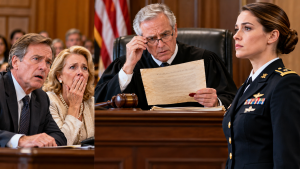
The judge lifted the document by one corner, handling it as though time had left the paper delicate.
For several moments, the entire courtroom remained silent.
I stood beside the defendant’s table, dressed in my Navy dress blues. My parents were seated at the plaintiff’s table, just twelve feet from me. It was the closest we had been to one another in twelve years.
Before the judge spoke, I recognized the signature at the foot of the document.
Samuel Carter.
My grandfather had always written his name with an unusually large S, finishing with an upward flourish that somehow made his signature look optimistic.
My father recognized it as well. I saw him shift forward in his seat.
My mother suddenly stopped touching the strand of pearls around her neck.
Judge Simmons pushed his glasses higher on his nose.
“This is a notarized property agreement,” he said, “dated March 16, 2012. It was recorded with the Portsmouth Circuit Court land records three weeks later.”
My father blinked in disbelief.
“There must be some mistake.”
The judge raised his eyes above the document.
“About the signature?”
“No, Your Honor,” Dad said. “About what it means.”
The judge paused to consider his response.
“Then perhaps,” he said, “we should read what it means.”
My name is Evelyn Carter. I’m thirty-seven years old, and I serve as a commander in the United States Navy.
Five weeks before that courtroom appearance, a process server approached me outside my apartment building in Norfolk. He seemed young and uncomfortable, apologizing as he passed me a legal envelope.
I tore it open beside my truck while Knox, my dog, pressed against my leg.
Robert Carter and Margaret Carter, Plaintiffs, v. Evelyn Carter, Defendant.
My own parents had taken me to court.
I read the complaint twice without moving from the parking lot. Later, sitting on my kitchen floor, I read it once more.
According to the lawsuit, my grandfather’s farmhouse on Willow Creek Road had stood abandoned since his passing in 2014. It claimed the ownership transfer to me had never been legally finalized. My parents asserted that they had spent years maintaining the property with their own money.
They also claimed they had personally covered every property tax payment since 2015.
Now they wanted a judge to recognize them as the rightful owners.
Sitting with my back against the kitchen cabinets, I began laughing. There was nothing joyful about it. Knox rested his head across my lap because that particular laugh always unsettled him.
I was the one who had paid the property taxes.
Year after year, the money had come directly from my account. I had arranged payments while aboard ships, stationed at military bases, and even once while recovering in a hospital bed.
To understand how things reached the point where my parents and I communicated through legal documents, you need to know what happened before.
I was raised about half an hour from the farmhouse, in a tidy brick home surrounded by equally tidy houses in a subdivision outside Portsmouth.
My father worked as an engineer. My mother supervised the reception office of a dental practice, along with practically every aspect of our household.
They had already decided what my future should look like.
Although they rarely described the entire plan openly, I understood it perfectly. Attend a respectable nearby college. Find steady, sensible employment. Marry a man from a respectable family. Buy a home within a few streets of theirs. Come over for Sunday dinners. Eventually give them grandchildren.
When I was sixteen, my mother regularly left wedding magazines on the living room coffee table. She would point to subdivisions popular with “young families” and talk about them as though my future address had already been selected.
But my favorite place was never that neighborhood.
I spent nearly every summer, and most weekends, at my grandfather’s farm.
Samuel Carter was my father’s father. He had worked as a shipyard welder for thirty years and constructed much of his farmhouse with his own hands. Anything he hadn’t personally built was something he regarded with suspicion.
He showed me how to repair a loose gate hinge, put an edge on a lawn mower blade, and replace a flat tire during a downpour.
He loaned me his socket set and conveniently ignored the fact that I misplaced nearly half the pieces.
He also loved talking about his years at the shipyard.
He described the gray naval vessels passing Norfolk, the sailors he’d encountered, and the lives those ships carried beyond the horizon.
At seventeen, I announced to my parents that I had submitted an application to the Naval Academy.
My father set his fork on the table.
“That’s a phase,” he said.
He was wrong.
I attended Annapolis and earned my degree. Both my parents appeared at graduation, sat among the spectators, and departed before the traditional hat toss.
My chosen specialty was explosive ordnance disposal—identifying and neutralizing dangerous devices.
As soon as my father learned what the job involved, he concluded that I had deliberately selected the most hazardous career imaginable simply to demonstrate that I could live without anyone else’s help.
Our relationship finally collapsed during the week before my first extended deployment.
I was twenty-four.
We were in my parents’ kitchen. Dad stood beside the sink, his arms tightly folded.
“If you choose that life,” he said, “then you’re choosing it over this family. You’re not the daughter I raised.”
I walked out of the house that evening.
Seven days later, my mother sent a single text.
I was standing on a pier in Norfolk, carrying my seabag over one shoulder, when I opened it.
We raised a daughter, not a soldier.
I left the message unanswered.
Twelve years passed.
From that point onward, my grandfather was the only family member who truly remained in my life.
I phoned him whenever I reached a port. I mailed photographs of my ship, my qualifications, and every promotion.
He displayed them on his refrigerator, held in place by little fish-shaped magnets.
In 2014, Grandpa passed away peacefully in his sleep inside the farmhouse. He was eighty-six.
I returned home by plane for his funeral.
Wearing my uniform, I stood near the rear of the church while my parents occupied the front pew.
We never exchanged a word.
Grandpa’s will named me as the person who would inherit the farmhouse.
I stored a copy of that will in my Navy footlocker, beneath the folded flag that had once belonged to my friend Lewis.
Every year, I continued paying the property’s taxes.
But I never went back to see the house.
In my memory, the place remained frozen in time: the front porch, the enormous oak tree, and the workshop beyond the barn.
I imagined everything staying exactly as Grandpa had left it.
Of course, houses don’t remain unchanged simply because we remember them that way.
Neither do the people in our families.
On the day of the hearing, I had to attend a military award ceremony at seven that morning. Changing clothes afterward wasn’t possible, so I drove directly to the courthouse in my dress blues, complete with ribbons and insignia.
I hadn’t retained an attorney.
I possessed Grandpa’s will, years of tax records, and twelve years’ worth of unresolved resentment. At the time, I believed those things were sufficient.
The moment I entered Courtroom 3B, my mother turned to look behind her.
Her eyes landed on my uniform.
The color drained from her face. She stared at the rows of ribbons pinned across my chest, then instinctively reached for her pearls.
Her expression suggested embarrassment, although I couldn’t tell whether she was ashamed of me or uncomfortable because I was there.
My father never bothered turning around.
Judge Simmons was slender, with gray hair and a controlled voice that rarely rose above a conversational level.
Before the hearing, he explained, he had personally examined the county’s land records concerning the farmhouse. Reviewing the title history was something he routinely did when ownership was disputed.
That search had revealed the document.
He began reading deliberately.
“Samuel Edward Carter grants Evelyn Marie Carter sole beneficial ownership of the property located at 1187 Willow Creek Road, together with all structures and improvements thereon, while retaining a life estate for himself.”
Dad shut his eyes.
I understood enough about property law to grasp what Grandpa had done.
He had reserved the legal right to remain in the farmhouse until his death. Once he passed away, the property would belong to me.
This wasn’t an informal promise or a sentimental line Grandpa had written inside a birthday card.
It was legally established ownership.
Entirely mine.
The judge continued.
“The document also states that neither Robert Carter nor Margaret Carter holds an ownership interest.”
Mom murmured, “Robert.”
My father refused to look in her direction.
Judge Simmons brought the document down slightly.
“Mr. Carter. Were you aware of this instrument?”
Dad cleared his throat before responding.
“I knew Dad intended Evelyn to have the house eventually.”
“Eventually?”
“He talked about it.”
The judge lightly tapped the document against his desk.
“This isn’t a conversation, Mr. Carter. This is a recorded deed.”
My father adjusted his position in the chair.
It was barely noticeable, but I recognized the movement immediately.
He had done the same thing during Sunday dinners whenever Grandpa challenged something he said. Grandpa was one of the few people my father couldn’t defeat simply by remaining silent.
Then Judge Simmons addressed me.
“Commander Carter. Were you aware this document had been recorded?”
“I knew my grandfather left me the farmhouse, Your Honor. I have a copy of his will. I didn’t know about this specific filing.”
He acknowledged my answer with a nod and lifted another page.
“Property taxes on this parcel have been paid consistently since 2014,” he said, “through an escrow account linked to Commander Carter’s military credit union.”
For the first time since I’d entered the room, Dad turned toward me.
The expression on his face was more bewildered than furious.
“You paid them?”
I nearly laughed again, although the situation was far from amusing.
“Every year.”
“But the county notices—”
“Went to the farmhouse,” I said quietly. “The payments came from my account.”
Judge Simmons glanced between us.
“Mr. Carter, your complaint states that you personally paid all property taxes beginning in 2015.”
Dad remained silent for a moment.
Mom lowered her gaze to the purse resting in her lap.
“I believed I had,” Dad said finally.
“That’s different from having paid them.”
“I understand.”
The atmosphere in the courtroom changed.
There were no shocked gasps, and I experienced none of the satisfaction I had imagined winning might bring.
Instead, I felt deeply disappointed.
Sitting across from me, my father suddenly appeared smaller. Older.
For twelve years, the version of my parents I carried in my mind had remained exactly as I’d last seen them: rigid, convinced of their own correctness, and certain my decisions reflected some fundamental defect in me.
But my father’s hair had turned gray.
Fine wrinkles had formed beside my mother’s eyes, lines I didn’t remember seeing before.
Those twelve years had passed for them as well.
The judge asked what condition the property was in.
Dad described how he and Mom had visited occasionally after Grandpa died.
The roof had developed leaks. Sections of the porch had decayed. The well pump had broken twice.
They’d brought in contractors. Mom had paid someone to maintain the lawn for a period of time. Dad had personally installed replacement windows.
As I listened, an uncomfortable realization settled over me.
He was telling the truth.
I had faithfully covered the tax bills, but I had never cleared a single gutter.
When I was deployed, the possibility of rotting porch boards hadn’t even entered my thoughts.
Dad opened a brown leather folder and presented a pile of receipts.
Judge Simmons carefully reviewed them.
“These reflect repairs,” he said. “Not property taxes.”
“No,” Dad admitted.
“Then why does your complaint say otherwise?”
For the first time that morning, my mother answered.
Her voice lacked the firmness I remembered.
“Because we misunderstood something.”
Dad turned sharply. “Margaret.”
“No, Robert.”
His posture stiffened.
Mom removed a folded document from her handbag.
“I told you we should have asked first,” she said.
She approached the bench and handed the paper over herself.
When she returned to her chair, she left her pearls untouched.
Judge Simmons opened the document and raised his eyebrows.
“Interesting.”
I hated hearing that word.
Inside a courtroom, it seldom signaled anything reassuring.
“What is it?” I asked.
“A county property statement from 2018. It lists your grandfather’s estate as the mailing contact for the property, and the mailing address was changed to your parents’ home.”
“Grandpa died in 2014,” I said.
“Correct.”
Dad leaned toward the bench. “That’s what I told the clerk.”
“So you started receiving notices,” the judge said.
“Yes.”
“But not the electronic payment confirmations,” I said.
“No.”
“Because those came to me.”
Dad pressed his lips together. “Apparently.”
Judge Simmons placed both hands on the bench.
“This is beginning to sound like poor recordkeeping, assumptions, and incomplete communication.”
I turned my attention to my father.
“Except you sued me.”
He looked directly back at me.
“Yes.”
He offered no explanation afterward.
Somehow, that surprised me more than anything else that had happened.
The judge directed both parties to submit comprehensive documentation.
I needed to supply proof of ownership and records of my tax payments. My parents were to provide their receipts for repairs.
He also requested that the county investigate why an estate belonging to someone who had died years earlier was still listed in connection with the property.
Then he raised a finger toward the three of us.
“And I strongly suggest that before our next hearing, you all find out what actually happened.”
He brought the gavel down gently.
“Continued for fourteen days.”
And just like that, the proceeding ended.
Nobody had won. Nobody had lost.
We simply had another court date.
The room filled with the sounds of people standing and organizing paperwork.
I remained seated.
Under my uniform trousers, my injured knee had begun to ache.
Mom lifted her purse onto her shoulder and turned toward me.
“Your grandfather used to keep copies of everything.”
“I know.”
She paused. “In the workshop. He had that metal filing cabinet behind the tool bench.”
“We looked,” Dad said.
Mom faced him.
“You looked through the top drawer.”
His expression shifted almost imperceptibly, but I caught it.
“Your grandfather didn’t trust filing cabinets,” Mom said to me. “He used to say thieves go for drawers first.”
In spite of everything, a smile nearly escaped me.
Grandpa had always trusted coffee cans hidden beneath his workbench more than any bank.
Judge Simmons was approaching the side exit when he stopped.
“Mrs. Carter. If you find any documents related to this case, preserve them exactly as you found them. And share them with the other party.”
“Yes, sir.”
He studied us briefly.
“Families often remember the same person differently,” he said. “Documents sometimes help.”
Then he disappeared through the doorway.
I had almost reached the elevator when I heard my mother call out.
“Evelyn.”
For twelve years, I hadn’t heard her say my name directly to me.
I turned.
Standing closer to her, I noticed that her hair was much shorter than before. Silver strands showed around her temples.
She parted her lips, but no words followed.
Dad glanced toward the elevator.
“We should inspect the workshop.”
“Fine.”
“Tomorrow?”
“Today.”
The speed of my answer appeared to surprise all three of us.
“It’s going to rain,” Dad said.
“It’s Virginia.”
A faint smile touched Mom’s face. “You still say that?”
The elevator arrived, and I stepped inside.
“Evelyn,” Mom said again.
Her gaze drifted toward the decorations on my chest.
This time, there was no embarrassment in her expression.
Only uncertainty.
“I didn’t know,” she said.
I could have demanded an explanation.
Didn’t know what?
My rank? My military career? The injuries I’d suffered? The property taxes?
Or anything about the woman I’d become?
“There’s a lot you don’t know,” I said.
The elevator doors slid shut.
Before heading to Willow Creek Road, I changed into boots, jeans, and an old Navy sweatshirt.
The moment I opened my truck door, Knox climbed into the passenger seat.
He had never encountered either of my parents.
As far as he was concerned, they simply didn’t exist.
Dogs have a more straightforward understanding of time than humans do.
With every mile, the roads became increasingly familiar.
The bait shop that had once been painted blue was now yellow. The old gas station had been converted into a pharmacy.
But the turn onto Willow Creek Road felt unchanged.
Narrow asphalt. Roadside ditches. Pine trees tilting toward the overhead power lines.
Around the bend appeared Grandpa’s mailbox.
CARTER was still visible on its side, the painted letters weathered but intact.
Dad’s car was beside the barn.
Mom stood waiting on the front porch.
She watched as Knox bounded out of my truck.
“He’s large.”
“That’s his main hobby.”
Knox approached her cautiously.
Mom extended a hand, allowing him to sniff it.
Then, much to my surprise, he leaned his considerable weight against her leg.
She laughed.
Hearing that sound startled me.
For one fleeting moment, I saw her as she’d been at thirty-eight, standing in our old kitchen with a dusting of flour on her cheek.
Then the memory faded.
Dad emerged from beside the farmhouse holding a flashlight.
“We should do this before the storm.”
He had returned to his practical tone.
That made the situation easier for everyone.
Grandpa’s workshop stood behind the barn, built from salvaged timber sometime in the 1970s.
When Dad pulled open its door, familiar smells washed over us.
Cedar. Dust. Machinery oil. Damp lumber.
My throat tightened.
Few things can bring the past rushing back as quickly as a familiar scent.
I could almost see Grandpa standing at his workbench, humming out of tune while sharpening a mower blade.
Dad switched on the overhead fixture.
The light blinked twice before glowing steadily.
“Still works,” he said.
“He’d be offended you doubted it.”
Dad turned toward me.
To my surprise, he nodded.
“Probably.”
Against the wall stood the same green metal filing cabinet.
Four drawers.
Dad pulled open the first one, revealing insurance paperwork, tractor instruction manuals, and receipts from the hardware store.
The second contained old income tax documents.
The third refused to slide out completely.
Dad tugged harder.
“Don’t,” I said.
He immediately stopped.
I bent into a crouch, earning an unpleasant protest from my knee, and slipped my fingers beneath the drawer’s edge.
“Grandpa used to jam a carpenter’s pencil along the rail. So it would stick.”
Sure enough, a yellow carpenter’s pencil was wedged inside, brittle from age.
I removed it, and the drawer slid forward smoothly.
Dad stared.
“You remembered that?”
“I spent more time out here than you did.”
The words came out more sharply than I’d intended.
His expression immediately hardened.
Behind us, Mom spoke quietly.
“She’s right.”
Dad turned to her.
She lifted her shoulders.
“She did.”
The drawer contained envelopes arranged according to year.
Tucked behind them were three folders, each labeled in Grandpa’s unmistakable block lettering.
ROBERT. MARGARET. EVELYN.
I froze with my hand hovering above them.
Dad noticed.
“Open it.”
“It’s mine.”
“I know,” he said.
His voice carried an unexpected gentleness.
I removed the folder bearing my name.
Inside was a record of my life.
School photographs. Report cards. A clipping from the local newspaper showing seventeen-year-old me holding a track trophy.
And my Naval Academy graduation portrait.
Dad pointed at it.
“Where did he get that?”
“I sent it.”
Neither of us spoke for a moment.
“You sent Dad photographs?”
“Always.”
My father lowered his gaze to the floor.
Beneath the photographs lay a handwritten letter dated February 2013.
Evelyn,
If you’re reading this because you’re snooping, put it back.
If you’re reading it because I’m gone, then I suppose you’ve finally earned the right.
I smiled.
Mom leaned closer.
“That’s him,” she said softly.
Most of Grandpa’s letter contained practical information.
He identified the lawyer who had prepared the deed, explained where to find the insurance documents, and named the person responsible for maintaining the well.
Then I reached a sentence that made me stop.
You and your father are more alike than either of you has the good sense to admit.
Dad saw my expression.
“What?”
I passed the letter across to him.
As he read, the hint of a smile crossed his face.
“Dad always thought he was funny.”
“He was.”
“Sometimes.”
He continued reading.
Gradually, his expression changed.
When he reached the end, he returned the paper without speaking.
I read the final paragraphs myself.
Robert thinks strength means holding your ground. You think strength means walking your own road. Both of you may be right, but neither of you knows when to turn around.
The farmhouse belongs to you because you understand what it means to come home without needing to stay.
Don’t let the place become a monument. Houses are for living. Use it. Sell it. Fix it. Fill it with people.
Just don’t let pride make the decision for you.
Rain began pattering against the workshop’s metal roof.
I handed the letter to Mom.
She settled onto an upside-down bucket and took her time reading.
“He knew,” she whispered.
“Knew what?” Dad asked.
“All of it.”
We examined the remaining folders.
Dad’s held keepsakes I had never seen before.
His engineering certifications. Photographs of him and Grandpa working shirtless on the farmhouse roof, both red from the sun.
There was even a Father’s Day card he’d drawn in crayon when he was eight.
He lifted the card and studied it.
“I thought he threw this away.”
Mom’s smile was faint.
“He never threw anything away.”
That was when Knox began investigating the space behind the workbench.
“Leave it,” I told him.
Naturally, he ignored me.
Knox is exceptionally obedient whenever my instructions happen to align with his own intentions.
He pushed his nose behind a wooden crate, producing a scraping noise.
Dad shifted the crate aside.
An old red toolbox was hidden behind it.
“That wasn’t there before,” Dad said. “I cleaned this shop after the funeral.”
“You cleaned around things,” Mom replied.
“I cleaned.”
“You relocated dust.”
Dad shot her a look.
And I laughed.
It wasn’t loud, but it was genuine.
Both my parents looked at me.
Then Mom began laughing too.
Even Dad managed a smile.
For roughly thirty seconds, it felt as though the twelve missing years had never happened.
Then reality returned.
Beneath the toolbox’s upper tray, we discovered a small locked metal cashbox.
We tried every key hanging from the pegboard.
None opened it.
“Check the coffee cans,” Mom said.
Three cans stood on a shelf.
One was filled with nails, another with washers, and the last contained a tangled collection of old keys.
We tested them individually until a small brass key finally turned in the lock.
Inside were bank statements, canceled checks, and several photographs.
There was also a sealed envelope.
Written across its front in Grandpa’s handwriting were the words:
FOR ROBERT AND EVELYN TO OPEN TOGETHER.
Dad and I exchanged a look.
Mom retreated a step.
“Did you know about this?” Dad asked her.
“No.”
“You’re sure?”
“Robert, I’ve been married to you for forty-three years. I can lie better than that.”
Dad brought two folding chairs over to the workbench.
My knee was hurting badly enough that I was grateful to sit down opposite him.
Neither of us reached for the envelope.
“You open it,” he said.
“No.”
“It’s addressed to both of us.”
“Exactly.”
I rested one finger against a corner.
A moment later, Dad placed his hand on the opposite edge.
Together, with considerable awkwardness, we opened it.
Four handwritten pages were folded inside.
Dad began reading aloud.
“Robert and Evelyn. If you two are sitting in the same room willingly, then either a miracle has happened or somebody forced you.”
Mom raised a hand to cover her mouth.
Dad continued.
“I know what happened between you. Not every word, but enough. Robert believes Evelyn chose the Navy over her family. Evelyn believes Robert made her choose. Both stories contain truth. Neither story contains all of it.”
His jaw grew tense.
He moved farther down the page.
“There is something I should have told both of you while I was alive. Something about the farmhouse, and something about money.”
His voice became quieter.
“In 2011, before Evelyn shipped out, Robert came to me and asked for a loan.”
Dad lowered the letter onto the workbench.
Something in the workshop shifted.
It wasn’t a sense of danger, exactly, but the atmosphere was no longer the same.
“You borrowed money from Grandpa?” I asked.
Dad rubbed a hand across his forehead.
“It was complicated.”
“How much?”
He said nothing.
“Robert?” Mom prompted.
He let his hand fall.
“Seventy-eight thousand dollars.”
For a moment, even the rain seemed silent.
“For what?” I asked.
“The business.”
Mom had turned pale.
“You told me the company covered the loss.”
“They didn’t,” Dad said. “My partnership nearly went under in 2011. I’d have lost everything. The house. All of it.”
Memories of that year flooded back, but now I viewed them differently.
Dad arriving home late night after night.
Dad finding fault with nearly everything I did.
Dad insisting that responsibility to family mattered more than pursuing what he considered an unrealistic career.
I’d always assumed his anger came entirely from my decision to leave.
Now I wondered what else had been weighing on him during those confrontations in the kitchen.
“Read the rest,” I said.
Dad raised the letter again.
“Robert paid me back every dollar. That is important. He was not irresponsible. He was frightened. There is a difference.”
He stopped reading.
His gaze remained fixed on the page.
Never in my life had I heard anybody describe my father as frightened.
Eventually, he continued.
“What Robert never knew is that I did not lend him that money from my savings. I refinanced part of the farmhouse. I didn’t tell him because he would have refused it. I didn’t tell Evelyn because it was my debt, not hers. When Robert repaid me, I paid off the loan.”
The loan paperwork lay underneath.
Dad’s fingers trembled as he picked it up.
“Why would he do that?”
I already knew.
“Because you were his son.”
There was no blame in my answer.
Somehow, that seemed to affect him more deeply than an accusation would have.
Mom reached for the next page.
“I’ll read.”
“That is why I gave the house to Evelyn. Not because I loved her more. Not because Robert disappointed me. I gave it to the person least likely to see it as money.”
I dropped my gaze.
The meaning of that sentence struck somewhere deep inside me.
Grandpa had understood who I was, perhaps more clearly than I understood myself.
Mom read on.
“But there is another matter. After Evelyn was injured, the Navy contacted the emergency contact she had listed.”
I immediately raised my head.
Dad stared at me.
“You were injured?”
I nearly laughed at how impossible the situation seemed.
“You didn’t know?”
“No.”
“You knew I came home.”
“I knew you stopped going on field assignments.”
“How badly?” he asked.
My thoughts returned to an explosion in the dusty outskirts of a village whose name I still can’t bring myself to say.
The operations afterward.
The reconstruction of my knee.
Months spent in rehabilitation.
The cane I relied on for an entire year.
And the nights Knox had learned to pull me awake from nightmares I never discussed with anyone.
“You really didn’t know,” I said.
Dad slowly shook his head.
My chest felt strangely empty.
“Grandpa knew.”
Mom resumed reading, her voice gentler.
“Evelyn asked me not to tell Robert. I respected her request. But I came to regret something else. I let each of you believe the other had chosen silence.”
I remembered lying in a hospital in Germany.
Grandpa had been on the telephone, struggling to keep his voice steady.
Don’t you call them, Grandpa.
Kid—
Promise me.
And he had given me his word.
“Robert tried to reach Evelyn through me three times after she was hurt,” Mom read.
I stared at Dad.
“What?”
“I called Dad,” he said.
“When?”
“After Lewis called us.”
Hearing that name felt like ice passing through me.
“Lewis?”
Mom nodded.
“He called the house. He said you’d been hurt. He couldn’t give us details.”
Words failed me.
Lewis had been my closest friend.
The flag folded in my footlocker had covered his casket.
He had never mentioned contacting my parents.
“I asked Dad where you were,” my father said, “and he told me you didn’t want contact.”
I closed my eyes.
Of course that was what Grandpa had told him.
It was precisely what I’d instructed him to say.
“I thought you’d made your choice,” Dad said roughly.
I opened my eyes.
“You stopped after three calls.”
“You hadn’t spoken to us in years.”
“You told me I wasn’t your daughter if I chose that life.”
Dad visibly recoiled.
“I said things I shouldn’t have.”
“No,” Mom interrupted.
We both looked toward her.
Grandpa’s letter rested folded in her lap.
“We are not doing this the old way,” she said calmly. “We are not going to decide that one person is guilty enough that everyone else gets to stay innocent.”
The workshop fell silent.
She faced my father.
“You were cruel when Evelyn left.”
His expression tightened.
Then she turned toward me.
“And you closed every single door.”
I wanted to defend myself.
But Grandpa’s letter lay only inches from my hand.
Both stories contain truth. Neither contains all of it.
Mom lowered her eyes.
“And I let both of you.”
Rain beat steadily against the roof.
Knox had settled beneath my chair.
For years, I’d pictured a possible reunion with my parents as some enormous, almost unimaginable moment.
There would be a sweeping apology, exactly the right words, and one remarkable conversation that somehow repaired everything.
Instead, the three of us sat awkwardly inside a dusty workshop surrounded by exhausted batteries and corroded drill bits.
Nobody knew what to say next.
Perhaps that was closer to the truth.
One final page remained.
Dad pushed it toward me.
“There is one thing none of you knows. After the farmhouse loan was paid off, I opened another account. Every month I put something in it. Sometimes fifty dollars. Sometimes five hundred. It wasn’t much at first. Later it was more. The account belongs to neither Robert nor Evelyn alone. The instructions are with my attorney, Daniel Mercer.
Use it together. Or don’t use it at all.”
There was no cellular reception inside the workshop.
We stepped into the drizzle, and I managed to get a single bar of signal near the bottom of the porch steps.
Daniel Mercer.
Mercer & Hale in Portsmouth.
Estate planning attorney.
Still in practice.
I dialed his office.
A receptionist picked up, and I provided Grandpa’s full name and my birth date.
She placed me on hold.
Dad waited behind me while Mom sheltered under the porch roof with Knox.
After a long minute, the receptionist returned.
“Ms. Carter? Mr. Mercer left instructions about this matter.”
I gripped the phone more tightly.
“What instructions?”
“He’s only to speak with you when both Evelyn Carter and Robert Carter are present.”
I turned toward Dad.
He had heard every word.
“Tomorrow at ten?” the receptionist asked.
My eyes traveled across the farmhouse.
Flaking paint. The declining oak tree. The porch Grandpa had constructed himself.
For the first time, the building didn’t strike me as abandoned.
It seemed as though it had been waiting for us.
“Tomorrow,” I said.
Daniel Mercer was eighty-one.
He wore suspenders beneath his suit coat, and judging by his reaction, he’d been anticipating our arrival for twelve years.
He studied my father and me through a pair of wire-framed glasses.
“Well,” he said. “Samuel would have been annoyed it took this long.”
Dad almost smiled.
“I imagine so.”
Mr. Mercer’s gaze briefly settled on my limp.
He offered no comment, which immediately made me like him.
Mom had accompanied us to the office, but she was determined to remain in the waiting area.
“This was between Samuel, Robert, and Evelyn,” she’d said.
Twelve years earlier, respecting boundaries had not been her strength.
Apparently, people sometimes change without announcing it.
Mr. Mercer opened a substantial file.
“Your father set up a trust five months before he died.”
Dad immediately asked, “How much?”
The attorney paid no attention to the question.
“Samuel predicted you’d ask that first.”
Dad exhaled.
“Of course he did.”
Mr. Mercer pushed a handwritten letter toward us.
I recognized Grandpa’s writing.
Robert and Evelyn,
Money makes sensible people forget which questions matter. So before Mercer tells you what’s in the account, answer this:
What is the farmhouse for?
Dad raised his eyes toward the lawyer.
“Is that legally required?”
“No.”
“Then why—”
“Because I promised him.”
Dad sighed.
“He assumed you’d sigh,” Mr. Mercer said.
I laughed.
Dad joined in.
Unlike the laughter we’d shared in the workshop, this didn’t feel quite so unfamiliar.
I considered Grandpa’s question.
What purpose did the farmhouse serve now?
Was it a collection of memories?
Something I’d inherited?
Evidence that Grandpa had chosen me?
A valuable piece of property?
An obligation?
“It was home,” I said finally.
“It was,” Dad agreed.
“But I don’t think that’s enough anymore.”
He looked at me thoughtfully.
“No.”
In my mind, I imagined the porch restored to use and the rooms occupied once more.
Someone preparing dinner in Grandpa’s kitchen.
Boots scattered near the entrance.
People debating whose turn it was to make coffee.
Houses are for living.
“I think,” I said slowly, “it’s supposed to be useful.”
My father held my gaze.
After a moment, he nodded.
“That’s what Dad would say.”
Mr. Mercer shut the file.
“Good.”
Dad looked puzzled.
“That’s it?” Dad said. “You’re not going to make me answer?”
“You already did,” Mr. Mercer said. “When you agreed with her.”
Then he rotated the folder toward us.
“The account currently contains approximately two hundred and forty-six thousand dollars.”
For an instant, I was certain I’d misunderstood.
“Samuel’s deposits were modest,” Mr. Mercer said. “He invested conservatively. It grew.”
Grandpa had saved pieces of aluminum foil for reuse.
He complained whenever anyone left a light on in an unoccupied room.
Yet he’d quietly accumulated almost a quarter of a million dollars.
Mr. Mercer produced another document.
Its heading read:
CARTER FAMILY RESILIENCE TRUST.
Beneath the title, Grandpa had added a handwritten message.
If they ever come here together, tell them the house was only the beginning.
According to Mr. Mercer, Grandpa had established the trust for two specific purposes.
The first was to preserve the farmhouse or transform it into something useful.
It didn’t necessarily have to remain a private residence.
The second purpose was to provide modest grants for education or emergencies, provided both trustees agreed.
“Trustees?” Dad asked.
“Robert Carter and Evelyn Carter.”
We both said “No” at the same time.
“Again,” Mr. Mercer said, “exactly as Samuel predicted.”
Dad gestured toward me.
“She owns the property,” Dad said. “She should control it.”
“Samuel understood that owning something and caring for it aren’t always the same thing.”
I asked the obvious question.
“And if one of us refuses?”
“Then neither of you gets the money.”
Dad stared at the lawyer.
“That’s manipulative.”
Mr. Mercer gave the accusation some thought.
“Samuel would have objected to the word.”
“What word would he use?”
“Encouraging.”
I couldn’t stop myself from laughing.
Grandpa hadn’t commanded us to reconcile.
There were no mandatory apologies, no required Sunday dinners, and no condition that we even had to enjoy each other’s company.
He had simply arranged things so that neither of us could continue acting as if the other person didn’t exist.
My father looked toward Mr. Mercer.
“What did Dad imagine we’d do with the place?”
The attorney smiled.
“He had several ideas. His favorite was temporary housing.”
“For whom?” I asked.
Mr. Mercer turned to me.
“Veterans. Not a shelter. He was very specific about that. A guesthouse for veterans coming back from treatment, or training programs, or hard moves. Somewhere to land for a while.”
A tightness formed in my chest.
Grandpa had understood what I’d experienced.
Perhaps not every detail.
But enough.
“He never told me.”
“He didn’t want you to feel obligated.”
That was exactly the kind of thing Grandpa would have done.
“He also wanted part of it to go to scholarships,” Mr. Mercer said.
Dad’s expression softened into a faint smile.
“Dad never went to college.”
“That’s exactly why he cared.”
When we returned to the lobby, Mom was sitting with a gardening magazine.
Dad handed her the summary of the trust.
“We inherited a project.”
She read through it.
Her expression gradually softened.
“Veterans,” she said.
Then she looked at me.
“Your grandfather talked about that once. After you enlisted.”
“I didn’t enlist. I went to the Academy.”
“Right,” she said. “Right.”
Years earlier, I would have interpreted her mistake as evidence that my life had never mattered enough for her to learn about it.
Now I noticed the embarrassment on her face.
She was struggling to understand a world she’d avoided for twelve years.
“I don’t expect you to know everything,” I said.
“Maybe,” she said, “I should know something.”
Her words hurt more than I anticipated.
Not because they were unkind.
Because they weren’t.
Outside, beside my truck, Mom stopped walking.
“Would you have lunch with us?”
For twelve years, refusing contact had been my way of keeping myself safe.
No visits.
No explanations.
No opportunities for fresh disappointment.
Yet all those years of distance had also been built out of refusals.
“Where?”
“There’s a diner near the river,” Mom said.
“The food’s terrible,” Dad said.
“You’ve eaten there every Tuesday for six years.”
“The coffee’s decent.”
“Fine,” I said.
The diner had booths upholstered in red vinyl and a waitress named Denise who addressed practically everyone as honey.
Dad chose meatloaf.
Mom ordered chicken salad.
I asked for eggs.
“You always ate breakfast for lunch,” Mom said.
I lifted my eyes.
“You remember that?”
She seemed genuinely surprised by my question.
“Of course.”
After a moment, she asked, “Is Commander the right way to address you?”
“You can call her Evelyn,” Dad said.
“I’m asking, Robert.”
“Commander is correct formally,” I said.
Mom nodded.
“I looked up your ribbons last night. There were several I couldn’t find.”
My coffee cup stopped halfway to my lips.
I turned toward Dad.
“You looked too,” I said to Dad.
He remained silent.
“He was on that computer until one in the morning,” Mom said.
“I didn’t understand what they meant,” Dad said quietly.
I could hear questions beneath his words.
Questions he didn’t yet know how to put into sentences.
“Some of them mean I was in places that weren’t very pleasant,” I said.
His jaw tightened.
“The one with the star—”
“Don’t.”
He stopped immediately.
I made my voice gentler.
“Not yet.”
Dad nodded.
“All right.”
We continued eating in silence for several minutes.
Eventually, my father placed his fork on the table.
“I was wrong about the Navy,” he said. “I don’t mean every worry I had was wrong. I was afraid you’d disappear.”
“I did.”
“Yes. That’s the part I can’t decide whether I caused.”
“You helped.”
He nodded slowly.
“I know.”
Mom and I both stared at him.
I couldn’t recall a single previous occasion when he’d acknowledged making a mistake without immediately defending himself.
“I thought you picked the most dangerous possible life,” he said, “to prove you didn’t need anybody.”
There was enough accuracy in that observation to make me uncomfortable.
“Maybe part of me did,” I said.
“That’s what scared me.”
Mom carefully folded her napkin.
“What scared me was different,” she said. “I’d imagined your whole life before you ever got to imagine it yourself. College. A wedding. Children. A house down the street. I thought I knew what happiness looked like for you. When you chose something else, I acted like you were rejecting me.”
She met my eyes.
“That wasn’t fair.”
For twelve years, I’d imagined my mother admitting those words.
In every version I’d rehearsed privately, I responded with composure and dignity.
In reality, I could only stare at the eggs on my plate.
“No,” I said finally. “It wasn’t.”
I swallowed hard.
“I wasn’t fair either. Every promotion, every time something went right, I told Grandpa, and only Grandpa. I wanted him to tell you. I wanted you to hear how well I was doing and realize you’d been wrong.”
“I did,” Dad said quietly. “I just never knew what to do with it.”
The diner continued operating around us, indifferent to what was happening at our table.
Silverware tapped against plates.
Denise made another round with the coffee pot.
There was no dramatic music.
Nobody broke down in theatrical tears.
But something opened between us.
Not completely.
Just enough to let a little space appear where there had only been a wall.