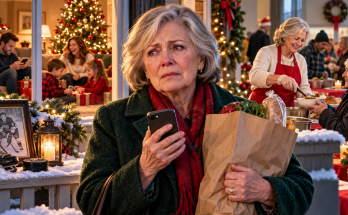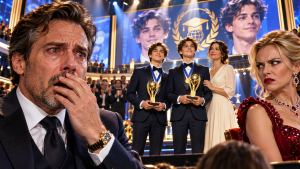
Thirteen years ago, I walked away from my pregnant wife because I believed another woman could give me a better life. I thought I had escaped poverty, responsibility, and regret. But at an elite academic tournament, two teenage boys with my face received the highest honor in the competition’s history. When their mother stepped into the spotlight, my billionaire wife demanded that I destroy them. What happened next revealed a secret that had been buried for thirteen years—and taught me that some fortunes cost far more than money.
PART 1 — THE TWO BOYS WHO LOOKED EXACTLY LIKE ME
The first time I saw my sons, they were standing beneath the brightest lights in the country.
And they had absolutely no idea that their father was sitting in the audience.
At least, that was what I believed.
My name is Julian Mercer.
At forty-six, I owned shares in seventeen companies, lived in a mansion overlooking the Atlantic, traveled on private jets, and wore watches that cost more than most people earned in five years.
People called me successful.
Some called me brilliant.
Others called me fortunate.
But none of them knew the truth.
Thirteen years earlier, I had abandoned my pregnant wife, Elena, for a wealthy woman named Victoria Ashford.
Victoria was everything Elena was not.
She came from old money. Her family owned hotels, financial institutions, and properties across three continents.
She introduced me to powerful investors, opened doors that had previously been closed, and promised me a future beyond anything I had imagined.
Elena had offered me something different.
Love.
Loyalty.
A modest home.
And a child.
I chose Victoria.
At the time, I convinced myself it was ambition.
Now I know it was cowardice.
For thirteen years, I had avoided thinking about the woman I left crying in our kitchen.
Until the night of the National Young Scholars Championship.
The competition was considered the most prestigious academic tournament for gifted teenagers in the country.
Hundreds of schools participated.
Thousands of students competed.
Only the brightest reached the grand finale.
My company was the tournament’s principal sponsor, and Victoria’s sixteen-year-old son, Preston, was one of the finalists.
Victoria had spent almost a million dollars on his education over the years.
Private tutors.
Elite boarding schools.
International mathematics camps.
Personal coaches.
She wanted him to become the youngest champion in the tournament’s history.
And she expected the entire auditorium to celebrate him.
That evening, as we entered the luxurious convention center, Victoria adjusted her diamond necklace and smiled confidently.
“Tonight is going to be unforgettable,” she whispered.
She was right.
Just not in the way she expected.
We had barely reached the entrance when I noticed a woman standing beside two teenage boys near the registration area.
She wore a simple cream-colored dress.
Her dark hair was pinned loosely behind her head.
There was nothing extravagant about her appearance.
But I recognized her immediately.
Elena.
My former wife.
The woman I had spent thirteen years pretending no longer existed.
She turned.
Our eyes met.
For a moment, neither of us spoke.
Then she offered a small, polite nod.
“Hello, Julian.”
My stomach tightened.
“What are you doing here?”
Her expression remained calm.
“I’m attending the tournament.”
“Why?”
“My sons are competing.”
Something about the word sons unsettled me.
Before I could respond, Victoria appeared beside me.
“Julian, who is this?”
Elena looked at her.
“Elena Holloway.”
Victoria’s smile vanished.
“Oh.”
She examined Elena’s inexpensive dress, then the two boys standing behind her.
Recognition slowly entered her eyes.
“So you’re the ex-wife.”
Elena didn’t flinch.
“That’s right.”
Victoria let out a sharp laugh.
“How interesting. Are you here looking for a donation?”
“Victoria,” I warned.
But she wasn’t listening.
“Because this is a very exclusive event. People like us have responsibilities here.”
Elena looked toward the boys.
“We have invitations.”
I should have defended her.
Instead, frightened that Victoria would cause a scene, I did something I would regret for the rest of my life.
I stepped closer to Elena.
“How dare you show up here?” I snapped. “You know exactly how complicated this is.”
For a moment, pain flickered across her face.
Then it disappeared.
“You’re right about one thing, Julian,” she replied quietly. “Tonight is complicated.”
She took a step away.
“But not for the reasons you think.”
One of the boys looked at me.
He had dark eyes and an expression of unsettling seriousness.
The other stood beside him, watching without speaking.
Something about their faces bothered me.
Something familiar.
But before I could understand it, Elena guided them toward the auditorium.
And I let them walk away.
Again.
Forty minutes later, everything changed.
“And now,” the host announced, “for the first time in tournament history, our Grand Prize goes to two competitors who achieved identical perfect scores!”
The audience erupted.
“Congratulations to twin brothers Leo Holloway and Ethan Holloway!”
Two boys stood from the front row.
I stopped breathing.
They were the same boys I had seen with Elena.
As they walked toward the stage, their faces appeared on the enormous screens.
My hands began to tremble.
The nose.
The jaw.
The shape of their eyebrows.
Even the slightly crooked smile on one boy’s face.
I had seen that face before.
Every morning.
In my own mirror.
When I was thirteen.
And their surname—
Holloway.
Elena’s maiden name.
Victoria stood abruptly.
“WHAT?”
Her voice cut through the applause.
“Where is Preston?”
The final rankings appeared.
Preston Ashford: Last Place.
Victoria’s face turned crimson.
“This is impossible!”
Then she looked toward the stage.
“Those two fatherless nobodies stole my son’s victory!”
Fatherless.
The word struck me like a physical blow.
Because suddenly I understood.
They weren’t fatherless.
Their father was sitting in a luxury seat, wearing a forty-thousand-dollar suit.
And he had never once held them.
PART 2 — THE WOMAN WHO RAISED MY CHILDREN ALONE
I barely heard the applause as Leo and Ethan received their gold medals.
They were so alike that strangers might have struggled to distinguish them.
But I could already see differences.
Leo smiled easily, his expression warm and open.
Ethan seemed quieter, studying everything with remarkable intensity.
They stood side by side before the microphone.
“Thank you,” Ethan began.
His voice was steady.
“We didn’t expect this.”
Leo leaned closer.
“Speak for yourself.”
The auditorium laughed.
Ethan smiled.
“All right. My brother expected it. He’s been practicing his victory speech in the bathroom for three weeks.”
More laughter.
Then Ethan’s expression changed.
“Seriously, though, there’s someone we need to thank.”
Leo nodded.
“Our mother.”
The giant screen shifted toward Elena.
She was sitting near the front of the auditorium, one hand covering her mouth.
Her eyes glittered with tears.
“Mom,” Leo said, “you taught us that being poor doesn’t mean being incapable.”
Ethan continued.
“When we were six, we wanted a computer. We couldn’t afford one. So Mom brought home three broken computers from a recycling center.”
The audience grew quiet.
“She told us that if we wanted something badly enough, we should begin by understanding how it worked.”
Leo smiled.
“We spent four months putting those computers together.”
“Five,” Ethan corrected.
“Four and a half.”
“Five.”
“Fine. Five.”
The audience laughed again.
“But eventually,” Leo said, “we made one work.”
Ethan looked toward their mother.
“And we learned something more important than computer programming.”
He paused.
“Nobody can take away what you’ve taught yourself.”
A standing ovation followed.
I couldn’t move.
Elena had repaired broken computers with our children.
While I had been buying Preston the newest equipment available.
She had stayed awake helping them solve problems.
While I attended business dinners in Singapore, Paris, and Dubai.
She had done everything I should have helped her do.
And she’d done it without me.
Then the host returned.
“Before we conclude tonight’s ceremony, our foundation has another extraordinary honor.”
A photograph appeared behind the twins.
Elena stood outside a modest apartment building, holding two newborn babies wrapped in blue blankets.
I recognized her green coat.
I had bought it for our second wedding anniversary.
The same coat she wore when I told her I was leaving.
Suddenly, I could remember that afternoon with painful clarity.
“Julian, please,” she had whispered. “We can work through this.”
“I don’t love you anymore.”
“You’re going to be a father.”
“I know.”
“Then how can you do this?”
I had no answer.
So I walked out.
Now, thirteen years later, I was watching the consequences of that decision on an enormous screen.
The host continued.
“This year’s Family Excellence Award recognizes a mother who raised two extraordinary children while overcoming remarkable financial hardship.”
My chest tightened.
“Please welcome Elena Holloway!”
The auditorium erupted.
Elena rose slowly.
A silver-haired woman beside her embraced her.
Then Elena walked toward the stage.
Her sons rushed to meet her.
One hugged her from the left.
The other from the right.
And as they stood together, I saw something more devastating than anger.
Happiness.
They were happy.
Complete.
Proud.
They had built a beautiful life.
And I had contributed nothing to it.
PART 3 — THE BILLIONAIRE’S WIFE LOST CONTROL
“Julian!”
Victoria’s voice snapped me back to reality.
She was gripping the balcony railing so tightly her knuckles had turned white.
“You’re the main sponsor! Tell them to review those scores!”
I looked at her.
“What?”
“Those boys cheated! They must have!”
“They received perfect scores.”
“Exactly! That’s impossible!”
“It’s not impossible just because Preston didn’t do it.”
Her expression froze.
“Excuse me?”
I had never spoken to her that way.
Not publicly.
Not privately.
For years, I had allowed Victoria to dominate every uncomfortable conversation.
She determined where we traveled, whom we entertained, and which people were worth acknowledging.
And I had learned to keep quiet.
But now she was insulting my sons.
My sons.
The words felt strange even inside my head.
Victoria grabbed my jacket.
“You’re going to fix this.”
I removed her hand.
“No.”
She blinked.
“What did you say?”
“I said no.”
“Julian, don’t embarrass me.”
“You’ve already embarrassed yourself.”
The people in nearby seats turned toward us.
Victoria lowered her voice.
“Do you have any idea how much money we’ve invested in Preston?”
“Money doesn’t guarantee victory.”
Her eyes widened.
Before she could respond, Preston appeared beside her.
He was pale, his eyes red.
“Mom,” he whispered, “please stop.”
“Not now, Preston.”
“Everybody is staring.”
“Let them stare! They need to understand that this competition is fraudulent.”
Preston looked toward the stage.
“Those boys didn’t cheat.”
Victoria swung toward him.
“What?”
“I saw their work during the semifinal. They’re good. Really good.”
“You’re defending them?”
“I’m telling you the truth.”
She stared at him.
Then, in a voice cold enough to silence the entire row, she said:
“Perhaps if you’d spent more time studying and less time making excuses, we wouldn’t be having this conversation.”
Preston’s face changed.
I saw humiliation settle over him.
And for the first time, I understood something.
Victoria wasn’t only cruel to people she considered beneath her.
She was cruel to anyone who failed to fulfill her expectations.
Including her own son.
I stood.
“Come on, Preston.”
Victoria blocked the aisle.
“Where are you going?”
“Somewhere away from this spectacle.”
She followed my gaze toward the stage.
Then she looked at the twins.
Her expression changed.
“Wait.”
She grabbed my arm.
“Why are you staring at those boys?”
I said nothing.
“Julian?”
I looked at their faces on the screen.
And finally, I spoke the truth.
“I think they’re my sons.”
For several seconds, Victoria didn’t move.
Then she laughed.
It was a brittle, unpleasant sound.
“Don’t be ridiculous.”
“Elena was pregnant when I left.”
“With one baby.”
“That’s what we thought.”
Victoria looked back at the stage.
Her mouth tightened.
“No.”
I turned toward her.
“Victoria—”
“No,” she repeated. “You’re not doing this. You’re not going to humiliate me over some woman from your past.”
“Those children deserve respect.”
“Those children deserve nothing from us.”
Something inside me went cold.
I stepped closer.
“Don’t ever say that again.”
She stared at me.
For the first time in our marriage, she seemed uncertain whether I would obey her.
Then she leaned forward and whispered:
“You have no idea what you’re about to destroy.”
She was right.
I didn’t.
And neither did she.
PART 4 — THE SPEECH THAT SILENCED THE ENTIRE AUDITORIUM
Onstage, Elena stood between Leo and Ethan.
The host handed her a microphone.
“Mrs. Holloway, you’ve raised two remarkable young men. What advice would you give to parents watching tonight?”
Elena hesitated.
Then she smiled.
“I don’t know whether I’m qualified to give advice.”
The audience chuckled.
“But I can tell you something I’ve learned.”
She looked at her sons.
“Children don’t need perfect parents.”
My throat tightened.
“They need parents who stay.”
The words struck me harder than any accusation.
Elena continued.
“They need someone who shows up when they’re afraid, someone who believes them when they say something is difficult, and someone who celebrates their effort even when they don’t win.”
Her eyes briefly moved toward Preston.
I wondered whether she had heard Victoria humiliating him.
“Success isn’t just standing on a stage with a medal. Sometimes success is a child who finally believes they’re worthy of love even when they fail.”
The entire auditorium fell silent.
Then she added:
“I used to think that losing someone meant losing the future you imagined. But sometimes it means discovering a future you never knew you were capable of building.”
Leo took her hand.
Ethan took the other.
And the applause began.
It lasted nearly two minutes.
Victoria stood rigid beside me.
“She’s doing this deliberately,” she whispered.
I didn’t answer.
“She’s humiliating you.”
“No,” I said quietly.
“Then what is she doing?”
I looked at Elena.
“She’s telling the truth.”
That was when Victoria made the mistake that would destroy her carefully constructed image.
She stepped toward the nearest staff member.
“Get me the event director. Immediately.”
The young woman looked confused.
“Madam?”
“My husband funds this tournament. I want those results investigated before any prize money is released.”
The employee hesitated.
“Madam, the scores are certified by an independent panel—”
“Then I want that panel replaced!”
Several cameras turned in our direction.
The staff member stepped away.
Preston buried his face in his hands.
And just as Victoria opened her mouth again, someone behind us spoke.
“Mrs. Ashford?”
A distinguished older man stood at the end of the aisle.
It was Dr. Samuel Bennett, chairman of the championship’s governing board.
His expression was stern.
“Perhaps you should come with me.”
Victoria straightened.
“Finally. Someone with authority.”
But Dr. Bennett wasn’t looking at her.
He was looking at me.
“Mr. Mercer,” he said gravely, “there is something about tonight’s winners that you should know.”
My heartbeat quickened.
“What?”
He glanced at Elena onstage.
“Something we have reason to believe was deliberately kept from you.”
Victoria went perfectly still.
And for the first time, I saw real panic in her eyes.
PART 5 — THE LETTERS I WAS NEVER SUPPOSED TO SEE
Dr. Bennett led us into a private conference room behind the auditorium.
The applause continued faintly through the walls.
Victoria followed, complaining about tournament management.
Preston remained outside, too embarrassed to accompany us.
Once the door closed, Dr. Bennett placed a manila envelope on the table.
“Mr. Mercer, I apologize for bringing this matter to you under such unusual circumstances.”
“What matter?”
He opened the envelope.
Inside were several photocopied letters.
Old letters.
Some yellowed around the edges.
At the top of the first page was my name.
Julian Mercer.
Underneath was a date.
March 14, thirteen years earlier.
I read the opening lines.
Julian,
I know you asked me not to contact you again, but I believe you need to know something.
The ultrasound confirmed that I’m carrying twins.
Two boys.
I don’t know whether this changes anything for you, but I wanted you to know.
My hands began trembling.
I continued reading.
I am not asking you to return to our marriage.
I am asking whether you intend to be part of their lives.
They deserve an answer.
The letter ended:
Whatever you decide, please understand that one day they will ask about you. I hope I can tell them you at least tried.
Elena.
I stared at the page.
“I never received this.”
Dr. Bennett nodded slowly.
“We suspected that might be the case.”
Victoria crossed her arms.
“This is absurd. Anyone can write a letter.”
Dr. Bennett removed another document.
A postal receipt.
Then another.
An acknowledgment signed by someone at my office.
I leaned closer.
The signature was unmistakable.
Margaret Finch.
Victoria’s former executive assistant.
I looked at Victoria.
“What is this?”
She said nothing.
“Victoria.”
Her face had turned pale.
Dr. Bennett spoke carefully.
“Mrs. Holloway’s attorney contacted me several weeks ago when the championship’s publicity department proposed a family-history feature. She wanted to ensure that nothing about her former marriage became part of the public presentation.”
“Then why do you have these letters?”
“Because she provided them to explain why she did not want your name included. She was concerned that someone might assume she had intentionally kept her children hidden.”
I swallowed.
“She didn’t?”
“No. According to the records, she attempted to contact you several times.”
Victoria suddenly laughed.
“Julian, surely you aren’t going to believe this nonsense.”
I picked up the second letter.
It had been written three months after the twins’ birth.
They arrived early.
Leo weighed four pounds, nine ounces.
Ethan weighed three pounds, fourteen ounces.
They spent seventeen days in neonatal care.
They’re healthy now.
I thought you might want to know.
Another letter.
Their first birthday.
Another.
Their third birthday.
Then one written when they turned five.
They asked today why other children have fathers who attend school events.
I told them families are different and that they are loved.
I hope you are well, Julian.
My vision blurred.
There was one final page.
It wasn’t a letter from Elena.
It was an internal office memorandum.
The instructions were brief.
All correspondence originating from Elena Holloway or her representatives must be redirected to Mrs. Ashford’s private office. No exceptions.
Signed:
Victoria Ashford.
Silence filled the room.
I looked up slowly.
“Victoria.”
She took a step backward.
“Before you say anything—”
“Did you intercept these letters?”
“Julian, I was protecting our marriage.”
The words seemed to hang in the air.
I stared at her.
“Did you know?”
She hesitated.
“Know what?”
“That Elena gave birth to twins.”
Victoria looked away.
And that was all the answer I needed.
PART 6 — THE THIRTEEN-YEAR LIE
“How long?” I asked.
Victoria folded her arms.
“You’re being dramatic.”
“How long have you known?”
She turned toward the window.
“Since they were born.”
The room seemed to tilt.
Thirteen years.
For thirteen years, she had known I had two sons.
For thirteen years, she had watched me celebrate Preston’s birthdays, attend his school functions, and pay for his education.
All while knowing that somewhere else, two little boys were growing up without their father.
“You knew they were twins.”
“Yes.”
“You knew Elena tried to contact me.”
“Yes.”
I felt sick.
“Why?”
Victoria turned sharply.
“Because we had a life to build!”
I stared at her.
“You were finally becoming someone important. You were meeting investors. You were joining boards. We were getting married.”
“And?”
“And I wasn’t going to let your pathetic little past ruin everything!”
Dr. Bennett quietly moved toward the door.
“I’ll give you some privacy.”
“No,” I said. “Please stay.”
Victoria glared at him.
“This is a private marital dispute.”
“No,” I replied.
I held up Elena’s letters.
“This concerns two children.”
Victoria’s eyes flashed.
“You left her, Julian. Remember that? You walked out voluntarily. I didn’t force you.”
Her words landed with terrible precision.
Because she was right.
I had abandoned Elena.
I had chosen Victoria.
I had ignored my responsibility before Victoria ever intercepted a letter.
Nothing she had done erased what I had done first.
I lowered my head.
“You’re right.”
Victoria’s posture relaxed.
For a brief second, she thought she had won.
Then I looked at her again.
“I left Elena. That is my failure, and I will carry it for the rest of my life.”
I stepped toward the table.
“But you stole every chance I had to know what happened afterward.”
“Julian—”
“Did she ask for money?”
Victoria looked away.
“Occasionally.”
“How much?”
“I don’t remember.”
“Did you send anything?”
“We had other obligations.”
“Answer me.”
Her expression hardened.
“No.”
I closed my eyes.
All those years.
All those investments.
All those unnecessary purchases.
And Elena had been collecting broken computers so our children could learn.
Victoria suddenly grabbed her handbag.
“I’m leaving. You can come when you’ve stopped behaving like an idiot.”
She marched toward the door.
Before reaching it, she turned.
“And don’t forget who made you rich.”
I looked at her.
“No, Victoria.”
My voice was barely above a whisper.
“I won’t forget.”
She smiled triumphantly.
Then I finished.
“That’s exactly why I’m finally going to find out what it cost.”
PART 7 — THE QUESTION MY SONS HAD BEEN WAITING THIRTEEN YEARS TO ASK
I found Elena twenty minutes later.
The ceremony had ended.
Guests crowded the reception hall, congratulating the winners.
Leo and Ethan stood near a table covered in flowers, their medals hanging around their necks.
Elena was beside them.
When she saw me approaching, her smile faded.
“Julian.”
I stopped several feet away.
“May I speak to you?”
She studied my face.
Then looked at the envelope in my hand.
Her expression changed.
“You’ve seen them.”
I nodded.
“Yes.”
For a moment, she closed her eyes.
“I never wanted this to happen tonight.”
“I know.”
“This was supposed to be about the boys.”
“It still is.”
She looked toward her sons.
“Leo. Ethan. Could you come here for a moment?”
My heartbeat thundered.
The boys approached.
Up close, the resemblance was even more remarkable.
Leo was almost my exact image at that age.
Ethan had Elena’s eyes and my father’s narrow chin.
Elena took a deep breath.
“Boys, this is Julian Mercer.”
Leo’s expression tightened.
Ethan went very still.
Then Elena added:
“Your father.”
The words struck me with unexpected force.
My father.
Their father.
For thirteen years, I had been nothing more than a name.
And now that name belonged to the frightened man standing before them.
Leo looked me up and down.
“So it’s true.”
I swallowed.
“Yes.”
Ethan glanced at the envelope.
“Mom told us you knew she was pregnant.”
“I did.”
“But you left.”
I lowered my head.
“Yes.”
“Why?”
One word.
One simple question.
I had negotiated billion-dollar deals without hesitation.
I had testified before congressional committees.
I had spoken before thousands of investors.
But I couldn’t answer a thirteen-year-old boy.
Not immediately.
Finally, I forced myself to look into his eyes.
“Because I was selfish.”
Leo’s jaw tightened.
“That’s it?”
“No. I was also afraid. And ambitious. And foolish enough to believe money would make me happier than the people who loved me.”
Ethan studied me.
“Did it?”
I glanced toward the glittering chandelier above us.
Then back at him.
“No.”
Neither boy spoke.
Elena remained silent.
I continued.
“I only learned tonight that your mother tried to contact me after you were born. I didn’t receive those letters.”
Leo looked at his mother.
She nodded.
“That’s true.”
Hope flickered in my chest.
Perhaps they would understand.
Perhaps—
Then Ethan asked:
“But you knew she was pregnant before you left, right?”
“Yes.”
“And you never called to see if she was okay?”
I felt the hope disappear.
“No.”
“You never went looking for us?”
“No.”
“You never even sent a birthday card?”
“No.”
He nodded slowly.
“Then the letters don’t really change everything, do they?”
I stared at him.
His voice wasn’t angry.
That made it worse.
“Someone else stopped you from reading them,” he said. “But you stopped yourself from trying.”
I couldn’t answer.
Because at thirteen, Ethan had just understood something it had taken me forty-six years to learn.
There is a difference between being prevented from doing the right thing and never choosing to do it in the first place.
Leo stepped forward.
“Can I ask you something?”
“Anything.”
“Did you see us compete?”
“Yes.”
“Did you see us win?”
“Yes.”
He looked at my expensive watch.
Then my suit.
Then directly into my eyes.
“Would you have come looking for us if we’d lost?”
The question shattered me.
Because I didn’t know.
And Leo saw the uncertainty on my face.
He nodded once.
“That’s what I thought.”
Then he turned away.
I stood motionless.
For the first time in my life, I understood what it felt like to be rejected by someone whose love you had never earned.
PART 8 — THE SECRET INSIDE MY WIFE’S EMPIRE
The next morning, my lawyer arrived at my office before sunrise.
His name was Daniel Price.
He had represented my companies for nearly a decade.
When I showed him Elena’s letters and Victoria’s memorandum, his expression grew dark.
“This is serious, Julian.”
“How serious?”
“Potentially very serious. But we need the originals, and we need to establish who handled them.”
I stared out the window.
“Can we find Margaret Finch?”
Daniel hesitated.
“She’s already contacted me.”
I turned.
“What?”
“She called after seeing the tournament footage online. Apparently, she suspected you were going to discover what happened.”
He placed his phone on the desk.
“She wants to speak with you.”
An hour later, Margaret entered my office.
She looked older than I remembered.
Her hair was gray.
Her hands shook slightly as she sat.
“Mr. Mercer,” she began, “there are things I should have told you years ago.”
I remained standing.
“Then tell me now.”
Margaret opened a folder.
Inside were copies of correspondence, payment records, and several old emails.
“Mrs. Ashford instructed me to intercept all communication from Elena Holloway,” she said.
“Why didn’t you refuse?”
Margaret lowered her eyes.
“I was afraid of losing my job.”
I said nothing.
“At first, I thought it was just an ugly divorce. But then Mrs. Holloway started writing about the babies.”
Her voice cracked.
“One of them was very sick after birth.”
My chest tightened.
“Which one?”
“Ethan.”
I gripped the back of my chair.
Margaret continued.
“Mrs. Holloway wrote asking whether you could help pay part of the hospital bill. She didn’t ask for herself. She just wanted assistance with the medical expenses.”
I closed my eyes.
“How much?”
“Eleven thousand, six hundred dollars.”
I sank into my chair.
Eleven thousand dollars.
At that time, I had just spent eighty thousand dollars on a watch to celebrate my first major investment.
“What happened?”
“Mrs. Ashford told me to return the letter.”
“Did you?”
Margaret shook her head.
“No. She ordered me to destroy it.”
I stared at her.
“Why are you telling me this now?”
Tears filled her eyes.
“Because I watched those boys receive their medals last night. And I realized that I helped take something from them that I could never give back.”
She reached into her bag.
Then placed a small envelope on my desk.
“I kept this one.”
Inside was a photograph.
Two little boys sat on a kitchen floor, surrounded by pieces of an old computer.
One had a screwdriver in his hand.
The other was holding a circuit board.
On the back, Elena had written:
Leo and Ethan, age six.
They keep asking how machines work.
I wish their father could see how clever they’ve become.
I stared at the picture until the faces blurred.
Then Daniel spoke.
“Julian, there’s something else.”
Margaret nodded.
“Your wife also received copies of the boys’ scholarship applications years ago.”
I looked up.
“What applications?”
“Two educational grants administered by one of her foundations.”
“Did she approve them?”
Margaret’s silence was answer enough.
“She rejected them,” Daniel said.
“On what grounds?”
Margaret opened another document.
A short internal note appeared below their applications.
Applicants not suitable for foundation support. Decline without further correspondence.
Victoria’s initials appeared beside the instruction.
I stared at the page.
My wife hadn’t merely hidden my sons from me.
She had actively prevented them from receiving assistance from an organization created to help disadvantaged children.
And when I thought of Elena repairing broken computers at her kitchen table, something inside me hardened.
For years, I had measured wealth by the number of things I could buy.
Now I was beginning to understand its ugliest use.
The ability to close doors on people who had done nothing wrong.
PART 9 — WHEN THE WORLD FINALLY SAW VICTORIA’S TRUE FACE
By noon, videos from the tournament had spread across social media.
Someone had recorded Victoria screaming that the competition was rigged.
Another recording captured her demanding that tournament officials change the results.
The clips were viewed millions of times.
Headlines appeared everywhere.
BILLIONAIRE SPONSOR’S WIFE ATTACKS TEENAGE CHAMPIONS AFTER SON FINISHES LAST.
ELITE TOURNAMENT DEFENDS PERFECT-SCORE TWIN WINNERS.
DONOR FAMILY FACES QUESTIONS OVER ATTEMPTED INTERFERENCE.
Victoria called me seventeen times.
I ignored the first sixteen.
On the seventeenth, I answered.
“Where are you?” she demanded.
“At my office.”
“Do you have any idea what’s happening?”
“Yes.”
“Our reputation is being destroyed!”
“Your behavior was recorded.”
“You need to release a statement defending me.”
“No.”
Silence.
“What?”
“I won’t defend what you said.”
Her breathing changed.
“Julian, we’ve survived scandals before.”
“This isn’t a public-relations problem.”
“Then what is it?”
I looked at Elena’s letters spread across my desk.
“It’s thirteen years of decisions we should never have made.”
“Don’t you dare pretend you’re innocent.”
“I’m not.”
That stopped her.
“I know exactly what I did,” I continued. “And I’m finally going to take responsibility for it.”
She laughed bitterly.
“So what now? You’re going to give that woman millions? Buy yourself two children?”
“No.”
“Then what?”
“I’m filing for divorce.”
Her silence lasted several seconds.
Then she screamed.
“YOU CAN’T DO THAT!”
“I can.”
“Everything you own came from my family!”
“Some of it did. And our attorneys can determine what belongs to whom.”
“You’ll regret this.”
“I already regret thirteen years.”
Then I ended the call.
But the most unexpected call came thirty minutes later.
It was Preston.
“Julian?”
“Hey, buddy.”
His voice sounded fragile.
“Are you really divorcing Mom?”
“Yes.”
“Oh.”
I waited.
Then he whispered:
“Is it because I lost?”
My chest tightened.
“Preston, absolutely not.”
“She keeps saying everything happened because I embarrassed her.”
I closed my eyes.
“Listen to me carefully. You didn’t cause any of this.”
“But I came last.”
“So?”
He was silent.
“Preston, you worked hard. You qualified for one of the toughest tournaments in the country. That matters.”
“But I’m not like those twins.”
“You’re not supposed to be.”
I heard him take a shaky breath.
Then he asked something I hadn’t expected.
“If you’re leaving Mom, does that mean you’re leaving me too?”
The question struck me with a strange familiarity.
Another child.
Another fear of abandonment.
Another opportunity to walk away.
I gripped the phone.
“No, Preston.”
“You promise?”
“As long as you want me in your life, I’ll be here.”
He began crying.
And I realized something terrible.
For thirteen years, I had tried to become the man Victoria wanted.
Yet I had nearly forgotten how to become the man a child needed.
PART 10 — THE HOUSE THAT COST LESS THAN MY WATCH
Three days after the tournament, Elena agreed to meet me.
Not at my mansion.
Not at my office.
At her home.
I drove myself.
No chauffeur.
No security convoy.
Just me and the uneasy realization that I was about to step into a life I had abandoned before it began.
Her house was small.
Two stories.
White wooden siding.
A narrow porch.
Flowerpots lined the steps.
A basketball rested beside the garage.
Through the front window, I could see shelves filled with books.
When Elena opened the door, she looked surprised by the absence of my usual entourage.
“Julian.”
“Thank you for letting me come.”
She stepped aside.
“Come in.”
The house smelled of coffee and freshly baked bread.
Photographs covered one wall.
Leo and Ethan as toddlers.
Leo missing his two front teeth.
Ethan wearing oversized science goggles.
Both boys standing beside a homemade robot.
Both boys graduating from elementary school.
Both boys laughing in a field of sunflowers.
Every photograph represented a moment I had missed.
Elena noticed me looking.
“They grow up quickly.”
I swallowed.
“I can see that.”
She gestured toward the kitchen table.
“Coffee?”
“Please.”
We sat across from each other.
For several minutes, neither of us spoke.
Finally, I said:
“I know about the letters.”
Elena nodded.
“I assumed you would.”
“I know Victoria intercepted them.”
“Yes.”
“I know about the hospital bill.”
Something moved in her expression.
She looked toward the window.
“Ethan was very small when he was born.”
“Margaret told me.”
“He had trouble breathing. For a while, they weren’t sure whether he’d be okay.”
My throat tightened.
“I should have been there.”
Elena looked at me.
“Yes.”
There was no anger in her voice.
Only truth.
“I should have helped.”
“Yes.”
“I should have searched for you.”
“Yes.”
Each answer hurt.
And each one was deserved.
I reached into my jacket.
“I brought something.”
Elena’s eyes narrowed slightly.
“Julian.”
I placed a checkbook on the table.
She looked at it without touching it.
“How much?”
“Whatever you need.”
Her expression hardened.
“Put it away.”
“Elena, please—”
“No.”
“I owe you—”
“You owe your children a father who behaves like a father. Money can help with things, but it cannot replace thirteen years.”
“I know.”
“Do you?”
She leaned forward.
“Because I spent years worrying about rent, school supplies, and medical bills. I know exactly what money can solve.”
Her eyes filled with tears.
“But I also know what it can’t.”
I closed the checkbook.
Elena took a breath.
“Those boys don’t need a billionaire who suddenly wants to feel better about himself.”
I looked down.
“They need someone honest. Someone reliable. Someone who understands that a relationship isn’t something you purchase.”
She paused.
“And they need the freedom to decide whether they want you.”
I nodded slowly.
“Then that’s what I’ll give them.”
“No, Julian.”
She shook her head.
“Don’t give them another promise.”
Her voice softened.
“Give them time. And let your actions speak.”
PART 11 — THE BOX UNDER ETHAN’S BED
I was preparing to leave when footsteps sounded on the stairs.
Ethan appeared in the hallway.
He froze when he saw me.
“Mom?”
Elena stood.
“It’s all right, sweetheart. Julian was just leaving.”
Ethan studied me.
Then he said:
“Can I ask him something?”
Elena glanced at me.
“Of course.”
Ethan walked into the living room.
He was holding a battered blue cardboard box.
The corners were worn.
A piece of tape held the lid together.
He placed it on the table.
“Mom says you’re good at business.”
I nodded uncertainly.
“I suppose.”
“And problem-solving?”
“I’ve spent a lot of time doing that.”
He opened the box.
Inside were dozens of papers.
Some were drawings.
Others were old school assignments.
A few were photographs.
Ethan removed a folded sheet.
It was a drawing made with crayons.
A house.
A tree.
A woman holding two boys’ hands.
And beside them, a blank space.
At the top, in childish handwriting, were the words:
MY FAMILY.
I stared at it.
Ethan pointed at the empty space.
“I drew that when I was five.”
My throat tightened.
“Our teacher told us to draw our families.”
He looked at Elena.
“Everyone else drew their dads.”
Then he turned back to me.
“I didn’t know what you looked like.”
I couldn’t speak.
“So I left a space.”
He pulled out another picture.
The same three figures.
The same blank space.
“I drew another one the next year.”
Then another.
And another.
My eyes filled with tears.
“Why did you keep them?” I whispered.
Ethan shrugged.
“I thought maybe one day I’d find out what belonged there.”
I covered my mouth.
He watched me for a moment.
Then he said:
“When I was little, I used to think maybe you were an astronaut.”
Elena lowered her eyes.
“Or a soldier,” Ethan continued. “Or someone who had gone somewhere dangerous and couldn’t come home.”
My chest ached.
“Then I got older.”
He paused.
“And I realized sometimes people just leave.”
I bent forward, my elbows on my knees.
“I’m sorry, Ethan.”
He nodded.
“I know.”
I looked up.
“Can I ever make it right?”
He considered the question seriously.
“I don’t think you can make the past right.”
The answer hurt because it was true.
“But maybe,” he added, “you could stop making the future worse.”
I began crying.
Not quietly.
Not elegantly.
For the first time in years, I cried without trying to hide it.
Ethan looked uncomfortable.
Then he pushed the box slightly toward me.
“You can look at the pictures.”
I reached for the drawings.
But he stopped me.
“Just don’t take them.”
I nodded.
“Of course.”
“Those are mine.”
“I understand.”
And suddenly I realized that trust would begin with something very small.
Respecting what belonged to my son.
Even if it was only a box of paper.
PART 12 — LEO’S ONE CONDITION
Leo was more difficult.
He refused my first invitation to lunch.
He ignored my second phone call.
When I sent him a message congratulating him on a science award, he replied with two words.
Thank you.
Nothing more.
Elena warned me not to push.
So I didn’t.
I continued visiting only when invited.
Sometimes Ethan wanted to talk about engineering.
Sometimes Elena allowed me to attend one of their robotics demonstrations.
Leo usually kept his distance.
Then, six weeks after the tournament, he called.
“Julian?”
I nearly dropped my phone.
“Leo. Hi.”
“Are you busy Saturday?”
“No.”
“We have a robotics competition.”
I stood abruptly.
“I’d love to come.”
“Don’t make a big deal out of it.”
“I won’t.”
“And don’t bring cameras.”
“Of course.”
“No expensive gifts.”
“All right.”
“And don’t tell anyone you’re my father.”
That hurt.
But I answered:
“Understood.”
He hesitated.
Then added:
“One more thing.”
“Anything.”
“If we lose, you still have to stay until the end.”
I closed my eyes.
Now I understood.
Leo wasn’t testing my interest in robotics.
He was testing my willingness to remain when there was nothing to celebrate.
“I’ll stay,” I promised.
Saturday arrived.
I reached the school gymnasium forty minutes early.
The room was crowded with families.
Children ran between tables.
Robots moved along brightly painted tracks.
I sat in the back row.
Leo saw me.
He didn’t wave.
But he knew I was there.
Their team performed brilliantly in the opening rounds.
Then, during the final demonstration, a sensor failed.
Their robot turned in the wrong direction.
Struck a barrier.
And stopped.
The judges awarded the victory to another school.
Leo’s shoulders slumped.
Ethan stared at the floor.
I could see their disappointment.
And suddenly I remembered the question Leo had asked me the night we first met.
Would you have come looking for us if we’d lost?
After the ceremony, the winners gathered for photographs.
Other parents rushed forward with flowers.
Leo stood beside his broken robot.
Ethan was trying to fix the damaged sensor.
I approached carefully.
“Hey.”
Leo looked up.
“We lost.”
“I saw.”
“Our code was perfect.”
“I believe you.”
“The sensor failed.”
“That happens.”
Leo looked at me sharply.
“You’re not going to tell us we should’ve worked harder?”
“No.”
“Or that second place is unacceptable?”
“No.”
He studied me.
“Then what are you going to say?”
I looked at the robot.
Then at both boys.
“I’m proud of you.”
Leo’s expression changed.
“But we lost.”
“I know.”
“Then why are you proud?”
“Because you worked hard. You competed honestly. And now you’re trying to understand what went wrong.”
I hesitated.
“Your mother was right. That’s what matters.”
For a moment, Leo didn’t speak.
Then he whispered:
“You stayed.”
I nodded.
“I said I would.”
His eyes reddened.
“Most people leave after the winners get announced.”
“I know.”
He looked down at the robot.
Then asked, so quietly I almost didn’t hear:
“Can you help us carry this to the car?”
It was a small request.
The robot weighed perhaps twenty pounds.
But as I lifted it from the table, I felt as though I had been entrusted with something priceless.
PART 13 — THE NIGHT VICTORIA CAME BACK
Three months later, Victoria arrived at my office unannounced.
The divorce proceedings had become ugly.
Her legal team disputed the ownership of several properties and companies.
Mine challenged the use of foundation funds and requested a forensic accounting of the scholarship program.
I had also commissioned an independent review of the academic tournament sponsorship.
Victoria hated losing control.
And now she was losing it everywhere.
She entered my office wearing a white designer suit and carrying a leather handbag.
“You look terrible,” she said.
I glanced up.
“Hello, Victoria.”
She sat without being invited.
“I’ve heard you’ve been visiting your little science projects.”
My expression hardened.
“Don’t call them that.”
She rolled her eyes.
“Oh, please. Must we pretend they’re suddenly the center of your universe?”
“They’re my children.”
“They weren’t for thirteen years.”
The words hurt.
But I didn’t argue.
“No,” I said. “They weren’t.”
Victoria seemed disappointed that I hadn’t reacted.
She leaned forward.
“I’ve come to offer you a way out.”
“Of what?”
“All of this.”
She placed a document on my desk.
A proposed settlement.
She was willing to end the divorce proceedings quickly, relinquish certain disputed assets, and stop contesting the company restructuring.
In exchange, I would withdraw the investigation into her foundation’s scholarship decisions and publicly characterize her tournament outburst as an emotional misunderstanding.
I stared at the document.
Then at her.
“You want me to lie.”
“I want you to be practical.”
“You rejected educational assistance for two children because their mother used to be married to me.”
She shrugged.
“Foundations reject applicants every day.”
“But not for that reason.”
She looked annoyed.
“Julian, those boys won the most prestigious competition in the country. Clearly, they survived.”
I felt cold.
For a moment, I saw the woman I had once mistaken for my future.
And I wondered how many warning signs I had ignored because she made me feel important.
“They survived,” I said quietly, “because their mother worked herself to exhaustion.”
Victoria smiled dismissively.
“How inspiring.”
I stood.
“Get out.”
Her smile disappeared.
“Excuse me?”
“Leave my office.”
She rose slowly.
“You’re throwing away billions for a woman who lives in a cheap little house.”
I looked at her.
“No.”
I walked to the door.
“I’m throwing away the belief that billions make someone valuable.”
Victoria’s face twisted.
“You’ll come crawling back.”
I opened the door.
“No, Victoria.”
My voice was steady.
“That man is gone.”
She stormed past me.
And for the first time in thirteen years, I didn’t watch her leave with fear.
I watched her leave with relief.
PART 14 — THE SON SHE HAD FORGOTTEN
Preston called me the following week.
“Can we talk?”
“Always.”
We met at a quiet restaurant near his school.
He arrived wearing a hoodie and jeans.
Without the expensive blazer Victoria insisted he wear at public events, he looked like an ordinary teenager.
A tired one.
He sat across from me.
“Mom says I’m supposed to transfer to another school.”
“Do you want to?”
“No.”
“Then why?”
“She says I need a fresh start after the tournament.”
I studied his face.
“What do you want, Preston?”
He hesitated.
Nobody seemed to have asked him that question before.
Finally, he whispered:
“I want to study music.”
I blinked.
“Music?”
He nodded.
“Composition. Film scores. Maybe sound design.”
I smiled.
“Since when?”
“Since I was nine.”
“Why didn’t you tell us?”
He gave a sad laugh.
“Mom says music is what people do when they aren’t smart enough for business.”
I felt anger rise.
Then something else.
Shame.
Because I had heard Victoria say things like that many times.
And I had remained silent.
“I’m sorry,” I told him.
He shrugged.
“You didn’t say it.”
“No. But I didn’t stop it.”
Preston looked down.
After a long silence, he said:
“Can I tell you something embarrassing?”
“Of course.”
“At the tournament, I was actually relieved when I lost.”
I stared at him.
He laughed nervously.
“Not when everyone was watching. That part was awful.”
“Then why?”
“Because I was tired.”
His voice cracked.
“Tired of studying subjects I hated. Tired of pretending I enjoyed competitions. Tired of feeling like I had to be number one for Mom to love me.”
I reached across the table.
“Preston, you never had to earn your worth through trophies.”
He looked up.
“Do you really mean that?”
“Yes.”
His eyes filled with tears.
Then he asked:
“Could you listen to something I wrote?”
He pulled out his phone.
I nodded.
“Of course.”
He pressed play.
Soft piano music filled the space between us.
It began gently.
Then the melody grew layered and complex, filled with longing and restrained sadness.
It was beautiful.
When the recording ended, Preston stared at me.
“Well?”
I swallowed.
“That was extraordinary.”
He looked embarrassed.
“Really?”
“Really.”
For the first time in months, he smiled.
And I realized that I had spent years trying to turn Preston into someone impressive while ignoring the extraordinary person he already was.
PART 15 — THE STRANGER AT THE FRONT DOOR
Six months after the tournament, something happened that none of us expected.
Elena invited me to dinner.
Not a business lunch.
Not a meeting about the boys’ schedules.
Dinner.
At her house.
I arrived carrying a modest bouquet of flowers for the dining table.
No jewelry.
No expensive gifts.
Just flowers.
Leo opened the door.
“You’re early.”
“Sorry.”
He glanced at the bouquet.
“Mom likes yellow ones.”
“I remembered.”
He studied me for a moment.
Then stepped aside.
“Come in.”
The kitchen was warm.
Elena stood by the stove, stirring a pot.
Ethan sat at the table working on a laptop.
“Julian,” Elena said.
“Thank you for inviting me.”
She smiled.
“Leo insisted.”
I looked at him.
He immediately turned away.
“I just thought you might like the lasagna.”
I smiled.
“Of course.”
Dinner was awkward at first.
Then Ethan began explaining a new project involving low-cost water-quality sensors.
Leo interrupted him repeatedly.
Elena scolded them both.
I laughed.
And then, without thinking, I reached for the bread basket and passed it to Ethan.
He took a slice.
“Thanks, Dad.”
The room went completely silent.
Ethan froze.
Leo stared at him.
Elena stopped moving.
I felt my chest constrict.
Ethan’s cheeks turned red.
“I mean—”
“It’s okay,” I whispered.
He looked at me.
“You don’t have to call me that.”
I struggled to speak.
“Not unless you want to.”
Ethan lowered his eyes.
Then, very quietly, he said:
“I think I might.”
My vision blurred.
Leo rolled his eyes.
“Oh, great. Now everybody’s going to cry.”
Elena laughed through her tears.
And then Leo looked at me.
“Don’t get used to it.”
I nodded.
“Understood.”
He paused.
Then added:
“Maybe someday.”
That was enough.
More than enough.
For the first time in thirteen years, I sat at a dinner table with the children I had abandoned.
Not as a hero.
Not as a savior.
Not as someone entitled to forgiveness.
Just as a man who had finally been allowed through the door.
PART 16 — THE FINAL SECRET ELENA HAD KEPT
One evening, nearly a year after the tournament, Elena asked me to stay behind after dinner.
The boys had gone upstairs.
We sat on the porch beneath a sky scattered with stars.
She handed me a cup of tea.
“There’s something I haven’t told you,” she said.
My stomach tightened.
“What?”
She looked toward the garden.
“The night the twins were born, I almost died.”
I turned toward her.
“What?”
“There were complications. More serious than I ever told anyone outside the hospital.”
I stared at her.
“Ethan was struggling to breathe. Leo needed immediate care. And I began hemorrhaging.”
Her voice remained steady.
“The doctors did everything they could.”
My hands tightened around the cup.
“What happened?”
“For a little while, they weren’t sure I would make it.”
I couldn’t breathe.
Elena continued.
“When I woke up, I asked about the boys.”
She smiled faintly.
“They were alive. Very small, but alive.”
I stared at her.
“And then?”
“And then I asked whether anyone had called you.”
My throat tightened.
“The nurse said they had tried the number I provided. Someone answered and said you weren’t available.”
I closed my eyes.
“Victoria.”
“Maybe.”
She looked at me.
“I don’t know who answered. And after everything that happened, I stopped trying.”
I bowed my head.
“I’m so sorry.”
“I know.”
We sat quietly.
Then Elena said:
“Do you know what frightened me most that night?”
I shook my head.
“That my sons might grow up believing they were unwanted.”
Tears filled my eyes.
“So I made myself a promise.”
“What promise?”
“That no matter what happened, they would never have to wonder whether their mother loved them.”
I covered my face.
Elena waited.
Then she said something I would remember for the rest of my life.
“Julian, I didn’t survive those years because I was extraordinary.”
I looked up.
“I survived because two little boys needed breakfast every morning. They needed clean clothes. They needed someone to tell them stories.”
She smiled sadly.
“Sometimes courage is just getting out of bed when you’re exhausted because someone is counting on you.”
For a long time, neither of us spoke.
Then I whispered:
“Do you think you’ll ever forgive me?”
Elena looked at the stars.
“I forgave you years ago.”
I turned toward her.
She continued.
“Not because you deserved it. Because carrying that anger was hurting me.”
Hope flickered inside me.
But she raised a hand.
“Forgiveness isn’t the same as wanting our marriage back.”
I nodded slowly.
“I understand.”
“And it isn’t permission to rewrite what happened.”
“I know.”
She looked toward the upstairs windows.
“What matters now is whether you can love those boys without asking them to heal your guilt.”
I swallowed.
“I’ll try.”
She smiled.
“Then keep trying.”
PART 17 — THE DAY MY SONS STOOD BESIDE ME
Two years after that unforgettable tournament, Leo and Ethan were fifteen.
They had become nationally recognized for developing an inexpensive water-purification monitoring system for rural communities.
Their invention used basic sensors, recycled components, and open-source software to detect certain indicators of water contamination.
It was designed to help communities identify when further water testing was urgently needed.
The project attracted attention from researchers, nonprofit organizations, and university laboratories.
Eventually, the twins were invited to present their prototype at a national innovation conference.
I attended as a guest.
Not a sponsor.
Not a benefactor.
Just a father sitting in the audience.
Elena sat beside me.
Preston, now studying music, had composed a short instrumental piece for the twins’ presentation video.
He sat on my other side.
And as I looked at the three people beside me, I felt something I had never experienced in any boardroom.
Peace.
The host introduced the twins.
They walked onto the stage.
Older now.
Taller.
More confident.
Their invention appeared on the screen.
Ethan explained the technology.
Leo described its potential applications.
The audience applauded.
Then the moderator asked:
“Who inspired you to create something that could help families with limited resources?”
Leo smiled.
“Our mother.”
Elena laughed softly.
Ethan nodded.
“And our grandmother, Mrs. Caroline Reeves.”
The silver-haired woman who had stood beside Elena at the tournament was seated a few rows ahead.
She wiped her eyes.
Then Leo continued.
“And someone else taught us something important over the past two years.”
My heart began beating faster.
He looked toward the audience.
“Someone taught us that people can make terrible mistakes.”
Ethan stepped closer.
“And that saying sorry is only the beginning.”
Leo nodded.
“The hard part is showing up afterward.”
My eyes filled.
“Especially,” Ethan added, “when there’s no prize to win.”
The audience grew quiet.
Then Leo looked directly at me.
“Dad?”
I froze.
He smiled.
“Would you stand up?”
For a moment, I couldn’t move.
Elena gently touched my arm.
“Go on,” she whispered.
I stood.
Hundreds of people turned to look at me.
Two years earlier, I had sat in an auditorium watching the sons I had abandoned receive medals.
Now they were looking at me.
Not with hatred.
Not with resentment.
But with something I had never imagined I might earn.
Trust.
Leo raised his microphone.
“Our dad wasn’t there for the beginning of our lives.”
The words hurt.
But I kept standing.
“He made some choices that hurt our family.”
Ethan nodded.
“But over the last two years, he’s done something different.”
Leo smiled.
“He stayed.”
I covered my mouth.
The applause began slowly.
Then grew louder.
But I barely heard it.
Because Ethan had stepped toward the microphone one last time.
“And we think that deserves to be recognized.”
He paused.
“Not because the past disappeared.”
He looked at Elena.
“But because people should be allowed to become better when they’re willing to do the work.”
I cried openly.
And for once, I wasn’t ashamed.
PART 18 — THE FORTUNE I FINALLY UNDERSTOOD
I never remarried Elena.
Our marriage had ended long before I understood what I had lost.
She had built her own life, found her own strength, and created a home full of love.
I learned to respect that without trying to claim it.
Victoria and I completed our divorce.
The independent review of her foundation led to administrative reforms, leadership changes, and repayment of improperly withheld program funds under the resulting settlement.
The details were handled through lawyers, auditors, and the proper authorities.
I didn’t celebrate her downfall.
For too long, I had already wasted my life measuring happiness against someone else’s suffering.
Preston remained in my life.
He eventually completed his first professional film score.
The night he invited me to hear it performed by a small orchestra, I sat in the front row and applauded until my hands ached.
Leo and Ethan continued studying.
Sometimes they called me for advice.
Sometimes they didn’t.
Sometimes we argued.
Sometimes they still asked difficult questions about the years I had missed.
And I answered them.
Every time.
I helped establish a scholarship program for children from financially struggling families, with independent oversight to ensure that applicants were judged fairly.
But I didn’t name it after myself.
I didn’t use the twins’ photographs in advertisements.
And I didn’t ask Elena to endorse it.
I had spent too many years confusing public generosity with private goodness.
Now I wanted to learn the difference.
One Sunday afternoon, I visited Elena’s house for a family barbecue.
Leo was arguing with Preston about music.
Ethan was trying to repair a malfunctioning outdoor speaker.
Elena was laughing at something Caroline had said.
I stood on the porch watching them.
My phone vibrated.
A business associate had sent a message.
Julian, congratulations. Your latest investment just crossed the billion-dollar mark.
I read it.
Then put my phone away.
Because Ethan was calling from the garden.
“Dad! Can you help me with something?”
I smiled.
“Coming!”
I walked down the steps.
For thirteen years, I had mistaken wealth for freedom.
I believed that the perfect life meant never having to answer to anyone.
Never being obligated.
Never sacrificing.
Never being needed.
But standing in that little garden, with grass stains on my shoes and my son waiting beside a broken speaker, I finally understood.
The greatest privilege in the world isn’t having enough money to buy whatever you want.
It’s having people who want you there.
Not because of what you own.
Not because of what you can give them.
But because your presence matters.
And that was something all the money in the world had never been able to purchase.
EPILOGUE — THE LETTER I WROTE THIRTEEN YEARS TOO LATE
On the twins’ eighteenth birthday, I gave them each a letter.
Not a car.
Not a luxury watch.
Not a mansion.
A letter.
I had spent several nights writing it.
I wanted every word to be true.
Leo opened his first.
Ethan read his more slowly.
Neither spoke until they reached the end.
This is what I wrote:
My dear sons,
There was a time when I believed success meant having everything.
The most expensive home.
The most powerful friends.
The largest bank account.
The most impressive name.
Then, thirteen years after making the worst decision of my life, I sat inside an auditorium and watched two boys walk onto a stage.
Those boys had my face.
But they had their mother’s courage.
Her kindness.
Her determination.
Her belief that people are worth more than what they possess.
I cannot give you back the years I missed.
I cannot pretend I was there when you learned to walk, when you said your first words, or when you needed someone to hold your hands.
I cannot erase the tears your mother cried because of my choices.
And I will never ask you to pretend those things didn’t happen.
But there is something I can promise.
For every day I have left, I will try to be the father you deserved from the beginning.
Not a perfect father.
Not a wealthy father.
Not an important father.
Just a father who stays.
And if there is one thing I hope you remember about me, let it be this:
I once thought I had to become rich to have a valuable life.
But my life became valuable when I finally understood how to love the people in it.
Happy eighteenth birthday, Leo and Ethan.
I love you more than words can express.
Dad.
When they finished reading, neither boy spoke.
Then Leo stood.
He walked toward me.
For a moment, he simply looked at my face.
And I saw the little boy who had once drawn an empty space where his father should have been.
Then he hugged me.
Ethan joined us.
I wrapped my arms around both of them.
And for a long time, none of us moved.
Across the room, Elena stood beside the window.
She was smiling.
Not because the past had been forgotten.
But because the future had become something none of us could have imagined thirteen years earlier.
A family that had learned how to live beyond its wounds.
A father who had finally learned how to stay.
And two young men who had never needed their father’s money to become extraordinary.
That night, after everyone had gone home, I found one final gift waiting on my desk.
It was a framed drawing.
A house.
A tree.
A woman.
Two little boys.
And a man standing beside them.
At the bottom, in Ethan’s handwriting, were six words:
“The empty space isn’t empty anymore.”
I sat down and cried.
Because after spending half my life chasing everything I thought mattered, I had finally been given the one thing I could never have bought.
A place in my children’s lives.
THE END.